Walking pad vs standing desk
These get shopped as alternatives and bought as a pair, and there is a published reason: a pad raises you four to seven inches, and that is height a fixed desk cannot give back.
By Stephen V. · Last updated
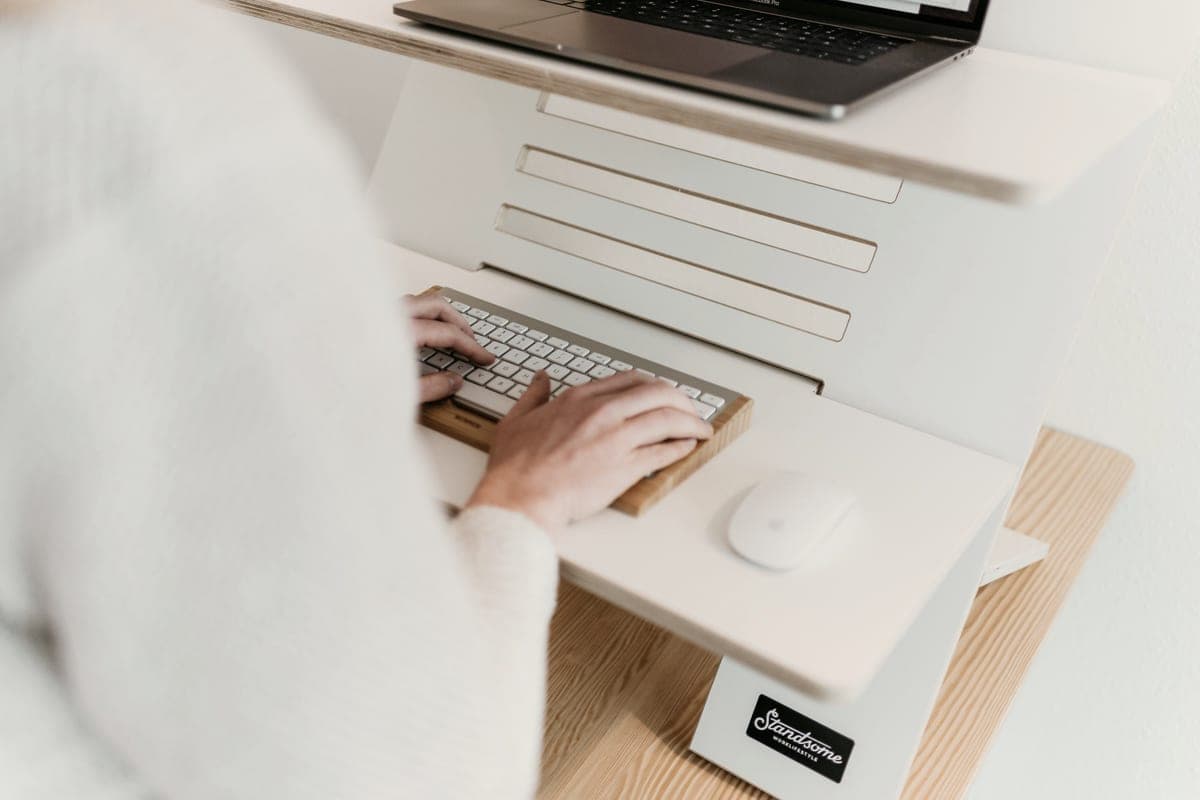
Mostly a false choice. A standing desk changes your posture; a walking pad accumulates distance. The constraint that settles the order is arithmetic: every pad we track raises your feet 4.1 to 7 inches, so the desk has to rise by the same amount and a fixed desk cannot. Buy the desk first— it is useful alone and makes the pad possible. Buy the pad first only if you are walking somewhere other than a desk.
How this page is funded: the buy links here are Amazon affiliate links, and we earn a commission if you buy through one — at no extra cost to you. It does not change what we rank first, because the commission rate is the same across every machine on this page. Full disclosure.
They are not the same purchase
A standing desk is a surface. A walking pad is a machine. The reason they end up in the same search is that both are sold as the answer to sitting all day, and they answer it differently enough that comparing them on a single axis produces nonsense.
What a desk does: it lets you stand. That is the whole of it, and it is not a small thing — it costs nothing to run, makes no sound, has no duty cycle and no motor, and it works for every hour you own it. What it does not do is move you. Standing still for four hours is a different posture problem, not an absence of one.
What a pad does: it accumulates walking. Distance, time at a pace, and whatever your step counter makes of it. In exchange it wants a wall outlet, floor space that does not disappear when you fold it, a noise budget that six of eight makers will not quantify, and it comes with the only published duration limit in the category — KingSmith states one hour at a time, then about half an hour off.
So the comparison that actually helps is not “which is better”. It is: a desk is a prerequisite for the pad, and the pad is an addition to the desk.
The arithmetic that decides the order
Here is the part that turns a preference into a measurement. Standing on a pad, you are standing on a platform. Your hands rise by the height of that platform, and your desk has to rise with them.
The sum, and you can run it in two minutes with a tape measure: floor-to-elbow height standing (elbow bent at about a right angle, forearm level) + the pad’s published deck height = the desk height you need. A conventional fixed desk is usually about 29 to 30 inches, which is a sitting height to begin with, so for most adults the result is that the fixed desk is short by most of a foot before the pad is even plugged in.
The other end of that sum has a published ceiling, and we found it building the desk roundup: the highest maximum height published by any desk sold for a walking pad is 47 inches. That clears a walker of roughly 5 ft 9 in on the Z1’s 4.1 inch deck and about 5 ft 5 in on the PacerMini’s 7 inch deck — so if you are tall, the desk is the harder half of this purchase, not the pad. The desks, ranked on published maximum height.
This is why the answer to “which first” is almost always the desk. A height-adjustable desk is immediately useful without a pad. A pad bought first for a fixed desk is frequently unusable at that desk, and the discovery happens after the box is open.
Published deck heights, all eight pads
Each figure is the maker’s own, in the maker’s own unit, with no conversion. Where a maker publishes nothing we have printed that rather than inferring a number from a photograph.
| Model | In use (L x W x H) | Belt (L x W) | Folded (L x W x H) | Unit weight |
|---|---|---|---|---|
| WalkingPad Z1 | 56.1" L x 22" W x 4.1" Hmanufacturer spec | 47.6" L x 15.7" Wmanufacturer spec | 31.8" L x 22" W x 5.4" Hmanufacturer spec | 51 lbmanufacturer spec |
| WalkingPad C2 | 56.9" L x 20.4" W x 4.9" Hmanufacturer spec | 47.2" L x 15.7" Wmanufacturer spec | 32.5" L x 20.4" W x 5.4" Hmanufacturer spec | 55 lbmanufacturer spec |
| WalkingPad A1 Pro | 56.5" L x 21.5" W x 5" Hmanufacturer spec | 47" L x 16.5" Wmanufacturer spec | 32.5" L x 21.5" W x 5" Hmanufacturer spec | 63 lbmanufacturer spec |
Across the whole field the published in-use heights are 4.1 inches (Z1), 4.9 (C2), 5.0 (P1 and A1 Pro), 5.9 (Sunny TreadPad, which also publishes 4.1 at the deck and 5.7 at full incline) and 7.0 (Lifepro PacerMini). Two machines publish nothing usable: UREVO’s 38.9 inch in-use figure for the Strol 2E is the top of its handle rather than the deck, and DeerRun publishes no dimensions at all.
The spread between the lowest and highest published deck is 2.9 inches. That sounds small and is not: it is the difference between a desk that just reaches and a desk that does not.
What the pad adds that the desk does not
Four things, and we would rather list them before you buy than after.
A duty cycle. One maker in this category publishes one, and it is an hour at a time with about half an hour off. A desk has no equivalent. What that means for an eight-hour day.
A noise budget. Six of eight makers publish no decibel figure. The two that do state under 65 dB (A1 Pro) and less than 60 dB (PacerMini), with no test conditions attached. A desk is silent.
A power cord.KingSmith publishes 110 V for the Z1 and the only wattage figure in the category is the P1’s 746 W motor rating. Its FAQ says cord length and inlet position vary by model and that the cord must not create a tripping hazard — in a room with a desk and a chair in it, that is a real constraint.
Floor space that persists. Folded figures run from 31.8 inches long (Z1) to 51.2 (Strol 2E), and two makers publish no folded dimensions at all. The desk occupies the same footprint whether you use it or not, which is at least predictable.
The three pads that cost a desk the least height
If the desk is the constraint — it usually is — these are the three machines whose published deck height takes the least of it back. Prices are live from the price layer with the date they were pulled.
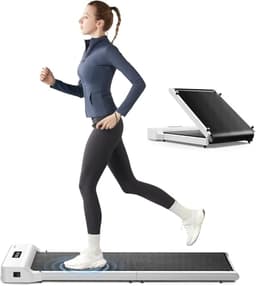
WalkingPad Z1
Smallest storage footprint
The only pad here that folds in half AND stays under 5.5 inches folded, which is the combination a small apartment actually needs.
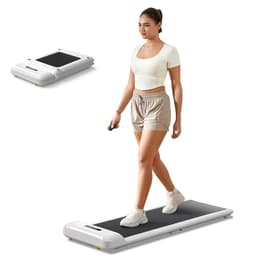
WalkingPad C2
Narrowest closet fit
The narrowest pad we list at 20.4 inches wide, which is the one that fits a genuinely tight closet — you pay for it in belt width.
Price as of October 10, 2026. #ad How we’re funded
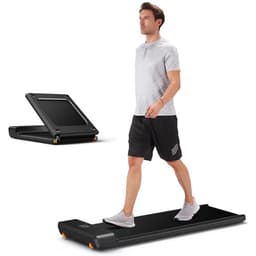
WalkingPad A1 Pro
A published noise figure
One of only two pads on this site whose maker publishes a decibel figure at all, and the only KingSmith model that does.
WalkingPad Z1— 4.1 inches in use, the lowest published deck on this site, which asks the least of your desk. Also the longest belt here at 47.6 inches and the shortest fold at 31.8. No published decibel figure, and a narrow 15.7 inch belt.
WalkingPad C2— 4.9 inches in use and 20.4 inches wide, the narrowest machine we track, which is the one that fits a desk with a pedestal or a tower beside it. Its published folded height rises to 5.4 inches, so it is taller folded than in use.
WalkingPad A1 Pro— 5.0 inches in use, the only KingSmith pad with a published noise figure (under 65 dB) and the lowest published minimum speed in the category at 0.5 mph, which is the setting that makes a desk walk compatible with detailed work.
The full standing-desk ranking, with the clearance arithmetic run for every pad.
What we have not done
We have not used any of these machines or desks, and we have measured no heights ourselves. Every deck height, belt figure, folded dimension and noise claim above is the maker’s own, read from the page named below on the date given. The 47 inch desk ceiling is the highest published maximum height among the desks in our registry, not a claim about every desk sold. We make no claim about health outcomes for standing or for walking. The full method.
Questions people actually ask
Walking pad or standing desk - which should you buy first?
The desk, in almost every case, and the reason is arithmetic rather than preference. A walking pad puts your feet 4.1 to 7 inches above the floor, so whatever desk height worked for you standing is now too low by that amount. A standing desk bought first is useful on its own from day one and makes the pad possible later; a pad bought first for a fixed-height desk often cannot be used at that desk at all. The exception is if you plan to walk in front of a television or a window rather than at a desk, in which case the desk is not part of the purchase.
Is a walking pad better than a standing desk?
They do different things, which is why the comparison is usually a false choice. A standing desk changes your posture and nothing else; a walking pad accumulates distance and steps. Standing still for hours is its own problem, so a desk alone does not solve what most people buy it to solve. Where the pad is genuinely better is movement; where the desk is genuinely better is that it works for the whole day, needs no power, makes no noise and has no duty cycle.
Do you need a standing desk to use a walking pad?
You need a work surface at the right height, and a height-adjustable desk is the usual way to get one - but not the only way. A desktop riser on an existing desk can reach the same height for less, and a fixed desk that is already tall enough works perfectly well. The figure to check is your own elbow height while standing on the pad: measure from the floor to the underside of your forearm with your elbow bent at about a right angle, then add the deck height of the pad you are considering.
How much height does a walking pad add?
Between 4.1 and 7 inches among the pads we track, and three of the eight makers do not publish the figure at all. KingSmith publishes 4.1 inches for the Z1, 4.9 for the C2 and 5 for the P1 and A1 Pro. Sunny publishes 4.1 inches flat and 5.7 at maximum incline for the TreadPad, which is the only maker here that states both ends. The Lifepro PacerMini's published in-use height is 7 inches, the tallest deck on this site. UREVO, DeerRun and the folded figures for two others publish no usable deck height at all.
Can you put a walking pad under a normal desk?
Sometimes, and it is a measurement rather than a gamble. A conventional fixed desk is usually around 29 to 30 inches to the work surface, which is a sitting height - add a 4 to 7 inch deck and you are standing with your hands near your waist. For most people that does not work. What does sometimes work is a tall fixed desk, a counter or a kitchen island, which is why the measurement is worth doing before you rule it out.
Is a standing desk with a walking pad worth it?
That depends on something only you can price: whether you will use it after the first month. What we can tell you is what the combination costs you in constraints rather than money - the pad has a published one-hour continuous-use limit from the only maker that states one, it needs a wall outlet, it makes noise that six of eight makers will not quantify, and it occupies floor space the desk does not. A desk on its own carries none of those.
Read next
- Best walking pads for a standing desk — the clearance arithmetic run for every pad, with the picks.
- Best standing desks for a walking pad — the other half of the purchase, ranked on published maximum height.
- Is a treadmill desk worth it? — elbow-height and deck-height arithmetic computed for four user heights.
- Best walking pads for all-day use — the published one-hour limit, and what a realistic working day looks like.
- Walking pad vs walking outside — the comparison against the free alternative, including who should not buy one.
- Walking pad dimensions, explained — which published figure is which, and the two that are routinely confused.
Sources
- WalkingPad Z1 - walkingpad.com product spec table: published in-use and folded dimensions, belt size, unit weight and capacity (read 2026-07-24)
- WalkingPad C2 - walkingpad.com product spec table: published in-use and folded dimensions, belt size, unit weight and capacity (read 2026-07-24)
- WalkingPad A1 Pro - walkingpad.com product spec table: published in-use and folded dimensions, belt size, unit weight and capacity (read 2026-07-24)
- KingSmith / WalkingPad - brand FAQ: the one-hour continuous-use limit with a half-hour cool-down, and the power-cord answer on cord length, outlet placement and tripping hazards (read 2026-10-11)
- Sunny Health & Fitness TreadPad Sleek Stride - product spec table: the only published deck-to-floor height at both ends of an incline range, 4.1 in flat and 5.7 in at maximum (read 2026-07-24)
- UREVO Strol 2E - product spec table: the 38.9 in in-use height, which is the handle post rather than the deck (read 2026-07-24)