Pad & Pace

Best under-desk ellipticals

An elliptical stroke keeps your knee lower than a pedal circle does, which is the whole reason to buy one. Then you find out how little any of these makers publish.

By Stephen V. · Last updated

The Stamina InMotion E1000 is the pick, because it is the only one of the three where the maker publishes dimensions, weight and a 250 lb user limit together. Take the Cubii Moveinstead if your desk apron is tight — at 9.5 inches it is the lowest machine here, but nobody publishes a weight limit for it.

How this page is funded:the buy links here are Amazon affiliate links, and we earn a commission if you buy through one — at no extra cost to you. It does not change what we rank first, because the commission rate is the same across every machine on this page. Full disclosure.

Quick picks

Ranked on how much the maker publishes and what those figures say — overall height against a desk apron, unit weight, and a maximum user weight, which two of these three machines leave you to guess at.Select a row to jump to the full write-up. We have not walked on any of these — here is exactly what we did instead.

#ModelBest forKey figurePrice
1
Stamina InMotion E1000

Stamina InMotion E1000

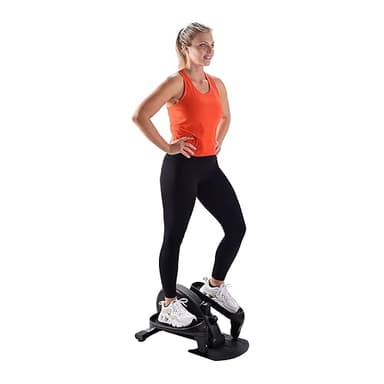
The only seated machine here whose maker publishes dimensions, unit weight and a user weight limit together — and the tallest of the three, at 11.38 inches.
Most complete published spec250 lb limit
$132.99 · View on Amazon

Price as of August 11, 2026. #ad How we’re funded

2
Cubii Move

Cubii Move

The lowest seated machine we have found a published height for, at 9.5 inches — which is the whole argument when your desk apron is the constraint.

Lowest published height9.5 in high
$159.99 · View on Amazon

Price as of August 11, 2026. #ad How we’re funded

3
Cubii JR1

Cubii JR1

An elliptical stroke instead of a circular one, which keeps the knee lower — and it is the only seated machine here that publishes a user weight limit.

Narrowest, with 8 resistance levels17.56 in wide
$169.99 · View on Amazon

$279.9939% off

Price as of August 11, 2026. #ad How we’re funded

How we picked these

Ranked on how much the maker publishes and what those figures say — overall height against a desk apron, unit weight, and a maximum user weight, which two of these three machines leave you to guess at.

We have not walked on these machines. We do not own them and we have no test lab. What we did was open each manufacturer’s own specification page, record every published figure with the date we read it, write “not published” where a figure does not exist rather than estimating one, and do the arithmetic ourselves — folded size against a real storage gap, deck length against stride, unit weight against a flight of stairs. The full method, in detail.

Why an elliptical rather than a pedal exerciser

The two categories look interchangeable in a listing photo and they are not. The difference is the path your foot travels, and it has one practical consequence that decides the purchase for a lot of people.

A pedal exerciser is a crank. Your foot goes round a circle, and your knee rises by the full diameter of that circle at the top of every revolution. A seated elliptical flattens that circle into an oval: the same distance travelled, less of it vertical. For a given amount of desk clearance, the elliptical is the more forgiving geometry.

That is the honest argument for one. The arguments you will see elsewhere — that an elliptical burns more, or engages more muscle — are not things we can source, and we are not going to repeat them. What we can source is the geometry, and the geometry is enough of a reason on its own if your desk is the constraint.

If your desk has plenty of room underneath, the pedal exercisers are cheaper and there are more of them. We rank those separately.

What these three actually publish

The last figure in the 'in use' column is overall height — the number to check against your desk apron. Every figure read from the source named at the bottom of this page.
ModelIn use (L x W x H)Unit weightMax userPublished noise
Stamina InMotion E100024.5" L x 17" W x 11.38" Hmanufacturer spec24 lbmanufacturer spec250 lbmanufacturer specNot publishednot published
Cubii Move21.5" L x 19.5" W x 9.5" Hretail listing17.5 lbretail listingNot publishednot publishedNot publishednot published
Cubii JR123.2" L x 17.56" W x 10" Hretail listingNot publishednot published150 lbretail listingNot publishednot published

Three machines, and between them: two published user weight limits, two published unit weights, three sets of dimensions, no stride lengths and no decibel figures. That is the state of the category, and it is worse than the walking pads — at least the pad makers publish a spec table.

The most striking gap is Cubii’s. Cubii is the best-known name in seated ellipticals, and its own product pages for the Move and the Go publish a resistance level count and effectively nothing else — no dimensions, no weight, no capacity. Every dimensional figure we have for the Move on this page comes from a retailer, and it is labelled as such in the table above.

#1
pick

The only complete spec sheet in the category

Stamina InMotion E1000

The only seated machine here whose maker publishes dimensions, unit weight and a user weight limit together — and the tallest of the three, at 11.38 inches.

Stamina InMotion E1000 walking pad
$132.99 · View on Amazon

Price as of August 11, 2026. #ad How we’re funded

Stamina publishes dimensions, product weight and a maximum user weight on its own product page, which sounds like a low bar until you look at what the competition publishes. The 250 lb limit is the substantive part: it is 100 lb above the Cubii JR1's published figure, and it is a number rather than a silence. At 24 lb the machine is light enough to move between rooms one-handed, the pedals reverse, and the frame is sold for standing as well as seated use. The cost is height — 11.38 inches is the tallest of the three, nearly two inches more than the Cubii Move, and on a desk with a low apron or a shallow drawer that is exactly where this machine fails. Measure first. Stamina also publishes no resistance-level count and no stride length.

What the specs give you

  • Stamina publishes dimensions, product weight and capacity on its own page — the only elliptical here where all three come from the manufacturer
  • 250 lb user capacity, 100 lb higher than the Cubii JR1's published limit
  • 24 lb, light enough to move between rooms one-handed
  • Pedals reverse, and the frame is rated for standing as well as seated use

What they cost you

  • 11.38 inches tall — the tallest of the three ellipticals here, and the one most likely to foul a low desk apron
  • Stamina publishes no resistance-level count, only 'adjustable tension'
  • No stride length published, so you cannot check the knee travel before buying
  • No decibel figure published
Published specifications for the Stamina InMotion E1000
Footprint in use24.5" L x 17" W x 11.38" Hmanufacturer spec
FoldedNot publishednot published
Walking beltNot publishednot published
Unit weight24 lbmanufacturer spec
Max user weight250 lbmanufacturer spec
Top speedNot publishednot published
InclineNot publishednot published
Published noiseNot publishednot published
Pedal heightNot publishednot published
Resistance levelsNot publishednot published

All figures read from staminaproducts.com product page on 2026-08-11. Where it says “not published”, we checked and no figure exists — we did not estimate one.
#2
pick

Lowest published height of anything seated here

Cubii Move

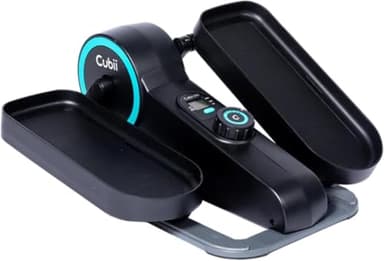
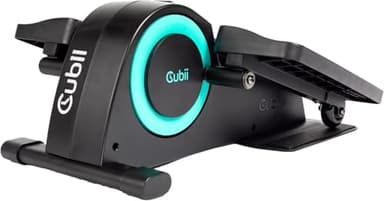
The lowest seated machine we have found a published height for, at 9.5 inches — which is the whole argument when your desk apron is the constraint.

Cubii Move walking pad
$159.99 · View on Amazon

Price as of August 11, 2026. #ad How we’re funded

9.5 inches is the lowest overall height we have found a published figure for on any seated machine, half an inch under the Cubii JR1 and nearly two inches under the Stamina. When the desk apron is the binding constraint — and on a lot of older desks with a drawer it is — that is the machine that fits when the others do not. At 17.5 lb it is also the lightest machine of any kind on this site. What you are not getting is a user weight limit: Cubii's own page publishes no dimensions, weight or capacity at all, and the retail listing we read publishes the first two and not the third. On a product you put your full body weight through, an unpublished limit is a real gap and it is the reason this is second rather than first.

What the specs give you

  • 9.5 inches tall, half an inch lower than the Cubii JR1 and nearly two inches lower than the Stamina
  • 17.5 lb — the lightest machine of any kind on this site
  • 6 magnetic resistance levels
  • Ships assembled, needs no outlet and nothing to store

What they cost you

  • No user weight limit published on Cubii's own page or the retail listing we read — a real gap on a machine you put your body weight through
  • Cubii's own product page publishes no dimensions, weight or capacity at all; the figures here come from a retailer
  • No stride length published
  • No decibel figure published
Published specifications for the Cubii Move
Footprint in use21.5" L x 19.5" W x 9.5" Hretail listing
FoldedNot publishednot published
Walking beltNot publishednot published
Unit weight17.5 lbretail listing
Max user weightNot publishednot published
Top speedNot publishednot published
InclineNot publishednot published
Published noiseNot publishednot published
Pedal heightNot publishednot published
Resistance levels6retail listing

All figures read from Rehabmart retail listing spec table on 2026-08-11. Where it says “not published”, we checked and no figure exists — we did not estimate one.

#3
pick

Narrowest footprint, and the limit to check first

Cubii JR1

An elliptical stroke instead of a circular one, which keeps the knee lower — and it is the only seated machine here that publishes a user weight limit.

Cubii JR1 walking pad
$169.99 · View on Amazon

$279.9939% off

Price as of August 11, 2026. #ad How we’re funded

The JR1 is the machine most people picture when they picture this category, and on two specifications it deserves that: 17.56 inches wide is the narrowest here by nearly two inches, and eight magnetic resistance levels is the most of the three. It sits at 10 inches, between the Move and the Stamina. Then there is the number that decides it for a lot of buyers: a published 150 lb maximum user weight, the lowest limit of anything on this site. That is not a detail buried in a manual — it is on the listing — but it is easy to miss, and it rules the machine out for a large share of the people who would otherwise buy it. Check it against yourself before anything else on this page.

What the specs give you

  • 10 inch height, same desk-clearance class as the DeskCycle
  • Elliptical path keeps the knee lower through the stroke than a pedal circle
  • 17.56 inches wide — nearly 6.5 inches narrower than the DeskCycle
  • Eight magnetic resistance levels

What they cost you

  • 150 lb maximum user weight is the lowest limit of anything on this site, and it rules the machine out for a lot of buyers
  • 23.2 inches deep, so it reaches further under the desk than it looks
  • No decibel figure published, despite the listing calling it whisper-quiet
Published specifications for the Cubii JR1
Footprint in use23.2" L x 17.56" W x 10" Hretail listing
FoldedNot publishednot published
Walking beltNot publishednot published
Unit weightNot publishednot published
Max user weight150 lbretail listing
Top speedNot publishednot published
InclineNot publishednot published
Published noiseNot publishednot published
Pedal height10 inretail listing
Resistance levels8retail listing

All figures read from Amazon retail listing spec table on 2026-07-24. Where it says “not published”, we checked and no figure exists — we did not estimate one.

Read the full Cubii JR1 spec breakdown

Skip this one

Any listing that publishes a resistance count and nothing else

There is a whole tier of this category — and it is a large tier — where the listing tells you the number of resistance levels, the app it connects to and the colour, and publishes no height, no footprint, no product weight and no user weight limit.

For a seated under-desk machine, height is not one specification among many. It is the pass-or-fail test, because a machine that does not clear your desk is not a worse machine, it is an unusable one. A listing that omits it is asking you to buy on faith and return it at your own inconvenience.

We would rather have three machines on this page with real numbers than eight with plausible ones. If a maker starts publishing, we will add them.

Before you order: the four measurements

The single most common way this purchase goes wrong is buying on the machine’s height alone. Height is the floor of the requirement, not the whole of it. Take these four numbers first:

  1. Floor to the underside of your desk.The lowest obstruction — the apron rail, a drawer, a cable tray — not the desktop.
  2. Floor to the top of your knee, seated. In the chair you actually use, at the height you actually use it.
  3. The gap between those two. That is your working clearance, and it is usually much smaller than people guess.
  4. How far under the desk the machine reaches. These are 21.5 to 24.5 inches deep. If your chair, your feet and a machine are all competing for the same depth, the fit is horizontal as well as vertical.

We work through that arithmetic properly here, including what to do when the numbers say no.

Questions people actually ask

What is the best under-desk elliptical?

On published specifications, the Stamina InMotion E1000: it is the only one of the three we track where the manufacturer publishes dimensions, product weight and a maximum user weight together, and that limit is 250 lb. The Cubii Move is lower at 9.5 inches, which matters if your desk apron is tight, but neither Cubii's own page nor the retail listing we read publishes a user weight limit for it.

How much clearance do you need for an under-desk elliptical?

More than the machine's height, because your thigh sits above the pedal and your knee rises through the stroke. The machines here publish overall heights of 9.5 to 11.38 inches. Measure from the floor to the underside of your desk — not the desktop, the apron or drawer above your knees — and treat the machine's height as the floor of the requirement rather than the whole of it. None of these three publishes a stride height or knee-travel figure, which is the number that would answer this properly.

Is an under-desk elliptical better than a pedal exerciser?

For desk clearance, usually yes. A pedal exerciser moves your foot in a circle, so your knee rises the full diameter of that circle. An elliptical moves it in a flattened oval, so the same amount of leg movement produces less vertical knee travel. That is the real argument for one, and it is a geometric one rather than a claim about calories burned.

Do under-desk ellipticals have a weight limit?

The published limits vary enormously and one of them is very low. The Stamina InMotion E1000 publishes 250 lb. The Cubii JR1 publishes 150 lb, which is the lowest limit of any machine on this site. Cubii publishes no limit at all for the Move on its own page or on the retail listing we read. Check the figure before you buy — it is not something the listing photography makes obvious.

Are under-desk ellipticals quiet enough for an office?

None of the three machines here publishes a decibel figure, so we cannot rank them on it. What we can say categorically is that a seated machine produces no footfall, which is the transmission path that causes almost every walking pad noise complaint. Whatever airborne sound a magnetic-resistance flywheel makes, there is no impact energy going into the floor at all.

Sources