Cubii Move review
The lowest and lightest machine on this site, from the brand that defined the category — and the only one where the maker publishes no dimensions of its own.
By Stephen V. · Last updated
At 9.5 in tall the Move is the lowest seated machine we track, which is the whole argument when a desk apron is the constraint. At 17.5 lb it is also the lightest thing on this site. The gap: nobody publishes a user weight limitfor it — not Cubii, not the retailer we read the rest of its specification from.
How this page is funded: the buy links here are Amazon affiliate links, and we earn a commission if you buy through one — at no extra cost to you. It does not change what we rank first, because the commission rate is the same across every machine on this page. Full disclosure.
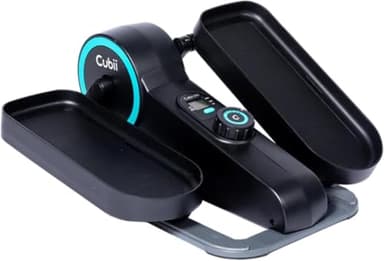
Cubii Move
The lowest seated machine we have found a published height for, at 9.5 inches — which is the whole argument when your desk apron is the constraint.
Best for: Lowest published height
Price as of September 25, 2026. #ad How we’re funded
The full published specification
Every figure below was read from Rehabmart retail listing spec table on 2026-08-11. Rows marked “not published” were checked and no figure exists.
| Footprint in use | 21.5" L x 19.5" W x 9.5" Hretail listing |
|---|---|
| Folded | Not publishednot published |
| Walking belt | Not publishednot published |
| Unit weight | 17.5 lbretail listing |
| Max user weight | Not publishednot published |
| Top speed | Not publishednot published |
| Incline | Not publishednot published |
| Published noise | Not publishednot published |
| Pedal height | Not publishednot published |
| Resistance levels | 6retail listing |
All figures read from Rehabmart retail listing spec table on 2026-08-11. Where it says “not published”, we checked and no figure exists — we did not estimate one.
What those numbers mean in a small room
This machine is defined by one number and undermined by one absence, and it is worth being precise about both.
9.5 inches, and why half an inch matters
Under-desk machines are bought on height and almost nothing else. You have a clear space between the floor and the lowest thing under your desk — usually the apron, sometimes a drawer box or a frame rail — and the machine plus your knee travel has to fit in it.
The published heights across the seated machines we track are 9.5 in (Move), 10 in (Cubii JR1 and DeskCycle) and 11.38 in (Stamina InMotion E1000). The Move is not marginally lowest, it is lowest by a clear margin over the tallest, and if you have measured and come up short by an inch, it is the only machine on this site that changes the answer.
The elliptical geometry compounds that. A pedal exerciser moves your foot in a circle, so your knee rises by the full diameter of the crank circle. An elliptical flattens the same motion into an oval, which produces less vertical knee travel for the same leg movement. That is a geometric fact rather than a marketing claim — and it is unquantifiable here, because no maker in this category publishes a stride length.
17.5 lb, in both directions
The lightest machine on this site. That is genuinely useful if it moves between a desk and a sofa, or lives in a cupboard between sessions.
It also means less mass holding it in place. A light frame on a hard floor is the thing most likely to creep away from you under load, and the machine has no anchoring of its own. The 24 lb Stamina behaves better in that specific respect, and it is the trade you are making for the 6.5 lb you save.
The missing capacity figure is the actual review
Every spec on this page carries the label “retail listing” rather than “manufacturer spec”, because Cubii’s own product page publishes no dimensions, no weight and no capacity. We found the dimensions and the resistance count on a retailer’s spec table. We found the capacity nowhere at all.
On a machine that takes a portion of your body weight through two pedals, that is not a trivia gap. Compare it to the Cubii JR1, which publishes 150 lb — a low figure, but a stated one you can check yourself against and reject the machine on. Here there is nothing to check. Every published capacity on this site, in one table — and this machine is one of the blanks in it.
Who it suits
Anyone whose desk clearance is genuinely marginal. If you have measured, and 10 inches plus knee travel does not fit, this is the only machine on this site that might. That is a narrow use case and it is a real one.
Someone who needs to move it constantly. 17.5 lb goes between rooms one-handed, which the 24 lb Stamina does less happily and a walking pad does not do at all.
Someone comfortably inside typical capacity ranges. If you are well under the 150 lb the JR1 publishes, the missing figure here is a documentation complaint rather than a practical risk for you.
Someone who wants the lowest knee travel available. The elliptical path plus the lowest frame is the least vertical movement in the category, even though neither maker will quantify the stride.
Who it does not
Anyone near the top of a typical capacity range. This is our main reservation and it is not a small one. A machine you stand a portion of your weight on, with no published limit from anyone, is a machine we would not recommend to a heavier buyer. The Stamina InMotion E1000 publishes 250 lb and is the direct alternative.
Anyone on a hard floor who pushes hard. 17.5 lb is not much mass to resist your own effort. Expect to brace it or accept that it moves.
Anyone who wants manufacturer-published data. Every figure here is second-hand. If provenance is why you are reading this site, note that this is the one machine where we could not get any of it from the maker.
What we did not do
We have not used this unit. We have not walked on it, we do not own one, and nobody sent us one. Everything above is our reading of the specification Cubii publishes, plus arithmetic on those numbers.
Which means there are real questions this page cannot answer: how the belt feels, whether the deck flexes under a heavier walker, how the motor sounds in your room, and whether any of it holds up over two years. Those need use. If a review tells you those things without having used the machine, it is telling you something it made up.
Questions people actually ask
What is the Cubii Move weight limit?
Not published. We checked Cubii's own product page and the retail listing our dimensions come from, and neither states a maximum user weight. That is a genuine gap rather than an oversight on our part: this is a machine you put a share of your body weight through, and every other seated machine on this site publishes a figure — 150 lb on the Cubii JR1, 250 lb on the Stamina InMotion E1000. If you are near either of those numbers, the absence of a figure here is itself the answer.
How tall is the Cubii Move?
9.5 inches, per the retailer spec table we read it from. That is the lowest published height of any seated machine we track — half an inch under the Cubii JR1 and the DeskCycle, and nearly two inches under the Stamina InMotion E1000. If your desk apron is the constraint, that half inch and that two inches are the entire argument for this machine.
Does Cubii publish specifications for the Move?
Not on its own product page, which is the finding. The dimensions, product weight and resistance-level count on this page all come from a Rehabmart retail listing rather than from Cubii. For a brand that effectively defined this category, publishing no dimensions for one of its own machines is unusual, and it is why the provenance labels under our figures read 'retail listing' rather than 'manufacturer spec'.
How many resistance levels does the Cubii Move have?
Six magnetic levels, per the retail listing. That is two fewer than the Cubii JR1's eight and ten fewer than the YOSUDA under-desk bike's sixteen — though the YOSUDA publishes no height at all, which on an under-desk machine is a much more consequential omission than a resistance count.
Is the Cubii Move quiet enough for an office?
No decibel figure is published, so we will not give you one. What is structurally true of every seated machine here is that there is no footfall — nothing lands, so nothing goes into the floor structure as impact energy. That removes the transmission path behind most apartment complaints about home cardio. What remains is magnetic resistance and bearing noise, which nobody in this category quantifies.
Read next
- Cubii Move vs Cubii JR1 — the head-to-head, where the deciding difference is not on either spec sheet.
- Best under-desk ellipticals — all three machines ranked on what their makers actually publish.
- Cubii JR1 review — half an inch taller, and it does publish a limit — 150 lb.
- Stamina InMotion E1000 review — the machine that publishes everything this one does not.
- Will an under-desk machine fit under your desk? — the four measurements, and where 9.5 inches actually helps.
- Walking pad vs under-desk elliptical — what a tenth of the floor space costs you in exercise.