DeerRun under-desk walking pad review
The highest published capacity on this site, an incline at the bottom of the market, and not one dimension published anywhere. This review is mostly about that.
By Stephen V. · Last updated
The DeerRun is the cheapest machine we track and the only one publishing a 300 lb capacity, with a 6 percent manual incline included. It also publishes no dimensions at all— no footprint, no folded size, no belt, no unit weight. For a small-space buyer that absence is disqualifying, and it is the honest headline.
How this page is funded: the buy links here are Amazon affiliate links, and we earn a commission if you buy through one — at no extra cost to you. It does not change what we rank first, because the commission rate is the same across every machine on this page. Full disclosure.
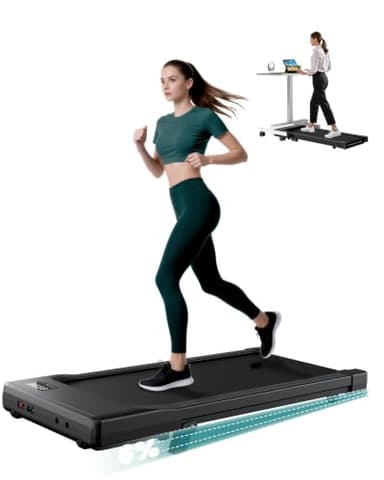
DeerRun Under-Desk Walking Pad
The cheapest way onto this list with a 300 lb capacity and an incline, and the clearest example of what you give up: no published dimensions at all.
Best for: Highest capacity for the money
Price as of September 24, 2026. #ad How we’re funded
The full published specification
Every figure below was read from Amazon retail listing on 2026-07-24. Rows marked “not published” were checked and no figure exists.
| Footprint in use | Not publishednot published |
|---|---|
| Folded | Not publishednot published |
| Walking belt | Not publishednot published |
| Unit weight | Not publishednot published |
| Max user weight | 300 lbretail listing |
| Top speed | 3.8 mphretail listing |
| Incline | 6 percent, manualretail listing |
| Published noise | Not publishednot published |
All figures read from Amazon retail listing on 2026-07-24. Where it says “not published”, we checked and no figure exists — we did not estimate one.
What those numbers mean in a small room
Look at the specification table above and count the rows that say “not published”. That is not a shortcut on our side: there is no DeerRun product page for this model that we could find, and the retail listing gives a capacity, a speed range and an incline percentage and then stops.
So the review has to be about what that means rather than about what the numbers say, because there are barely any numbers.
What is published is genuinely competitive.A 300 lb capacity is the highest figure on this site, and it beats the best-documented machines here by 35 lb. A 6 percent manual incline at this price is unusual — the only cheaper route to a grade is the Lifepro PacerMini’s swappable feet. The 0.6 to 3.8 mph range is wider at both ends than most of the KingSmith pads. On paper, for the money, that is a lot.
What is missing is everything a small room asks about. This site exists for a reader whose constraint is space, and for that reader the decisive questions are: what does it measure folded, will it clear my sofa gap, is the belt long enough for my stride, and can I carry it up two flights. Not one of those has an answer here. The manufacturer has declined to publish the numbers, and we are not going to fill them in.
It is worth being precise about why we will not estimate. A guessed folded height would look exactly like a real one on the page. Somebody would measure a six-inch sofa gap against it, order the machine, and find out we were wrong at the point where returning it is a genuine inconvenience. A blank is honest; a plausible number is not.
There is also a second-order signal in the omission that is worth weighing. A maker that publishes a capacity but not a footprint has made a choice about which numbers help it sell. Capacity is a figure that only ever looks good; dimensions are figures that invite comparison. We are not alleging anything about the machine’s build — we have not used it and cannot — but a spec sheet that contains only the flattering rows is information about the seller, and you are entitled to weigh it.
One thing we can say without qualification: the 300 lb capacity is a published figure from the listing, and if you are a heavier walker shopping at the bottom of the market, it is the highest number available. Whether you would rather have a well-documented 265 lb machine is the real question, and we work through it on our capacity ranking.
Who it suits
Someone testing whether they will use a walking pad at all. This is the cheapest entry on this site by a clear margin. If the honest alternative is not buying one, the missing dimensions matter less than the fact that you now own a treadmill.
A heavier walker on a tight budget. 300 lb published capacity, at this price, with an incline. Nothing else on this site offers that combination.
Anyone with room to spare. If the pad can live permanently in a spare room or a garage, the folded dimensions you were never given stop being a problem you have.
Anyone who wants a grade cheaply. 6 percent, manual. Set it once and it stays set, which for most people is how incline gets used anyway.
Who it does not
Anyone buying for a specific storage gap. The single most common reason to buy a walking pad is that it disappears afterwards, and there is no published number here to check against your sofa, bed frame or closet.
Anyone tall. Belt length is unpublished. Our whole approach to tall walkers is stride against deck, and there is no deck figure to run it on.
Anyone in a walk-up. Unit weight is unpublished. You do not know whether you are carrying 40 lb or 70 lb up those stairs until it arrives.
Anyone using a standing desk. Deck height is unpublished, and deck height is the number that decides whether your desk goes high enough once you are standing on the machine.
Anyone who wants a noise figure. None published, as with six of the eight pads we track.
What we did not do
We have not used this unit. We have not walked on it, we do not own one, and nobody sent us one. Everything above is our reading of the specification DeerRun publishes, plus arithmetic on those numbers.
Which means there are real questions this page cannot answer: how the belt feels, whether the deck flexes under a heavier walker, how the motor sounds in your room, and whether any of it holds up over two years. Those need use. If a review tells you those things without having used the machine, it is telling you something it made up.
Questions people actually ask
What are the DeerRun walking pad dimensions?
DeerRun does not publish them. There is no manufacturer specification page for this model that we could find, and the retail listing states a capacity, a speed range and an incline percentage without any dimensions at all — no footprint in use, no folded size, no belt length or width, and no unit weight. We are not going to estimate them. If the fit matters to you, that absence is the answer.
What is the DeerRun walking pad weight limit?
300 lb, per the retail listing. That is the highest published capacity of any machine on this site — 35 lb above the UREVO Strol 2E and the Sunny TreadPad, which are joint second at 265 lb. It is worth knowing that this number comes from a listing that publishes nothing else you could check it against.
Does the DeerRun walking pad have incline?
The listing states a 6 percent manual incline. Manual means you lift the deck and set a prop or swap a foot, not that you press a button — you configure it before you start and it stays there. At this price, an incline of any kind is unusual; every other machine on this site with a grade costs substantially more, except the Lifepro PacerMini.
Is the DeerRun walking pad any good?
It is the cheapest way onto this site with a 300 lb capacity and an incline, and if the alternative is not buying a walking pad at all, that is a defensible purchase. What it is not is a machine you can plan around. Every question a small-space buyer asks — will it fit under my sofa, is the belt long enough for me, can I carry it upstairs — is unanswerable from what DeerRun publishes.
How loud is the DeerRun walking pad?
No decibel figure is published. Only two machines on this site publish one at all: the WalkingPad A1 Pro at 'under 65 dB' and the Lifepro PacerMini at 'less than 60 dB'. For an apartment buyer the more useful point is that motor noise is rarely the complaint anyway — footfall through the floor structure is, and that is addressed with a dense mat rather than with a spec sheet.
Read next
- How much does a walking pad cost? — what you actually give up at the bottom of this market.
- Best cheap walking pads — where this is our top pick, with every missing figure listed.
- Best walking pads for heavier walkers — why a documented 265 lb outranks an undocumented 300 lb here.
- Walking pad dimensions: every model, folded and open — the master table, where this machine's row is mostly blank.
- How we rank these — why we print 'not published' instead of a plausible estimate.
- Will it fit? Folded sizes vs real apartment storage — the arithmetic this machine cannot be run through.