Pad & Pace

Best walking pads for a home office

An office at home is the one room where the noise that matters is the noise you can hear, not the noise your neighbour can. That single change reorders the ranking.

By Stephen V. · Last updated

The WalkingPad A1 Pro is the pick: the only KingSmith pad with a published decibel figure, on the widest belt in the range at 16.5 in. If your day is mostly typing rather than calls, the WalkingPad P1 and its 0.3 mph crawl is the better machine. If the office is a corner of another room, take the Lifepro PacerMini.

How this page is funded:the buy links here are Amazon affiliate links, and we earn a commission if you buy through one — at no extra cost to you. It does not change what we rank first, because the commission rate is the same across every machine on this page. Full disclosure.

Quick picks

Ranked for a room you also work in: whether the maker publishes an airborne noise figure at all, then belt width and minimum speed, because those decide whether you can type while it runs, then how quickly and completely it gets out of shot. Storage is a tiebreak here rather than the headline.Select a row to jump to the full write-up. We have not walked on any of these — here is exactly what we did instead.

#ModelBest forKey figurePrice
1
WalkingPad A1 Pro

WalkingPad A1 Pro

One of only two pads on this site whose maker publishes a decibel figure at all, and the only KingSmith model that does.
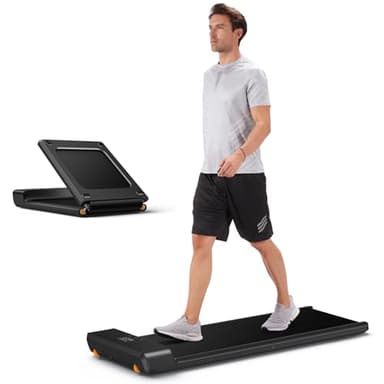
Published dB, widest beltUnder 65 dB
$529.00 · View on Amazon

Price as of August 12, 2026. #ad How we’re funded

2
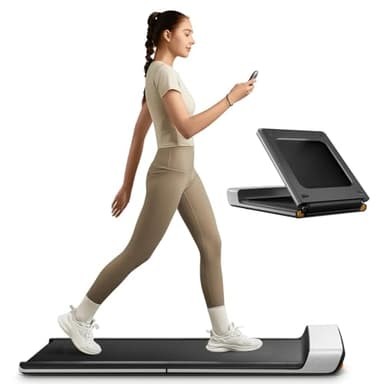
WalkingPad P1

WalkingPad P1

A 16.5 inch belt on a pad that still folds to 32.5 inches — the wider walking surface is the reason to pick it over the Z1.

Slowest crawl, for typing0.3 mph start
$349.00 · View on Amazon

Price as of August 12, 2026. #ad How we’re funded

3
WalkingPad Z1

WalkingPad Z1

The only pad here that folds in half AND stays under 5.5 inches folded, which is the combination a small apartment actually needs.

Lowest deck, fastest to stow4.1 in deck
$299.00 · View on Amazon

$329.009% off

Price as of August 12, 2026. #ad How we’re funded

4
Lifepro PacerMini

Lifepro PacerMini

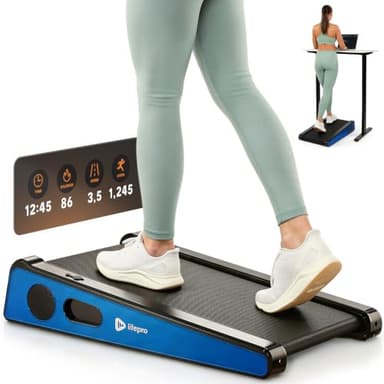
A 27.6 inch belt is short enough to be a real constraint, but it is the only pad here that publishes both an incline figure and a decibel figure.

Smallest, with a dB figure32.7 in long
$299.99 · View on Amazon

Price as of August 12, 2026. #ad How we’re funded

5
Sunny Health & Fitness TreadPad Sleek Stride (SF-T722069)

Sunny Health & Fitness TreadPad Sleek Stride (SF-T722069)

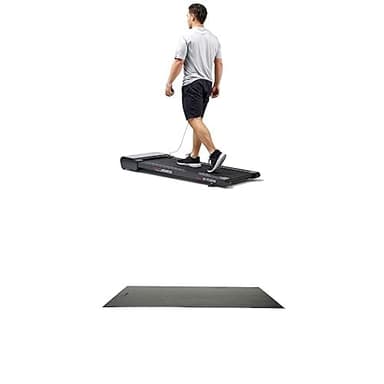
The only pad here with a motorized incline you can change while walking, and the only maker that publishes the deck-to-floor height you actually need for desk clearance math.

Incline you can change mid-call6 auto levels
$533.28 · View on Amazon

Price as of August 12, 2026. #ad How we’re funded

How we picked these

Ranked for a room you also work in: whether the maker publishes an airborne noise figure at all, then belt width and minimum speed, because those decide whether you can type while it runs, then how quickly and completely it gets out of shot. Storage is a tiebreak here rather than the headline.

We have not walked on these machines. We do not own them and we have no test lab. What we did was open each manufacturer’s own specification page, record every published figure with the date we read it, write “not published” where a figure does not exist rather than estimating one, and do the arithmetic ourselves — folded size against a real storage gap, deck length against stride, unit weight against a flight of stairs. The full method, in detail.

The noise question, inverted

Our apartment ranking says something that surprises people: the published decibel figures barely matter, because the person complaining is downstairs and what reaches them is footfall energy through the floor structure rather than motor noise through the air. That argument is set out in full in our noise guide and we stand behind it.

In a home office the geometry flips. The listener is you, four feet away, in the same air, wearing a microphone. Now airborne noise — the motor, the belt drum, the fan — is the whole problem, and structural transmission is somebody else’s. This is the one page on this site where a published decibel figure is genuinely the right thing to rank on.

Which makes the data situation frustrating. Two of the eight walking pads we track publish a figure at all: the WalkingPad A1 Pro at “under 65 dB” and the Lifepro PacerMini at “less than 60 dB”. Neither states a distance, a belt speed, a user weight or a floor surface, so they are not comparable with each other and neither is a measurement in any useful sense.

We are not going to rank five machines by decibel using two numbers and three blanks. What we will do is weight the willingness to publish — a maker that commits to a figure in writing has taken a position it can be held to, and six did not.

Belt width and minimum speed decide whether you can type

The specification that determines whether a walking pad is usable at a desk is not the top speed. It is the bottom one, and after that it is the belt width.

Minimum speed. Typing accuracy degrades with pace long before walking becomes hard work, so the useful desk range sits at the bottom of the dial. The WalkingPad P1 starts at 0.3 mph, which is a shuffle you can genuinely type through and is the slowest figure on this site. Most machines here begin somewhere between 0.5 and 1 mph, which is already a walk. Nobody markets this number, which is why we put it in its own guide.

Belt width. When your eyes are on a screen rather than on your feet, you drift. None of these machines has a handrail, so the belt edge is the only thing telling you where you are. The spread here is 15 to 16.5 inches. A 0.8 inch difference sounds trivial and is the difference between clipping an edge mid-sentence and not, if you are someone who does that.

What top speed buys you: not much, here.The UREVO Strol 2E reaches 6.2 mph and is a genuinely capable machine, but a running speed is irrelevant to a desk and we have ranked accordingly. If you want one machine for desk walking and for actual exercise, that is a different page — see the Strol 2E review.

Deck height comes out of your desk

This is the arithmetic that catches people who buy the pad first and think about the desk afterwards. A walking pad raises you by its in-use height. That height is subtracted from your desk’s maximum, and what is left has to be around your elbow height for typing to be comfortable.

The in-use heights across the machines on this page run from 4.1 inches (WalkingPad Z1) to 7 inches (Lifepro PacerMini). On a desk whose top of travel is 48 inches, that is the difference between 43.9 and 41 inches of working height — and for a lot of people one of those numbers works and the other does not.

Sunny is the only maker on this site that publishes deck-to-floor height as its own figure, and it publishes two: 4.1 inches flat and 5.7 at maximum incline. That second number is the one people miss. Raising the incline raises you, so a machine that fits your desk flat may not fit it inclined. The full desk-clearance arithmetic, with every model run through it.

The five machines side by side

Published noise last, because there are only two figures in that column and three blanks. In-use dimensions first: the third number is the height that comes out of your desk.
ModelIn use (L x W x H)Belt (L x W)Top speedInclinePublished noiseUnit weight
WalkingPad A1 Pro56.5" L x 21.5" W x 5" Hmanufacturer spec47" L x 16.5" Wmanufacturer spec3.75 mphmanufacturer specNot publishednot publishedUnder 65 dBmanufacturer spec63 lbmanufacturer spec
WalkingPad P156.5" L x 21.5" W x 5" Hmanufacturer spec47" L x 16.5" Wmanufacturer spec3.75 mphmanufacturer specNot publishednot publishedNot publishednot published62 lbmanufacturer spec
WalkingPad Z156.1" L x 22" W x 4.1" Hmanufacturer spec47.6" L x 15.7" Wmanufacturer spec4 mphmanufacturer specNot publishednot publishedNot publishednot published51 lbmanufacturer spec
Lifepro PacerMini32.7" L x 25" W x 7" Hretail listing27.6" L x 15.7" Wretail listing3 mphretail listingTwo fixed settings, 5 and 7 degreesretail listingLess than 60 dBretail listing40 lbretail listing
Sunny Health & Fitness TreadPad Sleek Stride (SF-T722069)58.2" L x 24.9" W x 5.9" Hmanufacturer spec45.7" L x 16" Wmanufacturer spec3.7 mphmanufacturer specSix auto levels, 1.67 to 3.81 degreesmanufacturer specNot publishednot published69.5 lbmanufacturer spec
#1
pick

A published number, on the widest belt in the range

WalkingPad A1 Pro

One of only two pads on this site whose maker publishes a decibel figure at all, and the only KingSmith model that does.

WalkingPad A1 Pro
$529.00 · View on Amazon

Price as of August 12, 2026. #ad How we’re funded

For a room where airborne noise is the problem, we would start with a maker that will state a figure, and KingSmith states one for exactly one model: 'under 65 dB' for the A1 Pro. Pair that with the widest belt in the KingSmith range — 47 x 16.5 inches, the same deck as the P1 — and a 230 lb capacity with a 300 lb variant sold alongside, and it is the most complete answer here for a desk. The caveats are specific. 'Under 65 dB' has no stated test method, distance, speed or load, so treat it as a commitment rather than a measurement. And at 63 lb it is the heaviest pad KingSmith makes, which is a real cost if the machine has to come out from under something every morning.

What the specs give you

  • KingSmith publishes 'under 65 dB' for this model — most makers publish nothing
  • Sold in a 300 lb capacity variant as well as the standard 230 lb
  • Same 47 x 16.5 inch belt as the P1

What they cost you

  • 63 lb is the heaviest pad here — a two-person carry up stairs
  • 'Under 65 dB' is a manufacturer claim with no stated test method, distance or speed
  • Folded height of 5 inches beats the Z1, but folded length is 0.7 inches longer
Published specifications for the WalkingPad A1 Pro
Footprint in use56.5" L x 21.5" W x 5" Hmanufacturer spec
Folded32.5" L x 21.5" W x 5" Hmanufacturer spec
Walking belt47" L x 16.5" Wmanufacturer spec
Unit weight63 lbmanufacturer spec
Max user weight230 lbmanufacturer spec
Top speed3.75 mphmanufacturer spec
InclineNot publishednot published
Published noiseUnder 65 dBmanufacturer spec

All figures read from walkingpad.com product spec table on 2026-07-24. Where it says “not published”, we checked and no figure exists — we did not estimate one.
Read the full WalkingPad A1 Pro spec breakdown

#2
pick

The one you can actually type at

WalkingPad P1

A 16.5 inch belt on a pad that still folds to 32.5 inches — the wider walking surface is the reason to pick it over the Z1.

WalkingPad P1
$349.00 · View on Amazon

Price as of August 12, 2026. #ad How we’re funded

If your working day is mostly keyboard rather than calls, the P1's 0.3 mph starting speed is worth more than any decibel claim on this page. It is the slowest crawl on the site by a wide margin, and it gives you a setting where your hands stay steady while you are still moving — which is the actual use case most people buy a walking pad for and then discover their machine will not do. The belt is the same 47 x 16.5 inches as the A1 Pro. What you give up: KingSmith publishes no noise figure for it, the 220 lb capacity is the joint-lowest here, and at 62 lb it is only a pound lighter than the A1 Pro. It is a machine picked for one specification, and it is the right specification for typing.

What the specs give you

  • 16.5 inch belt is 0.8 inches wider than the Z1 and C2 — noticeable if you drift
  • Starts at 0.3 mph, the slowest start here, which suits typing while walking
  • Folds to the same 32.5 inches as the C2

What they cost you

  • 220 lb capacity
  • 62 lb — 11 lb heavier than the Z1 for the same folded length
  • KingSmith publishes no decibel figure for it
Published specifications for the WalkingPad P1
Footprint in use56.5" L x 21.5" W x 5" Hmanufacturer spec
Folded32.5" L x 21.5" W x 5" Hmanufacturer spec
Walking belt47" L x 16.5" Wmanufacturer spec
Unit weight62 lbmanufacturer spec
Max user weight220 lbmanufacturer spec
Top speed3.75 mphmanufacturer spec
InclineNot publishednot published
Published noiseNot publishednot published

All figures read from walkingpad.com product spec table on 2026-07-24. Where it says “not published”, we checked and no figure exists — we did not estimate one.
Read the full WalkingPad P1 spec breakdown

#3
pick

Lowest deck, and the quickest to disappear

WalkingPad Z1

The only pad here that folds in half AND stays under 5.5 inches folded, which is the combination a small apartment actually needs.

WalkingPad Z1
$299.00 · View on Amazon

$329.009% off

Price as of August 12, 2026. #ad How we’re funded

Two figures make the Z1 the practical choice for a small office: 4.1 inches in use, the lowest deck on this site and therefore the least of your desk's travel spent, and 31.8 inches folded, the shortest folded length we track, which means it goes under the desk, behind the door or into a cupboard rather than staying out. In a room that has to look like an office on a call at short notice, that second number is the one you feel every day. At 242 lb capacity and 51 lb it is also the easiest full-size KingSmith pad to move. Against it: 15.7 inches of belt width is narrow for someone who drifts while reading, there is no handrail, and there is no published noise figure — which on this page is the ranking criterion it misses.

What the specs give you

  • Folds 180 degrees to 31.8 inches long — the shortest folded length of any pad we list
  • 5.4 inch folded height clears most sofa and bed gaps
  • 242 lb capacity is higher than the C2 and P1 despite weighing less
  • 51 lb is the lightest of the KingSmith pads, which matters on stairs

What they cost you

  • 47.6 x 15.7 inch belt is narrow — a 15.7 inch belt is tight if you drift
  • No handrail, so nothing to grab if you misstep
  • KingSmith publishes no decibel figure for it
Published specifications for the WalkingPad Z1
Footprint in use56.1" L x 22" W x 4.1" Hmanufacturer spec
Folded31.8" L x 22" W x 5.4" Hmanufacturer spec
Walking belt47.6" L x 15.7" Wmanufacturer spec
Unit weight51 lbmanufacturer spec
Max user weight242 lbmanufacturer spec
Top speed4 mphmanufacturer spec
InclineNot publishednot published
Published noiseNot publishednot published

All figures read from walkingpad.com product spec table on 2026-07-24. Where it says “not published”, we checked and no figure exists — we did not estimate one.

Read the full WalkingPad Z1 spec breakdown

#4
pick

When the office is a corner of another room

Lifepro PacerMini

A 27.6 inch belt is short enough to be a real constraint, but it is the only pad here that publishes both an incline figure and a decibel figure.

Lifepro PacerMini
$299.99 · View on Amazon

Price as of August 12, 2026. #ad How we’re funded

32.7 inches long in use — roughly half a KingSmith pad — and 40 lb, plus a published 'less than 60 dB', which is the lower of the two figures anyone in this category will commit to. If your home office is a desk in a bedroom or a corner of a living room rather than a room of its own, the machine's in-use footprint matters more than anything else on the spec sheet, and this is by far the smallest. The trade is the belt: 27.6 inches is the shortest we track and it is a genuine constraint above about five foot six, which is the kind of thing you notice by the end of a working day rather than in the first ten minutes. The deck also sits 7 inches up, the highest here, which is the most desk travel of any machine on this page.

What the specs give you

  • Publishes 'less than 60 dB' — one of only two figures on this site
  • Two fixed incline settings, 5 and 7 degrees, set with swappable feet rather than a motor
  • 40 lb, light enough for a one-person carry
  • Shortest overall unit here at 32.7 inches long

What they cost you

  • 27.6 inch belt is by far the shortest on this site — that is a short-stride machine, not a walking one for a tall user
  • 0.5 HP motor and a 3.0 mph ceiling
  • 220 lb capacity
  • The incline comes from feet you swap by hand, not a control you press
Published specifications for the Lifepro PacerMini
Footprint in use32.7" L x 25" W x 7" Hretail listing
FoldedNot publishednot published
Walking belt27.6" L x 15.7" Wretail listing
Unit weight40 lbretail listing
Max user weight220 lbretail listing
Top speed3 mphretail listing
InclineTwo fixed settings, 5 and 7 degreesretail listing
Published noiseLess than 60 dBretail listing

All figures read from Rehabmart retail listing spec table on 2026-07-24. Where it says “not published”, we checked and no figure exists — we did not estimate one.

Read the full Lifepro PacerMini spec breakdown

#5
pick

Incline you can change without stopping

Sunny Health & Fitness TreadPad Sleek Stride (SF-T722069)

The only pad here with a motorized incline you can change while walking, and the only maker that publishes the deck-to-floor height you actually need for desk clearance math.

Sunny Health & Fitness TreadPad Sleek Stride (SF-T722069)
$533.28 · View on Amazon

Price as of August 12, 2026. #ad How we’re funded

Six motorised incline levels changed from the remote, which on a long working day is a genuinely useful thing — you can add effort during a call you are only listening to and take it off when you need to type, without stepping off. Sunny is also the only maker on this site publishing deck-to-floor height for both flat and inclined positions, which is exactly the figure desk arithmetic needs. It is fifth on practicalities rather than capability: 69.5 lb is the heaviest machine on this site and a two-person lift, 58.2 inches in use is the longest footprint here, and Sunny publishes no folded dimensions at all, so a machine you cannot confirm folds is a machine that stays out. In a dedicated office with floor to spare, move it up this list.

What the specs give you

  • Six automatic incline levels, 1.67 to 3.81 degrees, changed from the remote
  • Publishes deck-to-floor height (4.1 in flat, 5.7 in at maximum incline) — nobody else on this site does
  • 45.7 x 16 inch belt, second-widest here
  • 265 lb capacity

What they cost you

  • 69.5 lb, the heaviest machine on this site
  • 58.2 inches long in use and Sunny publishes no folded dimensions
  • Sunny publishes no decibel figure
  • The Amazon listing we link bundles a floor mat, which is why it prices above the bare unit
Published specifications for the Sunny Health & Fitness TreadPad Sleek Stride (SF-T722069)
Footprint in use58.2" L x 24.9" W x 5.9" Hmanufacturer spec
FoldedNot publishednot published
Walking belt45.7" L x 16" Wmanufacturer spec
Unit weight69.5 lbmanufacturer spec
Max user weight265 lbmanufacturer spec
Top speed3.7 mphmanufacturer spec
InclineSix auto levels, 1.67 to 3.81 degreesmanufacturer spec
Published noiseNot publishednot published

All figures read from sunnyhealthfitness.com product spec table on 2026-07-24. Where it says “not published”, we checked and no figure exists — we did not estimate one.

Read the full Sunny Health & Fitness TreadPad Sleek Stride (SF-T722069) spec breakdown

Skip this one

Anything whose maker publishes no dimensions at all

The DeerRun under-desk pad is the cheapest machine we track and it is a defensible buy on our budget page. It is the wrong buy for a desk, for one reason: DeerRun publishes no in-use dimensions, which means no deck height.

Deck height is the number your standing desk arithmetic runs on. Buying a pad for a desk without knowing how far it lifts you is buying the one specification the purchase depends on sight unseen — and the answer arrives after the desk is already at its maximum.

If the office is shared

A shared office, a co-working desk or a partner working in the same room adds the one constraint a solo home office does not: somebody else has to listen to it all day, and they did not buy it.

Three things that change in that case. First, the published decibel figures become the primary criterion rather than a tiebreak, which moves the A1 Pro and the PacerMini further ahead. Second, minimum speed matters more, because the honest solution to shared-room noise is walking slower rather than buying quieter. Third, a machine that can be off and stowed in ten seconds is worth more than one that is marginally quieter while running — being able to stop is the most effective noise control available.

And the option worth naming rather than dismissing: a seated under-desk machine makes no footfall at all, needs no outlet, and nobody hears it. The seated machines, ranked. It is much less exercise, and in a genuinely shared space it is sometimes the only thing that survives the first month.

Questions people actually ask

Can you use a walking pad during video calls?

Yes, and the constraint is your microphone rather than the machine. Two things reach a call: airborne motor and belt noise, which a directional or headset mic largely rejects, and your own breathing, which it does not. In practice most people walk at a lower speed on camera than off it, and use push-to-talk or mute by default. The one thing worth testing before an important call is whether your desk transmits footfall into a desk-mounted mic — if it does, move the mic to a headset rather than slowing down.

Which walking pad is quietest for an office?

On published data, the two machines with any decibel figure at all are the Lifepro PacerMini at 'less than 60 dB' and the WalkingPad A1 Pro at 'under 65 dB'. Neither maker states the distance, speed, user weight or floor those were taken at, so they are manufacturer claims rather than comparable measurements. What we can say is that two makers committed to a number and six did not, and in a room where airborne noise is the whole problem, that willingness is worth something on its own.

What speed can you actually work at on a walking pad?

Lower than the machine's top speed and lower than most people guess. Typing accuracy falls off well before walking gets uncomfortable, so the useful range for keyboard work is at the bottom of the dial rather than the middle. That makes the minimum speed the specification to check: the WalkingPad P1 starts at 0.3 mph, the slowest we track, while most machines begin around 0.5 to 1 mph. Calls and reading tolerate more pace than typing does.

Do you need a standing desk for a walking pad?

Yes, in practice — the pad raises you by its deck height, so a fixed-height desk that was right for standing is now too low, and one that was right for sitting is far too low. The published in-use heights on this site run 4.1 to 7 inches. Work out your desk's maximum height, subtract the deck height, and check the result against your own elbow height before you buy either item.

Is a walking pad distracting while working?

It changes what kind of work is easy. Reading, calls, meetings and thinking generally get easier or stay the same. Precise keyboard work, detailed spreadsheet editing and anything requiring fine mouse control get harder, and no machine on this page fixes that. The common pattern that works is walking for the parts of the day that tolerate it and stepping off for the parts that do not, which is an argument for a machine that is quick to get on and off rather than a faster one.

Sources