Pad & Pace

Best under-desk cardio with adjustable resistance

Five of these nine machines publish a resistance level count. One publishes what a level is actually worth. Once you see that gap you stop shopping on the bigger number.

By Stephen V. · Last updated

A compact home office desk against an apartment wall with a laptop and chair

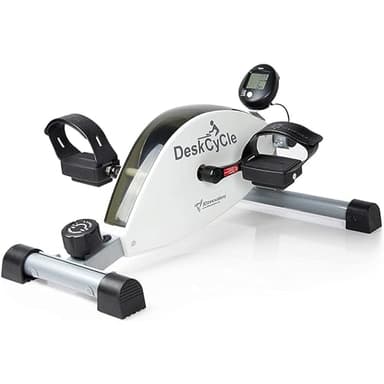
5 of the 9 machines here publish a resistance level count. One publishes what a level is worth. That one is the DeskCycle— eight magnetic settings up to 39 lb — and it is why it leads a page it does not win on quantity. The YOSUDA has the most steps at 16, with no magnitude and, more importantly, no published pedal height.

How this page is funded: the buy links here are Amazon affiliate links, and we earn a commission if you buy through one — at no extra cost to you. It does not change what we rank first, because the commission rate is the same across every machine on this page. Full disclosure.

Quick picks

Ranked on what the maker publishes about the resistance itself, in this order: whether it states what the resistance is WORTH at the top of the range, then whether it states the mechanism, then how many steps it divides that range into. A level count is placed last deliberately - it describes how finely a range is divided, not how hard the machine gets, and only one maker here publishes both. Select a row to jump to the full write-up. We have not walked on any of these — here is exactly what we did instead.

#ModelBest forKey figurePrice
1
DeskCycle Under Desk Bike Pedal Exerciser

DeskCycle Under Desk Bike Pedal Exerciser

A 10 inch pedal height is the whole product — it is the seated machine most likely to actually clear a standard 27 inch desk.
Only published resistance magnitude8 magnetic, to 39 lb
$149.99 · View on Amazon

Price as of September 30, 2026. #ad How we’re funded

2
YOSUDA Under Desk Bike

YOSUDA Under Desk Bike

Twice the resistance steps of the DeskCycle and app tracking, but the listing does not publish the pedal height that decides whether it fits your desk.

Most resistance steps16 magnetic
$119.99 · View on Amazon

$139.9914% off

Price as of September 30, 2026. #ad How we’re funded

3
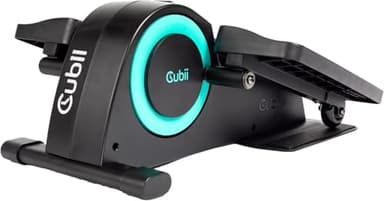
Cubii JR1

Cubii JR1

An elliptical stroke instead of a circular one, which keeps the knee lower — and it is the only seated machine here that publishes a user weight limit.

Magnetic, and the narrowest8 magnetic
$169.99 · View on Amazon

Price as of September 30, 2026. #ad How we’re funded

4
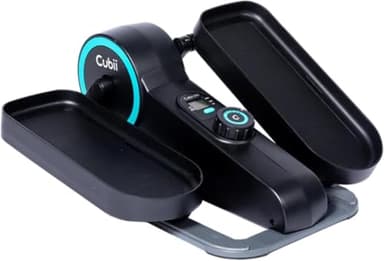
Cubii Move

Cubii Move

The lowest seated machine we have found a published height for, at 9.5 inches — which is the whole argument when your desk apron is the constraint.

Fewest steps, lowest machine6 magnetic, 9.5 in
$159.99 · View on Amazon

Price as of September 30, 2026. #ad How we’re funded

5
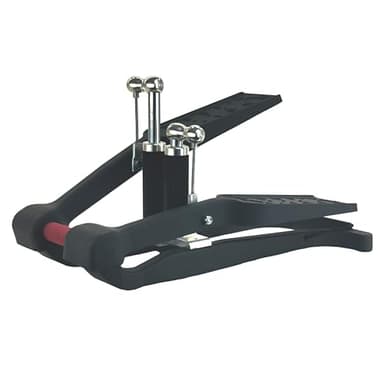
Xiser Commercial Mini Stairmaster

Xiser Commercial Mini Stairmaster

The most expensive machine on this entire site and the one that publishes the least about itself — a 400 lb capacity, an aluminum frame, three resistance settings and no dimensions at all.

Only stepper with a published count3 cylinder settings
$577.00 · View on Amazon

Price as of September 30, 2026. #ad How we’re funded

How we picked these

Ranked on what the maker publishes about the resistance itself, in this order: whether it states what the resistance is WORTH at the top of the range, then whether it states the mechanism, then how many steps it divides that range into. A level count is placed last deliberately - it describes how finely a range is divided, not how hard the machine gets, and only one maker here publishes both.

We have not walked on these machines. We do not own them and we have no test lab. What we did was open each manufacturer’s own specification page, record every published figure with the date we read it, write “not published” where a figure does not exist rather than estimating one, and do the arithmetic ourselves — folded size against a real storage gap, deck length against stride, unit weight against a flight of stairs. The full method, in detail.

Five publish a number. One says what it means.

“Adjustable resistance” is the second thing every listing in this category says about itself, after how quiet it is. It is also, on most of these machines, the least substantiated claim on the page.

We track 6 seated under-desk machines and 3 standing mini steppers. 5 of those 9 publish a resistance level count on the maker’s own site or the retail listing we link. 4publish no count at all — not a vague one, not an unsourced one, none.

Then there is the number underneath the number. Exactly one machine in this category publishes what its resistance is worth: the DeskCycle, whose maker states eight magnetic settings up to 39 lb of resistance. Every other count on this page is a bare integer. You are told a range has been divided into eight, or six, or sixteen parts, and never what the parts are parts of.

That is a strange gap, and it is worth sitting with rather than working around. A resistance level is the only control on most of these machines. It is the entire adjustable surface of the product. And for four makers out of five who print a count, the unit is missing.

A level count is not a magnitude

This is the part that changes a buying decision, so here it is plainly. A level count tells you how finely a range has been divided. It does not tell you how wide the range is, and it does not tell you where the top of it sits.

Put the two published counts side by side. The YOSUDA publishes 16 magnetic levels. The DeskCycle publishes eight. The obvious reading is that the YOSUDA is twice the machine, and its own listing invites that reading. But the DeskCycle is the one that tells you its eighth setting is 39 lb of resistance, and the YOSUDA does not tell you what its sixteenth is. Sixteen steps could divide a narrower total range more finely than eight steps divide a wider one. From the outside there is no way to know, and nothing in either listing closes the gap.

So the useful way to read a level count is as adjustment resolution, which is a real benefit and a smaller one than it looks. If you are pedaling while you read, the thing you want is to nudge the effort without thinking about it, and more steps make that nudge smaller. What more steps do not do is raise the ceiling.

We rank the published magnitude first for that reason. It is the only figure in this category that survives being compared between two brands.

Magnetic, hydraulic, and one that will not say

The second thing worth having is the mechanism, because it tells you what the resistance will do over time rather than how much of it there is.

  • Magnetic is non-contact. A magnetic field slows the flywheel without touching it, so there is no friction surface to wear down and nothing that starts to squeal at the top of the range. Four of the nine machines here state magnetic resistance outright: the DeskCycle, the YOSUDA, the Cubii JR1 and the Cubii Move.
  • Hydraulic cylinders are how the steppers work. Niceday publishes that its stepper uses hydraulic cylinders, and the Xiser publishes three cylinder settings adjusted by a knob. This is a different kind of resistance: you are loading a cylinder with your body weight from above, so the setting changes how quickly it yields rather than how hard a brake grips. It does not belong on the same scale as a pedal machine’s levels, and we do not put it there.
  • And then there is “adjustable tension”. The Stamina InMotion E1000 is, on almost every other measure, the best-documented machine in this category — it is the only seated machine whose maker publishes dimensions, unit weight and a maximum user weight together. On this one specification it says only that the tension is adjustable. No count, and no statement of whether that tension is magnetic or contact. On a page about resistance, that omission is the finding.

A mechanism you have been told is worth more than a count you have not. That is the order the ranking uses, and the Stamina is the machine it costs the most.

Resistance you cannot fit under the desk is not resistance

One practical warning before the picks, because it is the way this particular search goes wrong.

The machine with the most resistance levels on this page, the YOSUDA, publishes no pedal height at all. Pedal height is the figure that decides whether your knees clear the underside of your desk through the whole stroke, and it is the first number we sort on when we rank these machines on fit. A machine you cannot get under the desk has no usable resistance range whatsoever, however finely it is divided.

So if you are shopping this cluster, measure first and shop second. Our desk clearance guide sets out the two measurements that matter and what the published heights in this category actually clear. The DeskCycle and the Cubii JR1 publish 10 inches; the Cubii Move publishes 9.5, the lowest figure we have found in the category; the Stamina publishes 11.38, the tallest. Two of the nine publish nothing.

Resistance bands are a different product

A good share of the searches that land on a page like this one are actually looking for elastic bands rather than a resistance mechanism, so it is worth separating cleanly.

Bundled elastic bands are an upper-body accessory, not the machine’s resistance. They do not have levels. Their resistance is whatever the band you clip on provides, they are not connected to the flywheel or the cylinder, and they work your arms while your legs do something unrelated.

We do not credit a machine on this page for shipping with them, and the reason is methodological rather than snobbery: listings in this category are inconsistent about whether bands are in the box, so ranking on bands would mean ranking on a bundle that can change without the product changing. If bands are what you want, they are an accessory purchase that works with any machine here, including the ones that come with none.

The five machines side by side

Read the resistance column against the capacity column rather than on its own. The machine with the most levels publishes no maximum user weight and no pedal height, and the machine with the fewest publishes the lowest height in the category — which is the trade this whole page is about.

The five machines that publish a resistance level count. The column tells you how many steps each maker divides its range into - and for four of these five, nothing at all about what a step is worth. Note how much else is missing alongside it.
ModelIn use (L x W x H)Unit weightMax userResistance levelsPublished noise
DeskCycle Under Desk Bike Pedal Exerciser20" L x 24" W x 10" Hmanufacturer specNot publishednot publishedNot publishednot published8manufacturer specNot publishednot published
YOSUDA Under Desk BikeNot publishednot publishedNot publishednot publishedNot publishednot published16retail listingNot publishednot published
Cubii JR123.2" L x 17.56" W x 10" Hretail listingNot publishednot published150 lbretail listing8retail listingNot publishednot published
Cubii Move21.5" L x 19.5" W x 9.5" Hretail listing17.5 lbretail listingNot publishednot published6retail listingNot publishednot published
Xiser Commercial Mini StairmasterNot publishednot publishedNot publishednot published400 lbmanufacturer spec3manufacturer specNot publishednot published

The picks

Ordered by the criterion at the top: published magnitude first, then published mechanism, then the level count.

#1
pick

Only published resistance magnitude

DeskCycle Under Desk Bike Pedal Exerciser

A 10 inch pedal height is the whole product — it is the seated machine most likely to actually clear a standard 27 inch desk.

DeskCycle Under Desk Bike Pedal Exerciser
$149.99 · View on Amazon

Price as of September 30, 2026. #ad How we’re funded

First because it is the only machine in this category that tells you what its resistance is worth. Eight magnetic settings up to 39 lb of resistance is the single comparable resistance figure we have found anywhere in the seated or standing class - everywhere else you get a bare count. Magnetic means non-contact, so there is no friction surface to wear or squeal as you turn it up, and it publishes a 10 inch overall height, which is the number that decides whether it clears a standard desk. Against it, honestly: eight settings is half the YOSUDA's count, so if fine adjustment is what you are after this is not the machine; DeskCycle publishes no product weight and no maximum user weight, which is a real gap on something you load; it is 24 inches wide, so it takes serious footwell width even though it is short; and like every machine here it publishes no decibel figure.

What the specs give you

  • 10 inch overall height, which is what lets it live under a desk you already own
  • Eight magnetic resistance settings up to 39 lb of resistance
  • Steel frame, no assembly, no power outlet
  • Nothing to fold or store — it stays where it is

What they cost you

  • 24 inches wide, so it takes real floor width even though it is short
  • The maker publishes no product weight and no user weight limit
  • No decibel figure published
  • Seated pedaling is not walking — the calorie and step comparison is not close
Published specifications for the DeskCycle Under Desk Bike Pedal Exerciser
Footprint in use20" L x 24" W x 10" Hmanufacturer spec
FoldedNot publishednot published
Walking beltNot publishednot published
Unit weightNot publishednot published
Max user weightNot publishednot published
Top speedNot publishednot published
InclineNot publishednot published
Published noiseNot publishednot published
Pedal height10 inmanufacturer spec
Resistance levels8manufacturer spec

All figures read from VIVO (DeskCycle) product spec table on 2026-07-24. Where it says “not published”, we checked and no figure exists — we did not estimate one.

Read the full DeskCycle Under Desk Bike Pedal Exerciser spec breakdown
#2
pick

Most resistance steps

YOSUDA Under Desk Bike

Twice the resistance steps of the DeskCycle and app tracking, but the listing does not publish the pedal height that decides whether it fits your desk.

YOSUDA Under Desk Bike
$119.99 · View on Amazon

$139.9914% off

Price as of September 30, 2026. #ad How we’re funded

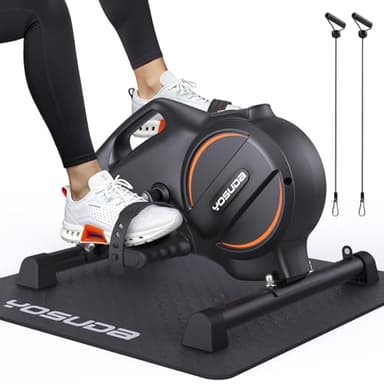
Second, and it is second rather than first on purpose. Sixteen magnetic levels is double the DeskCycle and the Cubii JR1, and that is genuinely the finest adjustment on this page - useful if you want to change the effort slightly without breaking concentration. It also publishes Bluetooth app tracking and is sold for floor use as well as under a desk. What keeps it off the top is that the count arrives with no unit: nothing in the listing states what the sixteenth level is worth, so it cannot be compared against the DeskCycle's 39 lb. And the more serious problem is not about resistance at all - the listing publishes no pedal height, no maximum user weight and no dimensions, so you cannot check before buying whether it fits under your desk. Resistance you cannot reach is not resistance.

What the specs give you

  • 16 magnetic resistance levels, double the DeskCycle and the Cubii
  • Bluetooth app tracking
  • Sold for use seated at a desk or on the floor

What they cost you

  • No published pedal height — the single most important number for an under-desk machine is missing from the listing
  • No published user weight limit
  • No decibel figure published
Published specifications for the YOSUDA Under Desk Bike
Footprint in useNot publishednot published
FoldedNot publishednot published
Walking beltNot publishednot published
Unit weightNot publishednot published
Max user weightNot publishednot published
Top speedNot publishednot published
InclineNot publishednot published
Published noiseNot publishednot published
Pedal heightNot publishednot published
Resistance levels16retail listing

All figures read from Amazon retail listing on 2026-07-24. Where it says “not published”, we checked and no figure exists — we did not estimate one.

Read the full YOSUDA Under Desk Bike spec breakdown

#3
pick

Magnetic, and the narrowest

Cubii JR1

An elliptical stroke instead of a circular one, which keeps the knee lower — and it is the only seated machine here that publishes a user weight limit.

Cubii JR1
$169.99 · View on Amazon

Price as of September 30, 2026. #ad How we’re funded

Third. Eight magnetic resistance levels put it level with the DeskCycle on both mechanism and count, and at 17.56 inches wide it is nearly 6.5 inches narrower - which matters in a real footwell, because a machine that fits without being nudged is a machine whose resistance setting is the only thing you are adjusting. Its elliptical path also keeps the knee lower through the stroke than a full pedal circle. Against it, and it is the serious one: the 150 lb maximum user weight on its listing is the lowest limit of anything on this site and rules the machine out for a lot of buyers before resistance is even a consideration. That figure comes from the retailer rather than from Cubii, which no longer lists the JR1 in its own range, and no magnitude is published for any of the eight levels.

What the specs give you

  • 10 inch height, same desk-clearance class as the DeskCycle
  • Elliptical path keeps the knee lower through the stroke than a pedal circle
  • 17.56 inches wide — nearly 6.5 inches narrower than the DeskCycle
  • Eight magnetic resistance levels

What they cost you

  • 150 lb maximum user weight is the lowest limit of anything on this site, and it rules the machine out for a lot of buyers
  • 23.2 inches deep, so it reaches further under the desk than it looks
  • No decibel figure published, despite the listing calling it whisper-quiet
Published specifications for the Cubii JR1
Footprint in use23.2" L x 17.56" W x 10" Hretail listing
FoldedNot publishednot published
Walking beltNot publishednot published
Unit weightNot publishednot published
Max user weight150 lbretail listing
Top speedNot publishednot published
InclineNot publishednot published
Published noiseNot publishednot published
Pedal height10 inretail listing
Resistance levels8retail listing

All figures read from Amazon retail listing spec table on 2026-07-24. Where it says “not published”, we checked and no figure exists — we did not estimate one.

Read the full Cubii JR1 spec breakdown

#4
pick

Fewest steps, lowest machine

Cubii Move

The lowest seated machine we have found a published height for, at 9.5 inches — which is the whole argument when your desk apron is the constraint.

Cubii Move
$159.99 · View on Amazon

Price as of September 30, 2026. #ad How we’re funded

Fourth, and it earns its place on a different axis. Six magnetic levels is the fewest published count among the seated machines, so on the criterion of this page it ranks last of the four pedal machines. What it wins instead is fit: a published 9.5 inches tall and 17.5 lb, the lowest and lightest machine on the entire site, which makes it the one most likely to actually clear a low desk apron and the easiest to move out of the way. It ships assembled and needs no outlet. Against it: six steps is coarse adjustment, no magnitude is stated, Cubii publishes no maximum user weight for any model in its range, and the dimensions quoted here come from a retailer because Cubii's own product page publishes none.

What the specs give you

  • 9.5 inches tall, half an inch lower than the Cubii JR1 and nearly two inches lower than the Stamina
  • 17.5 lb — the lightest machine of any kind on this site
  • 6 magnetic resistance levels
  • Ships assembled, needs no outlet and nothing to store

What they cost you

  • No user weight limit published on Cubii's own page or the retail listing we read — a real gap on a machine you put your body weight through
  • Cubii's own product page publishes no dimensions, weight or capacity at all; the figures here come from a retailer
  • No stride length published
  • No decibel figure published
Published specifications for the Cubii Move
Footprint in use21.5" L x 19.5" W x 9.5" Hretail listing
FoldedNot publishednot published
Walking beltNot publishednot published
Unit weight17.5 lbretail listing
Max user weightNot publishednot published
Top speedNot publishednot published
InclineNot publishednot published
Published noiseNot publishednot published
Pedal heightNot publishednot published
Resistance levels6retail listing

All figures read from Rehabmart retail listing spec table on 2026-08-11. Where it says “not published”, we checked and no figure exists — we did not estimate one.

Read the full Cubii Move spec breakdown

#5
pick

Only stepper with a published count

Xiser Commercial Mini Stairmaster

The most expensive machine on this entire site and the one that publishes the least about itself — a 400 lb capacity, an aluminum frame, three resistance settings and no dimensions at all.

Xiser Commercial Mini Stairmaster
$577.00 · View on Amazon

Price as of September 30, 2026. #ad How we’re funded

Fifth, and it is here as the honest answer to 'best mini stepper with adjustable resistance' rather than as a recommendation we are enthusiastic about. Three cylinder settings, adjusted by a knob, is the only published resistance count on a standing machine on this site - the other two steppers describe their resistance as adjustable and print no number. It also publishes a 400 lb capacity, the highest figure of any machine here, on a stated aircraft-grade cast aluminum alloy frame. Against it, and there is a lot: three settings is the coarsest adjustment on the page, cylinder resistance is not on the same scale as a magnetic brake so it cannot be compared with the four machines above, Xiser publishes no dimensions, no folded size and no unit weight at all, there is no handrail, and it costs several times what the other two steppers here cost. We rank it low elsewhere for exactly that emptiness - it is on this list only because on this one specification it does publish a number.

What the specs give you

  • 400 lb user capacity, the highest published figure of any machine on this site
  • Aircraft-grade cast aluminum alloy frame, which is why the capacity figure is credible on a machine this small
  • Three cylinder resistance settings, set by a knob, and the count is actually published
  • Ready to use out of the box with no assembly and no power

What they cost you

  • Xiser publishes no dimensions, no folded size and no product weight on its own page — on a machine at this price, that is the finding
  • The page calls it 'completely silent' and gives no decibel figure, which is a marketing adjective rather than a measurement
  • No handrail, at a price where you might reasonably expect one
  • It costs several times what the other two steppers here cost, and the specification sheet gives you almost nothing to justify the gap with
Published specifications for the Xiser Commercial Mini Stairmaster
Footprint in useNot publishednot published
FoldedNot publishednot published
Unit weightNot publishednot published
Max user weight400 lbmanufacturer spec
Resistance levels3manufacturer spec
MaterialAircraft grade cast aluminum alloymanufacturer spec
Published noiseNot publishednot published

All figures read from myxiser.com product page on 2026-08-12. Where it says “not published”, we checked and no figure exists — we did not estimate one.

Read the full Xiser Commercial Mini Stairmaster spec breakdown

Skip this one

The four that publish no count at all

The Stamina InMotion E1000 is the one that stings. It is the best-documented machine in this category on almost every other measure — the only seated machine whose maker publishes dimensions, unit weight and a 250 lb maximum user weight together, with reversible pedals and a frame rated for standing use. On resistance it says “adjustable tension” and stops: no count, and no statement of whether the tension is magnetic or contact. It is our top pick on the page where published capacity is the criterion, and it cannot be placed on this one, because an unstated mechanism with an unstated count is not a specification.

The Stamina SpaceMate and the Niceday both describe adjustable resistance without quantifying it. Niceday at least publishes the mechanism — hydraulic cylinders — and describes a stride knob without giving it a scale. The SpaceMate publishes the most complete size and weight data of any stepper here, folds to 9.5 inches and is the only one with handlebars, and still prints no resistance count. Both are properly ranked on our mini stepper roundup on the criteria they do support.

And the Sunny mini pedal exerciser publishes nothing about its resistance whatsoever — no count, no mechanism, no magnitude — alongside no pedal height, no dimensions and no user weight limit. It is the cheapest way on this site to find out whether you will use a seated pedaler at all, and that is the only claim we will make for it. If the resistance specification is what you are shopping on, it is not a candidate.

Measure the footwell before you pick a resistance level

Two of these nine machines publish no pedal height, and the tallest publishes 11.38 inches. The cheapest thing on this page is the one that tells you which of them can physically go under your desk - and a machine that does not fit has no usable resistance range at all.

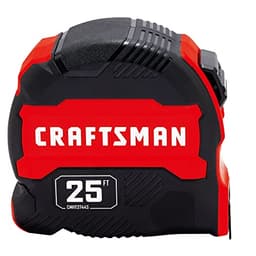
  • CRAFTSMAN 25 ft Tape Measure with fraction markings, manual-locking blade (CMHT37443S)

    CRAFTSMAN — 25 ft Tape Measure with fraction markings, manual-locking blade (CMHT37443S)

    Every folded dimension on this site is worth precisely nothing until you have measured the gap you plan to put the machine in. Sofa clearance at the center leg, closet door opening rather than closet interior, the 3 to 5 inches behind an open door. Five minutes with this settles a purchase that otherwise gets settled by hope.

    The catch: A tape measure is a tape measure. Any 25 ft locking tape does this job, including one you already own — this is the one to buy only if you do not have one, and buying it does not make our published dimensions any more or less reliable.

    Amazon retail listing, read 2026-08-26. We have not used this item; it is here because a page on this site already told you to do the job it does.

    $12.98 · View on Amazon

    $19.9835% off

    Price as of September 30, 2026. #ad How we’re funded

What we have not done

We have not measured the resistance of any machine on this page. We do not own them, we have no force gauge and no instrumented flywheel, and we have not turned a single one of these knobs. Every figure above is read from a manufacturer or retailer page named in the sources below, with the date we read it. The reasoning about what a level count can and cannot tell you follows from what a count is, not from testing.

We have not converted anybody’s level count into a magnitude. It would be easy to assume that sixteen levels spans twice the range of eight, or that every maker’s level five is roughly comparable, and both would be inventions. Where a magnitude is not published we say it is not published and leave the cell empty. Our full method.

We have not ranked the steppers against the pedal machines on resistance. A hydraulic cylinder loaded by body weight and a magnetic brake on a flywheel are different mechanisms measured in different terms. The Xiser appears on this list because it publishes a count, and it is placed below the pedal machines rather than interleaved with them on purpose.

Questions people actually ask

What is the best under-desk elliptical or bike with adjustable resistance?

The DeskCycle, and for a reason that has nothing to do with it having the most settings - it does not. It is the only machine in this category whose maker publishes what the resistance is worth: eight magnetic settings up to 39 lb of resistance. Everywhere else in the category you are given a number of levels with no unit attached, which tells you how finely the range is divided and nothing about where it ends. If you want the most steps rather than the most information, that is the YOSUDA at 16 magnetic levels, and you should know that its listing publishes no pedal height, which is the figure that decides whether it fits under your desk at all.

Is 16 levels of resistance better than 8?

Not necessarily, and this is the single most useful thing on this page. A level count tells you how many steps the maker has divided its range into. It does not tell you how wide that range is or where the top of it sits. Sixteen unlabeled steps can span a narrower total range than eight, and there is no way to tell from the outside, because only one maker here publishes a magnitude. Treat a higher count as finer adjustment - genuinely useful if you want small changes while you work - and not as a harder machine.

Do under-desk bikes and ellipticals have adjustable resistance?

Most do, and not all of them will tell you how much. We track six seated under-desk machines and three standing mini steppers. Five of those nine publish a resistance level count; four publish none at all. The Sunny mini pedal exerciser publishes nothing about its resistance on its own site or the listing we read, and the Stamina InMotion E1000 - otherwise the best-documented machine in the category - describes it only as adjustable tension without saying how many steps there are or what kind of resistance it is.

What does magnetic resistance mean on an under-desk bike?

It means the machine slows a flywheel with a magnetic field rather than by pressing something against it. Nothing touches, so there is no friction surface to wear down or squeal, and turning the resistance up does not add a rubbing sound. Four of the nine machines here state magnetic resistance outright - the DeskCycle, the YOSUDA, the Cubii JR1 and the Cubii Move. It is a mechanism claim rather than a performance claim: magnetic does not mean harder, it means non-contact.

Do mini steppers have adjustable resistance?

Two of the three we track describe it as adjustable and publish no count. The Xiser is the exception and publishes three cylinder settings, adjusted by a knob - the only standing machine here with a number attached. A stepper's resistance also works differently from a pedal machine's: you are loading hydraulic cylinders with your body weight from above, so the resistance setting changes how fast the cylinder yields rather than how much force a brake applies. The two are not on the same scale and we do not rank them against each other.

What about under-desk machines that come with resistance bands?

Elastic bands are an upper-body accessory that some of these machines are bundled with. They are not the machine's resistance and they are not adjustable in levels - a band's resistance is set by the band you clip on. We do not treat a bundled band as a resistance specification, and we do not rank any machine here higher for shipping with one, because the listings in this category are inconsistent about whether bands are included and we would be ranking on a bundle rather than on the machine.

How much resistance do I actually need for working at a desk?

Less than you would think, and the honest answer is that nobody can give you a number because the machines will not give you one either. The use case these are sold for is low, continuous movement while your attention is elsewhere, and at that intensity you are usually near the bottom of any range. The practical argument for a wide range with fine steps is not that you will use the top of it - it is that you can make a small change without the machine becoming distracting. If you want a machine you can genuinely train hard on, a seated pedaler is the wrong category and we say so at length on our page about whether under-desk bikes do anything.

Can I make an under-desk elliptical harder than its top setting?

Not in any way we would recommend or have tested. These are sealed consumer mechanisms, none of these makers publishes a service manual, and modifying a resistance mechanism is a good way to void a warranty and hurt yourself. The honest options are to buy for the mechanism and the published range in the first place, or to accept what the category is: the ceiling on a machine designed to fit under a desk at 10 inches tall is set by its size, not by its settings.

Sources