Pad & Pace

Best weighted vests for walking, ranked against what your pad allows

Every listing in this category sells you its maximum. On a walking pad the maximum is the problem, because the load lands on the one figure the pad maker published.

By Stephen V. · Last updated

A pair of worn walking shoes on a hardwood floor beside a doorway

Buy the Sportneer Adjustable Weighted Vest if you are putting it on a walking pad: its published range starts at 2 lb, which fits inside any pad’s headroom at any setting. The Liveet vest is the one to buy for precision — twenty removable 1 lb bags, so the load is settable to the pound. The budget pick is the Zeerun 10 lb vest, fixed rather than adjustable. And the number that should decide it: against the lowest published pad capacity on this site, 220 lb, the average American man has 21 lb of room for everything he is carrying.

How this page is funded: the buy links here are Amazon affiliate links, and we earn a commission if you buy through one — at no extra cost to you. It does not change what we rank first, because the commission rate is the same across every machine on this page. Full disclosure.

How we picked these

Ranked on the load you can actually set — the lowest published setting first, then the size of one removable weight — because on a walking pad the binding figure is not how heavy a vest goes, it is how much room the pad's published capacity leaves. Nothing here is ranked on fit or comfort: no listing in this category publishes an empty weight, a torso length or a chest size, and we have not worn any of them.

We have not walked on these machines. We do not own them and we have no test lab. What we did was open each manufacturer’s own specification page, record every published figure with the date we read it, write “not published” where a figure does not exist rather than estimating one, and do the arithmetic ourselves — folded size against a real storage gap, deck length against stride, unit weight against a flight of stairs. The full method, in detail.

The subtraction that sets your vest size

A weighted vest is the cheapest way to make a flat belt harder, and it is also the fastest way to spend a number somebody else wrote. Every walking pad publishes a maximum user weight — it is the one specification this whole category agrees to state — and not one maker says whether that figure includes what you are carrying. With the question unanswered, the only defensible reading is that the belt sees total mass. Your weight plus the vest.

Run that against real numbers and the vests in this category look different. Published capacities across the pads we track run from 220 lb to 300 lb, and 3 of them sit at the bottom figure. The CDC’s National Center for Health Statistics publishes a mean body weight of 199 lb for US men aged 20 and over and 171.8 lb for women, from its August 2021 to August 2023 survey data. Against the 220 lb pads that is 21 lb of headroom for the average man and 48.2 lb for the average woman.

21 lb is not very much vest. It is less than the maximum load on three of the four vests on this page, which means that for a large share of readers the headline number on the box is already out of reach — and a 20 lb vest at exactly the mean leaves one pound of margin on a 220 lb machine. Those are population averages rather than you, so put your own weight into the arithmetic instead; our capacity write-up runs the full table across every pad we track.

What this category publishes, and what it does not

We went looking for the specifications you would need to buy one of these properly, and found one. The load.

Not one of the four listings below publishes the empty weight of the vest, which matters because a vest marketed as “2 to 18 lb” may be stating total mass including the garment or added mass on top of it, and those are different purchases. Not one publishes a torso length or a chest range in inches, on a product whose whole job is to sit still on a moving body. Two of the four do not publish the weight of one removable pack, so the step size between settings is unknown even where the range is stated.

That shapes what this page can honestly be. It is not a fit review — we have not worn any of these, and there is no published figure to rank fit on even if we wanted to. It is a ranking of the one published specification against the one constraint that actually binds on a walking pad, which is the same thing this site does with folded heights and deck clearances everywhere else. Where a listing publishes nothing, the card below says Not published rather than filling the gap with a plausible number.

Every vest against every published capacity

Each vest at full load, and the heaviest walker who stays inside the lowest and highest published pad capacities on this site.
VestPublished loadOne weightFits a walker up to (220 lb pad)(300 lb pad)
Sportneer Adjustable vest, 2-18 lb2 to 18 lbretail listingNot publishednot published202 lbwithin 5 lb of the mean weight for US men282 lb
Liveet Adjustable vest, 1 lb steps20 lb, fixedretail listing1 lbretail listing200 lbwithin 5 lb of the mean weight for US men280 lb
VBSD Adjustable vest, 11-20 lb11 to 20 lbretail listingNot publishednot published200 lbwithin 5 lb of the mean weight for US men280 lb
Zeerun Fixed vest, 10 lb10 lb, fixedretail listingNot publishednot published210 lb290 lb

Read the fourth column, because it is the one nobody prints. Worn at full load on one of the 220 lb pads, 3 of the 4 vests here put the ceiling within 5 lb of the average American man’s weight — and the one that does not is the fixed 10 lb vest at the bottom of the ranking. That is not a fault in the vests. It is what happens when a 20 lb purchase meets a 21 lb allowance, and it is the reason the ranking below is built on the bottom of each range rather than the top.

The fifth column is the other half of the story. On the 300 lb machine the arithmetic stops biting for almost everybody, which is a genuine argument for buying the pad with the highest published capacity if you already know you want to walk under load. The catch is recorded on that machine’s own card: the listing publishing 300 lb publishes no dimensions at all. Every published capacity on this site, ranked has that trade in full, and the machine itself sits in the under-$400 band as its cheapest entry.

#1
pick

Best for a walking pad — the lowest published floor

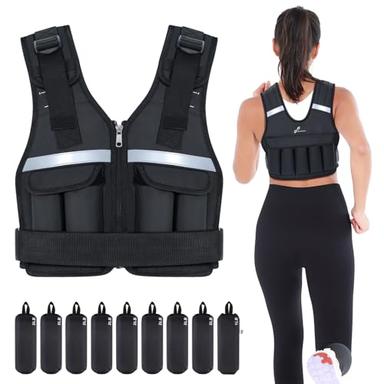
Sportneer Adjustable Weighted Vest, 2-18 lb, removable sand packs
Sportneer Adjustable Weighted Vest, 2-18 lb, removable sand packs
$48.44 · View on Amazon

$56.9915% off

Price as of November 23, 2026. #ad How we’re funded

It wins on the number this page is ranked on and nothing else: a published range starting at 2 lb, which is the only vest here that can be set well inside the 21 lb of headroom an average-weight man has on a 220 lb machine. The span to 18 lb is also the widest published adjustment of the four, so one purchase covers the light load you start with and the heavier one you may want in three months. Sand packs rather than iron is a real trade and it cuts both ways: the listing says they are washable, which nothing else here claims, but sand takes more volume than iron for the same weight. Two honest gaps, both the category's rather than ours — Sportneer does not publish the empty weight of the vest, so the bottom of that range may be the garment, and "zip-on fit" is not a measurement.

Published load
2 to 18 lb
retail listing
One removable weight
Not published
not published

Why it is here

The published floor is the reason it is here: 2 lb. A walking pad's capacity is the one figure every maker states, and against the lowest published capacity on this site the average American man has 21 lb of headroom - so a vest that can be set low is a vest that fits inside the number at any setting. Sportneer states the range as 2 to 18 lb with removable, washable sand packs, which is the widest published adjustment span of the four vests we list.

What it costs you

The listing publishes the load range and the fact that the packs come out. It does not publish the empty weight of the vest, so the bottom of that range may be the garment rather than added load, and it does not publish a torso length or a chest size in inches - a 'zip-on fit' is not a measurement. Sand packs are also not iron: they take more volume for the same weight, which is the trade for being washable.

Amazon retail listing, read 2026-11-17. We have not used this item — every figure above is the one its source publishes, and where it publishes none the row says so.
#2
pick

The only one that publishes its step size

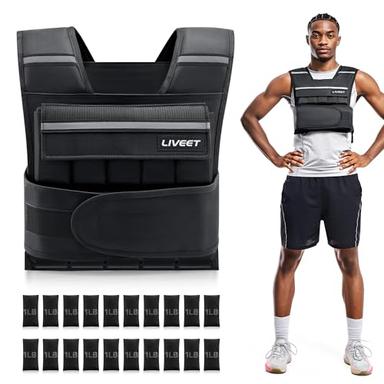
Liveet Adjustable Weighted Vest, 20 lb, 20 removable 1 lb iron sand bags

Liveet Adjustable Weighted Vest, 20 lb, 20 removable 1 lb iron sand bags
$55.99 · View on Amazon

$69.9920% off

Price as of November 23, 2026. #ad How we’re funded

Twenty removable 1 lb iron sand bags is the single most useful published figure in this category, and it is the only one of its kind here: it means the load is settable to the pound rather than to whatever a handful of unlabeled packs happens to weigh. On a pad that matters more than it sounds, because the gap you are filling is a specific number — your body weight subtracted from a published capacity — and a 1 lb step is the difference between using that gap and overshooting it. The listing also states 600D Oxford fabric, foam padding and a hook-and-loop strap, which is more construction detail than the rest of this page offers. It ranks second rather than first because the range has no published floor: at full load it is 20 lb, which is essentially the whole allowance on a 220 lb pad, and iron sand is not washable the way the sand-pack vests claim to be.

Published load
20 lb, fixed
retail listing
One removable weight
1 lb
retail listing

Why it is here

It is the only vest on this list that publishes the size of ONE weight: twenty removable 1 lb iron sand bags, which means the load can be set to any pound between empty and 20. That matters specifically on a walking pad, where what you are spending is the gap between your body weight and a published capacity, and a 1 lb step is the difference between using that gap and overshooting it. The listing also states 600D Oxford fabric, foam padding and a hook-and-loop strap.

What it costs you

At full load it is 20 lb, which is essentially the entire headroom the lowest-rated pads leave an average-weight man - this is the vest to buy for its adjustability, not to wear full on a 220 lb machine. The listing does not publish the vest's own empty weight or any sizing in inches, and iron sand bags are not washable in the way the sand-pack vests claim to be.

Amazon retail listing, read 2026-11-17. We have not used this item — every figure above is the one its source publishes, and where it publishes none the row says so.
#3
pick

Cheapest vest here that still adjusts

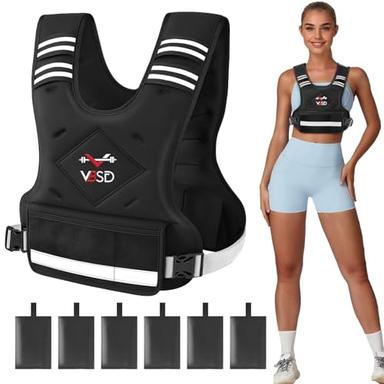
VBSD Adjustable Weighted Vest, 11-20 lb, 6 ironsand weights

VBSD Adjustable Weighted Vest, 11-20 lb, 6 ironsand weights
$23.99 · View on Amazon

Price as of November 23, 2026. #ad How we’re funded

Published adjustability for the least money of the three adjustable vests on this page: 11 to 20 lb across six removable ironsand weights. For a reader who already knows a double-figure load is comfortably inside their pad's capacity, this is the smallest outlay that still lets them change their mind later, which is worth more than it looks on a purchase most people get wrong on the first attempt. It ranks third on the page's own criterion: the floor is 11 lb, already half the average man's allowance on a 220 lb pad, so it cannot be dialed down the way the pick above can. VBSD also does not publish the weight of one ironsand pack, and the stated range does not divide evenly into six, so do not assume a neat increment.

Published load
11 to 20 lb
retail listing
One removable weight
Not published
not published

Why it is here

Published adjustability at the lowest price of the three adjustable vests here: the listing states an 11 to 20 lb range across 6 removable ironsand weights. For a reader who already knows a double-figure load sits inside their pad's published capacity, it is the least money that still lets them change their mind later.

What it costs you

The floor is 11 lb, which is already half the headroom the lowest-rated pads leave an average-weight man - it cannot be dialed down to a light load the way the Sportneer can. The listing does not publish the weight of one ironsand pack, the empty weight of the vest, or any sizing in inches, and the stated range does not divide evenly into six weights, so do not assume a neat increment.

Amazon retail listing, read 2026-11-17. We have not used this item — every figure above is the one its source publishes, and where it publishes none the row says so.

#4
pick

Budget pick — one known load, nothing to adjust

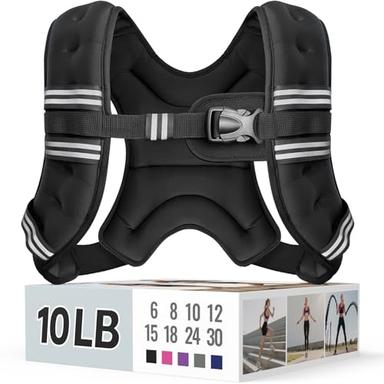
Zeerun Weighted Vest, 10 lb, black

Zeerun Weighted Vest, 10 lb, black
$14.24 · View on Amazon

$19.9929% off

Price as of November 23, 2026. #ad How we’re funded

Named as the budget pick: it is the cheapest item on this page and the simplest argument on it. 10 lb sits inside the 21 lb of headroom the lowest published pad capacity leaves an average-weight man, it is sold as one ASIN per weight rather than one listing spanning a range, so the load on the label is the load that arrives, and there is nothing to assemble or redistribute. It ranks last because of what "fixed" means on a page ranked on adjustability: if 10 lb turns out to be too much or too little, the vest is wrong rather than the setting. The adjustable part is the buckle. The wider family spans 6 to 30 lb across separate listings, so check the weight on the variant you are actually ordering.

Published load
10 lb, fixed
retail listing
One removable weight
Not published
not published

Why it is here

The cheapest way to add a known, fixed load. 10 lb sits inside the 21 lb of headroom the lowest published pad capacity on this site leaves an average-weight American man, and it is sold as one ASIN per weight rather than one listing spanning a range, so what arrives is the load on the label. The adjustable part is the buckle, not the weight.

What it costs you

There is nothing to remove and nothing to add: if 10 lb turns out to be too much or too little, the vest is the wrong one rather than the wrong setting. The listing publishes no empty weight, no sizing in inches and no breakdown of how the 10 lb is distributed, and the wider product family spans 6 to 30 lb across separate ASINs - check the weight on the variant you are actually buying before you order.

Amazon retail listing, read 2026-11-17. We have not used this item — every figure above is the one its source publishes, and where it publishes none the row says so.

Why a vest rather than an incline

The obvious objection to this entire page is that a treadmill already has a way to make walking harder. On this category, mostly it does not. Of the 8 pads we track, 3 publish an incline figure and 5 publish none at all — and of the three that do, one sets it by swapping the feet under the deck by hand and one by lifting the deck onto a prop. Exactly one changes while you are walking.

So for most readers here the choice is not vest versus incline, it is vest versus walking faster — and walking faster is mostly not available either, because seven of the eight pads we track top out between 3.0 and 4.0 mph, which is not where you add intensity while typing. That is the gap a vest fills, and it is why this page sits on a walking pad site rather than a general fitness one. The pads that do publish an incline are ranked separately, and if yours is one of them you may not need a vest at all.

One more mechanical point, because it is the kind of thing a spec sheet will not tell you. A vest raises your center of mass, and almost no walking pad has anything to hold — exactly one machine in our registry publishes a handrail. If you are adding load for the first time, adding it on the one pad with a handle is a more sensible order of operations than adding it at the top of a handle-free machine’s speed range.

Skip this one

The listings we would not rank, and why

Several of the best-selling weighted vests on Amazon are sold as one listing spanning an enormous range — 4 to 30 lb, or 6 to 30 lb, with the weight chosen in a dropdown. We left all of them off this page on purpose.

The reason is a rule this site already applies to machines: we do not rank a product whose listing title cannot tell us which variant an ASIN is. Our own content ledger records a walking pad refused on exactly that basis, because a specification that belongs to a different variant is worse than no specification. On a vest the variant is the specification — the load is the only published figure there is — so a parent listing is a page we could not write honestly.

Every ASIN above names one load in its own title. If you buy from a range listing anyway, which is a perfectly reasonable thing to do, read the weight on the variant in your cart rather than the one in the headline, and check it against the arithmetic at the top of this page before you add it to your body weight.

Questions people actually ask

What is the best weighted vest for walking?

On a walking pad, the Sportneer adjustable vest, because its published range starts at 2 lb. The number that decides this purchase is not the vest's maximum, it is your pad's published capacity minus your body weight — and against the lowest capacity in our registry, 220 lb, the CDC's mean body weight for US men leaves 21 lb of headroom. A vest that adjusts down to 2 lb fits inside that at any setting. The budget pick is the Zeerun 10 lb vest, which is fixed rather than adjustable and costs the least of the four here.

How much weight should you add on a walking pad?

Less than the vest can hold, and the ceiling is set by your machine rather than by your fitness. Published capacities across the pads we track run from 220 lb to 300 lb, and not one maker states whether that figure is your body weight or your body weight plus what you are carrying — so the only safe reading is that everything on the belt counts. Add your own weight and the vest together and check the total against the spec sheet before you buy either item. Our capacity write-up runs that arithmetic for every pad on the site.

Is walking with a weighted vest on a walking pad safe?

We are not a medical source and this is not medical advice. What we can tell you is mechanical: added load is added load whether you are on a belt or a sidewalk, and on a pad there are two differences worth naming. Most walking pads have no handrail — exactly one of the pads we track does — so there is nothing to grab if the extra mass unbalances you. And a vest raises your center of mass, which is the kind of change you want to make at a slow speed on a long belt rather than at the top of the machine's range.

Does a weighted vest count against the walking pad's weight limit?

Assume yes. We checked the published material for every pad in our registry and not one maker states whether its maximum user weight includes carried load. With the question unanswered, the conservative reading is the only defensible one: the machine sees total mass on the belt, so a 190 lb walker in a 20 lb vest is a 210 lb user. If that total is within a few pounds of the published figure, size the vest down rather than hoping.

Why not just use the incline instead of a vest?

Because most walking pads do not have one. Of the eight pads we track, three publish an incline figure and five publish none at all, and of those three, one is set by swapping feet by hand and one by propping the deck. If your machine is in the majority with no incline, a vest is the only way to make a flat belt harder without walking faster — which is the whole reason this page is on a walking pad site rather than a general fitness one.

What size weighted vest should you buy?

This is the question the category refuses to answer, and we will not invent a figure to fill the gap. Not one of the four listings here publishes a torso length, a chest range in inches or the empty weight of the garment — the published specification is the load and nothing else. Buy from a listing with a returns path you are comfortable with, and if you are between sizes, prefer the adjustable vests above the fixed one, because an adjustable vest at least lets you correct the load if the fit forces a compromise.

Sources