
Pad & Pace

Best under-desk cardio for bad knees

On a belt, every step lands. On a seated machine, nothing does - your feet never leave the pedals. That is the one structural difference in this whole category, and it is why this page ranks seated machines rather than pads.

By Stephen V. · Last updated

A compact home office desk against an apartment wall with a laptop and chair

The Cubii Move is the pick: an elliptical stroke rather than a full pedal circle, which keeps the knee lower through its travel, at the lowest published height in the category (9.5 in) so a fixed desk is not pushing your knees up into it. If you would rather know how hard the resistance actually gets, take the DeskCycleinstead — it is the only machine here that publishes a resistance figure in pounds (8 settings to 39 lb) and the only one with adjustable pedal straps. We are not clinicians, and nothing on this page is medical advice.

How this page is funded: the buy links here are Amazon affiliate links, and we earn a commission if you buy through one — at no extra cost to you. It does not change what we rank first, because the commission rate is the same across every machine on this page. Full disclosure.

Quick picks

Ranked on the path your knee travels and on what the maker will publish about it: whether the stroke is an ellipse or a full pedal circle, whether the foot is held on the pedal through the upstroke, how hard the hardest setting actually is, and how low the machine sits so your knee is not driven into the desk apron. We are not clinicians and nothing here is medical advice. Select a row to jump to the full write-up. We have not walked on any of these — here is exactly what we did instead.

#ModelBest forKey figurePrice
1
Cubii Move

Cubii Move

The lowest seated machine we have found a published height for, at 9.5 inches — which is the whole argument when your desk apron is the constraint.
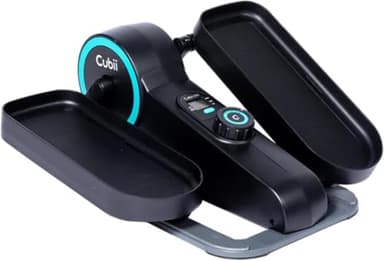
Lowest machine, elliptical stroke9.5 in tall
$159.99 · View on Amazon

Price as of October 22, 2026. #ad How we’re funded

2
DeskCycle Under Desk Bike Pedal Exerciser

DeskCycle Under Desk Bike Pedal Exerciser

A 10 inch pedal height is the whole product — it is the seated machine most likely to actually clear a standard 27 inch desk.

The only published resistance magnitude39 lb at setting 8
$149.99 · View on Amazon

Price as of October 22, 2026. #ad How we’re funded

3
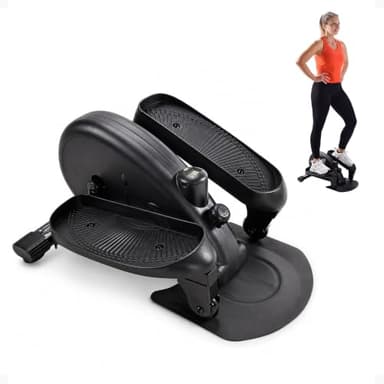
Stamina InMotion E1000

Stamina InMotion E1000

The only seated machine here whose maker publishes dimensions, unit weight and a user weight limit together — and the tallest of the three, at 11.38 inches.

Most complete published spec250 lb stated
$184.99 · View on Amazon

Price as of October 22, 2026. #ad How we’re funded

4
Cubii JR1

Cubii JR1

An elliptical stroke instead of a circular one, which keeps the knee lower — and it is the only seated machine here that publishes a user weight limit.

Narrowest footwell, 8 levels17.56 in wide
$169.99 · View on Amazon

Price as of October 22, 2026. #ad How we’re funded

How we picked these

Ranked on the path your knee travels and on what the maker will publish about it: whether the stroke is an ellipse or a full pedal circle, whether the foot is held on the pedal through the upstroke, how hard the hardest setting actually is, and how low the machine sits so your knee is not driven into the desk apron. We are not clinicians and nothing here is medical advice.

We have not walked on these machines. We do not own them and we have no test lab. What we did was open each manufacturer’s own specification page, record every published figure with the date we read it, write “not published” where a figure does not exist rather than estimating one, and do the arithmetic ourselves — folded size against a real storage gap, deck length against stride, unit weight against a flight of stairs. The full method, in detail.

What actually decides it: four things you can check before you buy

This page exists because our own walking-pad page on the same subject runs out of evidence. Nobody in the walking-pad category publishes a cushioning measurement — not a deck deflection figure, not a durometer rating, nothing you could use to compare two decks. So that page ends by naming the one difference that is structural rather than claimed: on a seated machine your feet never leave the pedals, so there is no footfall at all. Then it handed readers to a ranking built on desk clearance, which is the wrong criterion for someone whose constraint is a joint. This is the right one.

1. An ellipse or a circle.These are two different mechanisms and the difference is geometric, not marketing. A crank carries the foot around a circle, so the knee is lifted by the full crank diameter at the top of every turn. An elliptical linkage flattens that path, so the foot travels further forward and less upward and the knee stays lower through the stroke. That much is mechanical fact. What nobody will tell you is by how much — stride length, crank diameter and step height are the three figures from which range of motion could be derived, and not one maker we track publishes any of them, from companies that will state a product weight to a tenth of a pound.

2. How low the machine is. This is the figure most buyers get wrong on a knee purchase, because it sounds like a storage question. It is not. Your desk height is fixed. Every inch of machine under it raises your knee by an inch inside a gap that did not change, which means a tall machine forces a more bent knee for the whole session. The clearance arithmetic, with every published height. The published spread here is small and it matters: 9.5 in for the Cubii Move, 10 in for the JR1 and the DeskCycle, 11.38 in for the Stamina.

3. Whether the foot is held on. On the upstroke of a pedal circle the pedal is coming back up at you, and if nothing retains the foot you either push it down or lift the leg to follow it. One machine in this category publishes a solution: VIVO states adjustable pedal straps for the DeskCycle, re-read on 2026-10-17. That is the only published foot-retention feature in the category.

4. How hard the hardest setting is.A level count is not a magnitude — it tells you how finely a range is divided, not where the range ends. Exactly one maker here states where it ends: VIVO publishes 8 settings up to 39 lb of resistance for the DeskCycle. Every published resistance figure in the category, ranked on magnitude rather than on count. For a knee, the useful end of that range is usually the bottom, and the bottom is exactly what nobody publishes.

Every seated machine we track, on the figures that decide this

The six seated machines we track. Read the Max user column first: one of the six carries a figure from its own manufacturer. Read the Resistance column second, and remember it is a count of knob positions rather than a measure of how hard anything is - only one maker in this category publishes the magnitude at all.
ModelIn use (L x W x H)Unit weightMax userResistance levels
DeskCycle Under Desk Bike Pedal Exerciser20" L x 24" W x 10" Hmanufacturer specNot publishednot publishedNot publishednot published8manufacturer spec
Cubii JR123.2" L x 17.56" W x 10" Hretail listingNot publishednot published150 lbretail listing8retail listing
YOSUDA Under Desk BikeNot publishednot publishedNot publishednot publishedNot publishednot published16retail listing
Sunny Health & Fitness Under Desk Smart Mini Pedal Exerciser (SF-B023005)Not publishednot publishedNot publishednot publishedNot publishednot publishedNot publishednot published
Stamina InMotion E100024.5" L x 17" W x 11.38" Hmanufacturer spec24 lbmanufacturer spec250 lbmanufacturer specNot publishednot published
Cubii Move21.5" L x 19.5" W x 9.5" Hretail listing17.5 lbretail listingNot publishednot published6retail listing

Three of the six publish no dimensions whatsoever, which means you cannot check them against the gap under your desk before they arrive, let alone against a knee. That is the single most common finding on this site and it is not a research gap on our side: we opened the maker’s own page in every case and recorded what was absent.

One number in that table deserves to be read sceptically rather than trusted. The Cubii JR1’s 150 lbmaximum user weight comes from its retail listing, and Cubii has never published a maximum user weight for any model in its own range — re-checked on 2026-10-17. It is the lowest limit of anything on this site. We are not going to tell you it is wrong, because we cannot verify a different figure from a primary source; we are telling you where it came from.

#1
pick

The lowest machine here, with the flatter stroke

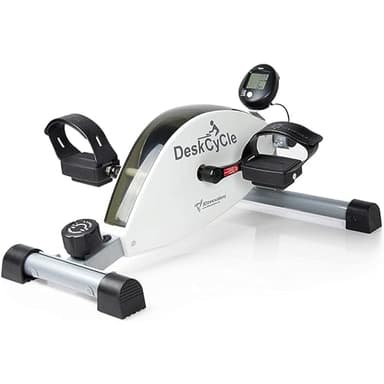
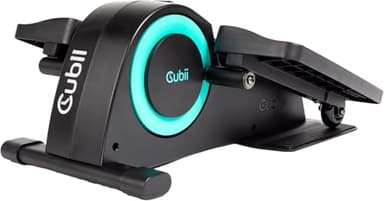
Cubii Move

The lowest seated machine we have found a published height for, at 9.5 inches — which is the whole argument when your desk apron is the constraint.

Cubii Move
$159.99 · View on Amazon

Price as of October 22, 2026. #ad How we’re funded

For the buyer whose desk height is fixed and whose knees do not want a deeper bend. First because it wins the two things this page can actually check: the stroke is an elliptical path rather than a full pedal circle, which keeps the knee lower through its travel, and at a published 9.5 inches it is the lowest seated machine we have found a height for anywhere - half an inch under the JR1 and nearly two inches under the Stamina. At 17.5 lb it is also the lightest machine of any kind on this site, so it can be slid out of the footwell with one hand rather than kicked out of the way. The costs are specific and they are all absences: Cubii publishes no maximum user weight for any model in its range, no stride length for this one, and no dimensions at all on its own product page - the figures above come from a retailer.

What the specs give you

  • 9.5 inches tall, half an inch lower than the Cubii JR1 and nearly two inches lower than the Stamina
  • 17.5 lb — the lightest machine of any kind on this site
  • 6 magnetic resistance levels
  • Ships assembled, needs no outlet and nothing to store

What they cost you

  • No user weight limit published on Cubii's own page or the retail listing we read — a real gap on a machine you put your body weight through
  • Cubii's own product page publishes no dimensions, weight or capacity at all; the figures here come from a retailer
  • No stride length published
  • No decibel figure published
Published specifications for the Cubii Move
Footprint in use21.5" L x 19.5" W x 9.5" Hretail listing
FoldedNot publishednot published
Walking beltNot publishednot published
Unit weight17.5 lbretail listing
Max user weightNot publishednot published
Top speedNot publishednot published
InclineNot publishednot published
Published noiseNot publishednot published
Pedal heightNot publishednot published
Resistance levels6retail listing

All figures read from Rehabmart retail listing spec table on 2026-08-11. Where it says “not published”, we checked and no figure exists — we did not estimate one.
Read the full Cubii Move spec breakdown

#2
pick

The only machine that says how hard it gets, and the only one that holds your foot on

DeskCycle Under Desk Bike Pedal Exerciser

A 10 inch pedal height is the whole product — it is the seated machine most likely to actually clear a standard 27 inch desk.

DeskCycle Under Desk Bike Pedal Exerciser
$149.99 · View on Amazon

Price as of October 22, 2026. #ad How we’re funded

For the buyer who wants to start at the easy end and know what the hard end is. Second, and first for anyone who refuses to buy resistance blind: VIVO publishes 8 magnetic settings up to 39 lb of resistance, which is the only resistance magnitude published in this entire category - everybody else gives a level count and no idea what a level is worth. It is also the only machine here with published adjustable pedal straps, which is what carries the foot through the upstroke instead of making you push the pedal back down, and the only one with a stated warranty on its product page (1 year, re-read October 17, 2026). A steel frame and a 10 inch height put it in the same desk-clearance class as the Cubiis. Against it: a crank lifts the knee by the full crank diameter at the top of every turn and VIVO publishes no crank diameter; it is 24 inches wide, the widest footwell demand here; and VIVO publishes no product weight and no maximum user weight.

What the specs give you

  • 10 inch overall height, which is what lets it live under a desk you already own
  • Eight magnetic resistance settings up to 39 lb of resistance
  • Steel frame, no assembly, no power outlet
  • Nothing to fold or store — it stays where it is

What they cost you

  • 24 inches wide, so it takes real floor width even though it is short
  • The maker publishes no product weight and no user weight limit
  • No decibel figure published
  • Seated pedaling is not walking — the calorie and step comparison is not close
Published specifications for the DeskCycle Under Desk Bike Pedal Exerciser
Footprint in use20" L x 24" W x 10" Hmanufacturer spec
FoldedNot publishednot published
Walking beltNot publishednot published
Unit weightNot publishednot published
Max user weightNot publishednot published
Top speedNot publishednot published
InclineNot publishednot published
Published noiseNot publishednot published
Pedal height10 inmanufacturer spec
Resistance levels8manufacturer spec

All figures read from VIVO (DeskCycle) product spec table on 2026-07-24. Where it says “not published”, we checked and no figure exists — we did not estimate one.

Read the full DeskCycle Under Desk Bike Pedal Exerciser spec breakdown

#3
pick

The one whose maker will put a user weight limit in writing

Stamina InMotion E1000

The only seated machine here whose maker publishes dimensions, unit weight and a user weight limit together — and the tallest of the three, at 11.38 inches.

Stamina InMotion E1000
$184.99 · View on Amazon

Price as of October 22, 2026. #ad How we’re funded

For the buyer who needs the manufacturer, not a retailer, to state what the machine is rated for. Third, and it would be first on a different page: Stamina publishes assembled dimensions, a 24 lb product weight and a 250 lb maximum user weight together on its own site, which no other elliptical here does, and it states that the pedals reverse and that the frame is rated for standing as well as seated use. Reversing matters more here than it looks - it is the only published way on any of these machines to change the direction the joint is driven without changing machine. What drops it to third on a knee page is the one figure that works against it: at 11.38 inches it is the tallest of the three ellipticals, so under a fixed desk it is the machine most likely to foul the apron and force a sharper knee angle. Stamina also publishes no resistance level count at all, only adjustable tension, and no stride length.

What the specs give you

  • Stamina publishes dimensions, product weight and capacity on its own page — the only elliptical here where all three come from the manufacturer
  • 250 lb user capacity, 100 lb higher than the Cubii JR1's published limit
  • 24 lb, light enough to move between rooms one-handed
  • Pedals reverse, and the frame is rated for standing as well as seated use

What they cost you

  • 11.38 inches tall — the tallest of the three ellipticals here, and the one most likely to foul a low desk apron
  • Stamina publishes no resistance-level count, only 'adjustable tension'
  • No stride length published, so you cannot check the knee travel before buying
  • No decibel figure published
Published specifications for the Stamina InMotion E1000
Footprint in use24.5" L x 17" W x 11.38" Hmanufacturer spec
FoldedNot publishednot published
Walking beltNot publishednot published
Unit weight24 lbmanufacturer spec
Max user weight250 lbmanufacturer spec
Top speedNot publishednot published
InclineNot publishednot published
Published noiseNot publishednot published
Pedal heightNot publishednot published
Resistance levelsNot publishednot published

All figures read from staminaproducts.com product page on 2026-08-11. Where it says “not published”, we checked and no figure exists — we did not estimate one.
Read the full Stamina InMotion E1000 spec breakdown

#4
pick

Narrowest footwell demand, with the limit you have to read first

Cubii JR1

An elliptical stroke instead of a circular one, which keeps the knee lower — and it is the only seated machine here that publishes a user weight limit.

Cubii JR1
$169.99 · View on Amazon

Price as of October 22, 2026. #ad How we’re funded

For the buyer with a pedestal desk and a body weight comfortably inside the stated limit. Fourth because the mechanism is right and the paperwork is not. It has the same elliptical stroke as the Move, eight resistance levels rather than six, and at 17.56 inches it is nearly two inches narrower than the Move and more than six narrower than the DeskCycle - genuinely the one that fits a footwell with a drawer pedestal beside it. Then the limit: its retail listing states a 150 lb maximum user weight, the lowest figure on this entire site, and Cubii itself publishes no such figure for any model. It is also 23.2 inches deep, so it reaches further back under the desk than its width suggests, and as of a re-check on October 17, 2026 Cubii does not list the JR1 in its own elliptical range - which is what makes a part or a manual harder to get in two years.

What the specs give you

  • 10 inch height, same desk-clearance class as the DeskCycle
  • Elliptical path keeps the knee lower through the stroke than a pedal circle
  • 17.56 inches wide — nearly 6.5 inches narrower than the DeskCycle
  • Eight magnetic resistance levels

What they cost you

  • 150 lb maximum user weight is the lowest limit of anything on this site, and it rules the machine out for a lot of buyers
  • 23.2 inches deep, so it reaches further under the desk than it looks
  • No decibel figure published, despite the listing calling it whisper-quiet
Published specifications for the Cubii JR1
Footprint in use23.2" L x 17.56" W x 10" Hretail listing
FoldedNot publishednot published
Walking beltNot publishednot published
Unit weightNot publishednot published
Max user weight150 lbretail listing
Top speedNot publishednot published
InclineNot publishednot published
Published noiseNot publishednot published
Pedal height10 inretail listing
Resistance levels8retail listing

All figures read from Amazon retail listing spec table on 2026-07-24. Where it says “not published”, we checked and no figure exists — we did not estimate one.

Read the full Cubii JR1 spec breakdown

Skip this one

The three machines we left off this page, and why

All three mini steppers— the Niceday, the Stamina SpaceMate and the Xiser. The reason is mechanical, not medical. A stepper is the only category here that is weight-bearing: you stand on it, so your body mass goes through the joint on every repetition rather than being carried by a chair. Its resistance also comes from a hydraulic cylinder, and a hydraulic cylinder resists harder the faster you push it — so unlike a magnetic brake, the load is set partly by your own pace rather than only by the knob. And not one of the three publishes a step height, which is the single figure that would tell you how far the knee has to bend. Our honest account of what a stepper is and is not for.

The YOSUDA under-desk bike and the Sunny mini pedal exerciserstay off this ranking for the same reason they stay off most of them: neither listing publishes a pedal height, a dimension or a user weight limit, so there is nothing to check a knee or a desk against. The YOSUDA’s 16 resistance levels are the most in the category and still tell you nothing about magnitude.

What we are not telling you

We have not used any of these machines, we have measured no joint load, and we are not clinicians. There is no EMG study of any machine on this page, no force-plate data, and no published stride length to derive range of motion from. Every figure above is the maker’s own or its retailer’s, read from the page named in the sources on the date given. The full method.

The one clinical source we will quote is about activities rather than about machines. Harvard Health, reporting a BMJ analysis of 217 randomized trials covering 15,684 participants, states that lower-impact aerobic exercise — walking, cycling and swimming — came out on top for relieving pain and improving function in knee osteoarthritis, and notes that the strength of the evidence was of moderate certainty. That sentence is about cycling as an activity. It is not a statement about the DeskCycle, and we are not going to present it as one.

If your knees hurt, the useful next step is a clinician who can look at the knee. A specification table cannot do that, and the ranking above is a ranking of published documentation, not of outcomes.

Questions people actually ask

What is the best under-desk elliptical for bad knees?

The Cubii Move, on two published figures rather than on a health claim. It traces an elliptical stroke rather than a full pedal circle, which keeps the knee lower through its travel, and at a published 9.5 inches it is the lowest seated machine we have found a height for - so it fits under a desk you already own instead of pushing your knees up into the underside of it. The cost is real and worth knowing before you order: Cubii publishes no maximum user weight for any model in its range and no stride length for this one, so there is no figure to check your own knee travel against.

Is an under-desk elliptical better for your knees than a walking pad?

There is one structural difference, and it is not a cushioning claim: on a seated machine your feet never leave the pedals, so there is no footfall at all. On a belt, every step lands. That is a difference in mechanism rather than a measured difference in joint load, and we are not going to convert it into a number - no maker on this site publishes a deck deflection figure, a durometer rating or a stride length, so nobody can do that arithmetic honestly.

Is a Cubii good for bad knees?

Cubii will not tell you, and that is the honest answer. We read Cubii's own model comparison again on October 17, 2026: it publishes a resistance level count and a display type per model, and no dimensions, no maximum user weight and no stride length for any of them. So the elliptical stroke is a real mechanical difference from a pedal circle, and the figure that would let you check how far your knee actually travels does not exist on the page. If you have a knee problem, that question belongs with a clinician who can look at your knee, not with a specification table.

Is a mini stepper bad for your knees?

We have excluded all three steppers from this ranking and the reason is mechanical rather than medical. A stepper is the one category here that is weight-bearing - you are standing on it, so your body mass goes through the joint on every repetition - and the resistance comes from a hydraulic cylinder whose force rises with how fast you push it. Not one of the three steppers we track publishes a step height, which is the single figure that would tell you how far the knee has to bend. A seated machine takes the body weight out of the movement entirely.

Which under-desk machine publishes the most about itself?

The Stamina InMotion E1000. Stamina states assembled dimensions, a 24 lb product weight and a 250 lb maximum user weight together on its own product page - the only elliptical here where all three come from the manufacturer rather than a retailer. It also states that the pedals reverse and that the frame is rated for standing as well as seated use. It is the tallest of the three ellipticals at 11.38 inches, which is the trade: tallest means the one most likely to foul a low desk apron.

Does a pedal exerciser help with knee pain?

That is a medical question and we are not qualified to answer it. What is published, and what we will quote rather than paraphrase: Harvard Health, reporting a BMJ analysis of 217 randomized trials covering 15,684 participants, states that lower-impact aerobic exercise - walking, cycling and swimming - came out on top for relieving pain and improving function in knee osteoarthritis, while noting the strength of the evidence was of moderate certainty. That is a statement about activities, not about any machine on this page.

What should I look for if my knees are the constraint?

Four things, in this order, and all four are checkable before you buy. One: is the stroke an ellipse or a full circle - a crank lifts the knee by the whole crank diameter at the top of every turn. Two: how low is the machine, because a tall machine under a fixed desk raises your knee rather than your foot. Three: is there a strap or a raised pedal lip, so the foot is carried through the upstroke instead of having to be pushed. Four: does the maker publish how hard the hardest setting is, which exactly one machine in this category does.

Sources