What muscles does an under-desk bike, elliptical or stepper work?
We can tell you exactly which joints each machine moves, because that follows from the mechanism. We cannot give you a muscle-by-muscle breakdown, because nobody has measured one and the makers withhold the three figures it would need.
By Stephen V. · Last updated
All three machines move the same three joints: hip, knee and ankle. Nothing above the waist is involved on a seated machine — Cubii’s own comparison page says so, marking “Full-Body Workout” as No for the Move and the Go. The real difference is weight-bearing: a stepper lifts your body mass every step, and a seated machine lifts none of it, because the chair carries you.
What this page can and cannot say
This is an anatomy question asked of a specification sheet, and it is worth drawing the line clearly before we start rather than apologising for it at the end.
- We can tell you which joints move.That follows directly from the mechanism — a crank moves your foot in a circle, and a circle at the foot means flexion and extension at the hip, knee and ankle. It is geometry, not a claim.
- We can tell you what is and is not weight-bearing. Whether your body mass is on a chair or on the machine is not a matter of opinion.
- We can tell you what each maker publishes about range and resistance, which is remarkably little and is the most useful finding on the page.
- We are not going to publish a ranked muscle-activation list. There is no EMG study of any machine on this site, we are not physiologists, and a list of muscle names ordered by how hard each one is working would be a fabrication wearing the clothes of a specification.
You will find that list on plenty of other pages. It is not derived from anything.
Three different paths your foot takes
The mechanical difference between these machines is entirely about the shape your foot travels through, so that is the right place to start.
The under-desk bike is a crank.Your foot goes round a closed circle. At the top of every turn your knee rises by the full diameter of that circle, which is both the largest vertical knee travel of the three and the reason desk clearance is the category’s defining problem. Hip, knee and ankle all cycle through their range once per revolution, continuously, with no dead point where the leg rests.
The under-desk elliptical flattens the circle into an oval. The foot travels further forward and back and less up and down for the same leg movement, which means less vertical knee travel. That is a genuine advantage under a low desk and it is the honest argument for the shape. The full head-to-head between the two shapes.
The mini stepper is a vertical push, and it is not a cycle. There is no closed path at all: each leg pushes a pedal down against a hydraulic cylinder while the other rises, and your whole body rises and falls with it. Nothing travels forward. That is a different movement from either of the others, not a smaller version of them.
The three figures nobody publishes
Here is where the honest answer runs out, and the pattern is consistent enough to be the finding rather than a caveat.
To say anything precise about what a machine does to a leg you need to know how far the leg travels. Each of the three mechanisms has exactly one figure that would tell you:
- Crank diameter for a pedal exerciser. Not published by any bike we track.
- Stride length for an elliptical. Not published by Stamina for the InMotion E1000, and not published by Cubii for any model in its range.
- Step height for a stepper. Not published by Niceday, Stamina or Xiser.
Three mechanisms, three decisive figures, and zero of them published anywhere by any maker on this site. These are the same companies that will publish a product weight to a tenth of a pound. The figure that describes what the machine does to your body is the one that goes missing, across the whole category.
So when a listing tells you which muscles its machine targets, ask where the range of motion figure is. It is not on the page.
Movement is not the same as work
This is the point that reframes the whole question, and it is why “what muscles” is usually the wrong thing to be asking about these machines.
A muscle adapts to resistance, not to movement. You can move a joint through its full range a thousand times against nothing and ask almost nothing of the muscles that cross it. So the specification that would answer “does this strengthen my legs” is not a muscle list — it is a force figure.
And the force figure is missing almost everywhere. The YOSUDA states 16 magnetic levels; Cubii states 6, 8 and 12 for the Move, Go and Total Body on its own comparison page, read 2026-09-17; the Cubii JR1 listing states 8; the Stamina InMotion E1000 says “adjustable tension” with no count; Sunny publishes nothing at all. None of those is anchored to a force, so level 6 on one machine could be harder than level 16 on another.
One machine in the category publishes a magnitude: the DeskCycle’s eight magnetic settings up to 39 lb of resistance. That is the only number in either the bike or the elliptical category from which anybody could reason about load at all, and it is why the DeskCycle appears first below. We took that gap apart in full on the weight-loss question, where it does even more damage.
The one difference that is not in doubt
Everything above is hedged because the figures are missing. This part is not hedged at all, and if you take one thing from the page it should be this.
On a seated machine, your body weight is on the chair. Your legs move against a magnetic brake and nothing is lifted. On a standing stepper, your body weight is on the machine, and every step lifts it. Stabilising on one leg while the other descends also involves your hips and trunk in a way that sitting in a chair structurally cannot.
That is the real answer to “what does this work”, and it is a bigger difference than any amount of resistance dialing on the seated side. It is also why walking outranks both: walking carries your whole mass with every step, which is the part that does the work for bone and balance as well as muscle.
What the seated machine wins in exchange is hours. You can pedal through an afternoon of work and almost nobody steps for an afternoon. Bike against stepper sets that trade out with the published figures, including the total split on user weight limits.
The 'full body' claim, in Cubii's own words
“Total body” and “full body workout” appear all over this category, and for once there is a maker statement precise enough to settle it.
Cubii’s own model comparison, read on 2026-09-17, carries a row labelled Full-Body Workout. It reads Yesfor the Total Body — the most expensive model in the range — and No for both the Go and the Move.
That is the manufacturer telling you, in a table, that its cheaper seated ellipticals are a leg movement and nothing more. It matches what you would expect mechanically: if your back is against a chair and your hands are on a keyboard, there is no load path through your torso or your arms to speak of.
There is one genuine exception in this category, and it is a cheap one. Several mini pedal exercisers are sold to be placed on a desktop and turned by hand as well as used on the floor — the Sunny mini pedal exerciser is explicitly sold for arms on a desktop as well as legs on the floor. That is a real second job rather than a marketing line, and it is useful for anyone whose legs tire first. What Sunny publishes about the machine otherwise is close to nothing: no pedal height, no dimensions, no unit weight, no user weight limit.
What to look for
Given that the muscle question cannot be answered from published data, here is what to read instead, in order.
1. A resistance magnitude. Not a level count. This is the only specification in the category that speaks to load, and one machine has one.
2. Whether the movement is weight-bearing. That is decided by whether you sit or stand, and it is the largest real difference between these machines.
3. Whether the direction can be varied. A machine whose pedals reverse gives you a second movement rather than one repeated for months, which matters on a machine you intend to use for hours a week. Stamina publishes reversible pedals for the InMotion E1000; nobody else on this page does.
4. Whether the maker will state what it carries. A published maximum user weight is the figure most closely tied to how a machine was engineered, and in the seated category exactly one maker states one. Every published capacity on this site in one table.
The machines that publish something
The only anchored resistance figure: the DeskCycle. Eight magnetic settings up to 39 lb, published by the maker. If the reason you are asking about muscles is that you want the movement to amount to something, this is the only machine in the category that tells you what you are pushing against.
The one with a second movement and a stated limit: the Stamina InMotion E1000. Its pedals reverse, which is a genuine variation in direction rather than a feature list item, and Stamina publishes a 250 lb maximum user weight with dimensions, a 24 lb unit weight and a warranty term beside it — the only maker in the seated category that does. Stamina also states the frame is rated for standing as well as seated use, which is the only crossover statement in the category. No stride length is published.
If you want your arms involved: the Sunny mini pedal exerciser, sold for use with arms on a desktop as well as legs on the floor, at the bottom of the price range. Read the trade honestly: Sunny publishes no pedal height, no dimensions and no user weight limit for it, so you are buying the second job and very little information.
If you want weight-bearing movement:the Niceday Mini Stair Stepper. You stand on it, so every step lifts your own mass — the one thing no seated machine does at any setting. About 1.3 square feet of floor, a published 300 lb capacity and a stated 1.5 mm steel frame. No step height is published, which is exactly the figure this page has been asking for, and you cannot work while using it.
How this page is funded: the buy links here are Amazon affiliate links, and we earn a commission if you buy through one — at no extra cost to you. It does not change what we rank first, because the commission rate is the same across every machine on this page. Full disclosure.
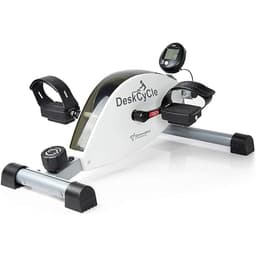
DeskCycle Under Desk Bike Pedal Exerciser
Fitting under a low desk
A 10 inch pedal height is the whole product — it is the seated machine most likely to actually clear a standard 27 inch desk.
Price as of September 24, 2026. #ad How we’re funded
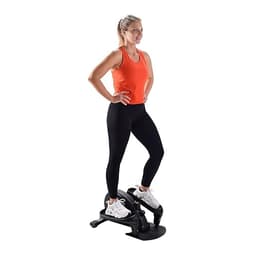
Stamina InMotion E1000
The most complete published spec
The only seated machine here whose maker publishes dimensions, unit weight and a user weight limit together — and the tallest of the three, at 11.38 inches.
Price as of September 24, 2026. #ad How we’re funded
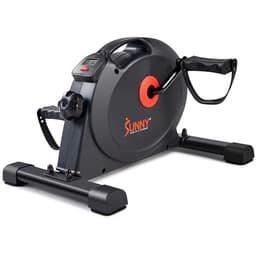
Sunny Health & Fitness Under Desk Smart Mini Pedal Exerciser (SF-B023005)
Trying the idea cheaply
The cheapest way to test whether you will actually use a seated pedaler before spending three figures on one.
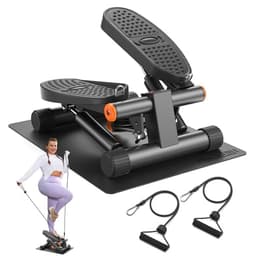
Niceday Mini Stair Stepper
Smallest footprint of anything here
A 16 x 12 inch footprint and a published 300 lb capacity — the most machine per square foot of anything on this site, and the smallest thing here you can genuinely raise your heart rate on.
What we have not done
We have not measured muscle activation, run an EMG, or used any of these machines. There is no lab here and no clinician. Everything above is either a manufacturer’s own published statement with the date we read it, or a description of how a mechanism moves a joint. Our full method.
We have not ranked any muscle group, and we have not told you which machine is best for one. Doing that requires a range of motion and a load, and the category publishes neither. Where a page tells you a machine targets a specific muscle, ask it for the stride length.
This is general information about published specifications and mechanics. It is not medical advice, and if there is a joint or rehabilitation question behind your interest, that belongs with a clinician who can look at you rather than at a spec table.
Questions people actually ask
What muscles does a pedal exerciser work?
The ones that cross the joints the machine moves, which on a seated pedal exerciser are your hips, knees and ankles - and nothing else. Your torso stays in the chair, your arms stay on the keyboard and nothing bears your weight. What we are not going to publish is a ranked muscle-by-muscle breakdown, because it would be invented: nobody has run an activation study on any machine on this site, and none of these makers publishes the crank diameter that would at least tell you the range each joint travels through.
What muscles does an under-desk elliptical work?
The same three joints as a pedal exerciser, moved through a different shape. A crank sends your foot around a circle; an elliptical flattens that circle into an oval, so the same leg movement produces less vertical knee travel for a similar amount of forward and back. That is a real geometric difference and it is the honest argument for the elliptical shape. What it is not is a different set of muscles - and no maker we track publishes a stride length, so how much the oval actually differs from the circle on any specific machine is not something anyone can tell you.
Does a Cubii strengthen your legs?
A muscle adapts to resistance, not to movement, and that is where this question runs into the category's central data gap. Cubii's own model comparison, read on September 17, 2026, publishes a resistance level count for each model - 6 for the Move, 8 for the Go, 12 for the Total Body - and no magnitude for any of them. A level count is the number of positions on a knob. Without a force figure, nobody can say what any setting asks of a muscle, which means nobody can answer this question from published data. Exactly one machine in the category publishes a force: the DeskCycle, at 39 lb.
Does an under-desk machine work your core or your arms?
Almost certainly not, and for once there is a published statement rather than an inference. Cubii's own comparison page has a 'Full-Body Workout' row: it reads Yes for the Total Body, its most expensive model, and No for both the Go and the Move. That is the maker telling you that its cheaper seated machines are a leg movement. Mechanically that is what you would expect - if your hands are on a keyboard and your back is on a chair, there is no load path through your torso or arms. The exception is a mini pedal exerciser placed on a desktop and turned by hand, which some are explicitly sold for.
What muscles does a mini stepper work?
The same three joints again - hip, knee, ankle - but with one difference that is more consequential than any of the geometry: you are standing, so the movement is weight-bearing. Every step lifts your own body mass against gravity, and stabilising on one leg while the other descends involves your hips and trunk in a way no seated machine does. That much follows from the mechanism. What cannot be quantified is how much, because no stepper maker we track publishes a step height, so the distance your mass travels per step is unknown.
Is a mini stepper good for glutes?
We are not going to make that claim, and we would rather explain why than give you an answer that sounds better. Attributing a result to one muscle group requires knowing the range of motion and the load, and the category publishes neither: no step height from any of the three stepper makers, and a resistance count rather than a force from two of them. What is checkable is the structural point - a stepper is weight-bearing and hip-driven where a seated machine is neither. Draw your own conclusion from that; we are not qualified to draw it for you.
Why does nobody publish the numbers you keep mentioning?
We do not know, and it is worth noticing that the pattern is consistent. Makers in this category will publish a resistance level count, a product weight to a tenth of a pound and a color, and not the crank diameter, stride length or step height - the three figures from which range of motion and work per repetition could actually be derived. Those are the figures that would let a buyer compare two machines on what they do to a leg. Their absence across every maker we track is the single most striking thing about this category's specification sheets.
Does it matter which muscles it works?
Less than the listings imply, if the honest goal is to be less still during a seated day. A seated machine's value is that it runs for hours alongside work; the muscles involved are whichever ones move your legs, and they are working lightly by design, because anything heavier stops you being able to type. If the goal is to build something rather than to move, the specification to chase is resistance rather than muscle coverage - and only one machine in this category publishes a resistance figure you can anchor to.
Read next
- Do under-desk bikes actually do anything? — the same honesty applied to the whole activity rather than to the mechanism.
- Can an under-desk bike or elliptical help you lose weight? — where the missing resistance magnitude does the most damage.
- Under-desk bike vs under-desk elliptical — the pedal circle against the oval, on published height.
- Under-desk bike vs mini stepper — seated against weight-bearing, and the total split on published user weight limits.
- Are walking pads good or bad for your knees? — the same refusal to publish what cannot be measured, applied to cushioning.
- Mini stepper calories, and the number nobody publishes — the missing step height, and how far the arithmetic gets without it.
- Sunny under-desk mini pedal exerciser review — the machine sold for arms as well as legs, and the emptiest spec sheet on this site.
Sources
- DeskCycle Under Desk Bike Pedal Exerciser — VIVO (DeskCycle) product spec table (read 2026-07-24)
- Stamina InMotion E1000 — staminaproducts.com product page (read 2026-08-11)
- Sunny Health & Fitness Under Desk Smart Mini Pedal Exerciser (SF-B023005) — Amazon retail listing (read 2026-07-24)
- Niceday Mini Stair Stepper — nicedaysteppers.com product page (read 2026-08-12)
- Cubii model comparison — the 'Full-Body Workout' row reading Yes for the Total Body and No for the Go and the Move; resistance published as a level count (6 / 8 / 12) with no magnitude, and no stride length for any model (read 2026-09-17)
- Stamina InMotion E1000 — reversible pedals, sitting or standing use, 250 lb maximum user weight, and no published stride length (read 2026-09-17)