Under-desk bike vs mini stepper
Both are sold as the small, cheap way into cardio. One runs for hours underneath your working day and one runs for ten minutes and stops it. They are not two sizes of the same idea.
By Stephen V. · Last updated
Take the under-desk bike if you want to move while you work— you stay seated, your hands stay still, and it runs for as long as you are sitting. Take the mini stepper if you want real effort in the least floor space— about 1.3 sq ft, and it lifts your whole body every step. And note the split on user weight limits: 3 of 3 steppers publish one, 0 of 3 bikes do.
How this page is funded: the buy links here are Amazon affiliate links, and we earn a commission if you buy through one — at no extra cost to you. It does not change what we rank first, because the commission rate is the same across every machine on this page. Full disclosure.
The table first
| Model | In use (L x W x H) | Folded (L x W x H) | Unit weight | Max user | Resistance levels |
|---|---|---|---|---|---|
| DeskCycle Under Desk Bike Pedal Exerciser | 20" L x 24" W x 10" Hmanufacturer spec | Not publishednot published | Not publishednot published | Not publishednot published | 8manufacturer spec |
| YOSUDA Under Desk Bike | Not publishednot published | Not publishednot published | Not publishednot published | Not publishednot published | 16retail listing |
| Sunny Health & Fitness Under Desk Smart Mini Pedal Exerciser (SF-B023005) | Not publishednot published | Not publishednot published | Not publishednot published | Not publishednot published | Not publishednot published |
| Niceday Mini Stair Stepper | 16" L x 12" W x 14" Hmanufacturer spec | Not publishednot published | Not publishednot published | 300 lbmanufacturer spec | Not publishednot published |
| Stamina SpaceMate Folding Stepper | 30.25" L x 16.25" W x 54.5" Hmanufacturer spec | 38.5" L x 16.25" W x 9.5" Hmanufacturer spec | 45 lbmanufacturer spec | 250 lbmanufacturer spec | Not publishednot published |
| Xiser Commercial Mini Stairmaster | Not publishednot published | Not publishednot published | Not publishednot published | 400 lbmanufacturer spec | 3manufacturer spec |
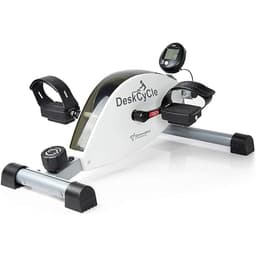
DeskCycle Under Desk Bike Pedal Exerciser
Fitting under a low desk
A 10 inch pedal height is the whole product — it is the seated machine most likely to actually clear a standard 27 inch desk.
Price as of September 24, 2026. #ad How we’re funded
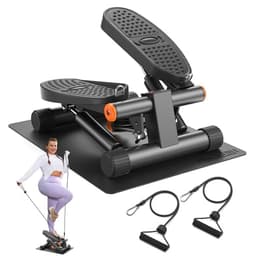
Niceday Mini Stair Stepper
Smallest footprint of anything here
A 16 x 12 inch footprint and a published 300 lb capacity — the most machine per square foot of anything on this site, and the smallest thing here you can genuinely raise your heart rate on.
The finding: the capacity column splits perfectly
We went into this comparison expecting the interesting difference to be effort per minute. It is not. It is this:
- Niceday Mini Stair Stepper: 300 lb, published by Niceday.
- Stamina SpaceMate: 250 lb, published by Stamina.
- Xiser Commercial Mini Stairmaster:400 lb, published by Xiser — the highest figure of any machine on this site.
- DeskCycle: not published.
- YOSUDA Under Desk Bike: not published.
- Sunny mini pedal exerciser: not published.
Three out of three, and zero out of three. There is a mechanical logic to it — a stepper carries your entire body weight through two hydraulic cylinders, so the maker has to have a number in mind, while a seated pedaler carries almost none of you because the chair does. But the consequence for a buyer runs the other way from what you might expect: the machines that ask least of your body are the ones whose makers will tell you least about what they can take.
If a stated limit is what you need in writing, this page has three answers and they are all steppers. If you want a stated limit on a seated machine, there is exactly one on this site and it is an elliptical rather than a bike — the Stamina InMotion E1000, at 250 lb. Every published capacity on this site in one table.
The pedal circle, which is the bike's real constraint
An under-desk bike is a crank. Your foot goes round a circle, and at the top of every turn your knee rises by the full diameter of that circle. That is the geometry the desk has to accommodate, and it is why a 10 inch machine does not need 10 inches of clearance.
DeskCycle publishes the most useful statement anyone in either category makes about it: its standard model works at a 27 inch desk for a user 5 ft 8 in or shorter. That is a real claim tied to a real user height, and nobody else on this page offers one. The DeskCycle’s own 10 inch overall height is the whole product: it is what lets the machine live under a desk you already own.
The other two bikes here do not let you run the same check. The YOSUDA publishes no pedal height at all— the single figure that decides whether an under-desk machine fits under your desk — and Sunny publishes no height, no dimensions and no unit weight for its mini pedal exerciser on its own site or the listing. Both are sold for under-desk use. The four measurements to take before you order one.
A stepper has no equivalent problem, because a stepper has no desk. What it has instead is a ceiling of a different kind: you are standing on it, so the machine’s height is added to yours.
Resistance: one published magnitude in six machines
Resistance is the only lever on either machine that converts movement into work, and it is the specification this category is least honest about.
Five of these six machines publish either a level count or nothing: the YOSUDA states 16 magnetic levels, the Xiser states 3 cylinder settings, and Niceday, Stamina and Sunny publish no count at all. A level count tells you how many positions the knob has. It tells you nothing about how hard any of them is. Sixteen levels of an unstated range is not more resistance than three levels of an unstated range.
One machine breaks the pattern. The DeskCycle publishes eight magnetic settings up to 39 lb of resistance— a magnitude, not a count. It is the only statement in either category of how hard the hardest setting actually is, and it is the main reason the DeskCycle leads our pedal exerciser ranking. If you intend to work rather than fidget, that figure is the one the whole question turns on.
Floor space, and why the paper answer misleads
On published dimensions the stepper wins easily. Niceday states 16 x 12 inches — about 1.3sq ft, roughly a quarter of what a walking pad needs in use — against about 3.3sq ft for the DeskCycle’s published 20 x 24 inches.
Then the practical correction. The bike’s footprint goes in the knee well of a desk you already own, which is floor that had no other job. The stepper needs its own open patch, plus standing room around it, and it stays there because there is nowhere for it to go. The one exception is the Stamina SpaceMate, which is 3.4sq ft and 54.5 inches tall in use but folds to a published 9.5 inches — it is the only stepper here that slides under a bed the way a walking pad does.
Two machines publish nothing to do this arithmetic with. The Xiser — the most expensive machine on this entire site — publishes no dimensions, no folded size and no unit weight on its own page, and the YOSUDA publishes no dimensions either. On a purchase decided by whether a thing fits, that is the finding rather than a footnote.
Who should buy which
Buy the under-desk bike if you have a desk job and the honest goal is to be less still during hours you were going to spend sitting anyway. It attaches to a habit you already have, which is why it survives February. Start with the DeskCycle: it is the only machine on this page that publishes a height, a resistance magnitude and a user height together.
Buy the mini stepper if you are steady on your feet, you want effort rather than movement, and floor space is the binding constraint in your home. Start with the Niceday: 1.3 square feet, a published 300 lb capacity and a stated 1.5 mm steel frame, which is more construction detail than most makers in this category give. If you want handlebars and somewhere for it to go afterwards, the SpaceMate is the one that folds.
Buy neither if what you wanted was walking. Both of these replace stillness rather than exercise, and we would rather say that plainly than sell you the smaller machine. Pad against pedal exerciser and pad against stepper both take that question seriously.
What we did not do
We have not used any of these six machines. No test lab, no owned units, no force plate. Every figure above is read from a manufacturer or retailer page with the date we read it, listed in the sources below, and the arithmetic on those figures is ours. Our full method.
We have not compared effort with a number. Nobody publishes a step height for a stepper or a crank diameter for a bike, and without those two figures the work-per-repetition comparison cannot be computed. What we have done instead is describe the mechanics and say where the description stops.
None of this is medical advice and we are not qualified to give any. A stepper in particular asks something of your balance, and if that is a live question for you it belongs with a clinician rather than a specification table.
Questions people actually ask
Is an under-desk bike or a mini stepper better?
They answer different questions. An under-desk bike is used sitting, so it runs underneath a working day and the amount you can do is roughly the amount of time you spend in a chair - light work, for hours. A mini stepper is used standing and lifts your whole body with every step, so it is much harder work per minute and impossible to type through - real effort, for minutes. If the goal is to be less motionless between 9 and 5, take the bike. If the goal is effort in the smallest patch of floor in your home, take the stepper.
Which has a weight limit, an under-desk bike or a mini stepper?
This is the cleanest split on the page. All three mini steppers we track publish a maximum user weight - Niceday 300 lb, Stamina 250 lb and Xiser 400 lb - and not one of the three under-desk bikes publishes any figure at all. DeskCycle, YOSUDA and Sunny all decline to state one. That makes sense mechanically, because a stepper carries all of you and a seated pedaler carries almost none of you, but a machine with no published limit is still a machine with no published limit.
Can you use a mini stepper under a desk?
No, and not because it is slightly too tall. A stepper is used standing, so your whole body rises and falls with every step and your hands and eyeline go with it. The Stamina SpaceMate is 54.5 inches tall in use because it has handlebars; the Niceday is 14 inches tall but you have to stand on it, which puts your head where a desk is not. None of the three stepper makers we track describes seated use for its stepper. If you want leg movement from a chair, the machine built for it is a pedal exerciser or an under-desk elliptical.
Which burns more calories, a mini stepper or an under-desk bike?
Per minute, the stepper, and that is mechanics rather than a measurement: each step lifts your body mass, while seated pedaling lifts none of it because the chair carries you. What nobody can hand you is a number. No stepper maker we track publishes a step height, only one machine on this page publishes how hard its hardest setting is, and none of the six knows what you weigh - so any calorie figure on any of these displays is inferred from revolutions and an assumption. Over a whole day, minutes on the machine count for as much as intensity, and the bike is the one that can run alongside work.
Which takes up less space?
The Niceday stepper on paper, at a published 16 x 12 inches - about 1.3 square feet, less than half of what the DeskCycle's 20 x 24 inches takes. But the bike's footprint sits in the knee well of a desk you already own, which is floor that had no other job, and the stepper needs its own open patch with room to stand on it. In a studio apartment that can flip which one is genuinely smaller. Two of the six machines here - the YOSUDA and the Xiser - publish no dimensions at all.
Do you need to plug either of them in?
Neither. All three steppers here are hydraulic, so there is no motor and no outlet, and the bikes use magnetic resistance you set by hand. That is a real advantage over a walking pad in a room where the outlet is not yours, and it is the reason both categories exist alongside the pads rather than beneath them. What none of the six publishes is how its display is powered, which is a gap we name rather than fill in.
Which is quieter in an apartment?
Not one of the six makers publishes a decibel figure, so we will not rank them on noise. What is structural rather than claimed: a seated pedaler puts nothing into the floor, because nothing lands and your weight stays on the chair. A stepper takes your full body weight onto a frame every step, and that energy has to go somewhere - which for the apartment below you is the noise that actually matters. Quiet in your room and quiet through a floor are two different questions.
Which one will I still be using in March?
We cannot predict that and nobody who tells you otherwise can either. What we can point at is the structural difference: a seated bike asks you to do nothing new with your day - you were going to sit anyway - while a stepper asks you to set aside a block of time and stand on it. Habits that require a new decision fail more often than habits that attach to an existing one. That is the honest argument for the bike, and it has nothing to do with which machine is better built.
Read next
- Under-desk elliptical vs mini stepper — the neighboring fork, decided on what each maker says about sitting and standing.
- Under-desk bike vs under-desk elliptical — pedal circle against elliptical stroke, if you have already ruled the stepper out.
- Best under-desk bikes and pedal exercisers — the bike side of this page, ranked on published pedal height.
- Best mini steppers for small spaces — the stepper side, ranked on floor space and what each maker publishes.
- Are mini steppers worth it? — the harder question behind this comparison, and the three buyers a stepper is wrong for.
- Mini stepper calories, and the number nobody publishes — why the calorie comparison on this page stops where it does.
- Is there a walking pad that needs no electricity? — all six machines here run on nothing; not one walking pad does.
Sources
- DeskCycle Under Desk Bike Pedal Exerciser — VIVO (DeskCycle) product spec table (read 2026-07-24)
- YOSUDA Under Desk Bike — Amazon retail listing (read 2026-07-24)
- Sunny Health & Fitness Under Desk Smart Mini Pedal Exerciser (SF-B023005) — Amazon retail listing (read 2026-07-24)
- Niceday Mini Stair Stepper — nicedaysteppers.com product page (read 2026-08-12)
- Stamina SpaceMate Folding Stepper — staminaproducts.com specification tab (read 2026-08-12)
- Xiser Commercial Mini Stairmaster — myxiser.com product page (read 2026-08-12)