Can an under-desk bike or elliptical help you lose weight?
It can contribute. It is a small contribution, and the reason nobody will tell you how small is that the specification you would need to work it out is published by exactly one maker in the category.
By Stephen V. · Last updated
It can contribute, and only a little per hour.Seated pedaling carries none of your body weight, because the chair does — which is the whole difference from walking. Nobody can give you a calorie figure, and we will not: one machine in this category publishes how hard its hardest setting is (the DeskCycle, 39 lb), and none of them knows what you weigh.
What this page is, and what it is not
Pad & Pace reads specification sheets. We have no clinicians, no dietitians and no metabolic lab, and the boundary of what we can usefully say is worth stating before anything else:
- We can tell you what each maker publishes about resistance, and we can tell you that almost none of it is a magnitude.
- We can describe the mechanics of what a seated machine does and does not move, because that follows from the geometry rather than from a claim.
- We can quote public health guidance with its source and its own wording.
- We cannot tell you how much weight you would lose, or how many calories an hour costs you. Not because it is a sensitive subject, but because the inputs do not exist in anything these makers publish.
This is general information about published specifications. It is not medical or dietary advice, and if there is a medical reason behind the question, that conversation belongs with a clinician.
The mechanism, stated plainly
Weight loss is energy balance over months. Movement is one input into it, alongside what you eat, how much you sleep and everything else you do in a day. A machine does not have a special relationship with the outcome — it just adds movement.
What a seated under-desk machine adds is specific and it is worth being precise about, because the precision is the honest part: it converts hours you would have spent motionless into hours of light leg movement. Not hours of exercise. Hours of not-stillness.
And here is the structural fact that caps how much that can ever be: on a seated machine, the chair carries your body weight. Your legs move against a magnetic brake and nothing lifts. Walking lifts and lowers your entire mass with every step, which is why the two activities are not in the same class of work and why no amount of resistance dialing closes that gap. Pad against pedal exerciser sets the trade out in both directions, because the seated machine wins on a different axis entirely: it is the one you will actually do for four hours.
Why we will not give you a calorie figure
Every other page answering this question hands you a range. We are going to explain why we cannot, because the explanation is more useful than the range would be.
Estimating the energy cost of pedaling needs three inputs: your body mass, the force you are working against, and the rate you are doing it at. Here is the state of each one in this category.
- Your body mass: not one machine we track takes it as an input. There is nowhere to enter it. The consoles that show a calorie figure are using a stored assumption about somebody else.
- The force: published by exactly one maker. Every other machine in the category publishes a level count instead, which is the number of positions on a knob.
- The rate: yours, unmeasured, and varying with whatever you are typing.
Two of three inputs are missing on almost every machine here. A number produced from that is not an estimate, it is a decoration. We took the same position on walking pad calorie displays and on mini stepper calorie arithmetic, where the missing figure is the step height.
The one figure that would change that
Resistance is the only lever on a seated machine that converts movement into work. It is also the specification this category is least honest about, and the gap is total rather than partial.
Here is what the machines publish. The YOSUDA states 16 magnetic levels. Cubii states 6 for the Move, 8 for the Go and 12 for the Total Body on its own comparison page, read on 2026-09-17. The Cubii JR1 listing states 8. The Stamina InMotion E1000states “adjustable tension” and no count at all. The Sunny mini pedal exerciser publishes nothing.
None of those is a force. Level 6 on one machine could be harder than level 16 on another, and nothing published anywhere would tell you. Cross-brand resistance comparison in this category is guesswork dressed as a spec row, and a listing that leads with a level count is leading with the number that means least.
One machine breaks the pattern. The DeskCycle publishes eight magnetic settings up to 39 lb of resistance— a magnitude, anchored to a force, on the maker’s own page. It is the only such figure we have found in either the bike or the elliptical category, and it is the reason the DeskCycle leads our pedal exerciser ranking and this page. Not because 39 lb is a lot — we are not going to characterise it — but because it is a number at all.
| Model | In use (L x W x H) | Max user | Resistance levels | Published noise |
|---|---|---|---|---|
| DeskCycle Under Desk Bike Pedal Exerciser | 20" L x 24" W x 10" Hmanufacturer spec | Not publishednot published | 8manufacturer spec | Not publishednot published |
| Cubii JR1 | 23.2" L x 17.56" W x 10" Hretail listing | 150 lbretail listing | 8retail listing | Not publishednot published |
| YOSUDA Under Desk Bike | Not publishednot published | Not publishednot published | 16retail listing | Not publishednot published |
| Sunny Health & Fitness Under Desk Smart Mini Pedal Exerciser (SF-B023005) | Not publishednot published | Not publishednot published | Not publishednot published | Not publishednot published |
| Stamina InMotion E1000 | 24.5" L x 17" W x 11.38" Hmanufacturer spec | 250 lbmanufacturer spec | Not publishednot published | Not publishednot published |
| Cubii Move | 21.5" L x 19.5" W x 9.5" Hretail listing | Not publishednot published | 6retail listing | Not publishednot published |
Duration is the lever; intensity is not
This is the practical heart of the page, and it runs against the instinct most buyers arrive with.
On a desk machine, intensity is self-limiting. Turn the resistance up and your legs start recruiting your torso for stability; your shoulders follow; your typing degrades. At that point one of two things happens: you turn it back down, or you stop using the machine during work — which means you stop using it, because during work was the entire plan.
Duration has no such ceiling. A magnetic-resistance machine with no motor has nothing to overheat, so the limit is your tolerance rather than the machine’s. That makes the real question how many of your sitting hours can have your legs moving through them, not how hard you can make twenty minutes.
Which means the specification that best predicts a result here is not on any spec sheet: it is whether you will still be doing it in March. A machine that fits under your actual desk, that you do not have to set up each time, and that does not fight your chair, gets used. Setting one up so it stays used is a more consequential page than this one for most people.
A test you can run without a device
Since no machine will measure your output, here is a check that needs no machine, no watch and no assumptions about you.
MedlinePlus, read on 2026-09-17, states the adult guidance as “at least 150 to 300 minutes of moderate-intensity or 75 to 150 minutes of vigorous-intensity aerobic physical activity each week”, and defines the threshold behaviorally: “Moderate intensity means that while you are doing that activity you should be able to say a few words in a row but not sing”, while vigorous means you “won’t be able to say more than a few words without stopping for a breath”.
Run that while pedaling at a pace you can work through. If you could comfortably sing, you are below moderate intensity — which, honestly, most desk pedaling is, and that is fine as long as you know it. It means the minutes you log are not interchangeable with the minutes in that guidance. It does not mean they are worth nothing; the comparison that matters is against sitting still, and against sitting still it wins.
If you want a genuine measurement rather than a test, your watch will not provide one either — Apple’s Activity app reads arm motion, and yours is on a keyboard. A chest strap is the one input that is actually about your body.
What to look for if this is the goal
Four things, in the order that matters if the reason you are buying is the one in the title.
1. A published resistance magnitude, not a level count. This is the whole of the specification argument on this page. One machine in the category has one.
2. Enough positions that you can progress. Secondary to the above but not worthless: if you expect to outgrow the bottom of the range, more steps between the bottom and the top gives you somewhere to go, even unanchored.
3. A machine that will still be under the desk in March. Fit, height and not having to set it up. Boring, and the best predictor of any result.
4. Consider standing instead, if you want work rather than movement. A stepper lifts your own body weight every step. That is genuinely more work per minute than any seated machine at any resistance setting, for mechanical reasons rather than marketing ones. What it costs you is the ability to do it while working, which takes the sessions from hours down to minutes.
The machines that publish something useful
The only published magnitude: the DeskCycle. Eight magnetic settings up to 39 lb of resistance, published by the maker, alongside a 10 in overall height and adjustable pedal straps. If you want to know what you are pushing against rather than which position a knob is in, this is the only machine in the category that tells you. Against it: 24 inches wide, no published unit weight and no published user weight limit.
The most positions to progress through:the YOSUDA Under Desk Bike, at 16 magnetic levels — double the DeskCycle and the Cubii JR1, with Bluetooth app tracking. Read the caveat as seriously as the feature: those 16 levels are unanchored, so they are 16 steps between two unstated endpoints, and YOSUDA publishes no pedal height, which is the figure that decides whether the machine fits under your desk at all.
If you want work rather than movement:the Niceday Mini Stair Stepper. It is on this page because it is the honest answer to “more per minute” — you stand on it, so every step lifts your own body weight, which no seated machine does at any setting. About 1.3 square feet of floor, a published 300 lb capacity and a stated 1.5 mm steel frame. What it costs you: you cannot type on it, so this is a ten-minute machine rather than a four-hour one, and Niceday publishes no resistance count and no unit weight.
How this page is funded: the buy links here are Amazon affiliate links, and we earn a commission if you buy through one — at no extra cost to you. It does not change what we rank first, because the commission rate is the same across every machine on this page. Full disclosure.
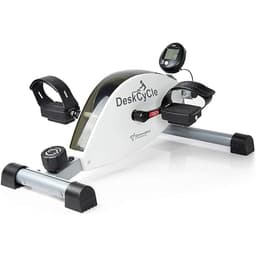
DeskCycle Under Desk Bike Pedal Exerciser
Fitting under a low desk
A 10 inch pedal height is the whole product — it is the seated machine most likely to actually clear a standard 27 inch desk.
Price as of September 24, 2026. #ad How we’re funded
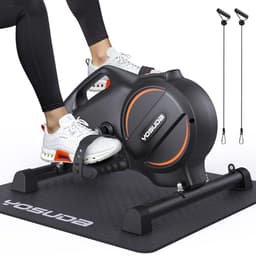
YOSUDA Under Desk Bike
Most resistance steps
Twice the resistance steps of the DeskCycle and app tracking, but the listing does not publish the pedal height that decides whether it fits your desk.
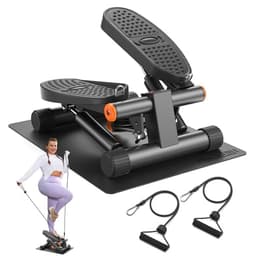
Niceday Mini Stair Stepper
Smallest footprint of anything here
A 16 x 12 inch footprint and a published 300 lb capacity — the most machine per square foot of anything on this site, and the smallest thing here you can genuinely raise your heart rate on.
All 3 steppers we track publish a maximum user weight, which the seated machines almost never do, and we rank them properly here if the standing route is the one that appeals.
When the answer is no
Three situations where we would tell you not to buy one of these for this reason, and we would rather say so than take the commission.
If you are buying it instead of something you can already do. If walking is available to you — outside, or on a pad — it carries your body weight and a seated machine does not. Buying the seated machine as an upgrade on walking is buying less work for more money. Outside is free and it is better exercise.
If you are expecting the number to motivate you. It will not, because the number is inferred and your watch will show almost nothing. People who buy a machine for the readout stop using it when the readout disappoints, which in this category is week two.
If the honest problem is diet and you are hoping this is the lever. We are not qualified to advise on that and will not pretend a pedal exerciser is a substitute for advice we cannot give. What we can say is that the machine’s contribution per hour is small, and no specification on this site would let anyone tell you otherwise.
What we have not done
We have not measured an energy cost, tested a machine, or calculated a calorie figure. No test lab, no owned units, no metabolic cart. Every figure above is read from a maker’s own page or a retail listing with the date we read it, or quoted from named public health guidance. Our full method.
We have not ranked these machines on effort, and we will not until a second maker publishes a resistance magnitude. Ranking on unanchored level counts would be inventing a comparison, which is the one thing this site exists not to do.
This page is general information about published specifications and published guidance. It is not medical or dietary advice.
Questions people actually ask
Can you lose weight using an under-desk bike or pedal exerciser?
It can contribute, and it is a small contribution that we cannot size for you. Weight loss is a matter of energy balance over months, and movement is one input into it alongside what you eat and how much you sleep and move otherwise. What a seated machine does is convert hours you would have spent motionless into hours of light leg movement. That is a real change and it is a small one per hour. Anyone giving you a figure for it is inventing the figure, because the machines do not publish the resistance magnitude and do not know your body weight.
Does a Cubii help with weight loss?
Cubii publishes nothing that would let anyone answer that quantitatively, and we are not going to fill the gap. Its own model comparison, read on September 17, 2026, publishes a resistance level count for each model - 6 for the Move, 8 for the Go, 12 for the Total Body - and no magnitude for any of them, no dimensions and no maximum user weight. A level count tells you how many positions the knob has. It does not tell you how hard any of them is, which is the only figure from which an energy cost could be estimated.
Which under-desk machine is best for weight loss?
On published specifications, the DeskCycle - not because it is harder but because it is the only machine in the category that tells you how hard it is. Eight magnetic settings up to 39 lb of resistance is the only stated magnitude we have found in either the bike or the elliptical category. If you want more work per minute rather than more hours, the honest answer is a standing machine instead: a mini stepper lifts your own body weight with every step, which a seated machine never does because the chair carries you.
Do under-desk bikes burn calories?
Yes, in the trivial sense that any movement does, and no in the sense you are probably asking. There is no way to put a number on it from published data: not one of these machines knows your body weight, and only one publishes what its resistance actually amounts to. The figure on the machine's own display is revolutions multiplied by a stored assumption about somebody who is not you. We would rather tell you the number is unknowable from the specifications than print one that looks authoritative.
Is pedaling at a desk better than walking for weight loss?
No, and the difference is structural rather than marginal. Walking carries your entire body weight with every step; seated pedaling carries none of it, because your weight is in the chair. That is the single biggest difference in work between the two and it is not close. Where the seated machine wins is availability: you can pedal through four hours of desk work and almost nobody walks for four hours. If you can walk instead, walk. If the alternative is being still, pedaling is the better of those two.
Would a mini stepper burn more than a seated machine?
Per minute, yes, and that follows from mechanics rather than from any measurement. Each step on a stepper lifts your body mass against gravity; a seated pedal stroke lifts nothing. What nobody can quantify is how much more, because no stepper maker we track publishes a step height - and without the height lifted, the work per step cannot be computed. The trade is time: you cannot work on a stepper, so the sessions are minutes rather than hours.
How long would I have to pedal for it to matter?
We cannot give you that number honestly and nor can anyone else working from these specifications. What we can say about the shape of the answer: duration is the variable you control at a desk and intensity is the one you do not, because past a certain resistance you stop being able to work and the machine stops being used. So the useful version of the question is not 'how long per session' but 'how many of my sitting hours can have my legs moving through them'. Public health guidance is framed in minutes per week rather than in sessions, and a pace you can type through will usually fall below the intensity threshold it uses.
Are the resistance levels on these machines comparable between brands?
Not at all, and treating them as comparable is the most common mistake in this category. Sixteen levels on one machine and six on another tells you only that one knob has more positions. Neither figure is anchored to a force, so level 6 on one machine could be harder than level 16 on another. The DeskCycle's 39 lb is the only anchored figure we have found. Until a second maker publishes one, cross-brand resistance comparisons in this category are guesswork.
Read next
- Do walking pads help you lose weight? — the standing version of this question, where the machine at least publishes a speed.
- Do under-desk bikes actually do anything? — the broader honest account: it replaces stillness, not exercise.
- Does an under-desk bike or elliptical count as steps? — why your watch will not confirm any of this, in Apple's own words.
- What muscles does an under-desk bike or elliptical work? — which joints actually move, and where the geometry stops supporting a claim.
- Mini stepper calories, and the number nobody publishes — the same arithmetic run on the standing machines, and where it stops.
- Is a walking pad good cardio? — the talk test applied to desk-pace walking, against the same published standard.
- Best under-desk bikes and pedal exercisers — the category ranked on published pedal height, with the resistance column read properly.
Sources
- DeskCycle Under Desk Bike Pedal Exerciser — VIVO (DeskCycle) product spec table (read 2026-07-24)
- YOSUDA Under Desk Bike — Amazon retail listing (read 2026-07-24)
- Niceday Mini Stair Stepper — nicedaysteppers.com product page (read 2026-08-12)
- MedlinePlus — 'Get at least 150 to 300 minutes of moderate-intensity or 75 to 150 minutes of vigorous-intensity aerobic physical activity each week'; 'Moderate intensity means that while you are doing that activity you should be able to say a few words in a row but not sing'; 'Vigorous intensity means that while you are doing that activity, you won't be able to say more than a few words without stopping for a breath' (read 2026-09-17)
- Cubii model comparison — resistance levels published as 6 (Move), 8 (Go) and 12 (Total Body), with no magnitude, no dimensions and no maximum user weight for any model (read 2026-09-17)
- DeskCycle — eight magnetic settings up to 39 lb of resistance, 20 x 24 x 10 in, adjustable pedal straps, no power outlet required (read 2026-09-17)