How to use an under-desk bike or pedal exerciser
The instructions in the box cover assembly. They do not cover the thing that actually goes wrong in the first five minutes, which is that your chair has wheels and physics does not care about your plans.
By Stephen V. · Last updated

In order: measure floor to the underside of your desk (not the desktop), place the machine forward enough for your knee rather than your foot to clear it, brace the chair so it cannot roll backwards, then start at the lowest resistance and build duration rather than difficulty. The chair is the step everyone skips and the reason most of these machines stop getting used.
Four measurements, before you buy
Almost every returned machine in this category is a fit failure rather than a quality failure, and all four of the measurements that prevent it take five minutes with a tape measure.
- Floor to the underside of your desk. The apron rail or the bottom of a shallow drawer, not the desktop surface. A standard desk is 29 to 30 inches to the surface and roughly 27 to 28 inches underneath, and a drawer can take two or three inches off that.
- Footwell width. Between the pedestals, the divider, or whatever else is down there. This rules machines out that the height figure would have passed.
- Footwell depth. How far back you can go before a modesty panel or a cable tray. The machines here run 20 to 24.5 inches front to back.
- Your own seated knee height at the top of the stroke. This is the one people skip, and it is the reason a 10 inch machine can fail under a 27 inch desk.
We have a whole page on this arithmetic, including the one genuinely useful published claim in the category: DeskCycle states its standard model works at a 27 inch desk for a user 5 ft 8 in or shorter. Nobody else ties a machine to a user height at all.
Where the machine actually goes
Further forward than feels natural, and this is worth getting right on day one because the wrong position is uncomfortable in a way you will blame on the machine.
Your knee rises as the pedal comes over the top. On a crank machine it rises by the full diameter of the pedal circle; on an elliptical the oval flattens that, which is the real argument for the elliptical shape under a low desk. Either way, the clearance test is your knee at the highest point of the stroke, not the machine’s own height sitting on the floor. Position the machine so that the top of that arc happens in front of the desk edge rather than under the apron.
Then check you can still reach the resistance control. On most of these it is a knob on the frame, and if the machine is far enough forward to clear your knees it is usually still reachable — but if the machine ends up deep under a desk, changing the setting means getting out of the chair, and a control you have to stand up for is a control you will stop using.
The chair problem nobody publishes
Here is the failure that is not in any manual, and it happens within about ninety seconds of the first firm stroke.
Pushing a pedal forward pushes you backwards with the same force. In a fixed chair that force goes into the chair and the floor and nothing happens. In an office chair on five castors on a hard floor, it goes into rolling you away from the desk. What you get is a stalemate: you roll back, you stretch to keep your feet on the pedals, your posture collapses, and at some point either you pull the chair back in or the machine skids forward instead.
We are confident this is the common experience rather than an edge case, because it is what people search for. The same query capture that produced this page carries cubii wheel stoppers, cubii chair wheel stopper and cubii on wheels as live searches. People are looking for a product to solve it.
We are not going to sell you one, because we do not have one worth recommending. Nothing on this site does that job, and inventing a pick to fill a gap is exactly the thing we promise not to do. The fixes that work cost nothing:
- Back the chair against something. A wall behind you, or the chair base against a desk pedestal. The force now has somewhere to go.
- Lock the castors if your chair has locking wheels. Many task chairs do and most owners have never used them.
- Use a chair that does not roll for pedaling sessions. A dining chair is genuinely better for this than an expensive task chair.
- Pedal on carpet if you have the choice. Pile grips both the chair and the machine frame far better than hardwood or tile.
If the machine itself is the thing sliding rather than the chair, the cause is the same and so is the answer: these machines are light — 17.5 lb and 24 lb are the two published unit weights among our picks — and light frames need bracing rather than additional mass.
Resistance: start lower than you think
The instinct is to set resistance where it feels like exercise. On a desk machine that is the wrong target, and it is the second most common reason one stops being used.
The point of a seated machine is that it runs whileyou do something else. Resistance is what breaks that: as it rises your legs start recruiting your torso for stability, your shoulders follow, and your typing degrades before your legs get tired. What you are aiming for is the lowest setting you actually notice — enough that it is not free-spinning, low enough that you forget you are doing it.
Then treat the knob as an interval tool rather than a baseline. Ten minutes at a harder setting between tasks, back down to the working level afterwards.
One warning about reading resistance specifications, because this category is misleading about it. A level count tells you how many positions the knob has and nothing at all about how hard any of them is. The YOSUDA publishes 16 levels and the Cubii Move 6; that does not mean the YOSUDA is harder, because neither states a magnitude. Exactly one machine in this category does: the DeskCycle’s eight settings up to 39 lb of resistance. Why that single figure decides so much.
How long, and what 'how long' measures
Two separate questions get asked here and they deserve separate answers.
How long will the machine take?Indefinitely, as far as anything published goes, and that is a genuine advantage over a walking pad. A pad has a motor, and a motor has a duty cycle — a figure we went looking for on the pads and did not find. A magnetic-resistance machine with no motor has nothing to overheat. The limit is you.
How long should you do it for? Build duration, not difficulty. Two twenty-minute blocks is a reasonable first week, and the honest ceiling is however much of your seated day you can tolerate having your legs moving through.
A caution about mapping this onto public guidance. MedlinePlus, read on 2026-09-17, frames adult activity as “at least 150 to 300 minutes of moderate-intensity or 75 to 150 minutes of vigorous-intensity aerobic physical activity each week”, and defines the threshold with a test you can run yourself: “moderate intensity means that while you are doing that activity you should be able to say a few words in a row but not sing”. Run that test while pedaling at a pace you can work through and it will usually come out below moderate. So the minutes you log on a desk machine are not interchangeable with the minutes in that guidance, and we would rather tell you that than let you assume otherwise.
Feet, straps and cadence
No maker we track publishes a foot-position instruction, so we are not going to invent one. What is published is more useful anyway.
Straps are the feature that matters. DeskCycle states adjustable pedal straps, and a strap is what keeps your foot on the pedal through the upstroke. Without one, a seated pedal cycle becomes a repeated exercise in re-placing your foot, which is both annoying and the reason people slow down until the machine is barely moving. If your machine has straps, set them so the foot is held without pressure.
If it has no straps, drop the cadence. Slower turns keep contact. Trying to spin quickly on an unstrapped pedal is how your foot comes off, and on a machine under a desk your foot comes off into the underside of the desk.
Shoes or socks is genuinely your call, and there is nothing published either way. What is worth saying is that this is a much lower-stakes question than it is on a moving belt, where grip and support change what happens if you misstep. Seated, nothing is moving under you.
What to look for in the machine itself
If you have not bought one yet, everything above collapses into four specifications. Two of them are commonly published and two are not, which is itself the thing to know.
1. A published overall height.Non-negotiable. This is the figure that decides whether the machine fits at all, and a surprising share of this category does not state it — the YOSUDA publishes no pedal height, and Sunny publishes no height, dimensions or unit weight for its mini pedal exerciser.
2. A resistance magnitude rather than a level count. One machine in the category gives you this. Prefer it.
3. Pedal straps. Stated in writing, not inferred from a photograph.
4. A published maximum user weight. Rare here and worth noticing when it appears: of the six seated machines we track, one maker publishes it.
The three machines that publish what you need
The most complete instructions to follow: the DeskCycle. It is the only machine here that publishes a height (10 in), a resistance magnitude (8 settings to 39 lb), adjustable pedal straps, and a desk-height-plus-user-height claim. It needs no power outlet and no assembly. Against it: 24 inches wide, so it takes real footwell width, and no published unit weight or user weight limit.
If you measured and came up short: the Cubii Move, at a published 9.5 inches the lowest seated machine we have found a height for, and at 17.5 lb the lightest machine of any kind on this site. Ships assembled, needs no outlet. Against it: six resistance levels with no magnitude stated, no published user weight limit, and its figures come from a retailer because Cubii publishes no dimensions itself.
If you want the maker to state what it will carry: the Stamina InMotion E1000 — 250 lb, published by Stamina alongside dimensions, a 24 lb unit weight and a warranty term. Its pedals reverse, which is a genuine variation when one direction starts to feel repetitive, and Stamina states the frame is rated for standing as well as seated use. Against it: 11.38 inches tall, the most likely of the three to be stopped by a desk apron, so do the measurement first.
How this page is funded: the buy links here are Amazon affiliate links, and we earn a commission if you buy through one — at no extra cost to you. It does not change what we rank first, because the commission rate is the same across every machine on this page. Full disclosure.
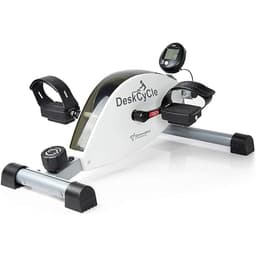
DeskCycle Under Desk Bike Pedal Exerciser
Fitting under a low desk
A 10 inch pedal height is the whole product — it is the seated machine most likely to actually clear a standard 27 inch desk.
Price as of September 24, 2026. #ad How we’re funded
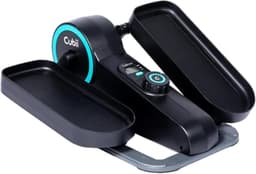
Cubii Move
Lowest published height
The lowest seated machine we have found a published height for, at 9.5 inches — which is the whole argument when your desk apron is the constraint.
Price as of September 24, 2026. #ad How we’re funded
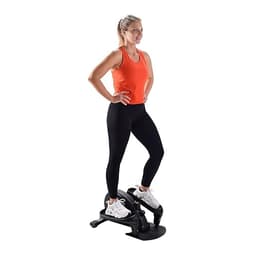
Stamina InMotion E1000
The most complete published spec
The only seated machine here whose maker publishes dimensions, unit weight and a user weight limit together — and the tallest of the three, at 11.38 inches.
Price as of September 24, 2026. #ad How we’re funded
What goes wrong in month two
Three things, and none of them is the machine breaking.
The tracking disappoints you.This is the big one. An hour of seated pedaling registers as almost nothing on a wrist tracker, because Apple’s Activity app — in Apple’s own words — “relies on arm motion and an accelerometer”, and your arms are on a keyboard. Read this before you conclude the machine is not working, because the fix is a setting rather than a purchase.
It slides more than it did.Usually a floor change rather than a machine change — a rug moved, or you switched chairs. Go back to the bracing section; nothing else has gone wrong.
The display goes dark.No maker on this site publishes how the monitor on one of these machines is powered or what replacing that power source involves, which means you cannot plan for it. Worth knowing in advance that the numbers on it were inferred from revolutions and a stored assumption anyway — none of these machines knows what you weigh.
What we did not do
We have not used any of these machines.No test lab, no owned units. The setup advice above is reasoning from published specifications and from mechanics — the chair rolls backwards because force has a direction, not because we watched it happen. Our full method.
We have not given you a foot position, a cadence or a session length as though a maker had published one. None has. Where this page gives a number it is either a manufacturer’s own figure or a quotation from named public health guidance, both dated in the sources below.
This is general information about published specifications, not medical advice. If there is a joint, circulation or cardiac question in the picture, that conversation belongs with a clinician.
Questions people actually ask
How do you use a pedal exerciser at a desk?
In this order. Measure the height from your floor to the underside of your desk - the apron or drawer, not the desktop - before you buy anything. Place the machine far enough forward that your knee clears that underside at the top of the stroke, not just your foot. Brace your chair so it cannot roll backwards, which is the first thing that actually goes wrong. Start at the lowest resistance setting, because the point of a desk machine is that you can keep working. Then build the duration rather than the difficulty.
Why does my chair roll backwards when I pedal?
Because that is what a chair on castors does. Pushing the pedals forward pushes you backwards with equal force, and on a rolling chair on a hard floor there is nothing to absorb it - so either the chair moves or the machine does, and usually both take turns. It is the single most common reason a seated machine stops being used, and not one maker on this site publishes a word about it. The fixes are free: pedal with the chair backed against a wall or with its base against the desk pedestal, lock the castors if your chair has locks, or use a chair that does not roll at all.
How long should you use a pedal exerciser?
Longer and lighter beats shorter and harder on a machine like this, and the reason is that duration is the only variable you actually control at a desk. Public health guidance is written in minutes rather than sessions - MedlinePlus states 'at least 150 to 300 minutes of moderate-intensity' aerobic activity a week - but be careful mapping that onto a desk machine, because pedaling at a pace you can type through will usually fail the intensity test it uses. Treat the time as time spent not being still. Build from a couple of twenty-minute blocks rather than starting with an hour.
What resistance should I set it to?
The lowest one that you notice, if the machine is going to run while you work. The whole value of a desk machine is that it coexists with typing, and resistance is what breaks that first - your legs start recruiting your torso for stability, your shoulders follow, and your typing goes. Set it low, and treat the resistance knob as something you turn up for ten minutes between tasks rather than the setting you live at. The DeskCycle is the only machine we track that publishes what its range actually means: eight settings up to 39 lb of resistance.
Should my whole foot be on the pedal, or just the ball of my foot?
Neither maker we could find publishes an instruction, so we will not give you one as though it were sourced. What is published and worth using: DeskCycle states adjustable pedal straps, and a strap is the feature that stops your foot leaving the pedal on the upstroke - which is the difference between pedaling and repeatedly re-placing your foot. If your machine has straps, set them so the foot is held without pressure. If it does not, expect to need a slower cadence to keep contact.
Can I use it in front of an armchair instead of a desk?
Yes, and it changes which figures matter. Under a desk, overall height is a pass-or-fail test because the apron sits above your knees. In front of a chair there is nothing above you, so height stops deciding anything and two other things take over: whether you can reach the resistance control without bending to the floor, and whether the machine stays put on carpet while you pedal. Neither is published by any maker we track, which is why we say so rather than rank on it.
Does the machine need to be plugged in?
The ones we track do not. These are magnetic-resistance machines with no motor, so there is nothing to plug in and nothing to trip a breaker - the DeskCycle states plainly that it needs no power outlet, and the Cubii Move ships assembled and needs none either. The one thing no maker publishes is how the little display is powered, which is worth treating as an unknown rather than as included.
Will it damage my floor or my carpet?
Not published, by anyone, for any machine in this category - and the honest reading is that the risk is sliding rather than damage. These machines are light: the two that publish a unit weight here are 17.5 lb and 24 lb, which is not enough to mark a floor and is also not enough to stay put against a firm stroke on a hard surface. On carpet the pile holds the frame better and the machine tends to stay where you put it. On hardwood or tile, expect to brace it against something.
Read next
- Will an under-desk machine fit under your desk? — the four measurements from step one, worked through with the published figures.
- Does an under-desk bike or elliptical count as steps? — the month-two disappointment, answered in Apple's and Fitbit's own words.
- How to use a walking pad at a desk — the standing version of this page, where the failure modes are completely different.
- Best under-desk bikes and pedal exercisers — the category ranked on published pedal height, if you have not bought yet.
- Best under-desk cardio for an office desk you do not own — the same setup problem where you also cannot adjust the desk or claim the outlet.
- Do under-desk bikes actually do anything? — what all this setup is actually buying you, stated without the marketing.
- What muscles does an under-desk bike or elliptical work? — what the pedal circle does and does not move, and where the honest answer stops.
Sources
- DeskCycle Under Desk Bike Pedal Exerciser — VIVO (DeskCycle) product spec table (read 2026-07-24)
- Cubii Move — Rehabmart retail listing spec table (read 2026-08-11)
- Stamina InMotion E1000 — staminaproducts.com product page (read 2026-08-11)
- MedlinePlus — 'Get at least 150 to 300 minutes of moderate-intensity or 75 to 150 minutes of vigorous-intensity aerobic physical activity each week'; 'Moderate intensity means that while you are doing that activity you should be able to say a few words in a row but not sing' (read 2026-09-17)
- Apple Support — 'The Activity app relies on arm motion and an accelerometer to track movement, but the Workout app can use the accelerometer, the heart rate sensor, and GPS' (read 2026-09-17)