DeskCycle under desk bike review
One specification carries this entire product, and it is a good one. Here is what a 10 inch pedal height buys, and the two numbers the maker does not publish.
By Stephen V. · Last updated
The DeskCycle’s argument is 10 inches of heighton a 20 x 24 in footprint — the seated machine most likely to actually clear a desk you already own, with eight magnetic resistance levels and nothing to assemble, plug in or store. The maker publishes no product weight and no user weight limit, which is the gap to weigh.
How this page is funded: the buy links here are Amazon affiliate links, and we earn a commission if you buy through one — at no extra cost to you. It does not change what we rank first, because the commission rate is the same across every machine on this page. Full disclosure.
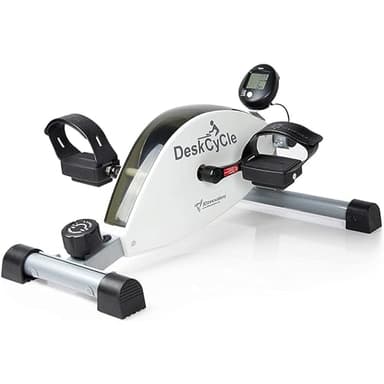
DeskCycle Under Desk Bike Pedal Exerciser
A 10 inch pedal height is the whole product — it is the seated machine most likely to actually clear a standard 27 inch desk.
Best for: Fitting under a low desk
Price as of September 24, 2026. #ad How we’re funded
The full published specification
Every figure below was read from VIVO (DeskCycle) product spec table on 2026-07-24. Rows marked “not published” were checked and no figure exists.
| Footprint in use | 20" L x 24" W x 10" Hmanufacturer spec |
|---|---|
| Folded | Not publishednot published |
| Walking belt | Not publishednot published |
| Unit weight | Not publishednot published |
| Max user weight | Not publishednot published |
| Top speed | Not publishednot published |
| Incline | Not publishednot published |
| Published noise | Not publishednot published |
| Pedal height | 10 inmanufacturer spec |
| Resistance levels | 8manufacturer spec |
All figures read from VIVO (DeskCycle) product spec table on 2026-07-24. Where it says “not published”, we checked and no figure exists — we did not estimate one.
What those numbers mean in a small room
A seated under-desk machine has one hard constraint and it is vertical. Your knee travels through the top of the pedal stroke; if the underside of your desk sits lower than that, the machine is not uncomfortable, it is unusable. Everything else on the spec sheet — resistance levels, display, app connectivity — is preference. Height is pass or fail.
The DeskCycle is built around that. 10 inches overall is low for the category, and it is a published figure from the maker’s own specification table rather than an inference from a listing photo. That combination — the right number, published properly — is rarer here than it should be. The YOSUDA under-desk bike we also track publishes no pedal height whatsoever, which on this product is a refusal to answer the only question that matters.
The trade is horizontal. At 24 inches widethe DeskCycle is the widest seated machine we track — nearly 6.5 inches wider than the Cubii JR1 — and 20 inches deep. Under a desk that is already carrying a tower, a bin and your feet, that width is real. It is a short machine, not a small one.
The resistance system is the other genuine strength. Eight magnetic settings up to a stated 39 lb of resistance, on a steel frame, with no assembly and no power outlet. Magnetic resistance also means there is no contact friction to wear or squeak, and nothing to plug in means the machine can sit anywhere a chair does.
Then the omissions. The maker publishes no product weight, which matters more than it sounds: on a hard floor, a light seated machine slides forward as you pedal, and mass is what stops it. And it publishes no maximum user weight. That is a genuine gap on a product you load with your leg drive, and it is worth knowing that the published limits in this category range from 150 lb to 250 lb — an enormous spread for machines that look nearly identical.
Finally, the honest framing on what the machine does. Seated pedaling is not walking, and the comparison is not close. If you have the floor space for a pad and somewhere to put it away, take the pad. The DeskCycle wins on a specific constraint: no floor space, a desk that does not raise, or a floor situation where footfall noise is genuinely not negotiable. We set that comparison out properly here.
Who it suits
Anyone with a fixed-height desk. A walking pad needs a desk that raises. This does not, and that single fact rules out the pads for a lot of people who assume otherwise.
Anyone whose downstairs neighbor is the whole problem. There is no footfall, so there is no impact energy going into the floor. That is the transmission path behind almost every walking pad noise complaint, and a seated machine sidesteps it entirely rather than mitigating it.
Anyone with no storage at all. Nothing to fold, nothing to lift into a closet. It stays where it is, which in a studio is sometimes the deciding feature.
Someone who wants a real resistance range. Eight magnetic levels up to a stated 39 lb is enough that the top settings are actual work rather than a token.
Who it does not
Anyone who could fit a walking pad instead. Standing and walking recruits far more of you. If the floor space exists, this is the lesser machine and we would rather say so.
Anyone with a shallow or crowded desk. 24 inches wide and 20 deep is the largest seated footprint we track. Measure the space your feet and chair already use before assuming it fits.
Anyone who needs a published user weight limit. There is not one. If that figure is part of your decision, the Stamina InMotion E1000 publishes 250 lb.
Anyone on a hard floor who has had machines slide. No published product weight means no way to judge how planted it will be before it arrives.
Anyone expecting walking-equivalent output. It is not, and no honest page will tell you otherwise.
What we did not do
We have not used this unit. We have not walked on it, we do not own one, and nobody sent us one. Everything above is our reading of the specification DeskCycle publishes, plus arithmetic on those numbers.
Which means there are real questions this page cannot answer: how the belt feels, whether the deck flexes under a heavier walker, how the motor sounds in your room, and whether any of it holds up over two years. Those need use. If a review tells you those things without having used the machine, it is telling you something it made up.
Questions people actually ask
How tall is the DeskCycle?
10 inches overall, per the maker's specification table, on a footprint of 20 by 24 inches. That 10 inch figure is the reason to buy it: it is the low-profile design that gives it a genuine chance of clearing a standard desk. Remember that your knee rises above the pedal through the stroke, so 10 inches is the floor of the clearance requirement rather than the whole of it.
Will a DeskCycle fit under a standard desk?
More often than most machines in this category, and still not always. A standard desk is roughly 29 to 30 inches to the surface and 27 to 28 inches to the underside of the apron, but the number that matters is the gap between your seated knee and the lowest obstruction under your desk — an apron rail, a drawer, a cable tray. Measure that first. A 10 inch machine under a desk with a keyboard tray at 25 inches is not a fit.
What is the DeskCycle weight limit?
The maker publishes no maximum user weight and no product weight for it. That is a real gap, and it is a common one in this category — of the seated machines we track, most publish neither. The Cubii JR1 publishes 150 lb and the Stamina InMotion E1000 publishes 250 lb, so it is a figure that varies enormously and is worth having before you buy.
How many resistance levels does the DeskCycle have?
Eight magnetic resistance settings, up to a stated 39 lb of resistance. That is the same count as the Cubii JR1 and half the YOSUDA under-desk bike's 16, though the YOSUDA publishes no pedal height at all — which on an under-desk machine is the more important omission.
Is the DeskCycle better than a walking pad?
It is answering a different question. A walking pad asks for floor space and somewhere to store it; the DeskCycle asks for vertical clearance under a desk you already own and never needs storing. If you have the floor space, the walking pad is the better machine, because standing and walking recruits far more of you than seated pedaling. If you do not, this is a real option rather than a consolation prize.
Read next
- Do under-desk bikes actually do anything? — what seated pedaling delivers, stated without the marketing.
- DeskCycle vs Cubii JR1 — a pedal circle against an elliptical stroke, at the same 10 inch height.
- DeskCycle vs YOSUDA under desk bike — a published height against sixteen resistance levels and an app.
- YOSUDA under desk bike review — the machine that leads on resistance and publishes no height.
- Best under-desk bikes and pedal exercisers — where the DeskCycle is our top pick, and what it beat.
- Will an under-desk bike fit under your desk? — the four measurements to take before you order this.
- Walking pad vs under-desk bike — which constraint you have decides this, not which is better.
- Best under-desk ellipticals — the flatter pedal path, when clearance is even tighter.
- Cubii JR1 review — narrower by 6.5 inches, with a 150 lb limit you should read first.