Pad & Pace

Quietest under-desk cardio machines

Nine machines, and not one maker publishes a decibel figure for any of them. That rules out the obvious ranking, so here is the one that actually decides it in an apartment.

By Stephen V. · Last updated

A small apartment living room with a sofa, rug and low coffee table in warm daylight

0 of the 9 machines here publish a decibel figure. So this is ranked on mechanism instead. For a downstairs neighbor any seated machine wins outright— nothing lands, so nothing goes into the floor. Within the seated group the DeskCycle publishes the most complete account of its mechanism; the Cubii Move is the easiest to move away from a shared wall.

How this page is funded: the buy links here are Amazon affiliate links, and we earn a commission if you buy through one — at no extra cost to you. It does not change what we rank first, because the commission rate is the same across every machine on this page. Full disclosure.

Quick picks

Ranked on what each machine puts into your floor first, because impact through the structure is what the apartment below actually hears and no seated machine produces any. Then on what the maker will state about the resistance mechanism, because a non-contact brake has nothing to rub. Decibel figures are not part of this ranking for one reason: not one maker of these nine machines publishes one. Select a row to jump to the full write-up. We have not walked on any of these — here is exactly what we did instead.

#ModelBest forKey figurePrice
1
DeskCycle Under Desk Bike Pedal Exerciser

DeskCycle Under Desk Bike Pedal Exerciser

A 10 inch pedal height is the whole product — it is the seated machine most likely to actually clear a standard 27 inch desk.
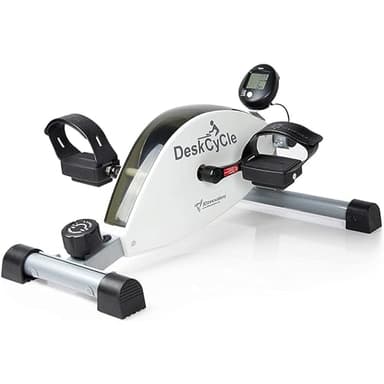
Best-documented quiet mechanism8 magnetic, 39 lb
$149.99 · View on Amazon

Price as of September 24, 2026. #ad How we’re funded

2
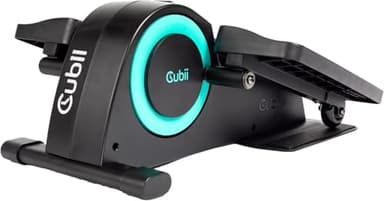
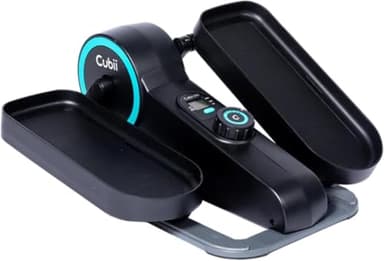
Cubii Move

Cubii Move

The lowest seated machine we have found a published height for, at 9.5 inches — which is the whole argument when your desk apron is the constraint.

Lightest to move off a shared wall9.5 in, 17.5 lb
$159.99 · View on Amazon

Price as of September 24, 2026. #ad How we’re funded

3
Cubii JR1

Cubii JR1

An elliptical stroke instead of a circular one, which keeps the knee lower — and it is the only seated machine here that publishes a user weight limit.

Narrowest, and magnetic17.56 in wide
$169.99 · View on Amazon

Price as of September 24, 2026. #ad How we’re funded

4
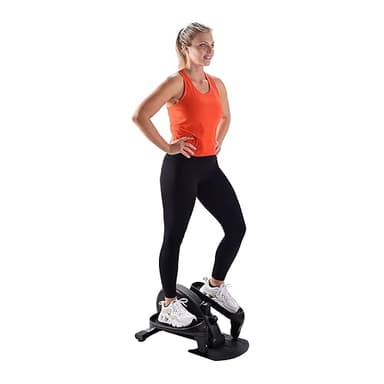
Stamina InMotion E1000

Stamina InMotion E1000

The only seated machine here whose maker publishes dimensions, unit weight and a user weight limit together — and the tallest of the three, at 11.38 inches.

Most published spec, unstated mechanismNot published
$174.99 · View on Amazon

Price as of September 24, 2026. #ad How we’re funded

5
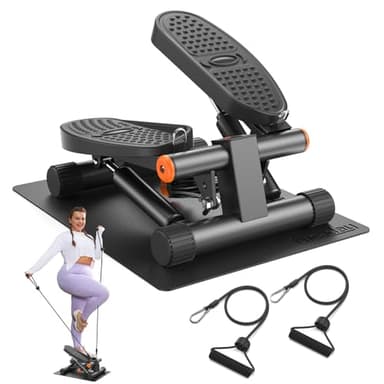
Niceday Mini Stair Stepper

Niceday Mini Stair Stepper

A 16 x 12 inch footprint and a published 300 lb capacity — the most machine per square foot of anything on this site, and the smallest thing here you can genuinely raise your heart rate on.

Quietest stepper, and still a stepper300 lb, hydraulic
$62.99 · View on Amazon

$69.9910% off

Price as of September 24, 2026. #ad How we’re funded

How we picked these

Ranked on what each machine puts into your floor first, because impact through the structure is what the apartment below actually hears and no seated machine produces any. Then on what the maker will state about the resistance mechanism, because a non-contact brake has nothing to rub. Decibel figures are not part of this ranking for one reason: not one maker of these nine machines publishes one.

We have not walked on these machines. We do not own them and we have no test lab. What we did was open each manufacturer’s own specification page, record every published figure with the date we read it, write “not published” where a figure does not exist rather than estimating one, and do the arithmetic ourselves — folded size against a real storage gap, deck length against stride, unit weight against a flight of stairs. The full method, in detail.

Zero of nine publish a figure

This page was supposed to be the seated version of our quietest walking pads ranking, which is ordered on published noise data and only published noise data. That works on the pad side because two of the eight pads we track publish a decibel figure, so there is something to sort on.

It does not work here. We track 6 seated under-desk machines and 3 standing mini steppers, and 0 of those 9 publishes a decibel figure on its own site or on the listing we link. Not a weak figure, not an unsourced one — none at all.

A ranking criterion that returns nothing for every candidate is not a criterion. So the choice was to abandon the page or to rank on something real, and the something real turns out to be more useful than a decibel figure would have been anyway — because in an apartment, the number on the box is usually measuring the wrong thing.

Two noise problems, and only one matters downstairs

The reason a decibel rating disappoints people is that “is it loud” is two separate questions with two separate answers.

Airborne noisetravels through the air. It is what you hear sitting at the desk, and it is the only thing a manufacturer’s decibel figure ever describes. Structure-borne noise travels through solids: mass lands on the floor, that impact energy enters the building, and it arrives downstairs as a thud that no amount of airborne quiet prevents. We set that distinction out in full on the pad side and will not repeat the whole argument here.

Apply it to these nine machines and something unusually clean falls out:

  • A seated machine produces no impact at all. Your body weight is on the chair. Nothing is lifted and nothing lands, so there is no impact event to transmit. Its only noise is airborne and mechanical.
  • A standing stepper produces impact on every step. You are on the machine, so your full body weight is raised and lowered onto a frame that is sitting on the floor, repeatedly. That is the noise the flat below hears.
  • A walking pad produces both. A motor making airborne noise continuously, and footfall driving impact into the floor with every step.

That is a difference in kind, not in degree, and it is derived from how the machines work rather than from anything a maker claims. It is also why a mini stepper can be the quietest thing in your room and the worst choice in your building at the same time.

What the makers say instead of numbers

The absence of figures is not an absence of noise claims. Every one of these listings wants you to believe the machine is quiet; they just will not commit to a number. Three examples, quoted, each from the source we link for that product:

  • Cubii JR1 — the retail listing calls it whisper-quiet, and publishes no decibel figure.
  • Niceday Mini Stair Stepper— the maker’s page says quiet and says silent, and gives no number. Those are not the same thing as each other, let alone the same thing as a measurement.
  • Xiser Commercial Mini Stairmaster— the maker’s page calls it completely silent. It is the most expensive machine on this entire site, and “completely silent” is an adjective rather than a figure.

We are not calling any of those false. We have not measured these machines and cannot say whether they are quiet or not. The point is narrower and it is the reason this site exists: you cannot rank two machines against each other on adjectives, and a category where every maker reaches for one is a category that has collectively decided not to be compared on this.

The mechanism that decides it

With impact settled by whether you sit or stand, the remaining question inside the seated group is what the resistance mechanism has to rub against. This is the second criterion, and it splits the field in a way the marketing copy does not.

Magnetic resistance is non-contact. A magnet slows a flywheel without touching it, which means there is no friction surface to wear, glaze or squeal. Four machines here state magnetic resistance outright: the DeskCycle (eight settings), the Cubii JR1 (eight levels), the Cubii Move (six levels) and the YOSUDA (sixteen levels).

Tension resistance usually works by contact, and contact is where mechanical noise comes from. Here is the gap, and on a page about noise it is the finding: the Stamina InMotion E1000— otherwise the best-documented machine of the nine, and the only seated machine on this site whose maker publishes a maximum user weight — describes its resistance only as adjustable tension and does not state the mechanism. We cannot tell you whether it is magnetic or contact, and neither can its spec sheet.

Hydraulic cylindersare what the three steppers use. No motor, no outlet, and in airborne terms usually very little — which is exactly why stepper listings reach for the word “silent” so confidently. It is also beside the point if you live above someone, because the cylinder is not the part making the noise that travels.

One more thing worth naming, because it applies to all nine: a magnetic level counttells you how many positions a knob has and nothing about the mechanism’s noise. The DeskCycle is the only machine in this category that publishes a resistance magnitude— eight settings up to 39 lb — which is the single most complete statement anyone here makes about what is happening inside the machine. Why that one figure keeps deciding things.

The part you control

Since the machines will not give you numbers, the levers that actually change what you and your neighbors hear are mostly not purchases. Worth knowing before you spend anything.

Where the machine sits matters more than which one it is.A light frame on a hard floor moves microscopically under load and that is a noise source; the same machine on carpet usually stops doing it, because pile grips the feet. Two of these publish a unit weight — 17.5 lb for the Cubii Move and 24 lb for the Stamina — and neither is heavy enough to stay put on hardwood against a firm stroke without being braced against something.

A wall you share is worse than a floor you share, for a seated machine. Because a seated pedaler makes no impact, its noise is airborne and mechanical, and airborne noise is what a shared wall transmits. This is the one case where the lightest machine has a real advantage that has nothing to do with carrying it: the Cubii Move at 9.5 inches and 17.5 lb is trivially easy to relocate to the other side of a room.

Resistance is a noise setting as well as an effort setting. Higher resistance means more force through the linkage and more force through the frame into whatever it stands on. If the machine got louder when you turned the knob up, that is the mechanism doing what mechanisms do, not a fault.

A mat is doing almost nothing under a seated machine. Mats address impact transmission, and a seated pedaler produces no impact. Under a stepper or under a walking pad a dense mat is genuinely working. Under a DeskCycle it is mostly protecting your floor from the feet, which is a different job worth doing for a different reason.

The five machines side by side

Read the noise column first, and read it as the finding rather than as missing data. Every cell in it says the same thing, across five machines from five different companies at five different prices.

Four seated machines and the best-documented stepper. The noise column is unanimous: not one maker publishes a figure. Note also how much else goes missing - two of the five publish no unit weight, and three publish no maximum user weight.
ModelIn use (L x W x H)Unit weightMax userResistance levelsPublished noise
DeskCycle Under Desk Bike Pedal Exerciser20" L x 24" W x 10" Hmanufacturer specNot publishednot publishedNot publishednot published8manufacturer specNot publishednot published
Cubii Move21.5" L x 19.5" W x 9.5" Hretail listing17.5 lbretail listingNot publishednot published6retail listingNot publishednot published
Cubii JR123.2" L x 17.56" W x 10" Hretail listingNot publishednot published150 lbretail listing8retail listingNot publishednot published
Stamina InMotion E100024.5" L x 17" W x 11.38" Hmanufacturer spec24 lbmanufacturer spec250 lbmanufacturer specNot publishednot publishedNot publishednot published
Niceday Mini Stair Stepper16" L x 12" W x 14" Hmanufacturer specNot publishednot published300 lbmanufacturer specNot publishednot publishedNot publishednot published

The picks

Ordered by the criterion at the top: what the machine puts into the floor first, then what its maker will state about the mechanism.

#1
pick

Best-documented quiet mechanism

DeskCycle Under Desk Bike Pedal Exerciser

A 10 inch pedal height is the whole product — it is the seated machine most likely to actually clear a standard 27 inch desk.

DeskCycle Under Desk Bike Pedal Exerciser
$149.99 · View on Amazon

Price as of September 24, 2026. #ad How we’re funded

It is first because it tells you more about what is happening inside it than anything else in the category. Eight magnetic resistance settings up to 39 lb is the only published resistance magnitude we have found in either the bike or the elliptical class, and magnetic resistance is non-contact braking, so there is no friction surface to wear or squeal. It is seated, so it puts nothing into the floor; it is a steel frame with no motor and no power outlet, so there is no airborne hum either. Against it, honestly: DeskCycle publishes no decibel figure like everybody else, no unit weight and no maximum user weight, and at 24 inches wide it takes real footwell width. The quiet case here rests on mechanism and construction, not on a measurement, and we would rather say that plainly.

What the specs give you

  • 10 inch overall height, which is what lets it live under a desk you already own
  • Eight magnetic resistance settings up to 39 lb of resistance
  • Steel frame, no assembly, no power outlet
  • Nothing to fold or store — it stays where it is

What they cost you

  • 24 inches wide, so it takes real floor width even though it is short
  • The maker publishes no product weight and no user weight limit
  • No decibel figure published
  • Seated pedaling is not walking — the calorie and step comparison is not close
Published specifications for the DeskCycle Under Desk Bike Pedal Exerciser
Footprint in use20" L x 24" W x 10" Hmanufacturer spec
FoldedNot publishednot published
Walking beltNot publishednot published
Unit weightNot publishednot published
Max user weightNot publishednot published
Top speedNot publishednot published
InclineNot publishednot published
Published noiseNot publishednot published
Pedal height10 inmanufacturer spec
Resistance levels8manufacturer spec

All figures read from VIVO (DeskCycle) product spec table on 2026-07-24. Where it says “not published”, we checked and no figure exists — we did not estimate one.

Read the full DeskCycle Under Desk Bike Pedal Exerciser spec breakdown
#2
pick

Lightest to move off a shared wall

Cubii Move

The lowest seated machine we have found a published height for, at 9.5 inches — which is the whole argument when your desk apron is the constraint.

Cubii Move
$159.99 · View on Amazon

Price as of September 24, 2026. #ad How we’re funded

Second, and it wins a specific version of this problem. If your noise complaint is a shared wall rather than a downstairs neighbor, the fix is usually to move the machine, and at a published 9.5 inches and 17.5 lb this is the lowest and lightest machine on the entire site - you can relocate it one-handed. It is magnetic with six resistance levels, ships assembled and needs no outlet. Against it: six levels is the fewest here and no magnitude is stated, Cubii publishes no maximum user weight for any model in its range, and the dimensions we quote come from a retailer because Cubii's own product page publishes none. No decibel figure, naturally.

What the specs give you

  • 9.5 inches tall, half an inch lower than the Cubii JR1 and nearly two inches lower than the Stamina
  • 17.5 lb — the lightest machine of any kind on this site
  • 6 magnetic resistance levels
  • Ships assembled, needs no outlet and nothing to store

What they cost you

  • No user weight limit published on Cubii's own page or the retail listing we read — a real gap on a machine you put your body weight through
  • Cubii's own product page publishes no dimensions, weight or capacity at all; the figures here come from a retailer
  • No stride length published
  • No decibel figure published
Published specifications for the Cubii Move
Footprint in use21.5" L x 19.5" W x 9.5" Hretail listing
FoldedNot publishednot published
Walking beltNot publishednot published
Unit weight17.5 lbretail listing
Max user weightNot publishednot published
Top speedNot publishednot published
InclineNot publishednot published
Published noiseNot publishednot published
Pedal heightNot publishednot published
Resistance levels6retail listing

All figures read from Rehabmart retail listing spec table on 2026-08-11. Where it says “not published”, we checked and no figure exists — we did not estimate one.

Read the full Cubii Move spec breakdown

#3
pick

Narrowest, and magnetic

Cubii JR1

An elliptical stroke instead of a circular one, which keeps the knee lower — and it is the only seated machine here that publishes a user weight limit.

Cubii JR1
$169.99 · View on Amazon

Price as of September 24, 2026. #ad How we’re funded

Third on mechanism and placement together. Eight magnetic resistance levels put it alongside the DeskCycle on non-contact braking, and at 17.56 inches wide it is nearly 6.5 inches narrower - which matters here because a machine that fits properly in a footwell is a machine that is not being nudged into a desk pedestal every few strokes, and contact with furniture is a noise source people rarely attribute correctly. Against it, and it is a serious against: the 150 lb maximum user weight on its listing is the lowest limit of anything on this site and rules the machine out for many buyers before noise is even a consideration. That figure comes from the retailer, not from Cubii, which as of this month does not list the JR1 in its own elliptical range at all. The listing calls it whisper-quiet and publishes no number.

What the specs give you

  • 10 inch height, same desk-clearance class as the DeskCycle
  • Elliptical path keeps the knee lower through the stroke than a pedal circle
  • 17.56 inches wide — nearly 6.5 inches narrower than the DeskCycle
  • Eight magnetic resistance levels

What they cost you

  • 150 lb maximum user weight is the lowest limit of anything on this site, and it rules the machine out for a lot of buyers
  • 23.2 inches deep, so it reaches further under the desk than it looks
  • No decibel figure published, despite the listing calling it whisper-quiet
Published specifications for the Cubii JR1
Footprint in use23.2" L x 17.56" W x 10" Hretail listing
FoldedNot publishednot published
Walking beltNot publishednot published
Unit weightNot publishednot published
Max user weight150 lbretail listing
Top speedNot publishednot published
InclineNot publishednot published
Published noiseNot publishednot published
Pedal height10 inretail listing
Resistance levels8retail listing

All figures read from Amazon retail listing spec table on 2026-07-24. Where it says “not published”, we checked and no figure exists — we did not estimate one.

Read the full Cubii JR1 spec breakdown

#4
pick

Most published spec, unstated mechanism

Stamina InMotion E1000

The only seated machine here whose maker publishes dimensions, unit weight and a user weight limit together — and the tallest of the three, at 11.38 inches.

Stamina InMotion E1000
$174.99 · View on Amazon

Price as of September 24, 2026. #ad How we’re funded

Fourth here and first on almost any other page, which is worth explaining rather than leaving as a demotion. It is the only seated machine we track whose maker publishes a maximum user weight - 250 lb, alongside dimensions, a 24 lb unit weight and a warranty term, the most complete spec set in the category. Its pedals reverse and Stamina states the frame is rated for standing as well as seated use. What drops it on THIS page specifically is a single omission: Stamina describes the resistance only as 'adjustable tension' and does not state whether that tension is magnetic or contact. On a page ranking machines by what the mechanism has to rub against, an unstated mechanism cannot be credited. It is also the tallest seated machine here at 11.38 inches, so check your desk apron first.

What the specs give you

  • Stamina publishes dimensions, product weight and capacity on its own page — the only elliptical here where all three come from the manufacturer
  • 250 lb user capacity, 100 lb higher than the Cubii JR1's published limit
  • 24 lb, light enough to move between rooms one-handed
  • Pedals reverse, and the frame is rated for standing as well as seated use

What they cost you

  • 11.38 inches tall — the tallest of the three ellipticals here, and the one most likely to foul a low desk apron
  • Stamina publishes no resistance-level count, only 'adjustable tension'
  • No stride length published, so you cannot check the knee travel before buying
  • No decibel figure published
Published specifications for the Stamina InMotion E1000
Footprint in use24.5" L x 17" W x 11.38" Hmanufacturer spec
FoldedNot publishednot published
Walking beltNot publishednot published
Unit weight24 lbmanufacturer spec
Max user weight250 lbmanufacturer spec
Top speedNot publishednot published
InclineNot publishednot published
Published noiseNot publishednot published
Pedal heightNot publishednot published
Resistance levelsNot publishednot published

All figures read from staminaproducts.com product page on 2026-08-11. Where it says “not published”, we checked and no figure exists — we did not estimate one.

Read the full Stamina InMotion E1000 spec breakdown

#5
pick

Quietest stepper, and still a stepper

Niceday Mini Stair Stepper

A 16 x 12 inch footprint and a published 300 lb capacity — the most machine per square foot of anything on this site, and the smallest thing here you can genuinely raise your heart rate on.

Niceday Mini Stair Stepper
$62.99 · View on Amazon

$69.9910% off

Price as of September 24, 2026. #ad How we’re funded

Fifth, and it is on this page as the honest answer to 'best quiet mini stepper' rather than as a recommendation for an apartment. Hydraulic cylinders mean no motor and no outlet, and in your own room a stepper is often the quietest machine here - which is exactly why the category reaches for words like silent. The problem is the one no figure would have shown you: you stand on it, so your full body weight is lifted and lowered onto a frame on the floor with every step, and that impact is what travels downstairs. It is the best-documented of the three steppers - a published 16 x 12 x 14 in footprint, a 300 lb capacity and a stated 1.5 mm steel frame. Against it: no unit weight published, no resistance count, no handrail, and Niceday's own page uses both 'quiet' and 'silent' without a number behind either.

What the specs give you

  • 16 x 12 x 14 in — roughly 1.3 square feet of floor, less than a quarter of what a walking pad needs
  • 300 lb capacity, matched only by the DeerRun pad on this site
  • Hydraulic cylinders, so there is no motor and no outlet
  • 1.5 mm steel frame published by the maker, which is more construction detail than most makers give
  • Nothing to assemble and nothing to fold

What they cost you

  • Niceday publishes no product weight, so we cannot tell you what it is to carry or how well it will stay put
  • No decibel figure — the page says 'quiet' and 'silent' and gives no number, which is not the same thing
  • No resistance-level count published; the stride knob is described but not quantified
  • There is no handrail, and a stepper without one asks more of your balance than a walking pad does
  • Stepping is a fixed, repetitive motion in a small range — it is not a substitute for walking distance
Published specifications for the Niceday Mini Stair Stepper
Footprint in use16" L x 12" W x 14" Hmanufacturer spec
FoldedNot publishednot published
Unit weightNot publishednot published
Max user weight300 lbmanufacturer spec
Resistance levelsNot publishednot published
Material1.5 mm steel framemanufacturer spec
Published noiseNot publishednot published

All figures read from nicedaysteppers.com product page on 2026-08-12. Where it says “not published”, we checked and no figure exists — we did not estimate one.

Read the full Niceday Mini Stair Stepper spec breakdown

Skip this one

The most expensive machine here, and anything sold on the word silent

The Xiser Commercial Mini Stairmaster is not on this list on purpose. Its own page calls it completely silent, which is the strongest noise claim made by any maker on this site — and it is attached to no decibel figure, no dimensions, no folded size and no unit weight. It is also several times the price of the other two steppers. We have no reason to think it is a bad machine and we rank it properly elsewhere on the criteria it does support. But the strongest adjective in the category, at the highest price, with the emptiest specification sheet, is not something we can put at the top of a noise ranking.

And treat “whisper-quiet” as a category convention rather than information. It appears across this class of product regardless of mechanism, price or construction, which tells you it is a listing phrase rather than a property of any particular machine. If a figure existed, the maker charging the most would be the one publishing it.

If it is making a NEW noise

Worth separating out, because it is a common search and it is a different question: not how loud is this machine but why has mine started doing that. A decibel figure on a box would never have helped with it.

We cannot diagnose your machine. We do not own these, we have not taken one apart, and not one of the nine makers publishes a service manual we could point you at. What we can offer is the mechanical logic, which narrows it usefully:

  • On a magnetic machine, a new noise is not the resistance. Non-contact braking has nothing to wear in. Look at the parts that do touch: the pedal mountings, the crank or linkage, and the feet.
  • Check whether the machine has moved. A frame that has walked a few inches across a hard floor and is now touching a desk pedestal, a wall or a cable will transmit through whatever it is touching. This is the most common cause and the easiest to miss.
  • Check the feet and the pedals for tightness before assuming the mechanism. On a machine you have been loading daily, fasteners are the moving parts nobody thinks of.
  • Then use the maker’s support channel.In a category that publishes no service documentation, contacting the manufacturer is not a fallback — it is the only route to actual information about your unit.

If the noise coincided with turning the resistance up, that is expected rather than a fault: more force through the linkage is more force into the frame.

If you want a number for your own room

This page exists because nine manufacturers declined to publish a decibel figure. There is exactly one way to get one for the machine you actually own, in the room you actually own it in, and it costs less than any machine on this page.

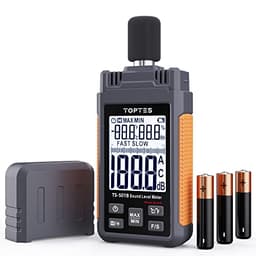
  • TopTes TS-501B Sound Level Meter, A/C weighted, 30-130 dB

    TopTes — TS-501B Sound Level Meter, A/C weighted, 30-130 dB

    Two of the eight walking pads we track have a published decibel figure at all, and we are not going to invent the other six. A handheld meter is how you get a number for the machine you actually own, in the room you actually own it in — which is the only reading that was ever going to answer your question.

    The catch: This measures airborne sound, and in an apartment the complaint downstairs is usually impact through the floor, which a sound meter in your own room does not capture. A consumer meter is also not a calibrated instrument: treat it as a before-and-after comparison tool, not as evidence in a dispute with a landlord.

    Amazon retail listing, read 2026-08-17. We have not used this item; it is here because a page on this site already told you to do the job it does.

    $29.99 · View on Amazon

    Price as of September 24, 2026. #ad How we’re funded

What we have not done

We have not measured the noise of any machine on this page. We do not own them, we have no anechoic chamber and no calibrated meter, and we have not sat in the room below one. Every figure above is read from a manufacturer or retailer page with the date we read it, and the reasoning about impact and airborne noise follows from how the machines work. Our full method.

We have not ranked these machines against each other on loudness, and we will not until somebody publishes a figure. What this page ranks is impact class and stated mechanism, which are checkable. If you came here for “machine A is 4 dB quieter than machine B”, no honest source can give you that today, and any page that does is making it up.

We have not tested any of the placement advice either. Carpet gripping better than hardwood, a frame transmitting through something it touches, resistance raising mechanism load — those are descriptions of how objects behave, not results we produced.

Questions people actually ask

What is the quietest under-desk elliptical or bike?

On mechanism rather than on measurement, the DeskCycle - and the distinction matters. No maker in this category publishes a decibel figure, so nobody can hand you a measured answer. What the DeskCycle does publish is the most complete account of its mechanism of anything here: eight magnetic resistance settings up to 39 lb, on a steel frame, with no motor and no power outlet. Magnetic resistance is non-contact braking, so there is no friction surface to wear or squeal. The Cubii Move is the one to pick if you need to move the machine away from a shared wall, at 9.5 inches and 17.5 lb.

Do under-desk bikes and ellipticals publish decibel figures?

Not one of them. We track six seated under-desk machines and three standing mini steppers, and zero of the nine makers publishes a decibel figure anywhere we could find. That is a worse result than the walking pads, where two of eight publish one. What you get instead is adjectives: the Cubii JR1's listing calls it whisper-quiet, Niceday's page says quiet and silent, and Xiser's page says completely silent. None of those is a measurement, and we will not rank machines against each other on them.

Is a seated machine quieter than a walking pad for neighbors?

Categorically, yes, and this is the one claim on this page we can make without a single number. Apartment noise complaints about exercise equipment are usually impact through the floor structure rather than sound through the air, and a seated machine produces no impact at all - nothing lands, because your body weight stays on the chair. A walking pad has both a motor making airborne noise and a footfall driving impact into the floor with every step. That is a difference in kind, not in degree.

Are mini steppers quiet?

In your own room they are usually the quietest thing here, because a hydraulic cylinder has no motor and very little to make noise. For the person below you they are the loudest machine on this page, and those two facts are not in conflict. You stand on a stepper, so your full body weight is lifted and lowered onto a frame with every step, and that impact energy goes into the floor. If you live above somebody, the seated machines are the safer choice and the reason is structural rather than a matter of build quality.

Why is my Cubii making noise all of a sudden?

A change in noise is a different question from how loud a machine is, and it is the one question a decibel figure on a box would never have answered. We are not able to diagnose your specific machine and we have not taken one apart. What we can say is that a new noise on a magnetic-resistance machine is a mechanical change rather than a resistance change, because the braking itself is non-contact and has nothing to wear. Check the obvious physical causes first - the machine having shifted on a hard floor, a loose foot or pedal, or something caught in the linkage - and use the maker's support channel, because none of these makers publishes a service manual.

Does a mat make an under-desk machine quieter?

For a seated machine, there is very little for a mat to do, and we would rather say that than sell you one. A mat addresses impact transmission into the floor, and a seated pedaler produces no impact - nothing lands. Under a standing stepper, a dense mat is doing real work, because that is a machine that puts your whole body weight into the floor repeatedly. The same is true under a walking pad, which is why our mat roundup exists on the walking pad side of this site rather than this one.

How can I find out how loud my machine actually is?

Measure it, because nobody in this category will. A handheld sound level meter gives you a number for the machine you own, in the room you own it in, which is the only reading that was ever going to answer the question you are asking. Two honest limits: a consumer meter is not a calibrated instrument, so treat it as a before-and-after comparison tool rather than evidence in a dispute with a landlord, and it measures airborne sound only - the impact through the floor that a downstairs neighbor complains about is not what it captures.

Is a magnetic under-desk bike quieter than one with tension resistance?

Probably, on mechanism, and we cannot confirm it for every machine because not every maker states which one it uses. Magnetic resistance slows a flywheel without touching it, so there is no contact surface to squeal or wear. A tension or friction system works by contact, which gives it something to make noise with. The gap in this category is that the Stamina InMotion E1000 - otherwise the best-documented machine of the nine - describes its resistance only as adjustable tension and does not state the mechanism. On a page about noise, that omission is the finding.

Sources