Are walking pads loud? What the specs actually say
Two of the eight machines we track publish a decibel figure. And even those two are describing a kind of noise that is not the one your neighbor is complaining about.
By Stephen V. · Last updated
Walking pad motors are quiet. The problem in an apartment is not the motor — it is footfall impact traveling through the floor structureinto the ceiling below, which no decibel rating on a spec sheet describes. That is why a dense mat under the deck does more for your neighbor than picking a “quieter” machine.
Two kinds of noise, and only one is on the spec sheet
This distinction is the whole guide, so it is worth getting straight before any numbers.
Airborne noisetravels through the air. It is the motor hum, the belt whirr, the fan. It is what a decibel rating measures — a microphone at some distance, picking up pressure waves in air. It is also what mostly stays in your own room, because walls and floors are reasonably good at stopping it.
Structure-borne noise travels through solids. Every time your foot lands on the deck, that impact energy goes into the deck, through whatever is under the deck, into the floor, and radiates out of the ceiling below as a thump. Walls and floors are much worse at stopping this, because they are the transmission medium rather than a barrier to it.
A walking pad produces both. The published decibel figure — when one exists — describes the first. Your downstairs neighbor is almost always complaining about the second.
That is why this whole category’s marketing focus on “quiet motor” is answering a question nobody in an apartment is asking. A silent motor and a hard floor still produces rhythmic thumping in the unit below.
What is actually published
We checked the manufacturer specification page for every walking pad we track. Of 8 machines, 2 publish a noise figure.
| Model | Published figure | Source |
|---|---|---|
| WalkingPad Z1 | Not publishedchecked, none stated | walkingpad.com product spec table |
| WalkingPad C2 | Not publishedchecked, none stated | walkingpad.com product spec table |
| WalkingPad P1 | Not publishedchecked, none stated | walkingpad.com product spec table |
| WalkingPad A1 Pro | Under 65 dBmanufacturer claim | walkingpad.com product spec table |
| UREVO Strol 2E | Not publishedchecked, none stated | urevo.com product spec table |
| Lifepro PacerMini | Less than 60 dBmanufacturer claim | Rehabmart retail listing spec table |
| Sunny Health & Fitness TreadPad Sleek Stride (SF-T722069) | Not publishedchecked, none stated | sunnyhealthfitness.com product spec table |
| DeerRun Under-Desk Walking Pad | Not publishedchecked, none stated | Amazon retail listing |
The KingSmith case is the interesting one. Same company, same product line, same specification page template — and a figure for the A1 Pro only, with nothing for the Z1, C2 or P1. We do not know why and we are not going to speculate.
6 machines publish nothing: WalkingPad Z1, WalkingPad C2, WalkingPad P1, UREVO Strol 2E, Sunny Health & Fitness TreadPad Sleek Stride (SF-T722069), DeerRun Under-Desk Walking Pad. If you have read a decibel number for any of those elsewhere, it did not come from the manufacturer.
Why even the real figures are weak
Both published figures are stated as ceilings — “under 65 dB”, “less than 60 dB”. Neither manufacturer states:
- the distance the measurement was taken from
- the belt speed it was taken at
- whether anyone was walking on it
- the user weight if so
- the floor surface underneath
Every one of those materially changes a decibel reading. A measurement at one meter with the belt running empty is a very different number from one at two meters with a 180 lb person walking at 3 mph on a hardwood floor.
So the honest read is: these two figures tell you a manufacturer was willing to commit to a number in writing, which is a real signal about a company. They do not tell you that 60 is quieter than 65 in your apartment, because those two numbers were produced under unstated and probably different conditions.
We would be doing exactly what we criticize if we ranked eight machines by decibel using two figures and six blanks. Our quiet roundup ranks on published data and says so plainly, which is a less satisfying page and a truer one.
What actually helps
Given all of the above, here is where the effort is genuinely worth spending. Ordered by how much difference each makes.
1. A dense mat under the deck
This is the single most effective thing available to you, because it attacks impact transmission directly rather than airborne noise. What you want is dense and resilient — a proper equipment or treadmill mat, not a thin yoga mat, which compresses to nothing under a 50 lb machine plus a walker and does very little.
We do not currently rank mats and we are not going to recommend a specific one we have not researched to the same standard as the machines. But it is the purchase, not the pad, and saying otherwise would be selling you the wrong thing.
2. Walk slower
Impact energy rises sharply with pace. A 2 mph amble puts far less into the floor than a 3.5 mph stride, and at a desk you are usually walking slowly anyway. This costs nothing.
3. Soft-soled shoes, and no bare feet
Cushioned soles absorb impact before it reaches the deck. Manufacturers consistently advise against bare feet in their manuals anyway — bare skin on a moving belt abrades, and socks slide, which is a separate safety issue.
4. Hours
The same thump at 7am and at 2pm produce very different neighbor relationships. Check your building’s quiet hours, and if you are above someone, consider telling them what the noise is before they have to work it out. A conversation is cheaper than a complaint.
5. Where the pad sits in the room
Closer to a load-bearing wall generally transmits less into the middle of a floor span than dead center of the room does. That is a structural generality rather than a measurement we made, and we are flagging it as such — but it costs nothing to try.
If you want a number for your own room
Two of the eight machines we track have a published decibel figure, and we are not going to invent the other six. A handheld meter is how you get a reading for the machine you own, in the room it is in — which was always the only reading that could answer your question.
How this page is funded: the buy links here are Amazon affiliate links, and we earn a commission if you buy through one — at no extra cost to you. It does not change what we rank first, because the commission rate is the same across every machine on this page. Full disclosure.
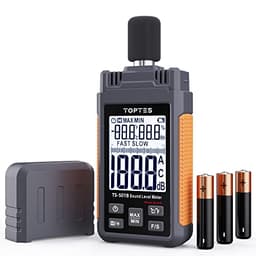
TopTes — TS-501B Sound Level Meter, A/C weighted, 30-130 dB
Two of the eight walking pads we track have a published decibel figure at all, and we are not going to invent the other six. A handheld meter is how you get a number for the machine you actually own, in the room you actually own it in — which is the only reading that was ever going to answer your question.
The catch: This measures airborne sound, and in an apartment the complaint downstairs is usually impact through the floor, which a sound meter in your own room does not capture. A consumer meter is also not a calibrated instrument: treat it as a before-and-after comparison tool, not as evidence in a dispute with a landlord.
Amazon retail listing, read 2026-08-17. We have not used this item; it is here because a page on this site already told you to do the job it does.
$29.99 · View on AmazonPrice as of October 22, 2026. #ad How we’re funded
Questions people actually ask
Do walking pads make a lot of noise?
The motor usually is not the problem. On a hard floor, most of what a downstairs neighbor hears is footfall energy transmitted through the structure, not motor noise through the air. That is why a thick mat under the deck does more for the person below you than a quieter motor does. It is also worth knowing how little data exists: of the walking pads we track, only two publish a decibel figure at all.
Are under desk treadmills noisy?
Manufacturer figures, where they exist, sit under 60 to 65 dB — roughly the level of ordinary conversation. But no manufacturer we found states the distance, speed, load or surface at which that figure was taken, so the numbers are not comparable across brands and none of them describe what travels through your floor.
How many decibels are footsteps?
We do not have a figure for that we could source and verify, so we are not going to give you one. The important point is a categorical one rather than numerical: a footstep produces both airborne sound in your room and an impact into the floor structure, and only the first of those is what a decibel rating on a spec sheet describes.
How do I make my walking pad quieter for downstairs neighbors?
Put something dense and resilient between the deck and the floor — a proper equipment mat rather than a thin yoga mat. That addresses impact transmission, which is the part that reaches the apartment below. Walking slower and in softer-soled shoes reduces impact energy at the source. Neither of those is about the machine you bought.
Which walking pads publish a noise figure?
Of the eight we track, two: the WalkingPad A1 Pro at 'under 65 dB' and the Lifepro PacerMini at 'less than 60 dB'. Both are manufacturer claims with no stated test distance, speed, load or surface, so they are not comparable to each other. Everything else publishes nothing.
Read next
- Best walking pads for gaming desks — the noise question with a desk microphone in the room for hours rather than minutes.
- Quietest under-desk cardio machines — the machines that make no footfall, ranked on what they put into the floor instead.
- Best gifts for someone who works from home — why the two published noise figures decide the gift for someone on calls.
- Best walking pad mats — the accessory sold on noise, and what it demonstrably does.
- Walking pad making a clicking or grinding noise — the other noise question: when the sound is a fault rather than the machine.
- Quietest walking pads — the ranked picks, on published data only, with the blanks named.
- Can you use a walking pad in an apartment? — the lease, the hours and the conversation with the neighbor below.
- Setting one up without drilling anything — what a renter can change about the floor between them and downstairs.
- Best walking pads for apartments — noise as one of three criteria, with the picks that follow from it.
- How we rank these — why this page has two numbers on it rather than eight.
- Can you use a walking pad on carpet? — why carpet helps less with the floor below than everyone assumes.
- Best walking pads for dorm rooms — the one case where airborne noise, not footfall, is the whole problem.
Sources
- WalkingPad Z1 — walkingpad.com product spec table (noise: not published, checked 2026-07-24)
- WalkingPad C2 — walkingpad.com product spec table (noise: not published, checked 2026-07-24)
- WalkingPad P1 — walkingpad.com product spec table (noise: not published, checked 2026-07-24)
- WalkingPad A1 Pro — walkingpad.com product spec table (noise: Under 65 dB, checked 2026-07-24)
- UREVO Strol 2E — urevo.com product spec table (noise: not published, checked 2026-07-24)
- Lifepro PacerMini — Rehabmart retail listing spec table (noise: Less than 60 dB, checked 2026-07-24)
- Sunny Health & Fitness TreadPad Sleek Stride (SF-T722069) — sunnyhealthfitness.com product spec table (noise: not published, checked 2026-07-24)
- DeerRun Under-Desk Walking Pad — Amazon retail listing (noise: not published, checked 2026-07-24)