WalkingPad A1 Pro review
One of two machines on this entire site whose maker publishes a noise figure, and the only KingSmith model that does. Here is exactly what that number is worth.
By Stephen V. · Last updated
The A1 Pro is the only KingSmith pad with a published decibel figure — “under 65 dB”— on a 47 x 16.5 in belt that is the widest in the range. It costs you 12 lb over the Z1 and folds no smaller. Buy it for the number on paper, not for the machine, because mechanically it is the P1.
How this page is funded: the buy links here are Amazon affiliate links, and we earn a commission if you buy through one — at no extra cost to you. It does not change what we rank first, because the commission rate is the same across every machine on this page. Full disclosure.
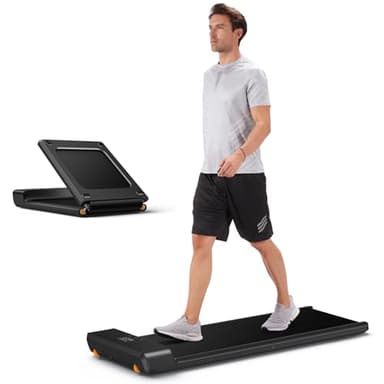
WalkingPad A1 Pro
One of only two pads on this site whose maker publishes a decibel figure at all, and the only KingSmith model that does.
Best for: A published noise figure
Price as of September 24, 2026. #ad How we’re funded
The full published specification
Every figure below was read from walkingpad.com product spec table on 2026-07-24. Rows marked “not published” were checked and no figure exists.
| Footprint in use | 56.5" L x 21.5" W x 5" Hmanufacturer spec |
|---|---|
| Folded | 32.5" L x 21.5" W x 5" Hmanufacturer spec |
| Walking belt | 47" L x 16.5" Wmanufacturer spec |
| Unit weight | 63 lbmanufacturer spec |
| Max user weight | 230 lbmanufacturer spec |
| Top speed | 3.75 mphmanufacturer spec |
| Incline | Not publishednot published |
| Published noise | Under 65 dBmanufacturer spec |
All figures read from walkingpad.com product spec table on 2026-07-24. Where it says “not published”, we checked and no figure exists — we did not estimate one.
What those numbers mean in a small room
Start with what this machine is, because the marketing obscures it: the A1 Pro is the WalkingPad P1 with a slightly higher capacity rating and a published noise figure. Same 47 x 16.5 inch belt, same 56.5 x 21.5 x 5 inch footprint, same 32.5 inch fold, same 3.75 mph ceiling. The difference is 10 lb of rated capacity, one pound of unit weight, and a line on the specification page.
That line is genuinely unusual and it is why this page exists. Of the eight walking pads we track, two publish a decibel figure at all. Same company, same product line, same specification template — and KingSmith publishes a number for this model and nothing for the Z1, C2 or P1. We do not know why, and we are not going to invent a reason.
What the figure does not carry is any of the context that would make it comparable. “Under 65 dB” is stated without a measurement distance, without a belt speed, without saying whether anyone was walking on it, without a user weight and without a floor surface. Change any one of those and the reading moves. So it is not comparable to the Lifepro PacerMini’s “less than 60 dB”, and anyone ranking those two against each other is comparing measurements taken under unstated and probably different conditions.
It also describes the wrong noise for the most common complaint. A decibel rating measures airborne sound — motor, belt, fan. What reaches your downstairs neighbor is mostly footfall energy going through the deck into the floor structure, which is a different physical path that no dB figure on any spec sheet describes. A dense mat under the deck does more about that than the gap between 60 and 65 ever will.
Where the figure has real value is as a signal about the company rather than the machine: KingSmith was willing to commit to a number in writing for this model. In a category where six of eight makers publish adjectives instead, that is worth something. It is just worth less than the marketing implies.
One more spec worth noticing, because it is unusual in the other direction: the A1 Pro folds to the same 5 inches it stands at. Most pads here get taller folded, because folding stacks one half of the deck on the other — the Z1 goes from 4.1 to 5.4 inches doing exactly that. The A1 Pro does not, so the number you measure your sofa gap against is the same number you read on the in-use row.
The fit arithmetic
Folded, this is 32.5 x 21.5 x 5 in. Against the storage gaps we check every machine on this site against:
| Storage spot | Typical gap | Result |
|---|---|---|
| Under a sofa | ~6 in | Fits1 in to spare |
| Under a bed | ~9 in | Fits4 in to spare |
| Standing in a closet | ~24 in | Fits2.5 in to spare |
| Behind a door | ~4 in | Does not fit1 in over |
On stride: the 47 inch belt against a typical stride of 28.4 in for a 5 ft 6 in walker and 31 in for someone 6 ft, using the common 0.43-times-height rule of thumb. That leaves roughly 16in of margin for a 6-foot walker — which has to absorb your forward and backward drift as well as the stride itself.
Who it suits
Anyone whose purchase is blocked on the noise question. If what is stopping you is that no maker will commit to a figure, this is the KingSmith machine that has. That is a real reason to pick it, provided you read the figure for what it is.
Anyone who drifts while typing. 16.5 inches is the widest belt in the KingSmith range and joint-widest on this site, nearly an inch more than the Z1 and C2. At a desk, where you are looking at a screen rather than your feet, that is the specification that stops you clipping the edge.
A heavier walker who wants a KingSmith. The standard 230 lb rating beats the C2 and P1, and the separately sold 300 lb variant is the highest-capacity machine on this site that comes with a full published spec table behind it.
Anyone storing it under something rather than in a closet. The 5 inch folded height clears a typical sofa gap, and unlike most pads here that number does not go up when you fold it.
Who it does not
Anyone carrying it upstairs. 63 lb is the heaviest KingSmith pad and the second-heaviest machine on this site. The Z1 does the same job at 51 lb with 12 lb more rated capacity, and neither machine has real handholds. If you are in a walk-up, this is the specification that will decide how you feel about the purchase.
Anyone who wanted the noise figure to settle a neighbor dispute. It will not, because it describes airborne noise and the dispute is almost certainly about impact through the floor. Buy the mat.
Anyone comparing it to the P1 on price. Mechanically these are the same machine. If the decibel line is not what is deciding you, there is nothing else here that the P1 does not also do.
Anyone who wants incline. KingSmith publishes none for this model and there is no incline mechanism. The Sunny TreadPad and the Lifepro PacerMini are the two machines on this site that have one.
Anyone hoping to run. 3.75 mph is a brisk walk and slightly slower than the Z1’s 4 mph. The UREVO Strol 2E reaches 6.2 mph if occasional jogging matters.
What we did not do
We have not used this unit. We have not walked on it, we do not own one, and nobody sent us one. Everything above is our reading of the specification WalkingPad publishes, plus arithmetic on those numbers.
Which means there are real questions this page cannot answer: how the belt feels, whether the deck flexes under a heavier walker, how the motor sounds in your room, and whether any of it holds up over two years. Those need use. If a review tells you those things without having used the machine, it is telling you something it made up.
Questions people actually ask
How quiet is the WalkingPad A1 Pro?
KingSmith publishes 'under 65 dB' for the A1 Pro, and it is the only model in its range with any figure at all — the Z1, C2 and P1 publish nothing. Read it as a ceiling rather than a measurement: KingSmith does not state the distance, the belt speed, whether anyone was walking on it, the user's weight, or the floor surface, and every one of those changes a decibel reading materially. It also describes airborne noise, which is not the transmission path that reaches a downstairs neighbor.
What are the WalkingPad A1 Pro dimensions?
56.5 x 21.5 x 5 inches in use and 32.5 x 21.5 x 5 inches folded, per KingSmith's specification page. Unusually for this category, the folded height is the same as the in-use height rather than greater — the A1 Pro folds the handle-less deck rather than stacking one half on the other, so 5 inches is the number to measure your storage gap against either way.
What is the WalkingPad A1 Pro weight limit?
230 lb on the standard model, which sits between the C2 and P1 at 220 lb and the Z1 at 242 lb. KingSmith also sells a 300 lb capacity variant of the same machine. The two look identical in listings, so check the capacity on the specific listing you are ordering from rather than assuming.
How much does the WalkingPad A1 Pro weigh?
63 lb, per KingSmith, which makes it the heaviest walking pad we track apart from the Sunny TreadPad at 69.5 lb. It is 12 lb heavier than the Z1 for the same folded footprint. On a third-floor walk-up that is the difference between an awkward solo carry and a two-person job, and it is the specification we would weigh most heavily against the noise figure.
Is the A1 Pro better than the WalkingPad P1?
They are near-identical machines: the same 47 x 16.5 inch belt, the same 32.5 inch folded length, the same 5 inch deck, the same 3.75 mph ceiling. The A1 Pro adds 10 lb of rated capacity, one pound of unit weight, and the published decibel figure. If that figure is what would let you commit to the purchase, it is worth the difference. If it is not, the P1 is the same machine.
Read next
- WalkingPad C2 vs A1 Pro — an inch of width against 0.8 inches of belt, and a 0.5 mph floor against the C2's 1 mph.
- WalkingPad A1 Pro vs P1 — same belt, same fold; a decibel figure against a 0.3 mph crawl.
- Best walking pads for a home office — where the only published KingSmith dB figure makes this our top pick.
- WalkingPad Z1 vs A1 Pro — the decision this review sets up: 12 lb against a published number.
- Quietest walking pads — where this machine ranks, and the six models that publish nothing.
- Are walking pads loud? — why a dB figure answers a different question than the one you are asking.
- WalkingPad P1 review — the same machine without the decibel line — worth reading before you pay for it.
- Best walking pads for tall walkers — where the 16.5 inch belt earns its keep against the rest of the field.