Do under-desk bikes actually do anything?
Every listing in this category promises a workout under your desk. The specification sheets do not support that, and there is a smaller true claim underneath it that is worth the money.
By Stephen V. · Last updated

Yes, at one specific job: replacing stillnessduring hours you are seated anyway. No, at being exercise — pedaling at a pace that lets you type is low intensity by definition. Their real structural advantage is that nothing lands, so nothing reaches the flat below.
How this page is funded: the buy links here are Amazon affiliate links, and we earn a commission if you buy through one — at no extra cost to you. It does not change what we rank first, because the commission rate is the same across every machine on this page. Full disclosure.
The claim being made, and the claim that is true
Listings in this category promise a workout while you work. Read the specifications and that claim has nothing behind it: there is no published resistance range on most of these machines, no way to measure your effort, and a seating position that limits how hard you can push without sliding your chair backwards.
The true claim is smaller and it is genuinely worth something. Sitting still for eight hours and sitting with your legs turning slowly for four of them are different days. The machine converts time you were already going to spend seated into time spent moving, at zero scheduling cost — and unlike a walking pad it asks nothing of your floor, your posture or your typing accuracy.
That is the frame we would buy one on. Anything more than that and the machine will disappoint you by about week three. Where the intensity line actually sits.
What the machines cannot know
A seated under-desk machine has no sensor pointed at you. It does not know your body mass, your fitness or your heart rate, and most of them do not publish a resistance figure in units that mean anything.
The exception is worth naming, because it is the only quantitative statement in the category: DeskCycle publishes eight magnetic levels up to a stated 39 lb of resistance. Cubii publishes a level count with no range; Stamina publishes “adjustable tension” with no count at all. So of the machines we track, exactly one lets you compare how hard it gets in any numerical way.
Which means any calorie number on a small display is a formula applied to pedal revolutions, with your body treated as a constant it was never told. That is the same problem walking pads have, and for the same reason. What a console can and cannot know.
The advantage nobody markets
Here is the argument for a seated machine that has nothing to do with fitness and is the strongest thing on its side of the ledger: there is no footfall.
Your feet stay on the pedals through the whole stroke. Nothing lands, which means no impact energy is delivered into the floor structure. In an apartment that is the mechanism behind essentially every complaint about home cardio — not motor noise through the air, but structure-borne thumping through the slab. Why the decibel figures in this category answer the wrong question.
Two other things follow from the same geometry. A seated machine cannot be fallen off, which matters if balance is a factor. And it does not raise you, so it has no effect on your desk height — the arithmetic that rules a walking pad out of many rooms does not apply. The desk-height arithmetic a pad requires.
The specification that decides everything
Height. Not resistance, not levels, not the app — height, and then the knee travel above it.
Published heights across the seated machines we track run from 9.5 in (Cubii Move) to 11.38 in (Stamina InMotion E1000). Your knee well has a fixed clearance and the machine plus your moving knee has to fit inside it. Neither figure is on the box, and no maker publishes a stride length you could use to calculate the second one.
That is why fit failures rather than quality complaints dominate returns in this category, and why the DeskCycle’s published fit statement — that the standard model suits a 27 inch desk for a user around 5 ft 8 in or shorter — is worth more than any feature on the page. The four measurements to take before ordering.
| Model | In use (L x W x H) | Unit weight | Max user | Resistance levels | Published noise |
|---|---|---|---|---|---|
| DeskCycle Under Desk Bike Pedal Exerciser | 20" L x 24" W x 10" Hmanufacturer spec | Not publishednot published | Not publishednot published | 8manufacturer spec | Not publishednot published |
| Cubii JR1 | 23.2" L x 17.56" W x 10" Hretail listing | Not publishednot published | 150 lbretail listing | 8retail listing | Not publishednot published |
| YOSUDA Under Desk Bike | Not publishednot published | Not publishednot published | Not publishednot published | 16retail listing | Not publishednot published |
| Sunny Health & Fitness Under Desk Smart Mini Pedal Exerciser (SF-B023005) | Not publishednot published | Not publishednot published | Not publishednot published | Not publishednot published | Not publishednot published |
| Stamina InMotion E1000 | 24.5" L x 17" W x 11.38" Hmanufacturer spec | 24 lbmanufacturer spec | 250 lbmanufacturer spec | Not publishednot published | Not publishednot published |
| Cubii Move | 21.5" L x 19.5" W x 9.5" Hretail listing | 17.5 lbretail listing | Not publishednot published | 6retail listing | Not publishednot published |
The three we would consider
For three different constraints. We have used none of them; every figure is published and sourced below, and the prices in the buttons are live rather than authored.
Best documented fit: the DeskCycle, 10 in tall, the only machine here whose maker tells you what desk and what user height it suits, and the only one publishing a resistance range rather than just a count.
Most complete specification: the Stamina InMotion E1000, the only seated machine whose maker publishes dimensions, product weight and a 250 lb user capacity together. It is also the tallest at 11.38 in, which is the catch.
Cheapest way to find out if you will use one: the Sunny mini pedal exerciser, which has the emptiest specification sheet on this site and the lowest price of entry. If you are not sure the habit will stick, finding out cheaply is a legitimate strategy.
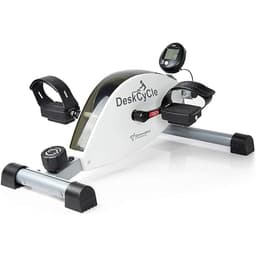
DeskCycle Under Desk Bike Pedal Exerciser
Fitting under a low desk
A 10 inch pedal height is the whole product — it is the seated machine most likely to actually clear a standard 27 inch desk.
Price as of October 2, 2026. #ad How we’re funded
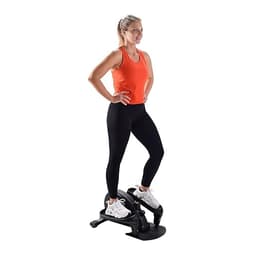
Stamina InMotion E1000
The most complete published spec
The only seated machine here whose maker publishes dimensions, unit weight and a user weight limit together — and the tallest of the three, at 11.38 inches.
Price as of October 2, 2026. #ad How we’re funded
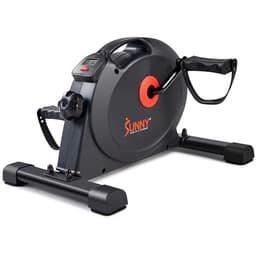
Sunny Health & Fitness Under Desk Smart Mini Pedal Exerciser (SF-B023005)
Trying the idea cheaply
The cheapest way to test whether you will actually use a seated pedaler before spending three figures on one.
The full pedal exerciser ranking and the ellipticals, which keep the knee lower through the stroke.
What we have not done
We have not pedaled any of these machines, measured a heart rate, or compared energy expenditure between a pedal exerciser and a walking pad. Anyone publishing that comparison from a spec sheet is inventing it.
We have published no calorie figures, for the reason set out above: the machine does not know your body mass and neither do we. Our full method. This page is general information about published specifications, not medical or fitness advice.
Questions people actually ask
Do under-desk bikes actually work?
They work at the thing they are for, which is turning stillness into movement while you stay seated and keep working. They do not work as a substitute for exercise: pedaling at a pace that lets you type is low intensity by definition, and it will not put you in the moderate-intensity band that public activity guidance describes. If your comparison is against a workout, they lose. If it is against sitting motionless for eight hours, they win easily.
How many calories does an under-desk bike burn?
Nobody can tell you honestly, including the machine. Energy cost depends mostly on your body mass and the work you are doing, and these machines have no way to measure either — none of the seated machines we track publishes a resistance range in usable units except the DeskCycle, and none has a sensor that knows anything about you. Any calorie figure on a small display is a formula applied to pedal revolutions.
Are under-desk bikes good for weight loss?
Not on their own, and no honest reading of the specifications suggests otherwise. What they do is add low-intensity movement to hours that would otherwise be still, which is a real change in daily activity and a small one per hour. Treat it as replacing sitting rather than as replacing exercise, and the machine stops disappointing people.
Is an under-desk bike better than a walking pad?
For a different problem, yes. A pad needs about 8.5 square feet of clear floor and gives you walking; a seated machine needs vertical clearance under a desk you already own and gives you low-intensity leg movement. In a shared room or an upstairs apartment the seated machine has one decisive advantage that has nothing to do with exercise: no footfall, so nothing transmits into the floor structure.
Do under-desk bikes make noise?
No maker on this site publishes a decibel figure for any seated machine, so we cannot compare them. What is structurally true is that there is no impact: nothing lands, so the low-frequency thumping that reaches a downstairs neighbor from a walking pad does not exist here. What remains is magnetic resistance and bearing noise, which stays in your room.
How long should you use an under-desk bike?
There is no published guidance specific to these machines and no maker on this site publishes a continuous-use limit. The public activity guidance is written in minutes of moderate-intensity activity per week, which desk pedaling generally will not reach — so the useful framing is duration rather than target: pedal for as much of the seated day as is comfortable, and get your moderate-intensity minutes somewhere else.
Read next
- Can an under-desk bike or elliptical help you lose weight? — the energy-balance version, and the one published resistance figure it turns on.
- What muscles does an under-desk bike or elliptical work? — which joints move, and the three geometry figures nobody publishes.
- Does an under-desk bike or elliptical count as steps? — the most common reason one of these stops getting used by week two.
- Best under-desk bikes and pedal exercisers — the full field, ranked on the height figure that decides fit.
- Will an under-desk bike fit under your desk? — the arithmetic, and the four measurements it needs.
- Walking pad vs under-desk bike — floor space against desk clearance, with both machines specified.
- Can you use a walking pad sitting down? — if this is the machine you were actually looking for.
- Best cardio equipment for a small apartment — where seated machines sit against pads, steppers and mats.
Sources
- DeskCycle Under Desk Bike Pedal Exerciser — VIVO (DeskCycle) product spec table (read 2026-07-24)
- Cubii JR1 — Amazon retail listing spec table (read 2026-07-24)
- YOSUDA Under Desk Bike — Amazon retail listing (read 2026-07-24)
- Sunny Health & Fitness Under Desk Smart Mini Pedal Exerciser (SF-B023005) — Amazon retail listing (read 2026-07-24)
- Stamina InMotion E1000 — staminaproducts.com product page (read 2026-08-11)
- Cubii Move — Rehabmart retail listing spec table (read 2026-08-11)