Pedal exerciser vs walking: is pedaling as good?
The honest answer depends entirely on which comparison you are actually making - and most people asking are making the second one without realizing it.
By Stephen V. · Last updated
Against walking, no. Seated, the chair carries your body weight, so your legs move your legs rather than moving you. But against sitting still, which is the real alternative, the machine wins by default. If you want walking, buy a walking pad. If you want movement during hours you cannot leave the desk, the DeskCycleis the pick here — it publishes a 10 in height and the only resistance magnitude in the category.
How this page is funded: the buy links here are Amazon affiliate links, and we earn a commission if you buy through one — at no extra cost to you. It does not change what we rank first, because the commission rate is the same across every machine on this page. Full disclosure.
There are two questions here, not one
“Is pedaling as good as walking?” gets asked in two completely different situations, and they have opposite answers. Separating them is most of the value of this page.
Question one: should I pedal at my desk instead of going for my walk? No. Nothing on this page is an argument for canceling a walk. Walking carries your body weight against gravity, uses the whole posterior chain, loads bone, and happens outdoors in daylight. A seated machine reproduces none of that.
Question two: I am going to be at this desk for six hours either way — should those hours include pedaling? Here the comparison is not pedaling against walking. It is pedaling against stillness, and stillness has no case to make. The machine wins, and it does not need to be as good as walking to win, because walking was never one of the options in those six hours.
Almost every buyer we write for is in situation two and phrasing it like situation one. That is why the search results for this query feel unhelpful: they answer the question that was typed rather than the one that was meant.
What the chair takes away
The single mechanical difference that drives everything else: on a seated pedal machine, your body weight stays on the chair.
Walking is a series of controlled falls. Each step lifts your mass, lands it, and catches it, and the muscles doing that work run from your feet to your core. Seated pedaling removes the lifting, the landing and the catching. Your legs turn a crank; nothing carries you.
There is a measurable consequence visible in this site’s own data, and it is the cleanest evidence we have for the point: four of the six seated machines we track publish no maximum user weight at all, while all three standing steppers publish one. That is not an accident of marketing. A stepper frame carries your whole body weight and has to be rated for it. A seated frame only ever sees pedal force, so the rating is a less meaningful number — and several makers simply do not bother. Every published limit, and every blank.
What the chair gives back is the thing the machines are bought for: you can do it while typing, in a meeting, on a call, for an hour, without changing clothes or breaking concentration. No walking pad can make that claim, and a stepper cannot come close.
Why a stepper sits between the two
A mini stepper is the closest thing in this category to walking, and the furthest thing from desk work. Both at once.
Closest, because you are standing on it. Your body weight is on the machine and is raised and lowered every step, which is the part seated pedaling removes. Furthest, because you cannot type while doing it, your heart rate rises quickly, and the one thing the whole seated category exists to deliver — movement that is invisible to your working day — is not on offer.
There is also a specific small-apartment consequence that we would rather state here than let you discover: a stepper puts your full body weight into the floor through a small frame, every step. It can be the quietest machine in your room and the worst choice for the apartment below, simultaneously. What each machine actually puts into your floor.
What a stepper does not reproduce from walking is forward travel and the gait that goes with it. The motion is a fixed vertical path in a small range. It is cardio; it is not a walk. Stepper against seated elliptical, in detail.
The numbers we will not give you
Every other page answering this query puts a calorie comparison in a table. We are not going to, and the reason is worth more to you than the table would be.
No maker here publishes an output figure. Not one of the nine seated and standing machines on this site publishes a validated calories-per-hour, a watts figure or a metabolic equivalent. The on-board displays compute an estimate from revolutions and a generic assumption about you.
The variables are yours, not the machine’s.Output depends on your mass, your cadence and your resistance setting. Only one machine in this entire category publishes what a resistance level is even worth — the DeskCycle, at eight magnetic settings up to 39 lb. The rest publish a level count, which describes how finely a range was divided rather than how wide it is. Why a level count is not a magnitude.
And the steps will probably not count. A wrist tracker infers steps from arm swing, and your arms are on a keyboard. We have written up exactly what Apple and Fitbit publish about this rather than guessing at it. Does under-desk cardio count as steps?
So the comparison we can make honestly is mechanical: walking lifts your body weight, seated pedaling does not, a stepper does. Everything past that would be a number we invented.
The machines, if the second question is yours
Four machines, picked on published specification rather than on any output claim: the one that fits the most desks, the one with the most complete spec sheet, the standing machine that comes closest to walking, and the narrowest seated option.
| Model | In use (L x W x H) | Unit weight | Max user | Resistance levels |
|---|---|---|---|---|
| DeskCycle Under Desk Bike Pedal Exerciser | 20" L x 24" W x 10" Hmanufacturer spec | Not publishednot published | Not publishednot published | 8manufacturer spec |
| Stamina InMotion E1000 | 24.5" L x 17" W x 11.38" Hmanufacturer spec | 24 lbmanufacturer spec | 250 lbmanufacturer spec | Not publishednot published |
| Niceday Mini Stair Stepper | 16" L x 12" W x 14" Hmanufacturer spec | Not publishednot published | 300 lbmanufacturer spec | Not publishednot published |
| Cubii JR1 | 23.2" L x 17.56" W x 10" Hretail listing | Not publishednot published | 150 lbretail listing | 8retail listing |
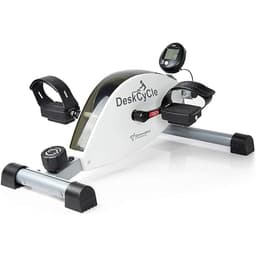
DeskCycle Under Desk Bike Pedal Exerciser
Fitting under a low desk
A 10 inch pedal height is the whole product — it is the seated machine most likely to actually clear a standard 27 inch desk.
Price as of October 4, 2026. #ad How we’re funded
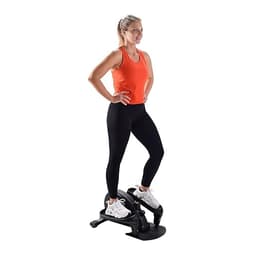
Stamina InMotion E1000
The most complete published spec
The only seated machine here whose maker publishes dimensions, unit weight and a user weight limit together — and the tallest of the three, at 11.38 inches.
Price as of October 4, 2026. #ad How we’re funded
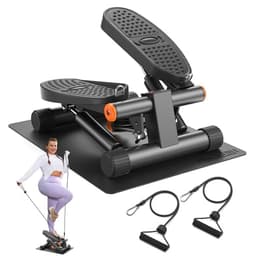
Niceday Mini Stair Stepper
Smallest footprint of anything here
A 16 x 12 inch footprint and a published 300 lb capacity — the most machine per square foot of anything on this site, and the smallest thing here you can genuinely raise your heart rate on.
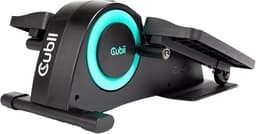
Cubii JR1
Low-impact seated motion
An elliptical stroke instead of a circular one, which keeps the knee lower — and it is the only seated machine here that publishes a user weight limit.
Price as of October 4, 2026. #ad How we’re funded
DeskCycle— for the desk you already own. 10 inches of overall height is the lowest figure published by any seated machine with a flywheel, and eight magnetic settings to 39 lb is the only published resistance magnitude in the category. It is 24 inches wide, so it is short rather than small.
Stamina InMotion E1000— for the buyer who wants to check everything first. The only seated machine whose maker publishes dimensions, unit weight and a 250 lb user limit together, and the frame is rated for standing use as well. At 11.38 inches it is the tallest of the three ellipticals here.
Niceday Mini Stair Stepper— for the reader who reached the end of this page and concluded they want the standing version. A 300 lb published capacity inside roughly 1.3 square feet of floor. No handrail, and not usable at a desk.
Cubii JR1— for a narrow desk space, at 17.56 inches wide. Read its published 150 lb maximum user weight first; it is the lowest limit on this site and it rules the machine out for many buyers.
And if the first question is yours
If what you want is walking, buy the thing that is walking. A walking pad is the same gait, the same loading and the same body mechanics as a walk, indoors, with deck length as the one constraint that genuinely limits it.
The pads we track publish maximum user weights from 220 to 300 lb and belt lengths from 27.6 to 47.6 inches, and every one of them publishes a capacity figure — which, after the blanks on this page, is worth noticing.
Two honest caveats before you switch categories. A pad needs floor space while it runs and somewhere to go when it does not, and it has a motor, which means noise through a floor that a seated machine does not make. Walking pad against under-desk bike, specification by specification — or, if the honest obstacle is getting outside rather than the machine, a pad against the pavement.
What we have not done
We have not used these machines and we have run no physiological comparison. Everything above is either a published specification with its source named at the bottom of this page, a mechanical statement about what a chair does to a load path, or a clearly labeled refusal to publish a number nobody has measured. We also make no medical or rehabilitation claims anywhere on this site. The full method.
Questions people actually ask
Is pedaling as good as walking?
Not as a straight swap, and the reason is structural rather than a matter of degree: when you pedal seated, the chair carries your body weight, so your legs move your legs rather than moving you. Walking loads the whole body against gravity at every step. The comparison that favors the machine is the one people actually face, though - pedaling at a desk against sitting still at the same desk, where the machine wins by default because the alternative is nothing.
Does an under-desk bike burn as many calories as walking?
Nobody on this site can tell you that honestly, and we are not going to publish a figure. Not one of the nine seated or standing machines we track publishes a validated calorie output, the on-board displays are unvalidated estimators, and the variables that decide it - your mass, your resistance setting, your cadence - are all yours rather than the machine's. What we can say is that a seated machine does not lift your body weight and walking does.
Do the steps count on a fitness tracker?
Generally no for a seated pedal machine. A wrist tracker counts steps from arm swing, and your arms are on a keyboard; Apple states that Apple Watch counts steps from arm motion while walking or running. A stepper is a different case because you are standing and your whole body rises and falls, but your arms are still not swinging. We cover exactly what Apple and Fitbit publish about this in a separate guide.
Is a pedal exerciser better than walking for seniors?
Those are different questions wearing the same words. A seated machine removes the two things that stop some older people walking - balance demand and joint impact - and that can make it the option that actually gets used, which is worth more than a theoretically better workout nobody does. We do not make medical recommendations and we do not rank these machines on joint impact, because no maker publishes a figure that would make that ranking honest.
Is a mini stepper closer to walking than a pedal exerciser?
Mechanically, yes, in one specific respect: you are standing, so your body weight is on the machine and is lifted and lowered every step rather than resting on a chair. That is why all three steppers we track publish a maximum user weight and four of the six seated machines publish none. It is also why a stepper cannot be used at a desk while you work, which is the whole reason people buy the seated machines.
What should I buy if I want walking?
A walking pad, which is the other half of this site. It is walking, on a belt, in your room - the same gait, the same loading, with the deck length as the one real constraint. The seated machines are for the hours when you have to stay at a desk, not instead of walking.
Read next
- Do under-desk bikes actually do anything? — the longer version of the second question on this page.
- Does under-desk cardio count as steps? — what Apple and Fitbit actually publish about arm-swing step counting.
- Can an under-desk bike or elliptical help you lose weight? — the same refusal to invent an output figure, worked through properly.
- Walking pads and knees — why we will not rank any of these machines on joint impact.
- Can you use a walking pad while sitting? — the question from the other direction, and the answer is not the obvious one.
- Under-desk machines with adjustable resistance — the one published magnitude figure in the whole category.
- What muscles does an under-desk bike or elliptical work? — which parts of the walking chain a chair takes out of the movement.
- Walking pad vs under-desk bike — if this page convinced you the pad is the right category after all.
- Under-desk cardio weight limits — the published-capacity split that proves the chair argument above.
- How to use an under-desk bike or pedal exerciser — including the chair problem, which is the real failure mode here.
Sources
- DeskCycle Under Desk Bike Pedal Exerciser — VIVO (DeskCycle) product spec table (read 2026-07-24)
- Stamina InMotion E1000 — staminaproducts.com product page (read 2026-08-11)
- Niceday Mini Stair Stepper — nicedaysteppers.com product page (read 2026-08-12)
- Cubii JR1 — Amazon retail listing spec table (read 2026-07-24)
- Apple — how Apple Watch tracks steps from arm motion (read 2026-09-17)
- MedlinePlus, US National Library of Medicine — physical activity guidance for adults (read 2026-09-17)