Does an under-desk bike or elliptical count as steps?
This is the question that decides whether a seated machine gets used or ends up in a cupboard, and the answer is in Apple's and Fitbit's own documentation rather than in any product listing.
By Stephen V. · Last updated

Essentially no, and it is not a fault.Apple states that the Activity app “relies on arm motion and an accelerometer”. Seated pedaling holds both arms still, so there is nothing for the sensor to read — an hour can register close to zero. Two things do work: start a workout instead of relying on passive tracking (Apple says the Workout app can use the heart rate sensor), or wear a chest strap.
What Apple actually says
We went to Apple’s own support documentation on 2026-09-17 rather than describing this from memory, because the exact wording turns out to be the whole answer. Four statements, quoted:
- “The Activity app relies on arm motion and an accelerometer to track movement, but the Workout app can use the accelerometer, the heart rate sensor, and GPS.”
- “To make sure that you earn Exercise credit during walks, allow the arm with your Apple Watch to swing naturally.”
- “If you need both hands while walking, for example to push a stroller, you can still earn Exercise credit with the Workout app.”
- “Every full minute of movement that equals or exceeds the intensity of a brisk walk counts toward your daily Exercise and Move goals… Any activity below this level counts only toward your daily Move goal.”
Read those four together and the seated-machine problem is fully described by Apple before anyone mentions a pedal exerciser. Passive tracking reads your arm.Pedaling at a desk holds both arms still on a keyboard, which is a more extreme version of the stroller case Apple names. And even where motion is detected, the intensity threshold is “equals or exceeds… a brisk walk” — and pedaling at a pace you can type through is, by definition, not that.
The way out is in the first quotation. The Workout app can use the heart rate sensor, and your heart rate does not care where your arms are.
What Fitbit actually says
Fitbit’s help documentation, read on the same date, arrives at the same place from the opposite direction — it is mostly written about the tracker over-counting, and in doing so it states the mechanism exactly:
- “If you wear a wrist-based Fitbit device and move your body while keeping your arms still (or vice versa), you may see a slightly different step count.”
- “When working at a desk, cooking, or performing other activities with arm movements, a device on your wrist may add some steps.”
- “When you ride a bike on bumpy trails, your device may add some steps.”
- “Fitbit devices have a finely-tuned algorithm for step counting.”
The second and third quotations are the ones worth sitting with, because they say something slightly uncomfortable: a wrist tracker can add steps for typing and for riding over bumps. It is reading vibration and motion patterns at the wrist and inferring walking. Seated pedaling produces neither the arm swing of walking nor the jolts of a bumpy trail, so it produces very little of anything.
Why this is not a bug
It is worth being clear that nothing here is broken, because the usual reaction is to assume the watch is wrong or the machine is faulty, and neither is true.
A wrist-worn tracker has one sensor for motion and it is on your wrist. It infers walking from a pattern of arm swing that has been tuned on people actually walking. Any activity that moves your legs while keeping your arms still is outside the pattern it was designed to detect: seated pedaling, but also cycling with your hands on the bars, pushing a shopping cart, and pushing a stroller — which is why Apple names that last one explicitly and tells you what to do about it.
What follows is a practical warning about a very common purchase mistake. If you buy a seated machine in order to close a ring, you will be disappointed within a week and the machine will stop being used. If you buy it to be less motionless during hours you were going to spend sitting anyway, it does that job, and we set out honestly what that is worth.
A stepper is a different case
“Does a mini stepper count as steps” is a separate question with a better answer, and it is worth separating because the two machines get searched together.
On a stepper you are standing, and every step raises and lowers your entire body. That produces real vertical motion at the wrist whether or not you are consciously swinging your arms, so a tracker usually registers something. What it will not give you is a count that means what an outdoor step means. Apple notes that the watch calibrates the accelerometer by learning your stride length when you walk or run outside, and a stepper has no forward travel to calibrate against— you are going up and down on the spot.
And on the machine’s own side of the question there is nothing at all: no mini stepper we track publishes a step height, which means the work done per step cannot be computed even in principle. We took that arithmetic as far as it goes and then stopped, which is further than the listings do.
What the machine's own display knows
If your watch will not count it, the obvious next hope is the monitor on the machine. Here is what that monitor actually has to work with.
It knows revolutions and it knows elapsed time. It does not know what you weigh, how long your legs are, or which resistance setting you are on — not one machine we track takes any of those as an input. So a calorie figure on one of these displays is revolutions multiplied by a stored assumption about a person who is not you.
Syncing is also less automatic than most buyers expect. Cubii’s own model comparison, read on 2026-09-17, lists the app compatibility of the Move and the Go as “Manual Data Entry” — you read the numbers off the monitor and type them in yourself — and only the Total Body, the top of the range, as “Bluetooth Seamless Syncing”. Display follows the same ladder: “Basic LCD Monitor” on the Move against “Backlit LCD Monitor” above it.
What to look for if tracking matters
Four checks, in order. Only the first two are usually stated in a listing, and the fourth is the one that actually solves the problem.
1. Does the machine sync, or do you type?Look for the words Bluetooth or app connectivity in the specification rather than in the marketing copy, and treat “app compatible” as ambiguous until you find out which of the two it means. Cubii’s own comparison page shows how far apart those can be inside a single brand’s range.
2. Does it publish a resistance magnitude, or just a count? If nothing can measure your output, the next best thing is knowing the input. A level count tells you how many positions the knob has. A stated resistance figure tells you what the hardest one is. Exactly one machine in this category publishes the second kind of number.
3. Can you put your watch into a workout instead? This costs nothing and is the single highest-value change on this page. Apple states in its own words that the Workout app can use the heart rate sensor rather than arm motion. Starting an indoor-cycle or other workout before you pedal moves you off the sensor that cannot see you and onto the one that can.
4. Measure the input the machine is missing. A chest strap reads your heart rate directly from your chest, which is the one signal that is genuinely about your body rather than about your wrist or about a stored assumption. If the reason you are on this page is that you want to know whether any of this is doing anything, this is the honest way to find out.
The machines that publish app tracking
Against those checks, three machines are worth naming — two that publish app connectivity, and one that publishes the input figure instead.
Most resistance steps, with app tracking: the YOSUDA Under Desk Bike. Sixteen magnetic resistance levels, double the DeskCycle and the Cubii JR1, plus Bluetooth app tracking. The honest caveat is large and it is not about tracking: YOSUDA publishes no pedal height, which is the single figure that decides whether an under-desk machine fits under your desk, and no user weight limit either.
The cheapest way to find out whether you will use one: the Sunny mini pedal exerciser. Bluetooth app connectivity at the bottom of the price range, sold as a low-profile design for under-desk use, and it works for arms on a desktop as well as legs on the floor — which, given everything above about arm motion, is a more interesting feature on this page than on any other. Sunny publishes no pedal height, no dimensions and no user weight limit for it.
No app, and the only published resistance magnitude: the DeskCycle. It has no Bluetooth and we are recommending it anyway, because it is the only machine in this category that publishes eight magnetic settings up to 39 lb of resistance — a magnitude rather than a count. If nothing is going to measure your output reliably, knowing exactly what you are pushing against is the substitute that does not depend on a sensor.
How this page is funded: the buy links here are Amazon affiliate links, and we earn a commission if you buy through one — at no extra cost to you. It does not change what we rank first, because the commission rate is the same across every machine on this page. Full disclosure.
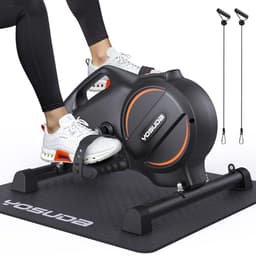
YOSUDA Under Desk Bike
Most resistance steps
Twice the resistance steps of the DeskCycle and app tracking, but the listing does not publish the pedal height that decides whether it fits your desk.
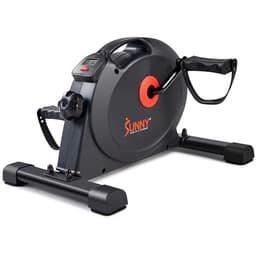
Sunny Health & Fitness Under Desk Smart Mini Pedal Exerciser (SF-B023005)
Trying the idea cheaply
The cheapest way to test whether you will actually use a seated pedaler before spending three figures on one.
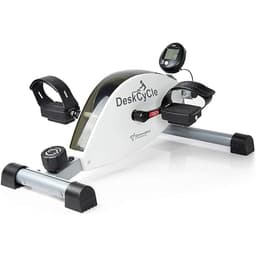
DeskCycle Under Desk Bike Pedal Exerciser
Fitting under a low desk
A 10 inch pedal height is the whole product — it is the seated machine most likely to actually clear a standard 27 inch desk.
Price as of September 24, 2026. #ad How we’re funded
The one thing that actually solves this
Everything above is about sensors that infer your effort from where your arms are. A chest strap measures your heart rate from your chest instead, which is the input both the machine and the wrist tracker are missing - and it is the reason Apple's own documentation points at the heart rate sensor for activities where your hands are occupied.
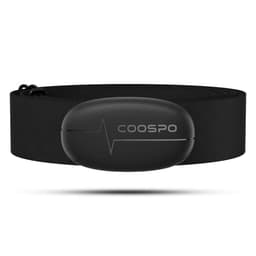
COOSPO — H6 Heart Rate Monitor Chest Strap, Bluetooth and ANT+
A walking pad's calorie display knows your speed and your time and nothing whatsoever about you. A chest strap measures the one input that is actually about your body, and it is the input the machine is missing. If the number on the console is the reason you are asking whether any of this is working, this is the cheap way to stop guessing.
The catch: It measures heart rate. It does not turn heart rate into a trustworthy calorie figure either — that conversion still runs on estimates of your weight, age and fitness, and the arithmetic stays an approximation. Chest straps are also consistently more accurate than a wrist optical sensor and consistently less comfortable than one.
Amazon retail listing, read 2026-08-17. We have not used this item; it is here because a page on this site already told you to do the job it does.
A better number than steps
Worth saying plainly, because this page could easily leave you chasing a metric that was never a good fit.
A step count became the number everyone tracks because it is easy to collect from a wrist, not because it measures work. Public health guidance is not written in steps. MedlinePlus, read on 2026-09-17, states it in minutes: “Get at least 150 to 300 minutes of moderate-intensity or 75 to 150 minutes of vigorous-intensity aerobic physical activity each week”, and defines the threshold by a test you can run without any device at all — “moderate intensity means that while you are doing that activity you should be able to say a few words in a row but not sing”.
Apply that talk test to a seated machine at a pace you can work through and it usually comes out below moderate. That is a more useful and more honest read of what you are getting than any step count would be, and it is available to you for free, right now, on the machine you already own. We ran the same test on walking pads and it reaches a similarly unflattering conclusion about desk pace.
What we did not do
We have not tested a watch against any of these machines. No wearables were compared, no step counts were logged, and nothing on this page is a measurement we made. What we did was read Apple’s and Fitbit’s own published documentation on 2026-09-17, quote it exactly, and reason from what it says about how the sensors work. Our full method.
We have not given you a conversion from revolutions to steps, and you should be suspicious of anyone who does. It would require a stride length, a resistance figure and your body weight, and the machines publish none of the three.
This is general information about published specifications and published vendor documentation. It is not medical advice.
Questions people actually ask
Does an under-desk elliptical count as steps?
On a wrist tracker, essentially no. Apple's own support documentation states that the Activity app 'relies on arm motion and an accelerometer to track movement', and seated pedaling involves no arm motion at all - your hands are on a keyboard. Fitbit states that if you 'move your body while keeping your arms still (or vice versa), you may see a slightly different step count'. Seated pedaling is the extreme version of arms-still movement, so an hour of it can register close to nothing. That is the sensor working as designed, not a fault.
Does a mini stepper count as steps on an Apple Watch or Fitbit?
More reliably than a seated machine, and still not dependably. A stepper is used standing and your whole body rises and falls with every step, so there is real vertical motion at the wrist even if you are not swinging your arms. What you cannot expect is a step count that means what an outdoor step means: Apple notes that the watch calibrates by learning your stride length when you walk or run outside, and a stepper has no forward travel to calibrate against. Treat the count as a rough activity signal, not a distance.
Why does my watch show nothing after an hour on my under-desk bike?
Because a wrist-worn tracker is reading your wrist, and your wrist did not move. Apple is explicit that to earn Exercise credit while walking you should 'allow the arm with your Apple Watch to swing naturally', and gives the example of letting the watch arm swing freely while the other holds a leash. Seated pedaling holds both arms still by design. There is no arm motion for the accelerometer to interpret, so the Activity app has nothing to credit.
How do I get credit for seated pedaling?
Start a workout rather than relying on passive tracking. Apple states the distinction plainly: 'The Activity app relies on arm motion and an accelerometer to track movement, but the Workout app can use the accelerometer, the heart rate sensor, and GPS.' Apple gives pushing a stroller as the case where both hands are occupied and says you can still earn Exercise credit with the Workout app. Pedaling at a desk is the same situation. A heart-rate chest strap does the same job more directly, because it measures the one input the machine and the watch are both missing.
Do these machines count steps themselves?
Some display a number, and it is not a step count in any meaningful sense - it is revolutions, or time, converted by an assumption. None of the machines we track knows what you weigh, how long your legs are, or what resistance setting you are on. Cubii's own model comparison, read on September 17, 2026, is instructive about how much syncing you actually get: the Move and the Go are listed as 'Manual Data Entry', meaning you read the numbers off the monitor and type them into the app yourself, and only the Total Body is listed as 'Bluetooth Seamless Syncing'.
Does a walking pad count steps properly?
Much better than a seated machine, for the same reason that makes seated machines invisible: you are walking, upright, with your arms free. If your hands are on a keyboard the whole time, some of the same problem returns - the watch is reading a wrist that is not moving - but your body is still travelling and rising with each stride, which is far more signal than pedaling produces. Our walking pad app guide covers what the machine's own console can and cannot know, which is a separate question from what your watch sees.
Is a step count worth optimizing for at all?
Not at the expense of the thing it measures. A step count is a proxy that happens to be easy to collect from a wrist, which is why it became the number everyone tracks - it is not a measure of work. MedlinePlus frames adult activity guidance in minutes rather than steps: 'Get at least 150 to 300 minutes of moderate-intensity or 75 to 150 minutes of vigorous-intensity aerobic physical activity each week', where moderate intensity means you 'should be able to say a few words in a row but not sing'. Applied to a seated machine at a pace you can type through, that test usually comes out below moderate, and a step counter will not tell you so.
Read next
- Are walking pad calorie counts accurate? — the same question asked of the machine's own console rather than your watch.
- Walking pad apps: what they do and cannot know — what a machine measures against what its screen infers.
- Do under-desk bikes actually do anything? — the honest account of what a seated machine replaces, which is stillness rather than exercise.
- Can an under-desk bike or elliptical help you lose weight? — the energy-balance version of this question, and the one published resistance figure it turns on.
- Mini stepper calories, and the number nobody publishes — why a stepper's count cannot be computed even in principle.
- Best under-desk bikes and pedal exercisers — the machines on this page ranked properly, on published pedal height.
- Is a walking pad good cardio? — the talk test applied to desk-pace walking, against a published standard.
Sources
- Apple Support — 'The Activity app relies on arm motion and an accelerometer to track movement, but the Workout app can use the accelerometer, the heart rate sensor, and GPS'; 'allow the arm with your Apple Watch to swing naturally'; 'If you need both hands while walking, for example to push a stroller, you can still earn Exercise credit with the Workout app' (read 2026-09-17)
- Fitbit Help — 'If you wear a wrist-based Fitbit device and move your body while keeping your arms still (or vice versa), you may see a slightly different step count'; 'When working at a desk, cooking, or performing other activities with arm movements, a device on your wrist may add some steps' (read 2026-09-17)
- MedlinePlus — 'Get at least 150 to 300 minutes of moderate-intensity or 75 to 150 minutes of vigorous-intensity aerobic physical activity each week'; 'Moderate intensity means that while you are doing that activity you should be able to say a few words in a row but not sing' (read 2026-09-17)
- Cubii model comparison — app compatibility listed as 'Manual Data Entry' for the Move and the Go and 'Bluetooth Seamless Syncing' for the Total Body only (read 2026-09-17)
- YOSUDA Under Desk Bike — Amazon retail listing (read 2026-07-24)
- Sunny Health & Fitness Under Desk Smart Mini Pedal Exerciser (SF-B023005) — Amazon retail listing (read 2026-07-24)
- DeskCycle Under Desk Bike Pedal Exerciser — VIVO (DeskCycle) product spec table (read 2026-07-24)