
Pad & Pace

Best walking pads for gaming desks

A gaming desk has a tower on the floor, a microphone over it and sessions that outlast any work block. Three constraints no other ranking on this site is built for.

By Stephen V. · Last updated

A compact home office desk against an apartment wall with a laptop and chair

The WalkingPad A1 Pro is the pick, on the one figure this use turns on: a published minimum speed of 0.5 mph, against the 1 mph KingSmith publishes for the C2 and Z1. It is also the only KingSmith pad with any published decibel figure at all. If the tower lives on the floor and the width is the problem, the WalkingPad C2 at 20.4 inches is the narrowest machine we track.

How this page is funded: the buy links here are Amazon affiliate links, and we earn a commission if you buy through one — at no extra cost to you. It does not change what we rank first, because the commission rate is the same across every machine on this page. Full disclosure.

Quick picks

Ranked for a desk that already has a tower beside it and a microphone above it: published width first, then the published MINIMUM speed rather than the maximum, then whatever decibel figure the maker will state, then what it takes to put the machine away between sessions. Select a row to jump to the full write-up. We have not walked on any of these — here is exactly what we did instead.

#ModelBest forKey figurePrice
1
WalkingPad A1 Pro

WalkingPad A1 Pro

One of only two pads on this site whose maker publishes a decibel figure at all, and the only KingSmith model that does.
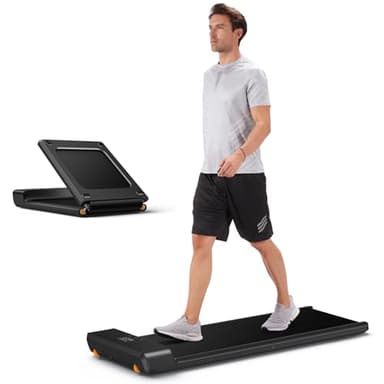
Lowest published minimum speed0.5 mph, under 65 dB
2
WalkingPad C2

WalkingPad C2

The narrowest pad we list at 20.4 inches wide, which is the one that fits a genuinely tight closet — you pay for it in belt width.

Narrowest - fits beside a tower20.4 in wide
$449.00 · View on Amazon

Price as of October 10, 2026. #ad How we’re funded

3
WalkingPad Z1

WalkingPad Z1

The only pad here that folds in half AND stays under 5.5 inches folded, which is the combination a small apartment actually needs.

Longest belt, folds smallest47.6 in belt
$299.00 · View on Amazon

$329.009% off

Price as of October 10, 2026. #ad How we’re funded

4
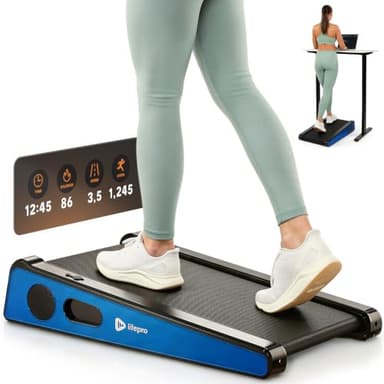
Lifepro PacerMini

Lifepro PacerMini

A 27.6 inch belt is short enough to be a real constraint, but it is the only pad here that publishes both an incline figure and a decibel figure.

Smallest floor area32.7 x 25 in
$269.26 · View on Amazon

Price as of October 10, 2026. #ad How we’re funded

How we picked these

Ranked for a desk that already has a tower beside it and a microphone above it: published width first, then the published MINIMUM speed rather than the maximum, then whatever decibel figure the maker will state, then what it takes to put the machine away between sessions.

We have not walked on these machines. We do not own them and we have no test lab. What we did was open each manufacturer’s own specification page, record every published figure with the date we read it, write “not published” where a figure does not exist rather than estimating one, and do the arithmetic ourselves — folded size against a real storage gap, deck length against stride, unit weight against a flight of stairs. The full method, in detail.

The tower is the constraint nobody writes about

Every walking-pad ranking assumes the floor under your desk is empty. On a gaming desk it usually is not: there is a tower down there, and it is sitting in exactly the space the pad needs.

That makes widththe first figure to read, which is unusual — on the desk pages it is deck height, and on the storage pages it is folded length. The published widths of the eight pads we track run from 20.4 inches on the WalkingPad C2 to 25 inches on the Sunny TreadPad and the Lifepro PacerMini. That is nearly five inches of spread, and five inches is roughly half a tower.

The arithmetic to run before you order anything: measure the clear floor width between your desk legs, subtract the width of whatever already stands there, and compare what is left against the column below. If the answer is tight, the honest fix is usually to get the tower off the floor rather than to buy a narrower belt. The floor area each machine actually needs, in use and stored.

Read the minimum speed, not the maximum

This is the figure that reorders the list, and it is the one almost nobody publishes prominently. Under a desk your pace is capped by your hands, and at a gaming desk your hands are doing more than typing. So the number that decides whether the machine is usable is the bottom of the range.

KingSmith publishes 0.5 to 3.75 mph for the A1 Pro and 1 to 4 mphfor the C2, with a 1 mph floor for the Z1 as well (read from walkingpad.com on 2026-09-01 — our product registry stores the top speed only, so the ranges were read separately and are cited against that date). 1 mph is a walk. 0.5 mph is a shuffle, and a shuffle is what you can sustain while aiming.

The cheaper machine being faster at the top and slower at the bottom is a genuine inversion in this category, and it is the whole argument for the A1 Pro here. The two machines side by side, with both published ranges.

Width, belt, fold and noise, side by side

All eight pads we track. Read the width figure inside the 'in use' column first - on a gaming desk it is the pass-or-fail number, because the tower is already using that floor. The noise column is mostly empty, and that is the finding.
ModelIn use (L x W x H)Belt (L x W)Folded (L x W x H)Published noise
WalkingPad Z156.1" L x 22" W x 4.1" Hmanufacturer spec47.6" L x 15.7" Wmanufacturer spec31.8" L x 22" W x 5.4" Hmanufacturer specNot publishednot published
WalkingPad C256.9" L x 20.4" W x 4.9" Hmanufacturer spec47.2" L x 15.7" Wmanufacturer spec32.5" L x 20.4" W x 5.4" Hmanufacturer specNot publishednot published
WalkingPad P156.5" L x 21.5" W x 5" Hmanufacturer spec47" L x 16.5" Wmanufacturer spec32.5" L x 21.5" W x 5" Hmanufacturer specNot publishednot published
WalkingPad A1 Pro56.5" L x 21.5" W x 5" Hmanufacturer spec47" L x 16.5" Wmanufacturer spec32.5" L x 21.5" W x 5" Hmanufacturer specUnder 65 dBmanufacturer spec
UREVO Strol 2E48" L x 22.6" W x 38.9" Hmanufacturer spec40.2" L x 15" Wmanufacturer spec51.2" L x 22.6" W x 4.6" Hmanufacturer specNot publishednot published
Lifepro PacerMini32.7" L x 25" W x 7" Hretail listing27.6" L x 15.7" Wretail listingNot publishednot publishedLess than 60 dBretail listing
Sunny Health & Fitness TreadPad Sleek Stride (SF-T722069)58.2" L x 24.9" W x 5.9" Hmanufacturer spec45.7" L x 16" Wmanufacturer specNot publishednot publishedNot publishednot published
DeerRun Under-Desk Walking PadNot publishednot publishedNot publishednot publishedNot publishednot publishedNot publishednot published
#1
pick

The only pad with a slow end you can game through

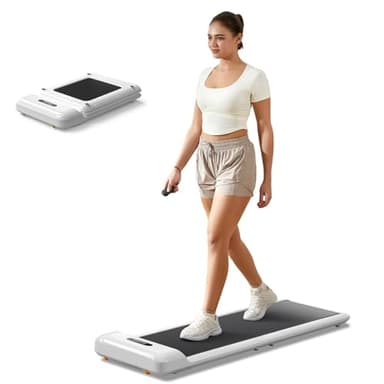
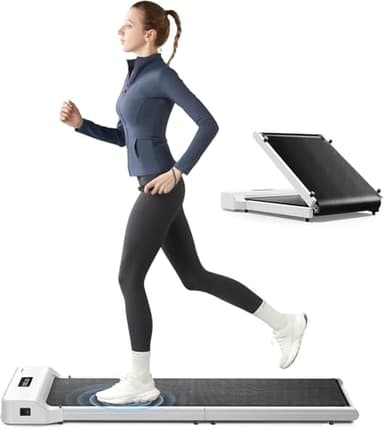
WalkingPad A1 Pro

One of only two pads on this site whose maker publishes a decibel figure at all, and the only KingSmith model that does.

First on the published minimum speed, which is the figure this use lives in: KingSmith states 0.5 to 3.75 mph for the A1 Pro against 1 to 4 mph for the C2 and a 1 mph floor for the Z1. Half the minimum is the difference between walking and shuffling, and shuffling is what works while your hands are busy. It is also the only KingSmith machine with any published decibel figure - under 65 dB - which is the only evidence available for a room with an open microphone in it, and its 16.5 inch belt is the joint-widest here. Against it: 21.5 inches wide is middle of the field rather than narrow, and 63 lb is near the top of the range if the machine has to move between sessions.

What the specs give you

  • KingSmith publishes 'under 65 dB' for this model — most makers publish nothing
  • Sold in a 300 lb capacity variant as well as the standard 230 lb
  • Same 47 x 16.5 inch belt as the P1

What they cost you

  • 63 lb is the heaviest pad here — a two-person carry up stairs
  • 'Under 65 dB' is a manufacturer claim with no stated test method, distance or speed
  • Folded height of 5 inches beats the Z1, but folded length is 0.7 inches longer
Published specifications for the WalkingPad A1 Pro
Footprint in use56.5" L x 21.5" W x 5" Hmanufacturer spec
Folded32.5" L x 21.5" W x 5" Hmanufacturer spec
Walking belt47" L x 16.5" Wmanufacturer spec
Unit weight63 lbmanufacturer spec
Max user weight230 lbmanufacturer spec
Top speed3.75 mphmanufacturer spec
InclineNot publishednot published
Published noiseUnder 65 dBmanufacturer spec

All figures read from walkingpad.com product spec table on 2026-07-24. Where it says “not published”, we checked and no figure exists — we did not estimate one.
Read the full WalkingPad A1 Pro spec breakdown

#2
pick

Narrowest machine we track, by 1.1 inches

WalkingPad C2

The narrowest pad we list at 20.4 inches wide, which is the one that fits a genuinely tight closet — you pay for it in belt width.

WalkingPad C2
$449.00 · View on Amazon

Price as of October 10, 2026. #ad How we’re funded

Second, and first if the tower is staying on the floor. At 20.4 inches wide it is the narrowest pad on this site - 1.1 inches narrower than the A1 Pro and 4.6 narrower than the widest - and it is only 4.9 inches tall in use, which is the lowest deck of any pad here apart from the Z1. KingSmith publishes 1 to 4 mph, so it has the higher ceiling and the higher floor at the same time. Two honest costs: the 220 lb capacity is the joint-lowest here, and the published folded height goes UP to 5.4 inches - it is taller folded than in use, which catches people who planned to slide it under something.

What the specs give you

  • 20.4 inch width is 1.6 inches narrower than the Z1 — the difference between fitting a 22 inch closet and not
  • Folds to 32.5 inches long
  • Only 4.9 inches tall in use, so it disappears under a desk

What they cost you

  • 220 lb capacity is the joint-lowest here
  • Folded height goes UP to 5.4 inches when folded — taller folded than in use
  • KingSmith publishes no decibel figure for it
Published specifications for the WalkingPad C2
Footprint in use56.9" L x 20.4" W x 4.9" Hmanufacturer spec
Folded32.5" L x 20.4" W x 5.4" Hmanufacturer spec
Walking belt47.2" L x 15.7" Wmanufacturer spec
Unit weight55 lbmanufacturer spec
Max user weight220 lbmanufacturer spec
Top speed4 mphmanufacturer spec
InclineNot publishednot published
Published noiseNot publishednot published

All figures read from walkingpad.com product spec table on 2026-07-24. Where it says “not published”, we checked and no figure exists — we did not estimate one.
Read the full WalkingPad C2 spec breakdown

#3
pick

Longest belt, and the easiest to clear away

WalkingPad Z1

The only pad here that folds in half AND stays under 5.5 inches folded, which is the combination a small apartment actually needs.

WalkingPad Z1
$299.00 · View on Amazon

$329.009% off

Price as of October 10, 2026. #ad How we’re funded

Third because of the two figures that matter either side of a session. Its 47.6 inch belt is the longest published walking surface on this site, which is forgiving when your attention is entirely on a screen, and it folds in half to 31.8 inches long - the shortest fold here - at 51 lb, the lightest of the KingSmith pads. If the desk is in a shared or small room and the pad has to leave the floor when you stop playing, this is the machine that does it. The trades: a 15.7 inch belt width is narrow, there is no published decibel figure, and the 1 mph floor is twice the A1 Pro's.

What the specs give you

  • Folds 180 degrees to 31.8 inches long — the shortest folded length of any pad we list
  • 5.4 inch folded height clears most sofa and bed gaps
  • 242 lb capacity is higher than the C2 and P1 despite weighing less
  • 51 lb is the lightest of the KingSmith pads, which matters on stairs

What they cost you

  • 47.6 x 15.7 inch belt is narrow — a 15.7 inch belt is tight if you drift
  • No handrail, so nothing to grab if you misstep
  • KingSmith publishes no decibel figure for it
Published specifications for the WalkingPad Z1
Footprint in use56.1" L x 22" W x 4.1" Hmanufacturer spec
Folded31.8" L x 22" W x 5.4" Hmanufacturer spec
Walking belt47.6" L x 15.7" Wmanufacturer spec
Unit weight51 lbmanufacturer spec
Max user weight242 lbmanufacturer spec
Top speed4 mphmanufacturer spec
InclineNot publishednot published
Published noiseNot publishednot published

All figures read from walkingpad.com product spec table on 2026-07-24. Where it says “not published”, we checked and no figure exists — we did not estimate one.

Read the full WalkingPad Z1 spec breakdown

#4
pick

Smallest floor area, strongest noise claim

Lifepro PacerMini

A 27.6 inch belt is short enough to be a real constraint, but it is the only pad here that publishes both an incline figure and a decibel figure.

Lifepro PacerMini
$269.26 · View on Amazon

Price as of October 10, 2026. #ad How we’re funded

Fourth, for the setup where there is genuinely almost no floor: 32.7 inches long in use is barely more than half the length of every other pad here, and 40 lb is the lightest machine on the site. The listing also states less than 60 dB, the lowest noise claim in the category. The reason it is fourth and not first is the 27.6 inch belt - twenty inches shorter than the Z1's, which caps who the machine suits before anything else is discussed - plus a 25 inch width that undoes some of the floor-area advantage next to a tower, no published folded dimensions, and specs that come from a retail listing rather than a maker spec page.

What the specs give you

  • Publishes 'less than 60 dB' — one of only two figures on this site
  • Two fixed incline settings, 5 and 7 degrees, set with swappable feet rather than a motor
  • 40 lb, light enough for a one-person carry
  • Shortest overall unit here at 32.7 inches long

What they cost you

  • 27.6 inch belt is by far the shortest on this site — that is a short-stride machine, not a walking one for a tall user
  • 0.5 HP motor and a 3.0 mph ceiling
  • 220 lb capacity
  • The incline comes from feet you swap by hand, not a control you press
Published specifications for the Lifepro PacerMini
Footprint in use32.7" L x 25" W x 7" Hretail listing
FoldedNot publishednot published
Walking belt27.6" L x 15.7" Wretail listing
Unit weight40 lbretail listing
Max user weight220 lbretail listing
Top speed3 mphretail listing
InclineTwo fixed settings, 5 and 7 degreesretail listing
Published noiseLess than 60 dBretail listing

All figures read from Rehabmart retail listing spec table on 2026-07-24. Where it says “not published”, we checked and no figure exists — we did not estimate one.

Read the full Lifepro PacerMini spec breakdown

Skip this one

What we would not put under a gaming desk

The UREVO Strol 2E wins our television ranking on its 6.2 mph top speed and its handle, and both are the wrong features here: the handle stands 38.9 inches off the floor, which is above the underside of most desks, and a 6.2 mph belt is unusable with a mouse in your hand. The Sunny TreadPadis 24.9 inches wide and 69.5 lb, the widest and heaviest combination on the site, and its incline raises the deck — the opposite of what a desk wants.

The DeerRun publishes no dimensions at all, which on this page is disqualifying by definition: the entire ranking is a width measurement, and there is no width to read.

Sessions are longer than the published limit

One figure applies to every machine here and it comes from a maker rather than from us. KingSmith’s FAQ states a limit of one hour at a time for a walking machine, followed by about half an hour off, and says the automatic stop after long use is by design rather than a fault.

That is shorter than a lot of gaming sessions, and it is worth planning around rather than discovering at hour two. It also reframes what a pad is doing at a gaming desk: it is not four hours of walking, it is a walking block in the middle of a long sit, which is a smaller and more honest claim than most pages about this make. The published duty cycle, and what happens when you exceed it.

The other thing that fails at hour two is the cable. KingSmith’s FAQ says only that cord length, outlet placement and power inlet location vary by model, and that the cord should be positioned where it cannot create a tripping hazard — which in a room with a desk, a chair and a tower is a real constraint rather than boilerplate. What the makers do and do not publish about extension cords.

What we have not done

We have not played a game on a walking pad, measured a microphone pickup, or timed how long anybody can aim while walking. Every number above is the maker’s own, from the page named in the sources on the date given. The speed ranges are cited separately because our registry stores top speed only. Where a maker publishes nothing — six of eight on noise, one of eight on dimensions entirely — we have printed that rather than estimating. The full method.

Questions people actually ask

What is the best walking pad for gaming?

The WalkingPad A1 Pro, on two published figures that are specific to this use. Its minimum speed is 0.5 mph, the lowest in the category and half the 1 mph floor KingSmith publishes for the C2 and Z1 - and at a gaming desk the bottom of the range is where you live, because your hands are occupied. It is also the only KingSmith pad with any published decibel figure at all, stated as under 65 dB, which is the only evidence available in a room with an open microphone in it.

Can you game while walking on a walking pad?

At the slow end of the speed range, for a lot of games, plausibly - and we are not going to tell you it works for yours, because that depends on what your hands are doing rather than on a specification. What the specifications do tell you is which machines have a slow end worth using. KingSmith publishes 0.5 mph for the A1 Pro and 1 mph for the C2 and the Z1. That gap is the difference between a shuffle you can aim through and a walk you cannot.

Will a walking pad show up on my microphone?

Probably, to some degree, and the published record cannot tell you how much. Six of the eight pads we track publish no noise figure at all. The two that do are the A1 Pro at under 65 dB and the Lifepro PacerMini at less than 60 dB, neither with a stated distance, speed, load or test method. A desk microphone is closer to the machine than a phone is, and it runs for hours rather than minutes - so if an open mic is part of the setup, we would treat the two machines with a stated figure as the only candidates.

Does a walking pad fit under a gaming desk with a PC tower?

That is a width question and it has a published answer. The pads we track run from 20.4 inches wide (WalkingPad C2) to 25 inches (Sunny TreadPad and Lifepro PacerMini). A mid-tower case is commonly 8 to 10 inches wide, so on a 48 inch desk with the tower underneath you are choosing between the tower and the widest pads, not fitting both. Measure the clear floor width between your desk legs before anything else - and if the tower can move onto the desk or a stand, the whole problem goes away.

How long can you walk during a gaming session?

There is exactly one published figure in this category to answer that with, and it is a machine limit rather than advice about you: KingSmith's FAQ states one hour at a time for a walking machine, followed by about half an hour off, and says the automatic stop after long use is by design rather than a fault. Most gaming sessions outrun that, which means a long night is walking blocks with the machine resting between them, not four hours of continuous belt.

Is a seated pedal machine better for gaming than a walking pad?

For a lot of gaming setups, yes, and we would rather say so than sell you a belt. If you play seated with a controller, an under-desk bike or elliptical keeps your hands completely still, puts no footfall into the floor, and does not care how fast the game gets. A pad is the better answer when the point is to accumulate walking during slower games or long queues. The ranking for the seated machines is a different page because the criteria are different.

Do you need a mat under a walking pad on a gaming setup?

A mat does two things worth having here and one thing it cannot do. It keeps the machine from creeping on a hard floor and it protects the floor itself. What it will not do is quieten the motor, because that noise is airborne rather than structural. We rank mats on published thickness and size, and the honest finding there is that none of the four we track publishes its own weight.

Sources