Can you plug a walking pad into an extension cord?
The only maker document in this category that discusses the cord and the outlet answers neither half of this question - and no maker publishes a cord length, which is the measurement you actually need.
By Stephen V. · Last updated

Use a wall outlet. We checked every maker page in our registry on 2026-10-11: the only maker FAQ in this category that addresses the power cord and the outlet at all says the machine must be connected to a supply matching its rated voltage and plug specification, that cord length varies by model and to consult the manual, and that the cord must not create a tripping hazard. It says nothing about extension cords or surge protectors— so nobody has published permission, and we are not going to issue it on their behalf.
How this page is funded: the buy links here are Amazon affiliate links, and we earn a commission if you buy through one — at no extra cost to you. It does not change what we rank first, because the commission rate is the same across every machine on this page. Full disclosure.
What the makers actually publish
This page exists because the question is asked constantly and answered everywhere by people guessing. So here is the published record, read on 2026-10-11, in full.
KingSmith’s brand FAQ carries a question specifically about this: “Does a WalkingPad need to be plugged in, and how can I check the power cord and outlet placement?” Its answer states that power requirements vary by product, that products using a power cord must be connected to a power supply matching the rated voltage and plug specifications, that cord length, outlet placement and power inlet location may vary by model so you should refer to the user manual for model-specific information, and that you should make sure the cord is positioned where it will not create a tripping hazard.
A second FAQ answer covers voltage: products sold on its US website are intended for use with US power standards, you should check the rated voltage and plug type of your specific model before purchasing, and you should not connect the product if the voltage is incompatible.
The product pages add two numbers and no guidance. The WalkingPad Z1 page publishes 110 V. The UREVO Strol 2E page lists a power cord in the box and nothing else electrical. And neither the FAQ nor any product page we read mentions an extension cord, a power strip or a surge protector.
That absence is the answer to the headline question. The arrangement every published document describes is a machine plugged into a supply that matches its rated voltage and plug type — a wall outlet. Anything else is undocumented, and an affiliate page is the wrong place to invent electrical permissions.
The three figures nobody publishes
Worth naming individually, because each one is a thing a buyer reasonably expects to be able to look up.
1. Cord length. Not published by any maker in our registry, and KingSmith says outright that it varies by model. This is the practical one: it determines whether the machine can live where you planned, and you cannot check it until the box is open.
2. Running wattage.One figure exists for one machine — the P1’s 746W — and it is a motor rating rather than a measured draw at walking speed. Seven of the eight pads we track publish no wattage at all.
3. Amperage. Nobody publishes one, for any machine. Which means the figure you would need in order to size a cord or a strip responsibly does not exist in the public record for this category.
Those three absences together are why this page does not end in a recommended cord gauge. We would be sizing a cable against a number that has not been published.
The arithmetic you can do
What the published record does support is an upper bound, and upper bounds are useful even when exact figures are missing.
The P1’s published 746 W at a published 110 V works out at roughly 6.8 amps if the motor were ever drawing its full rating. A standard household branch circuit supplies about 1800W at 15 A. So one walking pad, even at its published motor rating, is well inside a circuit on its own — in the region of 40 percent of it at the absolute worst, and considerably less while you walk slowly, because a motor at desk pace is not working at its rating.
The horsepower figures are a separate trap and this site has already done that arithmetic: KingSmith publishes 0.75 HP for the Z1, 3 HP for the C2 and 3.75 HP for the A1 Pro on 110 V machines, where 746W is exactly one horsepower. A genuine 3.75 HP continuous output would need roughly 2,800 W — about 25 amps at 110 V, more than a standard branch circuit provides. So those larger numbers are peak or marketing figures rather than electrical draw, and you should not size anything from them. The full running-cost arithmetic, with the EIA electricity price.
The power strip is the real question
Most people asking about an extension cord are really describing a desk. There is one outlet behind it, a strip already plugged into that outlet, and a monitor, a computer, a dock and two chargers already on the strip. The pad would be the sixth thing and by far the largest load.
That is the scenario where the missing amperage figure actually bites, because the question is not “can a strip run a pad” but “can this strip run a pad plus everything already on it” — and you cannot answer that without knowing the pad’s draw. For seven of the eight machines here, no draw figure has been published.
The second-order problem is the one KingSmith does address. A cord running from a desk strip to a machine on the floor crosses the exact area you are stepping on and off, and the FAQ’s one instruction about cords is that they should be positioned where they will not create a tripping hazard. A belt moving at 2 mph is the worst possible place to catch a foot.
And if the machine cuts out once it is plugged in, the cable is often not the cause at all. Three faults sorted by when the machine stops.
What to do instead of extending the cord
Four things, in the order we would actually do them.
Measure before you buy. From where the machine will stand to the nearest wall outlet. Since no maker publishes a cord length, this measurement is the only input you control, and it is the one that decides whether the plan works.
Move the machine, not the power. These are 40 to 70 lb machines that fold to between 4.6 and 5.4 inches tall. Repositioning a pad to reach an outlet is a one-off inconvenience; running a cable across a walkway is a permanent one.
Give it its own outlet where you can.Not because one pad threatens a circuit — the arithmetic above says it does not — but because it removes the only variable you cannot look up.
Cover the run you cannot avoid. If the cable has to cross any floor you walk on, a floor cord cover is the honest fix, and it is the one accessory this page would actually recommend. We track one. The renter-friendly setup, including the cord run.
What we are not going to do is publish a cord specification. If your manual carries an instruction about extension cords — and it may, since KingSmith’s FAQ repeatedly refers model-specific power questions to the manual — that instruction outranks anything on this page.
The pads that publish a power figure at all
Three machines, ranked by how much they will tell you about their own electrics. Prices are live from the price layer with the date they were pulled.
| Model | In use (L x W x H) | Belt (L x W) | Max user | Unit weight |
|---|---|---|---|---|
| WalkingPad P1 | 56.5" L x 21.5" W x 5" Hmanufacturer spec | 47" L x 16.5" Wmanufacturer spec | 220 lbmanufacturer spec | 62 lbmanufacturer spec |
| WalkingPad Z1 | 56.1" L x 22" W x 4.1" Hmanufacturer spec | 47.6" L x 15.7" Wmanufacturer spec | 242 lbmanufacturer spec | 51 lbmanufacturer spec |
| WalkingPad A1 Pro | 56.5" L x 21.5" W x 5" Hmanufacturer spec | 47" L x 16.5" Wmanufacturer spec | 230 lbmanufacturer spec | 63 lbmanufacturer spec |
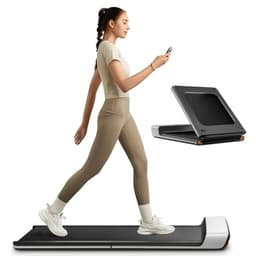
WalkingPad P1
Wider belt in a folding pad
A 16.5 inch belt on a pad that still folds to 32.5 inches — the wider walking surface is the reason to pick it over the Z1.
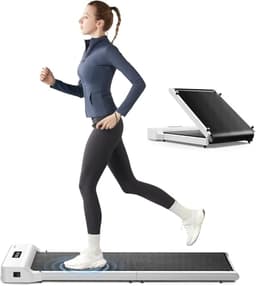
WalkingPad Z1
Smallest storage footprint
The only pad here that folds in half AND stays under 5.5 inches folded, which is the combination a small apartment actually needs.
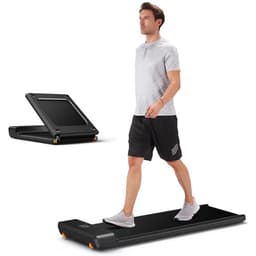
WalkingPad A1 Pro
A published noise figure
One of only two pads on this site whose maker publishes a decibel figure at all, and the only KingSmith model that does.
WalkingPad P1— the only machine on this site with a published wattage, 746 W. That single figure is the reason any of the arithmetic on this page is possible, and it is worth something that KingSmith published it when nobody else did. Its 16.5 inch belt is the joint-widest here; its 220 lb capacity is the joint-lowest, and its remote takes two AAA batteries rather than the CR2032 the rest of the range uses.
WalkingPad Z1— publishes 110 V, the lowest deck here at 4.1 inches and the longest belt at 47.6, and folds to 31.8 inches, which makes it the easiest machine to reposition to reach an outlet. No decibel figure published.
WalkingPad A1 Pro— included as the cautionary one: its published 3.75 HP is the largest motor figure in the range and, by the arithmetic above, cannot be an electrical draw at 110 V. It is also the only KingSmith pad with a published decibel figure, under 65 dB, and the lowest published minimum speed in the category at 0.5 mph.
What we have not done
We have not measured the draw of any machine, tested a cord, or opened a manual we do not have. Everything above is either quoted from the maker pages named below with the date we read them, or arithmetic performed on their published figures and shown in full. We have published no cord gauge, no amperage rating and no approval for an extension cord or a surge protector, because no maker in this category has published one. Your machine’s own manual outranks this page. The full method.
Questions people actually ask
Can you plug a walking pad into an extension cord?
No maker we track publishes permission to, and that is the honest state of the record rather than a dodge. KingSmith's brand FAQ is the only maker document in this category that addresses the power cord and the outlet at all, and its answer covers rated voltage, plug type, cord length varying by model and keeping the cord out of the way as a tripping hazard. It does not mention extension cords or surge protectors. Since the published documentation describes a machine connected to a supply that matches its rated voltage and plug specification, a wall outlet is the only arrangement we are willing to describe as supported.
Can you plug a walking pad into a surge protector or power strip?
Same answer, same reason: nobody in this category publishes a position on it. The question matters because of what a power strip usually has on it already - a monitor, a desktop, a charger - and a walking pad is the largest single load you would add to that strip. The only wattage figure published for any pad we track is the WalkingPad P1's 746 W, which is a motor rating rather than a measured draw. If a machine is going to share a strip with your whole desk, that is the figure to add up against the strip's own rating.
How long is a walking pad power cord?
Not published, by anybody. We checked every machine in our registry and KingSmith's FAQ states explicitly that cord length, outlet placement and power inlet location vary by model, and refers you to the user manual for your specific machine. That makes cord length one of the few practical figures in this category you cannot check before buying - so measure the distance from where the machine will stand to the nearest wall outlet, and treat a long gap as a reason to move the machine rather than to extend the cord.
How many amps does a walking pad draw?
No maker publishes an amperage figure. The one wattage figure in the category is the P1's 746 W at a published 110 V, which works out at about 6.8 amps if the motor were drawing its full rating - and it is not doing that while you walk slowly, because a motor at a slow walking speed is not working at its rating. A standard household branch circuit supplies about 1,800 W at 15 A, so one pad is a modest fraction of a circuit. The caution is not the pad on its own; it is the pad plus everything else already on that circuit.
Why does my walking pad keep cutting out when it is plugged into a strip?
There are at least three unrelated causes and the strip is only one of them, which is why we treat it on its own page. A machine that stops after a long session may be doing exactly what its maker published - KingSmith states a one-hour limit followed by about half an hour off, and says the automatic stop is by design. A machine that stops under load is a different fault pattern. Sorting them by when the stop happens is more useful than swapping cables.
Which walking pads publish anything about their power at all?
Very few figures exist. KingSmith publishes 110 V for the Z1 and 746 W for the P1 - that wattage is the only one we have found for any pad on this site. KingSmith also publishes horsepower figures that cannot be electrical draw: 0.75 HP for the Z1, 3 HP for the C2 and 3.75 HP for the A1 Pro on 110 V machines, where 746 W is exactly one horsepower. A genuine 3.75 HP continuous output would need roughly 2,800 W, which at 110 V is about 25 amps - more than a standard household circuit provides.
Read next
- What does a walking pad cost to run? — the same published wattage, turned into a figure on your bill.
- Why a walking pad keeps stopping — three faults sorted by when the stop happens - usually not the cable.
- How to set up a walking pad — where the outlet measurement belongs: before the machine is ordered.
- A lease-friendly walking pad setup — the cord run, the floor and everything you cannot drill into.
- Do under-desk machines need to be plugged in? — the seated machines, several of which need no power at all.
- Walking pad safety — what we will and will not tell you, and why the cord is on that list.
Sources
- KingSmith / WalkingPad - brand FAQ, read in full for this page: the power-cord-and-outlet answer (rated voltage and plug specification; cord length, outlet placement and power inlet location vary by model; refer to the user manual; position the cord so it does not create a tripping hazard), the voltage and plug-type answer for US products, and the one-hour continuous-use limit. No mention of extension cords, power strips or surge protectors anywhere in the document (read 2026-10-11)
- WalkingPad Z1 - product spec table: the published 110 V figure and the packing list (read 2026-10-11)
- UREVO Strol 2E - product page: power cord listed in the box, no electrical guidance published (read 2026-10-11)
- WalkingPad P1 - product spec table: the 746 W figure, the only wattage published for any pad in our registry (read 2026-07-24)