Do under-desk bikes and ellipticals need to be plugged in?
The short answer is no, and it is one of the strongest arguments for the whole category. The longer answer is about the one component every maker leaves undocumented.
By Stephen V. · Last updated

No. None of the nine seated or standing machines on this site has a motor, and not one lists a power cord, a voltage or a wattage in its specification. You are the engine; the resistance unit only brakes you. The caveat is small but real: every one of them has a display, and no maker publishes how that display is powered.
Why there is nothing to plug in
A treadmill has a motor because the belt has to move whether or not you push it. An under-desk bike, elliptical or stepper has no equivalent requirement: you move the pedals, and the machine’s only job is to make that slightly difficult. Resistance takes energy out of the system rather than putting it in, so it does not need a supply.
Two mechanisms do that job in this category, and both are passive.
Magnetic resistance. A magnet sits near a spinning metal flywheel. Moving it closer induces eddy currents in the flywheel and brakes it, and the only energy involved is the energy you are already putting in. It is also non-contact, which means there is no friction surface to wear out or squeal.
Hydraulic cylinders. The stepper mechanism. Your body weight compresses a cylinder, fluid is pushed through a restriction, and the restriction is the resistance. Xiser publishes that its system moves a silicone-based fluid between two cylinders as you step. No power either.
So “is it electric or manual” has a clean answer for everything in this category: manual. The machine never moves your legs, and that is not a limitation to be designed around — it is the reason the thing is nine inches tall and lives under a desk.
What each maker publishes about its mechanism
We checked all nine, because “it has no motor” should be verifiable rather than assumed. The split:
Magnetic resistance, published outright — four machines. The DeskCycle (eight magnetic settings, up to 39 lb of resistance), the Cubii JR1 (eight magnetic levels), the Cubii Move (six magnetic levels) and the YOSUDA under-desk bike (sixteen magnetic levels).
Hydraulic cylinders, published outright — three machines. The Niceday Mini Stair Stepper, the Stamina SpaceMate and the Xiser, which publishes the most detail of the three.
No mechanism published at all — two machines.The Stamina InMotion E1000, otherwise the best-documented seated machine on this site, describes its resistance only as “adjustable tension” with no count and no mechanism named. The Sunny mini pedal exerciser publishes nothing about resistance whatsoever.
Those last two are the honest limit of this page: neither is sold as a powered machine, neither lists a cord, and neither publishes the words that would let us say so positively. We are recording that rather than rounding it up to “all nine are magnetic”. Every published resistance figure, ranked on magnitude rather than count.
The display, which is the real question
Here is the part that actually sends people searching. The machine needs no power. The little screen on the front is a separate component, and it is the one thing nobody in this category documents.
Every machine we track has one. The DeskCycle publishes a “removable LCD stat tracking display” with Bluetooth. Stamina publishes an electronic fitness monitor showing strides, time and calories on the InMotion E1000, and a monitor showing steps per minute on the SpaceMate. Cubii lists a display type for every model in its range.
Not one of them publishes a battery type, a battery life, a charging method or whether a battery is in the box. We looked specifically for it on each source. Cubii’s own comparison page is the clearest illustration: it has rows for price, resistance levels, portability, app compatibility, display type, color and weight — and no row for power of any kind.
Three practical consequences:
- Treat the display’s power as unknown until the box is open. It may ship with a cell fitted, with one loose, or with none.
- A dead display is not a dead machine. The resistance mechanism is entirely mechanical. A flat battery costs you the numbers, not the exercise.
- The manual is the authority on which cell it takes. We cannot tell you, because nobody published it, and guessing a battery size for a machine we do not own would be exactly the kind of invented specification this site exists not to publish.
If the numbers matter to you, the app route is worth checking before the battery route. Several of these machines publish Bluetooth app tracking, which moves the data to a device that is definitely charged. What those apps can and cannot know about your steps.
The Cubii questions, specifically
Cubii generates most of the searching here, so the direct answers, each against what Cubii actually publishes:
Does it need to be plugged in?No. There is no motor and no cord. Magnetic resistance on both models we track — eight levels on the JR1, six on the Move.
Does it have a motor?No. If a seated elliptical moved your legs for you it would be a different and much heavier product, and the published weights make that clear: Cubii’s own comparison page lists 17.6 lb for the Move, which is about the weight of a full kettle of water.
Does it need batteries, and how do I charge it?Cubii publishes nothing about either, for any model in its range. The machine needs no charging because it has nothing to charge. The display’s power source is undocumented, and “undocumented” is the accurate answer rather than a placeholder for one we could not find — we checked Cubii’s comparison page and the retail listings we source from.
One thing worth knowing while you are here.The JR1 is no longer listed in Cubii’s own elliptical range, which currently shows the Total Body, the Go and the Move. The JR1 is still widely sold by retailers, and the 150 lb maximum user weight on its listing is the lowest published limit on this site. The two machines side by side.
Why this is a buying advantage, not a footnote
Needing no power sounds like a technicality. For several real situations it is the deciding specification.
An office desk you do not own. No outlet to claim, no cable running across a shared walkway, no facilities conversation, and nothing that has to be unplugged before you go home. The same machines ranked for a workplace desk.
A rental you cannot modify. No cable to route, nothing to anchor, and no load on a circuit you share with a neighbor.
A room with one accessible outlet. Which is most small apartments. A walking pad wants that outlet; a seated machine does not care.
No breaker risk at all. A walking pad can trip a shared circuit under load, and it is one of the more common complaints in that category. A machine with no electrical draw cannot. The circuit problem, on the side of the site that has one.
Walking pads are the opposite case
Worth stating plainly so the two halves of this site do not blur together. A walking pad has a motor and must be plugged in. KingSmith publishes 110 V for the WalkingPad range we track, with motor figures from 0.75 HP on the Z1 up to 746 W on the P1, and UREVO publishes 2.25 HP for the Strol 2E.
That brings a set of questions this category simply does not have: what it costs to run, whether it shares a circuit with a kettle or a heater, and what happens when the motor has been working for an hour. What a walking pad costs to run, with the rate stated, and whether a non-electric walking pad exists at all.
The machines that need nothing at all
Three picks, chosen specifically on this page’s subject: each one publishes that it needs no outlet, and each one publishes enough else to be checked before you order. One for a low desk, one for the lowest published height in the category, and one standing machine with no electrical component of any kind.
How this page is funded: the buy links here are Amazon affiliate links, and we earn a commission if you buy through one — at no extra cost to you. It does not change what we rank first, because the commission rate is the same across every machine on this page. Full disclosure.
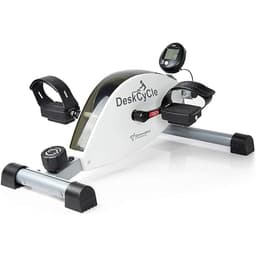
DeskCycle Under Desk Bike Pedal Exerciser
Fitting under a low desk
A 10 inch pedal height is the whole product — it is the seated machine most likely to actually clear a standard 27 inch desk.
Price as of October 4, 2026. #ad How we’re funded
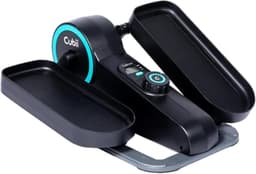
Cubii Move
Lowest published height
The lowest seated machine we have found a published height for, at 9.5 inches — which is the whole argument when your desk apron is the constraint.
Price as of October 4, 2026. #ad How we’re funded
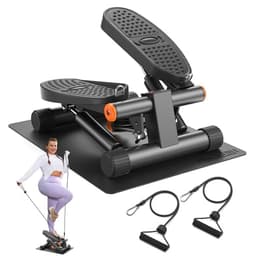
Niceday Mini Stair Stepper
Smallest footprint of anything here
A 16 x 12 inch footprint and a published 300 lb capacity — the most machine per square foot of anything on this site, and the smallest thing here you can genuinely raise your heart rate on.
DeskCycle— publishes “no power outlet” in as many words, alongside a 10 inch overall height, eight magnetic settings to 39 lb, and a removable LCD display. The removable part is useful here: a display you can take off is a display whose battery you can reach.
Cubii Move— ships assembled, needs no outlet, 9.5 inches tall on the retail listing we source from and 17.6 lb on Cubii’s own comparison page, with six magnetic levels and a basic LCD monitor. Cubii publishes no user weight limit for it, which is a real gap worth knowing before this one wins on height.
Niceday Mini Stair Stepper— hydraulic cylinders, so no motor and no outlet, and the machine with the fewest electrical components of anything on this site. A 300 lb published capacity in roughly 1.3 square feet. You cannot use it while typing, which is the trade.
Questions people actually ask
Does a Cubii need to be plugged in?
No. The Cubii machines are seated ellipticals with magnetic resistance and no motor, so there is no power cord and nothing to plug in - you provide all the movement. Cubii's own comparison page lists resistance levels, portability, app compatibility, display type and weight for its current range, and has no power or battery row at all.
Does a Cubii need batteries?
Cubii does not publish an answer, and we are not going to invent one. The machine itself needs no power. The display is a separate question: Cubii lists a 'Backlit LCD Monitor' on two models and a 'Basic LCD Monitor' on the Move, and publishes nothing about how any of them is powered. Treat the display's power source as an unknown you confirm from the box or the manual rather than as something included.
Is a Cubii electric or manual?
Manual, in the sense that matters: there is no motor and the machine does not move your legs. Resistance is magnetic, which means a magnet is moved closer to or further from a flywheel to brake it - that needs no electricity either. The only electrical component anywhere on these machines is the small display.
Do under-desk bikes and ellipticals use electricity?
Not the machine. Of the nine seated and standing machines we track, four publish magnetic resistance outright, three publish hydraulic cylinders, and two publish no mechanism at all - and none of the nine lists a power cord, a voltage or a wattage in its specification. The electricity question in this category belongs to walking pads, which do have motors and do plug into a wall.
Why does my under-desk machine's display not work?
The most common explanation is the thing nobody publishes: the display is battery powered and the battery is flat, or it was never fitted. Because no maker on this site states the battery type, we cannot tell you which cell yours takes - that comes from your manual. What we can tell you is that a dead display is not a dead machine: the resistance mechanism is entirely mechanical and keeps working regardless.
Which machine is best if there is no outlet where I work?
Any of them, which is the quiet advantage of this whole category and the reason it suits a workplace desk you do not control. Nothing needs an outlet, nothing trips a breaker, and nothing has to be unplugged and carried home. A walking pad cannot make any of those claims.
Read next
- Best under-desk cardio for an office desk you do not own — where needing no outlet stops being a footnote and becomes the criterion.
- How to use an under-desk bike or pedal exerciser — setup, the chair problem, and what to do about the display.
- Under-desk machines with adjustable resistance — the mechanisms on this page, ranked on what each one is worth.
- Cubii Move vs Cubii JR1 — why one of them has left Cubii's own range, and the 150 lb limit.
- DeskCycle vs Cubii JR1 — a pedal circle against an elliptical stroke, both at 10 inches.
- Is there a walking pad that needs no electricity? — the same question asked of the motorized half of this site.
- What a walking pad costs to run — the voltage, wattage and circuit figures this category does not have.
- Does under-desk cardio count as steps? — if the display is the reason you cared about the battery.
- Will an under-desk machine fit under your desk? — the measurement that matters more than any of this.
- How we rank these — why 'undocumented' is the answer here rather than a plausible battery size.
Sources
- Cubii — official comparison page: resistance levels, portability, app compatibility, display type and weight for the Total Body, Go and Move; no power or battery row of any kind, and the JR1 not listed (read 2026-10-05)
- VIVO (DeskCycle) — product spec table: magnetic resistance, 8 settings, 39 lb maximum resistance, removable Bluetooth LCD display, 20 x 24 x 10 in; no power requirement listed (read 2026-10-05)
- Stamina InMotion E1000 — product page: electronic fitness monitor showing strides, time and calories; resistance described as adjustable tension with no mechanism named and no battery specification (read 2026-10-05)
- Stamina SpaceMate — product page: hydraulic cylinders and an electronic monitor showing steps per minute; no battery specification (read 2026-10-05)
- Xiser — product page: patented hydraulic piston system moving a silicone-based fluid between cylinders, three knob settings, no power required (read 2026-10-05)
- DeskCycle Under Desk Bike Pedal Exerciser — VIVO (DeskCycle) product spec table, checked for a power requirement and a display battery specification (read 2026-07-24)
- Cubii Move — Rehabmart retail listing spec table, checked for a power requirement and a display battery specification (read 2026-08-11)
- Niceday Mini Stair Stepper — nicedaysteppers.com product page, checked for a power requirement and a display battery specification (read 2026-08-12)
- WalkingPad P1 — 746 W, 110 V, for the contrast with the motorized half of this site (read 2026-08-18)