Cubii Move vs Cubii JR1
Same brand, same idea, half an inch apart in height. The specification sheet points one way and the manufacturer's own website points the other, which is the most interesting thing about this comparison.
By Stephen V. · Last updated

Buy the Cubii Move. The JR1wins on paper — 8 resistance levels to 6, 17.56 in wide to 19.5, and the only published user weight limit of the two — but that limit is 150 lb, the lowest on this site, and it comes from the retailer rather than Cubii. And as of 2026-09-17, Cubii lists the Move in its own elliptical range and does not list the JR1 at all.
How this page is funded: the buy links here are Amazon affiliate links, and we earn a commission if you buy through one — at no extra cost to you. It does not change what we rank first, because the commission rate is the same across every machine on this page. Full disclosure.
The table first
| Model | In use (L x W x H) | Unit weight | Max user | Resistance levels | Published noise |
|---|---|---|---|---|---|
| Cubii Move | 21.5" L x 19.5" W x 9.5" Hretail listing | 17.5 lbretail listing | Not publishednot published | 6retail listing | Not publishednot published |
| Cubii JR1 | 23.2" L x 17.56" W x 10" Hretail listing | Not publishednot published | 150 lbretail listing | 8retail listing | Not publishednot published |
| Stamina InMotion E1000 | 24.5" L x 17" W x 11.38" Hmanufacturer spec | 24 lbmanufacturer spec | 250 lbmanufacturer spec | Not publishednot published | Not publishednot published |
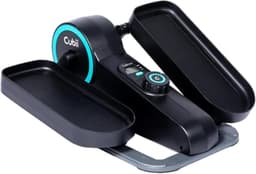
Cubii Move
Lowest published height
The lowest seated machine we have found a published height for, at 9.5 inches — which is the whole argument when your desk apron is the constraint.
Price as of September 24, 2026. #ad How we’re funded
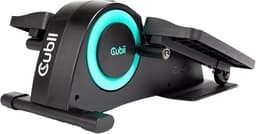
Cubii JR1
Low-impact seated motion
An elliptical stroke instead of a circular one, which keeps the knee lower — and it is the only seated machine here that publishes a user weight limit.
Price as of September 24, 2026. #ad How we’re funded
On paper, the JR1 wins three rows out of four
Let us do the honest version first, because it goes against the recommendation and it would be easy to leave out.
Resistance: 8 against 6.The JR1’s listing states eight magnetic levels; Cubii’s own comparison page states six for the Move. Neither figure tells you how hard any level is — a level count is the number of positions the knob has, not a magnitude — but if you expect to outgrow the bottom of the range, more positions is more room.
Width: 17.56 in against 19.5 in. Nearly two inches narrower, which is the difference between fitting a bench-desk footwell with a pedestal on one side and not.
A published capacity at all: 150 lb against nothing. The JR1 is the only one of the two with any user weight figure attached to it anywhere.
The Move takes the fourth row and takes it decisively for anyone buying for a desk: 9.5 in tall against 10, and 17.5 lb against no published unit weight at all. The footprints are almost identical in area — 2.9 sq ft for the Move against 2.8for the JR1 — but they are different shapes: the Move is wider and shallower, the JR1 narrower and 23.2 in deep, so it reaches further back under a desk than it looks. Which of those two dimensions is your constraint is worth five minutes with a tape measure before you order either.
Then the row that is not on either spec sheet
We read Cubii’s own elliptical range page and its own model comparison on 2026-09-17. Both list three machines: the Go, the Total Body and the Move. Neither lists the JR1.
At the same time the JR1 is still on sale at retail, still carries “Seniors” in its listing title, and still has a 150 lb maximum user weight printed on that listing — a figure Cubii itself has never published for any model, including this one.
We are not going to translate that into an announcement Cubii has not made. What we will say is what it means for a purchase. A mechanical machine with pedals, a linkage and a magnetic brake is a thing you may want a manual, a foot strap or a warranty conversation for in two years. The model that is in the maker’s own current range is the one where those exist. On a product where the two spec sheets are this close, that is not a tiebreak — it is the deciding factor, and it is the reason the Move is the pick despite losing three rows above.
| Model | Weight | Resistance | Display | App | In Cubii’s own range? |
|---|---|---|---|---|---|
| Cubii Move | 17.6 lb | 6 | Basic LCD Monitor | Manual Data Entry | Yes — in the range and the comparison |
| Cubii Go | 19.4 lb | 8 | Backlit LCD Monitor | Manual Data Entry | Yes — in the range and the comparison |
| Cubii Total Body | 22.7 lb | 12 | Backlit LCD Monitor | Bluetooth Seamless Syncing | Yes — in the range and the comparison |
| Cubii JR1 | Not published | 8 (retail listing) | Not published | Not published | No — in neither |
The app row nobody reads until afterwards
Cubii’s comparison page has one column that changes what a lot of buyers think they are getting, and it is not the resistance count.
Under app compatibility, the Move reads “Manual Data Entry”. So does the Go. Only the Total Body — the most expensive machine in the range — reads “Bluetooth Seamless Syncing”. Manual data entry means you read the numbers off the monitor and type them into the app yourself. Display follows the same ladder: “Basic LCD Monitor” on the Move, “Backlit LCD Monitor” on the two above it.
For the JR1 there is no current Cubii statement about app support at all, because the JR1 is not on the comparison page to have a row.
If tracking is a real part of why you want one of these, read that row before the price. And read what a wrist tracker does with seated pedaling before you assume your watch will pick up the slack — in Apple’s own words, it will not.
Where the 150 lb figure comes from, and what to do with it
This matters enough to be precise about. Cubii publishes no maximum user weight for any modelon its own comparison page — not for the Move, not for the Go, not for the Total Body. The 150 lb figure sits on the JR1’s retail listing, and it is the lowest user weight limit of any machine on this entire site.
Two practical consequences. If you are above that figure, the JR1 is not a close call and the extra resistance level does not come into it. And if a stated limit is something you want in writing from the company that made the machine, neither Cubii in this comparison gives you one — which is why the third machine is on this page.
The Stamina InMotion E1000is the only seated machine we track whose maker publishes a maximum user weight: 250 lb, on Stamina’s own page, beside dimensions, a 24 lb unit weight and a 1 year frame / 90 days parts warranty. It is taller at 11.38 in, which is the trade, and it publishes no resistance-level count at all. We rank the seated machines on exactly this criterion if it is the one that decides your purchase.
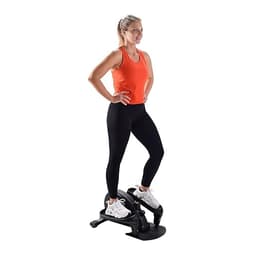
If neither Cubii will state a limit: Stamina InMotion E1000
The only seated machine here whose maker publishes dimensions, unit weight and a user weight limit together — and the tallest of the three, at 11.38 inches.
Price as of September 24, 2026. #ad How we’re funded
Who should buy which
Buy the Move if the machine goes under a desk (9.5 in is the lowest published height in the seated category), if it has to be carried anywhere (17.5 lb is the lightest machine on this site), or if you want the version Cubii is still describing on its own website.
Buy the JR1if your footwell is genuinely narrow — 17.56 in is nearly two inches tighter — and you are comfortably inside the 150 lb figure on its listing, and the extra resistance positions matter to you. Read its depth first: 23.2 in is the deepest machine in this comparison.
Buy neither if what you actually needed was a maker willing to state what the machine will carry. Both Cubiis fail that test and the Stamina passes it.
What we did not do
We have not pedaled either of these machines. We do not own them. Every figure above is read from Cubii’s own pages or from the retail listing, with the date we read it printed beside it in the sources. Our full method.
We have not said the JR1 is discontinued, and we will not, because Cubii has not said it. Absence from a range page is an observation, not an announcement, and the difference matters when somebody is about to spend money on the strength of it.
We have not resolved the JR1’s capacity beyond its listing. Cubii publishes no limit, the listing publishes 150 lb, and the official owner’s manual PDF is an image scan we could not extract text from. We are reporting the figure and its provenance rather than an interpretation of it.
Questions people actually ask
What is the difference between the Cubii Move and the Cubii JR1?
On paper, three things, and the JR1 wins all of them: 8 resistance levels against the Move's 6, a 17.56 inch width against 19.5 inches, and a published maximum user weight of 150 lb where the Move has none at all. The Move wins on height and weight - 9.5 inches against 10, and 17.5 lb against no published figure. The difference that actually decides it is on neither spec sheet: Cubii still lists the Move in its own elliptical range and its own model comparison, and as of September 17, 2026 it lists the JR1 in neither.
Which Cubii should I buy, the Move or the JR1?
The Move, unless you specifically need the narrower footprint. Two reasons. First, the 150 lb maximum user weight on the JR1's retail listing is the lowest limit of anything on this site and rules the machine out for a large share of buyers before any other figure matters. Second, a machine the manufacturer still lists is the machine you can get a manual, a part or a warranty conversation for in two years - and that is worth more on a mechanical product than two extra resistance positions.
Is the Cubii JR1 discontinued?
We cannot tell you that, because Cubii has not said it and we will not infer an announcement from a missing page. What we can tell you is exactly what we observed: on September 17, 2026, Cubii's own elliptical range page lists the Go, the Total Body and the Move, and the JR1 is not among them; Cubii's own model comparison lists the same three and not the JR1. At the same time the JR1 is still on sale at retail with 'Seniors' in the listing title. Read that pattern how you like - we would rather report it than translate it.
Does the Cubii Move connect to the app?
Not automatically. Cubii's own model comparison, read on September 17, 2026, lists the Move's app compatibility as 'Manual Data Entry' - you read the numbers off the machine and type them in yourself. Only the Total Body, the most expensive model in the range, is listed as 'Bluetooth Seamless Syncing'; the Go is also 'Manual Data Entry'. The Move's display is listed as a 'Basic LCD Monitor' against 'Backlit LCD Monitor' for the two above it. If app tracking is the reason you are buying, that row is the one to read first.
Does the Cubii Move or JR1 have a weight limit?
Cubii publishes no maximum user weight for any model on its own comparison page, including both of these. The 150 lb figure attached to the JR1 comes from the retail listing we link, not from Cubii, and it is the lowest limit of any machine on this site. For a machine you put your body weight through, we treat a manufacturer silence as a reason to ask rather than as permission. If a stated limit matters to you, the Stamina InMotion E1000 publishes 250 lb on Stamina's own page.
Which is quieter?
Unknown, and Cubii does not publish a figure for either one. Both listings use a word - the JR1's calls it whisper-quiet - and a word is not a measurement. What is structural rather than claimed: both are magnetic-resistance machines with no motor, so there is no continuous airborne hum, and both are seated, so nothing lands on the floor. The noise these machines make is mechanical, from the linkage. We will not rank two machines on a decibel figure that does not exist for either.
Why do Cubii and the retailer give different weights for the Move?
They differ by a tenth of a pound and we would rather show both than silently pick one. Cubii's own model comparison states 17.6 lb for the Move; the retail listing our dimensions come from states 17.5 lb. It makes no practical difference to anything - it is the lightest machine on this site either way - but the pattern is worth knowing about in this category, because the same two sources disagree about far more consequential figures on other products.
Read next
- Cubii Move review — the full spec breakdown of the pick, including what comes from Cubii and what from a retailer.
- Cubii JR1 review — the machine on paper, with the 150 lb limit read first.
- Cubii JR1 vs Stamina InMotion E1000 — the elliptical head-to-head where a published capacity settles it outright.
- DeskCycle vs Cubii JR1 — pedal circle against elliptical stroke at the same published height.
- Best under-desk ellipticals — the whole category ranked on desk clearance, with both of these in it.
- Best under-desk cardio for an office desk you do not own — the same machines ranked for a fixed-height desk and a daily carry.
- What muscles does an under-desk elliptical work? — what the elliptical stroke does differently from a pedal circle, and where the answer stops.
Sources
- Cubii Move — Rehabmart retail listing spec table (read 2026-08-11)
- Cubii JR1 — Amazon retail listing spec table (read 2026-07-24)
- Stamina InMotion E1000 — staminaproducts.com product page (read 2026-08-11)
- Cubii model comparison — Move 17.6 lb / 6 resistance levels / Basic LCD Monitor / Manual Data Entry; Go 19.4 lb / 8 / Backlit LCD / Manual Data Entry; Total Body 22.7 lb / 12 / Backlit LCD / Bluetooth Seamless Syncing. No dimensions and no maximum user weight for any model; the JR1 is not listed (read 2026-09-17)
- Cubii elliptical range — lists the Go, Total Body and Move; the JR1 is not among them (read 2026-09-17)
- Stamina InMotion E1000 — 250 lb maximum user weight, 24.5 x 17 x 11.38 in, 24 lb, 1 year frame / 90 days parts (read 2026-09-17)