
Pad & Pace

Best under-desk cardio for an office desk you do not own

Every other ranking on this site assumes you control the room. At work you control almost nothing: not the desk height, not the outlet, not the floor. Four machines, ranked for those constraints instead.

By Stephen V. · Last updated

A compact home office desk against an apartment wall with a laptop and chair

The Cubii Move is the pick: at a published 9.5 in it is the lowest seated machine we have found a height for, at 17.5 lb the lightest thing on this site, it ships assembled and it needs no outlet. If your footwell is narrow rather than shallow, the Cubii JR1 is 17.56 in wide. If you need a maker to state a user weight limit, only the Stamina InMotion E1000 does.

How this page is funded: the buy links here are Amazon affiliate links, and we earn a commission if you buy through one — at no extra cost to you. It does not change what we rank first, because the commission rate is the same across every machine on this page. Full disclosure.

Quick picks

Ranked for a desk you cannot adjust, in a room you do not control. Published overall height first, because a workplace desk is a fixed height and the machine has to fit under it as it is. Then unit weight, because this one gets carried in and carried home. Then whether it needs an outlet at all. Then how much of a shared footwell it takes. Price and resistance count are tiebreaks. Select a row to jump to the full write-up. We have not walked on any of these — here is exactly what we did instead.

#ModelBest forKey figurePrice
1
Cubii Move

Cubii Move

The lowest seated machine we have found a published height for, at 9.5 inches — which is the whole argument when your desk apron is the constraint.
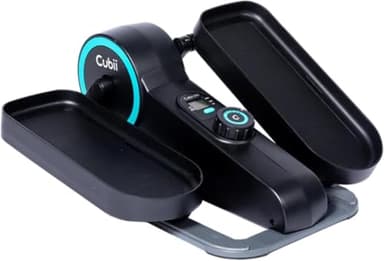
Lowest published height, lightest to carry9.5 in, 17.5 lb
$159.99 · View on Amazon

Price as of September 24, 2026. #ad How we’re funded

2
DeskCycle Under Desk Bike Pedal Exerciser

DeskCycle Under Desk Bike Pedal Exerciser

A 10 inch pedal height is the whole product — it is the seated machine most likely to actually clear a standard 27 inch desk.

The only published resistance magnitude8 settings, 39 lb
$149.99 · View on Amazon

Price as of September 24, 2026. #ad How we’re funded

3
Cubii JR1

Cubii JR1

An elliptical stroke instead of a circular one, which keeps the knee lower — and it is the only seated machine here that publishes a user weight limit.

Narrowest in a shared footwell17.56 in wide
$169.99 · View on Amazon

Price as of September 24, 2026. #ad How we’re funded

4
Stamina InMotion E1000

Stamina InMotion E1000

The only seated machine here whose maker publishes dimensions, unit weight and a user weight limit together — and the tallest of the three, at 11.38 inches.

The only stated user weight limit250 lb stated
$174.99 · View on Amazon

Price as of September 24, 2026. #ad How we’re funded

How we picked these

Ranked for a desk you cannot adjust, in a room you do not control. Published overall height first, because a workplace desk is a fixed height and the machine has to fit under it as it is. Then unit weight, because this one gets carried in and carried home. Then whether it needs an outlet at all. Then how much of a shared footwell it takes. Price and resistance count are tiebreaks.

We have not walked on these machines. We do not own them and we have no test lab. What we did was open each manufacturer’s own specification page, record every published figure with the date we read it, write “not published” where a figure does not exist rather than estimating one, and do the arithmetic ourselves — folded size against a real storage gap, deck length against stride, unit weight against a flight of stairs. The full method, in detail.

Four constraints that invert at work

This site already ranks the seated machines twice — once on desk clearance, once on published maximum user weight. Both rankings quietly assume you own the desk. At a workplace desk you own almost nothing about the situation, and four things change at once:

  • The desk height is fixed. At home, a machine that is an inch too tall is solved by raising the desk. At work there is nothing to raise, so published height stops being a preference and becomes a pass-or-fail test.
  • The machine commutes. Most people do not leave exercise equipment under a desk in a shared office overnight, and in a hot-desking office you cannot. Unit weight is therefore a daily cost rather than a moving-day one.
  • The outlet is not yours. Running a mains cable across a shared footwell is a conversation with facilities, not a purchasing decision. A machine that needs no power avoids the conversation entirely.
  • The floor is shared. A pad needs roughly eight and a half square feet while it runs. A desk footwell is the only floor you have any claim on, and you are sharing its acoustics with everyone in earshot.

Those four together are why no walking pad appears on this page. Every pad we track has a motor, a plug and a footprint, and it needs a desk that rises to standing height. If you do control the room, our home-office ranking covers the pads properly for exactly that case.

Height, against a desk you cannot raise

A standard desk is 29 to 30 inches to the surface and roughly 27 to 28 inches underneath once an apron rail or a shallow drawer is accounted for. That is the number that governs, and it is not the desktop height.

Then the trap: a 10 inch machine does not need 10 inches of clearance.Your foot sits on the pedal at 10 inches and your knee travels higher still as it comes over the top of the stroke. DeskCycle publishes the single most useful statement anyone in this category makes about that — their standard model works at a 27 inch desk for a user 5 ft 8 in or shorter. It is a real, checkable claim tied to a user height, and nobody else in the category offers one.

Of the four machines here, the published heights run 9.5, 10, 10 and 11.38 inches. That 1.88 inch spread sounds trivial and is the whole purchase when the desk cannot move: the Cubii Move at 9.5 inches and the Stamina at 11.38 inches are on opposite sides of a lot of office aprons. The four measurements to take before you order is the page to read before you buy any of them, and it takes five minutes with a tape measure.

Carry weight, which nobody ranks on

Here is a criterion that matters more at work than anywhere else and appears in no ranking we could find, including our own two.

Two of these four machines publish a unit weight: the Cubii Move at 17.5 lb and the Stamina InMotion E1000 at 24 lb. The other two — the DeskCycle and the Cubii JR1 — publish no unit weight at all. For a machine you plan to bring in on Monday and take home on Friday, a maker declining to say what it weighs is a gap worth pricing in, and the silence is not accidental: DeskCycle publishes a full set of dimensions and a resistance figure and stops short of the weight.

The 6.5 lb difference between the two that do publish is the difference between a machine you carry with a laptop bag and one you make a second trip for. If the machine is going to commute, treat this as the second criterion after height rather than an afterthought.

The outlet is not yours

Every machine on this page runs on you. The resistance comes from magnets or a friction mechanism you set by hand, so there is nothing to plug in, nothing to trip a breaker and no cable crossing a shared footwell. DeskCycle states plainly that its machine needs no power outlet, and the Cubii Move ships assembled and needs none either.

That is a bigger deal at work than at home, and it is worth being precise about why. A walking pad draws real current — we have measured what that costs to run against the one published wattage in the category — and in an office that means an extension lead, a facilities conversation and a cable in a walkway. A machine with no plug skips all three.

One honest gap, and it is the same gap on all four: several of these machines have a small display that shows time, revolutions and an inferred calorie figure, and no maker on this page publishes how that display is powered or what replacing its power source involves. Cubii’s own comparison page, read on 2026-09-17, lists a “Basic LCD Monitor” for the Move and a “Backlit LCD Monitor” for the two models above it, and states nothing about power for any of them. We are naming that rather than guessing at it. If you have ever had a console go dark on a machine you liked, that is the specification that would have told you in advance, and it does not exist.

Narrow or shallow: the footwell is a shape

A desk footwell is not one number, and the two machines that look closest on paper are the furthest apart in practice.

The Cubii JR1 is 17.56 inches wide and 23.2 inches deep: narrow, and it reaches a long way back under the desk. The DeskCycle is 24 inches wide and 20 inches deep: it takes real width but stays forward of a shallow footwell. If you are in a bench desk with a divider or a pedestal on one side, width is your constraint and the JR1 wins. If your desk has a modesty panel or a back rail close behind your feet, depth is your constraint and the DeskCycle wins. Reading only the height figure will get this wrong about half the time.

The Cubii Move sits between them at 21.5 inches deep and 19.5 inches wide, which is part of why it tops this page: it is the machine least likely to be ruled out by whichever dimension turns out to be tight.

The four machines side by side

Read the in-use column as three numbers rather than one. The third figure is the height that has to clear your desk; the first two are the depth and width that have to clear your footwell.

Every 'Not published' in this table is a figure the maker declines to state, not one we failed to find. Two of four publish no unit weight, three of four publish no maximum user weight, and not one of the four publishes a decibel figure - in a category whose listings all use the word 'quiet'.
ModelIn use (L x W x H)Unit weightMax userResistance levelsPublished noise
Cubii Move21.5" L x 19.5" W x 9.5" Hretail listing17.5 lbretail listingNot publishednot published6retail listingNot publishednot published
DeskCycle Under Desk Bike Pedal Exerciser20" L x 24" W x 10" Hmanufacturer specNot publishednot publishedNot publishednot published8manufacturer specNot publishednot published
Cubii JR123.2" L x 17.56" W x 10" Hretail listingNot publishednot published150 lbretail listing8retail listingNot publishednot published
Stamina InMotion E100024.5" L x 17" W x 11.38" Hmanufacturer spec24 lbmanufacturer spec250 lbmanufacturer specNot publishednot publishedNot publishednot published

The picks

Ordered by the criterion at the top: published height first, then carry weight, then whether it needs an outlet, then the footwell shape it suits.

#1
pick

Lowest published height, lightest to carry

Cubii Move

The lowest seated machine we have found a published height for, at 9.5 inches — which is the whole argument when your desk apron is the constraint.

Cubii Move
$159.99 · View on Amazon

Price as of September 24, 2026. #ad How we’re funded

It wins on the two criteria a workplace desk actually imposes. At a published 9.5 inches it is the lowest seated machine we have found a height for - half an inch below the Cubii JR1 and nearly two inches below the Stamina, which is the difference between clearing an office apron and not. At 17.5 lb it is the lightest machine of any kind on this site, which is the figure that decides whether it actually commutes with you rather than living in a cupboard by week three. It ships assembled and needs no outlet. Against it: Cubii publishes no maximum user weight for any model in its range and no dimensions on its own product pages, so every figure here comes from a retailer, and its six resistance levels are the fewest on this page.

What the specs give you

  • 9.5 inches tall, half an inch lower than the Cubii JR1 and nearly two inches lower than the Stamina
  • 17.5 lb — the lightest machine of any kind on this site
  • 6 magnetic resistance levels
  • Ships assembled, needs no outlet and nothing to store

What they cost you

  • No user weight limit published on Cubii's own page or the retail listing we read — a real gap on a machine you put your body weight through
  • Cubii's own product page publishes no dimensions, weight or capacity at all; the figures here come from a retailer
  • No stride length published
  • No decibel figure published
Published specifications for the Cubii Move
Footprint in use21.5" L x 19.5" W x 9.5" Hretail listing
FoldedNot publishednot published
Walking beltNot publishednot published
Unit weight17.5 lbretail listing
Max user weightNot publishednot published
Top speedNot publishednot published
InclineNot publishednot published
Published noiseNot publishednot published
Pedal heightNot publishednot published
Resistance levels6retail listing

All figures read from Rehabmart retail listing spec table on 2026-08-11. Where it says “not published”, we checked and no figure exists — we did not estimate one.
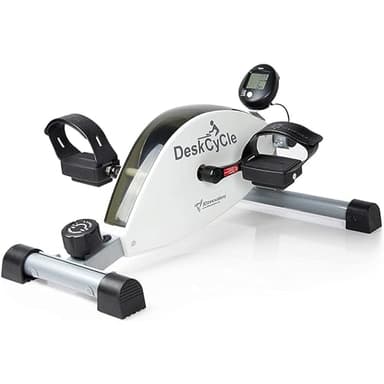
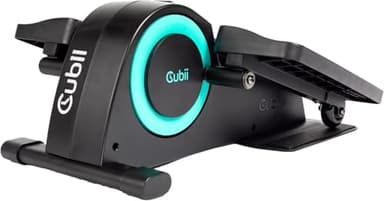
Read the full Cubii Move spec breakdown

#2
pick

The only published resistance magnitude

DeskCycle Under Desk Bike Pedal Exerciser

A 10 inch pedal height is the whole product — it is the seated machine most likely to actually clear a standard 27 inch desk.

DeskCycle Under Desk Bike Pedal Exerciser
$149.99 · View on Amazon

Price as of September 24, 2026. #ad How we’re funded

Second, and the one to buy if you intend to work rather than fidget. It is the only machine on this page - and the only one in this category we have found - that publishes how hard its hardest setting is: eight magnetic settings up to 39 lb of resistance. Everyone else publishes a level count, which tells you how many positions the knob has and nothing about what any of them does. DeskCycle is also the only maker here that states a desk height and a user height together, which is a genuinely checkable claim. Against it: 24 inches wide, so it takes real footwell width; no published unit weight, which matters if it commutes; and no published user weight limit.

What the specs give you

  • 10 inch overall height, which is what lets it live under a desk you already own
  • Eight magnetic resistance settings up to 39 lb of resistance
  • Steel frame, no assembly, no power outlet
  • Nothing to fold or store — it stays where it is

What they cost you

  • 24 inches wide, so it takes real floor width even though it is short
  • The maker publishes no product weight and no user weight limit
  • No decibel figure published
  • Seated pedaling is not walking — the calorie and step comparison is not close
Published specifications for the DeskCycle Under Desk Bike Pedal Exerciser
Footprint in use20" L x 24" W x 10" Hmanufacturer spec
FoldedNot publishednot published
Walking beltNot publishednot published
Unit weightNot publishednot published
Max user weightNot publishednot published
Top speedNot publishednot published
InclineNot publishednot published
Published noiseNot publishednot published
Pedal height10 inmanufacturer spec
Resistance levels8manufacturer spec

All figures read from VIVO (DeskCycle) product spec table on 2026-07-24. Where it says “not published”, we checked and no figure exists — we did not estimate one.

Read the full DeskCycle Under Desk Bike Pedal Exerciser spec breakdown

#3
pick

Narrowest in a shared footwell

Cubii JR1

An elliptical stroke instead of a circular one, which keeps the knee lower — and it is the only seated machine here that publishes a user weight limit.

Cubii JR1
$169.99 · View on Amazon

Price as of September 24, 2026. #ad How we’re funded

Third, and specifically for a narrow footwell: at 17.56 inches wide it is nearly 6.5 inches narrower than the DeskCycle, which is the whole argument in a bench desk with a divider. An elliptical stroke also keeps the knee lower through its travel than a pedal circle does, which matters under a fixed-height desk. Two things hold it back, and the second is the more important. Its 150 lb maximum user weight is the lowest figure of anything on this site and rules the machine out for a lot of buyers - and that figure comes from the retail listing, not from Cubii, whose own elliptical range page (re-checked 2026-09-17) no longer lists the JR1 at all. Buy it for the width, with the limit read first.

What the specs give you

  • 10 inch height, same desk-clearance class as the DeskCycle
  • Elliptical path keeps the knee lower through the stroke than a pedal circle
  • 17.56 inches wide — nearly 6.5 inches narrower than the DeskCycle
  • Eight magnetic resistance levels

What they cost you

  • 150 lb maximum user weight is the lowest limit of anything on this site, and it rules the machine out for a lot of buyers
  • 23.2 inches deep, so it reaches further under the desk than it looks
  • No decibel figure published, despite the listing calling it whisper-quiet
Published specifications for the Cubii JR1
Footprint in use23.2" L x 17.56" W x 10" Hretail listing
FoldedNot publishednot published
Walking beltNot publishednot published
Unit weightNot publishednot published
Max user weight150 lbretail listing
Top speedNot publishednot published
InclineNot publishednot published
Published noiseNot publishednot published
Pedal height10 inretail listing
Resistance levels8retail listing

All figures read from Amazon retail listing spec table on 2026-07-24. Where it says “not published”, we checked and no figure exists — we did not estimate one.

Read the full Cubii JR1 spec breakdown

#4
pick

The only stated user weight limit

Stamina InMotion E1000

The only seated machine here whose maker publishes dimensions, unit weight and a user weight limit together — and the tallest of the three, at 11.38 inches.

Stamina InMotion E1000
$174.99 · View on Amazon

Price as of September 24, 2026. #ad How we’re funded

Fourth on this page's criteria and first on a different one. It is the only seated machine we track whose maker publishes a maximum user weight, and 250 lb arrives alongside dimensions, a 24 lb unit weight and a 1 year frame / 90 days parts warranty - the most complete published spec set in the category. Stamina also states the frame is rated for standing as well as seated use, and the pedals reverse. It is fourth here only because at 11.38 inches it is the tallest machine on the page and therefore the one most likely to be ruled out by an office apron or a shallow drawer. If the desk has room, this is arguably the best-documented purchase on the page.

What the specs give you

  • Stamina publishes dimensions, product weight and capacity on its own page — the only elliptical here where all three come from the manufacturer
  • 250 lb user capacity, 100 lb higher than the Cubii JR1's published limit
  • 24 lb, light enough to move between rooms one-handed
  • Pedals reverse, and the frame is rated for standing as well as seated use

What they cost you

  • 11.38 inches tall — the tallest of the three ellipticals here, and the one most likely to foul a low desk apron
  • Stamina publishes no resistance-level count, only 'adjustable tension'
  • No stride length published, so you cannot check the knee travel before buying
  • No decibel figure published
Published specifications for the Stamina InMotion E1000
Footprint in use24.5" L x 17" W x 11.38" Hmanufacturer spec
FoldedNot publishednot published
Walking beltNot publishednot published
Unit weight24 lbmanufacturer spec
Max user weight250 lbmanufacturer spec
Top speedNot publishednot published
InclineNot publishednot published
Published noiseNot publishednot published
Pedal heightNot publishednot published
Resistance levelsNot publishednot published

All figures read from staminaproducts.com product page on 2026-08-11. Where it says “not published”, we checked and no figure exists — we did not estimate one.
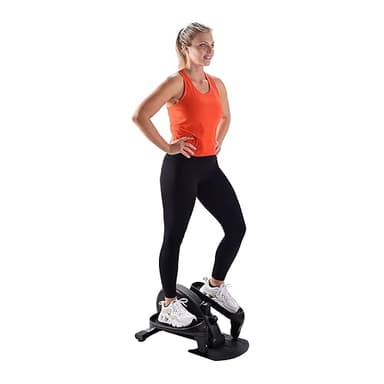
Read the full Stamina InMotion E1000 spec breakdown

Skip this one

Anything that needs an outlet, and anything that publishes no height

Skip the whole motorized category for a workplace desk. That includes every walking pad on this site. Not because they are bad machines — we rank eight of them and recommend them constantly — but because a mains plug, eight and a half square feet of shared floor, a fixed-height desk and a motor in a room full of calls are four separate blockers, and you would have to solve all four. The seated machines exist for precisely this situation.

And skip anything whose listing publishes a resistance count and no height. There is a large tier of this category that states the number of levels, the app it pairs with and the color, and then no overall height, no footprint and no unit weight. The YOSUDA under-desk bike is the clearest example we track: 16 magnetic levels, double anything on this page, and no published pedal height at all— the single figure that decides whether it fits the desk you are buying it for. For a machine you cannot try before it arrives at an office, being asked to buy on faith and return it at your own inconvenience is a real cost.

What it will and will not do at a desk

It replaces stillness, not exercise.Seated pedaling moves your legs through a small range against light resistance while your body weight stays in the chair. Nothing is weight-bearing, and the total work is low — which is exactly why you can do it through a meeting. Against a day of sitting completely still it is a clear improvement. Against a walk it is not close, and we set out the full account rather than letting the listings do it.

Your watch will barely register it. This surprises people more than anything else about these machines, and it is the most common reason one ends up unused: a wrist tracker reads arm motion, and there is none. Why an hour of pedaling shows up as almost nothing, with Apple’s and Fitbit’s own wording on it.

We have not used any of these machines at a desk, or anywhere else. There is no test lab here. Every figure above is read from a manufacturer or retailer page with the date we read it, and the arithmetic is ours. Our full method. This is general information about published specifications, not medical advice.

Questions people actually ask

What is the best under-desk machine for an office?

On published specifications, the Cubii Move. It is the lowest seated machine we have found a published height for at 9.5 inches, the lightest machine of any kind on this site at 17.5 lb, ships assembled and needs no power outlet - which is four out of four on the constraints a workplace desk actually imposes. The trade is that Cubii publishes no maximum user weight for any model in its range and no dimensions on its own product page, so the figures we use come from a retailer. If your footwell is narrow rather than shallow, the Cubii JR1 is 17.56 inches wide against the Move's 19.5.

Can you use a walking pad at a workplace desk?

Usually not, and the blockers are rarely the ones people plan for. A pad needs a mains outlet you do not own, roughly eight and a half square feet of floor in a room whose floor is shared, a desk that raises to standing height when the office desk is a fixed height, and it makes motor noise in a room full of people taking calls. Any one of those can be worked around; all four at once is why the seated machines exist. If you do control the room, our home-office ranking covers the pads properly.

Do under-desk bikes and ellipticals need to be plugged in?

The ones on this page do not. The DeskCycle is a steel frame with magnetic resistance and no power requirement at all, and the Cubii Move ships assembled and needs no outlet. What some of them do have is a small display for time and revolutions, and no maker on this page publishes how that display is powered or what it takes to replace the power source - which is a real gap on a machine you may keep for years, and we would rather name it than fill it in.

How much height do you need under a desk for a pedal exerciser?

More than the machine's own height, because your knee rises above the pedal as it comes over the top of the stroke. A standard desk is 29 to 30 inches to the surface and roughly 27 to 28 inches underneath once an apron or a shallow drawer is accounted for. DeskCycle publishes the single most useful statement anyone in this category makes about it: their standard model works at a 27 inch desk for a user 5 ft 8 in or shorter. Nobody else publishes a user height at all.

Will colleagues hear it?

We cannot tell you, because not one machine on this page publishes a decibel figure. Every listing in this category uses a word instead - quiet, whisper-quiet, silent - and a word is not a measurement. What we can say structurally is that none of these machines has a motor, so there is no continuous airborne hum of the kind a walking pad produces; the sound is mechanical, from the pedal linkage and the resistance mechanism. If the room is the reason you are buying a seated machine rather than a pad, that structural difference is the real answer, not a number we would have to invent.

Which is best if I share the footwell or hot-desk?

Carry weight decides it, and the spread is larger than the height spread. The Cubii Move is 17.5 lb and the Stamina InMotion E1000 is 24 lb, both published; the DeskCycle and the Cubii JR1 publish no unit weight at all, which for a machine you intend to carry daily is a gap worth weighing. On footprint, the JR1 is the narrowest at 17.56 inches but also 23.2 inches deep, so it reaches further under the desk than it looks. The DeskCycle is the opposite: short front to back at 20 inches, and 24 inches wide.

Is a seated machine at work actually worth doing?

It is competing with sitting completely still, and it wins that comparison comfortably. It is not competing with a walk, and it loses that one badly. Seated pedaling moves your legs through a small range against light resistance while your body weight stays in the chair, so nothing is weight-bearing and the total work is low. If the honest goal is 'be less motionless between 9 and 5', this is a reasonable purchase. If the goal is to replace exercise, it is not, and we set out why in full on our page about whether these machines do anything.

Sources