Under-desk bike vs under-desk elliptical
Two shapes of the same idea, and the difference between them is geometry rather than marketing. It shows up in exactly one place: how high your knee goes.
By Stephen V. · Last updated
If your desk apron is the constraint, take the elliptical: a pedal circle lifts your knee by the full crank diameter, an elliptical stroke flattens it into an oval. If you want published data and a resistance range you can check, the bikes are better documented — the DeskCycle is the only machine here that tells you what desk height it actually suits.
How this page is funded: the buy links here are Amazon affiliate links, and we earn a commission if you buy through one — at no extra cost to you. It does not change what we rank first, because the commission rate is the same across every machine on this page. Full disclosure.
Four machines, everything published
| Model | In use (L x W x H) | Unit weight | Max user | Resistance levels | Published noise |
|---|---|---|---|---|---|
| DeskCycle Under Desk Bike Pedal Exerciser | 20" L x 24" W x 10" Hmanufacturer spec | Not publishednot published | Not publishednot published | 8manufacturer spec | Not publishednot published |
| YOSUDA Under Desk Bike | Not publishednot published | Not publishednot published | Not publishednot published | 16retail listing | Not publishednot published |
| Cubii JR1 | 23.2" L x 17.56" W x 10" Hretail listing | Not publishednot published | 150 lbretail listing | 8retail listing | Not publishednot published |
| Stamina InMotion E1000 | 24.5" L x 17" W x 11.38" Hmanufacturer spec | 24 lbmanufacturer spec | 250 lbmanufacturer spec | Not publishednot published | Not publishednot published |
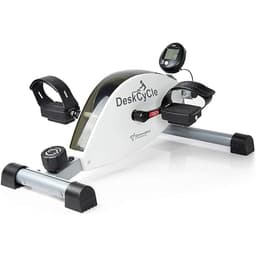
DeskCycle Under Desk Bike Pedal Exerciser
Fitting under a low desk
A 10 inch pedal height is the whole product — it is the seated machine most likely to actually clear a standard 27 inch desk.
Price as of September 25, 2026. #ad How we’re funded
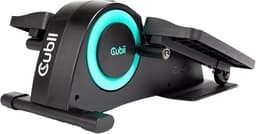
Cubii JR1
Low-impact seated motion
An elliptical stroke instead of a circular one, which keeps the knee lower — and it is the only seated machine here that publishes a user weight limit.
Price as of September 25, 2026. #ad How we’re funded
The geometry, which is the only real difference
A pedal exerciser is a crank. Your foot travels a circle, and the highest point of that circle is one crank diameter above the lowest. Your knee follows, so the vertical travel of your knee is set by the crank length, and it is the same on every rotation.
An elliptical stroke uses a linkage that stretches that circle into an oval: longer horizontally, flatter vertically. The same leg movement produces less vertical knee travel. That is why an elliptical is easier to fit under a desk than a bike of the same overall height, and it is a statement about mechanism rather than a claim about outcomes.
What it does not do is help with the machine’s own height. The frame is still the frame — 10 inches on the Cubii JR1, 11.38 on the Stamina, 10 on the DeskCycle. The elliptical advantage is entirely in the space above the machine, not below your knees.
And the honest limitation: nobody publishes a stride length. Not Cubii, not Stamina. So the geometric advantage is real and unquantified, and we cannot tell you how many inches of knee travel any specific machine saves you.
Where the bikes are ahead
One of them tells you what desk it fits
The DeskCycle is the only machine in this entire category that publishes a usable fit statement rather than a bare dimension: the standard model works at a 27-inch desk for a user around 5 ft 8 in or shorter, and the adjustable version sets to 9 or 10 inches and extends that to roughly 5 ft 10 in. That is a claim you can test yourself against before spending anything, and no elliptical here offers an equivalent.
Resistance range
The YOSUDA publishes sixteen magnetic levels and the DeskCycle eight, up to a stated 39 lb of resistance. On the elliptical side the Cubii JR1 publishes eight, the Cubii Move six, and Stamina publishes no count at all. If you want a fine adjustment for long sessions, the bikes lead.
Simplicity
A crank is a crank. There is less linkage to develop play and fewer moving parts overall. That is not a durability claim — we have not used any of these long enough to make one — but it is the reason a simple pedal exerciser is the cheapest way into this category.
Where the ellipticals are ahead
Knee travel, as above
The main structural argument, and it matters exactly as much as your desk apron does. If you have measured and you have room to spare, it stops mattering entirely.
The lowest machine here is an elliptical
The Cubii Move at 9.5 inches is the lowest frame on this site. It is also the machine with no published user weight limit anywhere, which is a real caveat — we go through it in the review.
The best-documented machine is an elliptical
The Stamina InMotion E1000 is the only machine on this page whose maker publishes dimensions, unit weight and a user weight limit together, and its 250 lb capacity is the highest published figure of the four. It is also the tallest, at 11.38 inches. Those two facts sit awkwardly together and they are both true.
Narrower footprints
The Cubii JR1 is 17.56 inches wide against the DeskCycle’s 24 — nearly six and a half inches narrower. Under a desk with pedestals or a narrow knee well, width is the second constraint after height, and the ellipticals here are consistently narrower.
Measure before you choose either
Almost every returned machine in this category is a fit failure rather than a quality failure, and it is avoidable with four measurements taken before you order. Floor to the underside of the desk. Floor to the underside of anything lower than that — a drawer box, a crossbar, a frame rail. Depth from your chair to the back of the knee well. And your own seated knee height.
We walk through all four and the arithmetic that follows. Do that first, and the choice between these two shapes usually makes itself.
What neither category settles
Noise: not one of the four machines here has a published decibel figure, and two of them are marketed as whisper-quiet. What is categorically true, and matters more than any of those adjectives, is that a seated machine makes no footfall — so unlike a walking pad, there is no impact energy entering the floor structure. That is the strongest argument for a seated machine in an apartment.
Also unsettled: bearing feel, whether the linkage develops play, and how any of them last. We have used none of these machines and would not pretend otherwise.
Choose a bike if...
- You have comfortable desk clearance and do not need the geometry.
- You want the widest published resistance range.
- You want a maker that states what desk height it suits.
- You want the cheapest way into the category.
Choose an elliptical if...
- Your desk apron is low, or there is a drawer box in the way.
- Your knee well is narrow — the ellipticals here are slimmer.
- You want the lowest frame available (Cubii Move, 9.5 in).
- You want the best-published machine in the category (Stamina, 250 lb).
Questions people actually ask
Is an under-desk elliptical better than an under-desk bike?
For desk clearance specifically, the elliptical geometry is genuinely better and the reason is mechanical rather than marketing. A pedal exerciser moves your foot around a circle, so your knee rises by the full diameter of that circle. An elliptical flattens the same leg movement into an oval, which produces less vertical knee travel. If the underside of your desk is the constraint, that is a real advantage. On everything else — resistance range, published capacity, price — the bikes hold up perfectly well.
Which is lower, an under-desk bike or an under-desk elliptical?
The published heights across the machines we track are: DeskCycle 10 inches, Cubii JR1 10 inches, Stamina InMotion E1000 11.38 inches, and the Cubii Move at 9.5 inches. So the lowest machine on this site is an elliptical and so is the tallest — the category matters less than the specific model. What is consistent is knee travel above the machine, and that is where the elliptical shape helps.
Which burns more calories, a desk bike or a desk elliptical?
Nobody publishes data that would let us answer that honestly, and any specific figure you see for either is an estimate dressed up as a measurement. Both are seated, low-resistance, low-intensity activity, and both are dominated by how long you actually do them for rather than by the machine. The displays on these machines calculate calories from a movement count and know nothing else about you.
Do under-desk bikes and ellipticals need power?
None of the four machines here needs an outlet. Resistance is magnetic and set by hand, and the displays are self-powered or battery-driven. That is a genuine practical advantage over a walking pad, which needs both a socket and somewhere for the cable to run, and it means these machines can live wherever a chair does.
Which is quieter?
Nobody in this category publishes a decibel figure — not for a single one of the four machines on this page. What is categorically true of all of them, and is the real answer for an apartment, is that a seated machine produces no footfall at all. Nothing lands, so nothing enters the floor structure as impact energy, and that is the transmission path behind almost every noise complaint about home cardio.
Read next
- What muscles does an under-desk bike or elliptical work? — the circle against the oval at the level of the joint rather than the desk.
- Will an under-desk bike fit under your desk? — the four measurements to take before you buy either shape.
- DeskCycle vs Cubii JR1 — the same argument narrowed to the two best-known machines.
- Best under-desk ellipticals — three machines, and how little two of them publish.
- Best under-desk bikes and pedal exercisers — two of four publish a pedal height. One publishes a capacity.
- Walking pad vs under-desk elliptical — if you are still deciding between seated and standing.