Walking pad vs under-desk elliptical
These are not two grades of the same product. One needs floor space, storage and a desk that raises. The other needs vertical clearance under a desk you already own. You have one of those problems.
By Stephen V. · Last updated
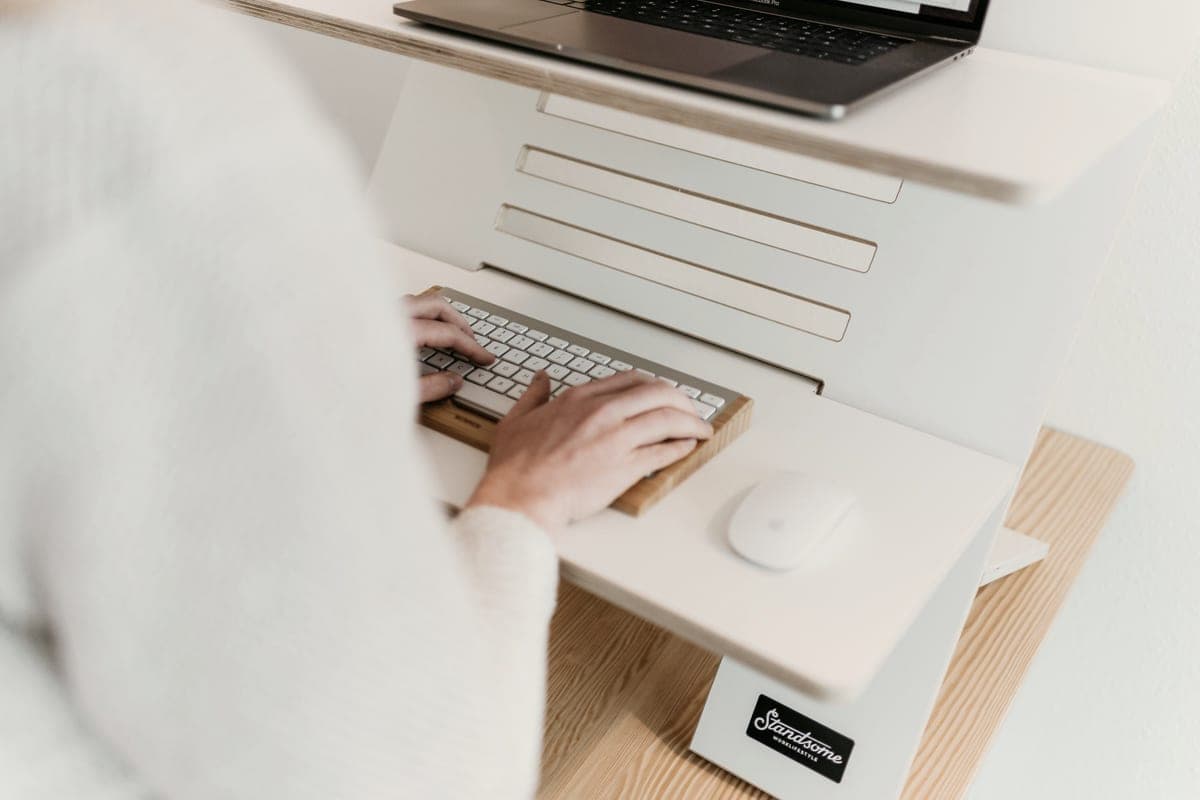
If you have the floor space and a desk that raises, take the walking pad— standing and walking recruits far more of you than seated pedaling, and that is not close. Take the seated elliptical when one of three things is true: no storage at all, a fixed-height desk, or a floor where footfall noise is not negotiable.
How this page is funded: the buy links here are Amazon affiliate links, and we earn a commission if you buy through one — at no extra cost to you. It does not change what we rank first, because the commission rate is the same across every machine on this page. Full disclosure.
A representative machine from each side
| Model | In use (L x W x H) | Folded (L x W x H) | Unit weight | Max user | Published noise |
|---|---|---|---|---|---|
| WalkingPad Z1 | 56.1" L x 22" W x 4.1" Hmanufacturer spec | 31.8" L x 22" W x 5.4" Hmanufacturer spec | 51 lbmanufacturer spec | 242 lbmanufacturer spec | Not publishednot published |
| Stamina InMotion E1000 | 24.5" L x 17" W x 11.38" Hmanufacturer spec | Not publishednot published | 24 lbmanufacturer spec | 250 lbmanufacturer spec | Not publishednot published |
WalkingPad Z1
Smallest storage footprint
The only pad here that folds in half AND stays under 5.5 inches folded, which is the combination a small apartment actually needs.
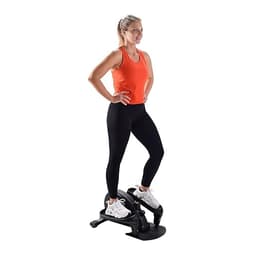
Stamina InMotion E1000
The most complete published spec
The only seated machine here whose maker publishes dimensions, unit weight and a user weight limit together — and the tallest of the three, at 11.38 inches.
Price as of September 25, 2026. #ad How we’re funded
What each machine actually asks of your room
The specification tables answer different questions for these two categories, which is why a straight side-by-side is misleading unless you know what to look at.
The pad asks for floor, and for a plan
In use, the Z1 occupies about 8.6 square feet of floor. That is not a lot in the abstract and it is a great deal in a studio, because it has to be clear floor in a straight line, and because you cannot walk through it while it is out.
Then it asks the harder question: where does it go afterwards? Folded dimensions are the entire reason this site exists, and the honest answer for a lot of rooms is “nowhere”. A pad with no storage plan gets left out, and a pad left out in a small room stops being a fitness purchase and starts being furniture you resent.
And it asks for a desk that raises. The deck adds 4.1 to 7 inches to your standing height across the models we track, and a desk built for sitting will not reach. That arithmetic is here, and it is a hard pass-or-fail rather than a preference.
The elliptical asks for vertical clearance
About 2.9square feet of floor — roughly a third of the pad — and crucially, floor you were not using anyway, in the void under your desk where your feet already live. Nothing to fold, nothing to store, no outlet needed.
What it asks instead is vertical: your knee rises through the top of the stroke, and if the underside of your desk sits lower than that, the machine is unusable rather than uncomfortable. The seated machines we track publish overall heights of 9.5 to 11.38 inches, and that is the floor of the requirement, not the whole of it. The four measurements to take are here.
It also asks a question the pads mostly do not: what do you weigh? Published limits in the seated category range from 150 lb to 250 lb across machines that look nearly identical, which is a far wider spread than the pads’ 220 to 300.
The part where we do not split the difference
Seated pedaling is not walking, and the gap is not marginal. Standing puts your postural muscles to work before the machine does anything; walking adds hip, glute and calf drive through a full range; your bodyweight is being carried rather than supported by a chair. Sitting removes all of that and leaves a leg movement.
We are not going to attach numbers to that, because a calorie comparison we cannot source is exactly the kind of confident-sounding fabrication this site exists to avoid. The categorical statement stands on its own and it is not controversial: if you can be on your feet, be on your feet.
Which is why the honest recommendation runs the way it does. The seated machine is not a lesser walking pad for people with less commitment. It is the right machine for three specific constraints, and the wrong one if you do not have any of them.
The one place the elliptical wins outright
Noise, and it is worth being precise about why, because it is not a decibel argument.
A walking pad produces two kinds of noise. Airborne — motor, belt, fan — which is what a decibel rating measures and which mostly stays in your room. And structure-borne: every footfall puts impact energy into the deck, through the floor, and out of the ceiling below as a thump. That second path is what generates neighbor complaints, and it is the one no spec sheet describes.
A seated machine has no footfall. Not a quieter footfall — none. The structure-borne path does not exist, and no amount of matting under a walking pad fully closes that gap.
If you are on an upper floor in a building with thin construction, and the thing actually stopping you buying is the person below, that is the argument for a seated machine and it is a good one. The full explanation of the two paths is here.
Choose the walking pad if...
- Your desk raises, or you are prepared to buy one that does.
- You have a specific storage plan — a measured gap, not “somewhere”.
- You are on a ground floor, or on a slab, or matting is a real option.
- You want the exercise to be meaningfully more than a leg movement.
- You want one machine that also does non-desk walking.
Choose the under-desk elliptical if...
- Your desk does not raise and replacing it is not happening.
- There is genuinely nowhere to store a folded pad. Not “it would be tight” — nowhere.
- The floor between you and a neighbor is the binding constraint.
- You want low-impact motion specifically — the elliptical path keeps the knee lower than a pedal circle does.
- You are under the published user weight limit. Check it first.
Questions people actually ask
Is a walking pad or an under-desk elliptical better?
If you have floor space and somewhere to store the machine, the walking pad, and it is not close — standing and walking recruits far more of you than seated pedaling does. The elliptical wins on three specific constraints: no floor space at all, a desk that does not raise, or a floor where footfall noise is genuinely not negotiable. It is a real answer to those constraints rather than a worse version of a pad.
How much floor space does each one need?
Computed from published dimensions, a WalkingPad Z1 occupies about 8.6 square feet in use and a Stamina InMotion E1000 about 2.9 — roughly a third. But the comparison is misleading on its own, because the pad's floor space is reclaimed when you fold it and the elliptical's never was floor space you were using; it sits in the void under your desk that your feet share.
Do you need a standing desk for a walking pad?
Effectively yes. A walking pad raises you by its deck height — 4.1 to 7 inches across the models we track — and a desk built for a seated user will not reach that. A seated elliptical needs no desk adjustment at all, which for someone with a fixed-height desk is often the whole decision, before any question of which gives a better workout.
Which is quieter for apartment neighbors?
The elliptical, categorically, and this is the one comparison here that is not close. A seated machine produces no footfall, so there is no impact energy entering the floor structure — which is the transmission path behind almost every walking pad noise complaint. It is not a question of decibels; it is a question of which physical path exists, and for a seated machine one of them does not.
Can you use an under-desk elliptical while standing?
Some are sold for it — the Stamina InMotion E1000 is rated for standing as well as seated use, for example. That is not the same as walking, and it does not turn the machine into a walking pad. If you want to be on your feet while you work, the pad is the machine designed for it.
Read next
- Best under-desk ellipticals — the three machines we track, and how little each maker publishes.
- Walking pad vs under-desk bike — the same fork with a pedal circle instead of an elliptical stroke.
- Will an under-desk machine fit under your desk? — the measurements that settle the seated half of this decision.
- Are walking pads loud? — the two transmission paths, and why only one of them matters here.
- Are walking pads worth it? — the comparison before this one — buy anything at all, or not.