Walking pad vs elliptical
These two machines take up almost exactly the same floor. One of them then folds to five inches and the other is five and a half feet tall for the rest of its life - and the stride it gives you is shorter than the one you walk with.
By Stephen V. · Last updated
On published figures the two machines occupy the same floor area — 8.6 sq ft for the Sunny elliptical, 8.6 sq ft for a WalkingPad Z1 in use. What separates them is height and what happens afterwards: the pad folds to about 4.9 sq ft at 5.4 in tall, the elliptical is 64.8 in tall and does not move. And the figure nobody mentions: published elliptical strides are 16 to 20 in, shorter than the roughly 30.1 in stride a 5 ft 10 in walker already has.
How this page is funded: the buy links here are Amazon affiliate links, and we earn a commission if you buy through one — at no extra cost to you. It does not change what we rank first, because the commission rate is the same across every machine on this page. Full disclosure.
What we track, and what we do not
Pad & Pace tracks walking pads and under-desk machines. That includes the small seated ellipticals that go beneath a desk, which we rank. It does not include full-size standing ellipticals, we have not used one, and we are not going to publish an elliptical ranking dressed up as research.
So this page does what our upright-bike comparison and our rowing-machine comparison do: two real machines, one at each end of the category, read from their makers’ own pages on 2026-10-27, set beside the pads we do track.
- SOLE E25, the reference end. Its specifications publish 70 L x 24 W x 70 H in, a machine weight of 209, with a gross shipping weight of 231 and no unit printed against either figure, a 350 lb maximum user weight, a 20 in stride, 20 levels of magnetic resistance, a 20 lb flywheel, power incline, 20 levels, with no range in degrees published, 110V plug-in, listed as AC120V/60Hz, and a warranty of lifetime frame and flywheel, 2 years magnetic brake, 2 years electronics, 1 year parts, 90 days labor. Whether it folds is not published.
- Sunny Health & Fitness Pro Smart Magnetic Elliptical Trainer (SF-E323038), the budget end — and the same maker as one of the walking pads in our registry, which means one company’s own documents sit on both sides of this comparison. It publishes 48 L x 25.8 W x 64.8 H in, a 300 lb maximum user weight, a 16 in stride, 16 resistance levels and a magnetic tension system. Product weight is not published, flywheel weight is not published, incline is not published, the power requirement is not published, the warranty is listed as Manufacturer Warranty with no stated duration, and folding is not published, though the page mentions transportation wheels.
If you want an elliptical recommendation, this is not the site for it. If you are trying to work out which of these belongs in a room you also have to live in, keep reading.
The same floor, a different room
This is the result we did not expect, and it is the most useful thing on the page.
The Sunny elliptical’s published base is 48 by 25.8 in, which is 8.6 sq ft. The WalkingPad Z1’s published open dimensions work out to 8.6 sq ft. To one decimal place those are the same number. On floor area alone, a compact elliptical and a walking pad are the same purchase.
Everything that actually decides this is in the third dimension and in what happens when you step off. The elliptical is 64.8 in tall — 5 ft 5 in — and the SOLE is 70 in, which is 5 ft 10 in. Neither maker publishes a folded state at all. The Z1 folds to about 4.9 sq ft at 5.4 in tall and slides under a bed. Our storage-fit arithmetic runs every folded figure against real gaps for exactly this reason: in a rented room the question is not how much floor the machine uses, it is how much of your home it occupies for the 23 hours you are not on it.
The SOLE is a larger object on both counts: 70 L x 24 W x 70 H in is 11.7 sq ft, roughly 1.4times the pad’s floor in use, and at 5 ft 10 in it is taller than most of the people who will stand on it.
One figure in the elliptical’s favor, because this cuts both ways: an elliptical needs no clearance behind it. A walking pad does — you have to be able to step off the back — and no pad maker publishes that number either, which is why our space-requirements guide has to build it from the deck up.
The figure that changes the question
Both elliptical makers publish a stride length. Not one of the eight walking pads we track publishes anything equivalent, so this is the first comparison on the site where the other category has the better figure — and once you have it, the popular framing of this choice falls apart.
Published strides: 16 in for the Sunny, 20 in for the SOLE.
Now the other side of the arithmetic, using the same rule of thumb the rest of this site uses — stride length as roughly 0.43 of standing height, cited as a rule of thumb rather than an ergonomic standard. A 5 ft 10 inwalker’s stride is about 30.1 in. A 5 ft 4 in walker’s is about 27.5 in.
So the longest published elliptical stride here, 20 in, is about 10.1 in shorter than the stride a 5 ft 10 in walker already has — and the Sunny’s 16 in is about 11.5 in shorter than the stride of a walker as short as 5 ft 4 in. An elliptical is not a walking pad with resistance bolted on. It is a shorter, guided, closed foot path, and your foot never finishes the movement it would make on a belt.
We are not saying that is bad. A closed path is precisely why some buyers want one: nothing lands, nothing has to be balanced, and the motion repeats identically. But it means two things for this comparison. First, “it is like walking but harder” is not what the specifications describe. Second, the pads this site tracks give you a belt between 27.6 and 47.6 in long to put a 30 in stride on, and the deck-against-stride arithmetic says one of them is already shorter than that stride. A pad can constrain your stride too — the difference is that the elliptical publishes the constraint and the pad makes you work it out.
The flip side, and it is a real one for anyone short: our short-walker ranking exists because the deck figures stop binding under about 5 ft 4 in. A 16 in elliptical stride does not stop binding at any height in that range, because 16 in is below every stride in the table.
Scheduled against accumulated
This is the part most comparisons get backwards by treating the two machines as different intensities of the same thing.
Neither elliptical page describes desk use, publishes a desk-friendly mode, or mentions working while using the machine — and the published heights make the question moot: 64.8 in and 70 in are machines that stand in front of a desk rather than under one. An elliptical session is a session. It competes with your working day for time.
A walking pad’s whole economic argument is that it does not. Its minutes happen while you answer email, and the public guidance is written in minutes per week rather than in sessions. The honest way to put the choice is a question about your calendar, not your fitness: will you reliably schedule 30 minutes, or do you need the movement to happen inside time you have already committed?
Where the elliptical wins outright is progression. It publishes 20 resistance levels and a power incline on the SOLE, 16 levels on the Sunny, and five of the eight pads we track publish no incline at all. A flat belt at 3 mph has nowhere to go once it stops being hard, which is the single best argument for buying the bigger machine — and the reason people start asking about weighted vests instead.
What each category publishes about your body
We have now read three machine categories outside our own — rowers, vibration plates and ellipticals — and the same pattern holds every time: everybody else publishes more about the body than the walking pad industry does.
The ellipticals publish a stride length. SOLE publishes a flywheel weight, a power requirement and a five-line warranty schedule. Both publish a maximum user weight — 300 lb and 350 lb— against 220 to 300 lb across our pads, with the highest pad figure coming from the one listing that publishes nothing else. Which of those capacity numbers to trust.
It is not a clean win for the elliptical category, though, and we should say where it fails on its own terms. Sunny publishes no product weight for a machine somebody has to get into a room, and no warranty duration at all. SOLE publishes an incline with 20 levels and no range in degrees, which is the same unit problem that makes our own incline page refuse to convert between degrees and percent. And neither publishes a folded dimension, because neither machine folds — which is the honest version of the storage answer rather than a documentation gap.
The clear win for the elliptical
If the person below you is the binding constraint, the elliptical is structurally the better machine and we are not going to pretend otherwise.
On a belt, every step lands, and footfall is what gets into a building’s structure — which is why a dense mat under the deck is the standard fix and why our noise guide is mostly about transmission rather than loudness. On an elliptical your feet never leave the pedals, so there is no footfall at all.
That is mechanism, not measurement. Neither elliptical page publishes a decibel figure; only two of our eight pads publish one. Both categories also make airborne noise — a flywheel and a belt both whirr — and nobody will tell you how much. What we will not do is convert a structural difference into a number, because that number would be ours rather than theirs.
The pads in this comparison, on published figures
| Model | In use (L x W x H) | Folded (L x W x H) | Belt (L x W) | Max user | Top speed | Published noise |
|---|---|---|---|---|---|---|
| WalkingPad A1 Pro | 56.5" L x 21.5" W x 5" Hmanufacturer spec | 32.5" L x 21.5" W x 5" Hmanufacturer spec | 47" L x 16.5" Wmanufacturer spec | 230 lbmanufacturer spec | 3.75 mphmanufacturer spec | Under 65 dBmanufacturer spec |
| WalkingPad Z1 | 56.1" L x 22" W x 4.1" Hmanufacturer spec | 31.8" L x 22" W x 5.4" Hmanufacturer spec | 47.6" L x 15.7" Wmanufacturer spec | 242 lbmanufacturer spec | 4 mphmanufacturer spec | Not publishednot published |
If the pad is the answer
Two pads cover most people who arrive here from an elliptical search. The WalkingPad A1 Pro is the pick if what attracted you to the elliptical was a bigger, more substantial machine: it has the joint-widest belt on the site at 16.5 in, and it is the only KingSmith model with a published noise figure. The WalkingPad Z1 is the pick if the elliptical’s 64.8 in of permanent height is the thing you are trying to avoid.
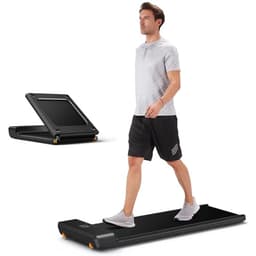
WalkingPad A1 Pro
A published noise figure
One of only two pads on this site whose maker publishes a decibel figure at all, and the only KingSmith model that does.
Price as of November 12, 2026. #ad How we’re funded
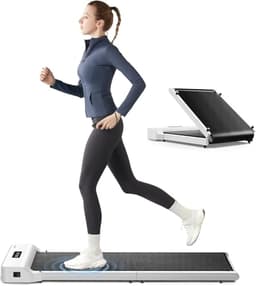
WalkingPad Z1
Smallest storage footprint
The only pad here that folds in half AND stays under 5.5 inches folded, which is the combination a small apartment actually needs.
And if it was the elliptical motionyou wanted rather than the machine — the closed path, the feet that never land — there is a third answer this site does track. The Stamina InMotion E1000 is the seated under-desk elliptical whose maker publishes the most about it: assembled dimensions, a 24 lb product weight and a 250 lb maximum user weight, all from Stamina rather than a retailer. It asks the least of the three machines on this page, and it is the only one that needs nothing from your calendar. The pad against that machine, which is the other half of this question.
So which one
Buy the walking pad if the machine has to disappear between uses, if the movement has to happen during work rather than instead of it, or if a 5 ft 5 in object standing permanently in a rented room is not something you can accept. Check your storage gap against the folded height first.
Buy the full-size elliptical ifyou will genuinely schedule sessions, if you want resistance and incline to progress into, or if the floor below you is the binding constraint and you want a machine where nothing lands. Do not buy one expecting it to save floor — on published figures a compact elliptical takes the same 8.6 sq ft a pad does, and then keeps it.
Buy a seated under-desk elliptical if you wanted the closed foot path and the at-your-desk part of a pad, and you accept that it is the least exercise of the three.
And do not pick between the first two on the belief that an elliptical is walking with the difficulty turned up. On the makers’ own stride figures it is a shorter movement than walking, not a longer one.
We have used none of these machines. Every figure above was read from the sources below on the dates shown, and the two ellipticals are quoted as published examples of their category rather than as recommendations. Our full method, including what we refuse to estimate.
Questions people actually ask
Walking pad or elliptical for a small apartment?
The walking pad, and the reason is storage rather than footprint. The Sunny Pro Smart elliptical's published 48 by 25.8 inch base is about 8.6 square feet - the same floor area as a WalkingPad Z1 in use, to one decimal place. The difference is what happens when you stop: the pad folds to roughly 4.9 square feet at 5.4 inches tall and goes under a bed, and the elliptical is 64.8 inches tall and stays exactly where it is. In a small home the decisive number is not the footprint, it is the height.
Is an elliptical better exercise than a walking pad?
An elliptical asks much more of you per minute and gives you resistance and, on some machines, incline - all of which a flat walking pad has no answer to. What it costs is the thing that makes a pad work: you cannot type, take a call or read a document on it, so its minutes have to be scheduled rather than accumulated. If you will genuinely schedule sessions, the elliptical is the stronger workout. If you will not, a pad delivers minutes an elliptical never gets.
Is an elliptical the same motion as walking?
No, and the published figures say so more clearly than any description could. The two ellipticals we read publish stride lengths of 16 and 20 inches. Using the common 0.43-times-height rule of thumb, a 5 ft 10 in walker's stride is about 30.1 inches - so even the longer of those two machines guides your foot through a path roughly 10 inches shorter than the stride you already walk with. An elliptical is not walking with resistance added. It is a different, shorter, guided foot path, and that is a reason some people prefer it rather than a flaw.
Can you use a full-size elliptical at a desk?
No. Neither of the machines we read publishes anything about desk use, and the geometry settles it anyway: at 64.8 and 70 inches tall these machines stand between you and a desk rather than under one. If the elliptical motion is what you want while you work, that is a seated under-desk elliptical, which is a different product entirely - and one we do track and rank.
Which is quieter in an apartment, a walking pad or an elliptical?
The elliptical, structurally, for the same reason a seated machine is: your feet never leave the pedals, so there is no footfall and no impact energy going into the floor on every step - and impact transmission is what the apartment below actually hears. That is a statement about mechanism, not a measurement. Neither elliptical page publishes a decibel figure and only two of the eight walking pads we track publish one either, so nobody in either category will give you a number.
How much does an elliptical weigh compared with a walking pad?
Far more, where it is published at all. SOLE publishes 209 for the E25, with a 231 gross shipping weight and no unit printed against either figure; the eight walking pads we track run from 40 lb to 69.5 lb. Sunny publishes no product weight for its elliptical, which is the same gap we keep finding in the pad category. The practical difference is not the mass so much as the shape: a folded pad is a flat slab you slide somewhere, and an elliptical is a five-to-six-foot frame that goes nowhere.
Do ellipticals publish better specifications than walking pads?
On the body that uses the machine, yes, and the gap is embarrassing. Both ellipticals publish a stride length, and SOLE publishes a flywheel weight and a five-line warranty schedule as well. Not one of the eight walking pads we track publishes a minimum or maximum user height, a stride range, or any other figure about your body. On capacity it also goes the elliptical's way: 300 and 350 lb against 220 to 300 lb across our pads. Where the elliptical category fails is the same place ours does - Sunny publishes no product weight and no warranty duration, and SOLE publishes an incline with 20 levels and no range in degrees.
Walking pad, full-size elliptical or under-desk elliptical?
Three different purchases. The walking pad is minutes during work that fold away afterwards. The full-size elliptical is a scheduled, progressive workout on a permanent machine. The seated under-desk elliptical is the least exercise of the three and the only one that asks nothing of your schedule at all - the Stamina InMotion E1000 is the one whose maker publishes the most about it, including dimensions, a 24 lb product weight and a 250 lb maximum user weight. Pick on which of those three sentences describes your week.
Read next
- Walking pad vs under-desk elliptical — the same motion in the seated machine we actually track and rank.
- Walking pad vs stationary bike — the full-size machine on the other side of the mirror, with the same folding finding.
- Small-space cardio equipment, ranked in square feet — every category we track, ranked on floor in use and floor when stored.
- Best walking pads for tall walkers — the stride arithmetic this page's central finding is built on.
- Best under-desk ellipticals — the seated machines, ranked on the clearance under your own desk.
- Walking pad vs vibration plate — the other machine that looks like a small-space rival and is a different purchase.
Sources
- SOLE - E25 elliptical product specifications, read 2026-10-27: 70 L x 24 W x 70 H in, machine weight published as 209 with a 231 gross shipping weight and no unit printed against either figure, 350 lb maximum user weight, 20 in stride, 20 levels of magnetic resistance, 20 lb flywheel, power incline with 20 levels and no range in degrees published, 110V plug-in listed as AC120V/60Hz, and a warranty of lifetime frame and flywheel, 2 years magnetic brake, 2 years electronics, 1 year parts and 90 days labor
- Sunny Health & Fitness - Pro Smart Magnetic Elliptical Trainer, 16 in stride (SF-E323038) product specifications, read 2026-10-27: 48 L x 25.8 W x 64.8 H in, 300 lb maximum user weight, 16 in stride, 16 resistance levels, magnetic tension system, and no published product weight, flywheel weight, incline, power requirement or warranty duration
- MedlinePlus (US National Library of Medicine) - How much exercise do I need: at least 150 to 300 minutes a week of moderate-intensity aerobic physical activity for adults, written in minutes of activity rather than in sessions
- WalkingPad A1 Pro - walkingpad.com product spec table: published dimensions, folded size, deck size, unit weight, capacity, top speed and noise figure (read 2026-07-24)
- WalkingPad Z1 - walkingpad.com product spec table: published dimensions, folded size, deck size, unit weight, capacity, top speed and noise figure (read 2026-07-24)
- Stamina InMotion E1000 - staminaproducts.com product page: published dimensions, folded size, deck size, unit weight, capacity, top speed and noise figure (read 2026-08-11)