Walking pad vs rowing machine
One of these is an exercise appointment and the other is a way of not sitting still for eight hours. The published floor area tells you which one your home can keep; the rest tells you which one you will use.
By Stephen V. · Last updated
Concept2 publishes an operational footprint of 9 ft x 4 ftfor the RowErg once you include the clearance to use it — 36square feet. The WalkingPad Z1’s published dimensions work out to about 8.6 sq ft in use, folding to roughly 4.9 sq ft at 5.4 in tall. So the pad wins the room, decisively. The rower wins the workout, and it wins the floor below you, because nothing lands.
How this page is funded: the buy links here are Amazon affiliate links, and we earn a commission if you buy through one — at no extra cost to you. It does not change what we rank first, because the commission rate is the same across every machine on this page. Full disclosure.
What we track, and what we do not
Pad & Pace tracks walking pads and under-desk machines. We do not track rowing machines, we have not read spec sheets for a field of them, and we are not going to publish a rower ranking dressed up as research.
What we can do honestly is use two real machines, at opposite ends of the rowing category, whose makers publish full figures — and then compare those figures against the pads we do track.
- Concept2 RowErg, the reference machine of the category. Its specification page, read on 2026-10-20, publishes overall dimensions of 96 x 24 in, an operational footprint of 8 ft x 2 ft and 9 ft x 4 ft with clearance for use, stored dimensions of 25 x 33 x 54 in with standard legs, a machine weight of 57 lb, a maximum user weight of 500 lb as tested by Concept2 and 300 lb under EN 20957-7, a 14 in seat height and a 54 in monorail.
- Sunny Health & Fitness SF-RW5515, the budget end, and the one that folds. Its product page, read on 2026-10-20, publishes assembled dimensions of 81.8 x 18.9 x 23.6 in, folded dimensions of 43.3 x 18.9 x 52.4 in, a 60.9 lb product weight, a 250 lb maximum user weight, 8 levels of magnetic resistance, a 53.4 in slide rail and a warranty of 3 year structural frame, 180 days other parts and components.
If you want a rower recommendation, this is not the site for it. If you are trying to work out which of these two belongs in a rented room, keep reading.
The floor each one needs, as published
This is the only section where one category publishes something the other refuses to. Concept2 does not just give the machine’s dimensions — it publishes the floor you need to use it: 9 ft x 4 ft, which is 36 square feet, against 8 ft x 2 ft for the machine standing still. The difference is the space the seat, the handle and your own legs travel through.
Not one walking pad maker on this site publishes an equivalent figure. We get the deck and nothing about the clearance behind it, which is why our own space-requirements guide has to build that number from the deck up. So the honest comparison is machine against machine, with the rower’s own clearance figure quoted next to it rather than invented for the pad.
The WalkingPad Z1’s published 56.1 x 22 in open dimensions are 8.6 sq ftof floor. The RowErg’s own machine footprint, 8 ft x 2 ft, is 16 sq ft, and with the clearance Concept2 states, 36 sq ft. Even comparing machine to machine and ignoring the clearance the maker itself says you need, the rower is close to twice the pad. Add the clearance and it is roughly four times.
The Sunny is shorter — 81.8 x 18.9 x 23.6 inassembled — which is still a machine 6 ft 10 in long. There is no version of a rower that occupies a small floor while you are on it.
Folding flat against standing up
Both categories use the word folding and they mean different things, which is the same finding as our comparison against an upright exercise bike.
A walking pad folds in the plane it lies in and the result is a slab. The Z1 goes to 31.8 x 22 x 5.4 in — about 4.9 sq ft of floor, 5.4 in tall, which clears the 6 in gap under a typical sofa and the 9 in under a typical bed frame. Every pad we track, measured against four real storage gaps.
A rower folds by standing up. Sunny publishes 43.3 x 18.9 x 52.4 in folded: the length comes back, and what is left is a 52.4 intall object leaning in the corner of the room — 4 ft 4 in. The RowErg does not fold at all; it separates into two pieces, which Concept2 publishes as 25 x 33 x 54 in stored, so the tallest stored dimension is 54 in. Both are furniture. Neither goes out of sight.
If your constraint is a room you also live in, that paragraph is the whole comparison. If you have a spare corner, it is almost irrelevant and you should read the next section instead.
The difference that actually decides it
Set the floor aside. These two machines ask for your time in completely different currencies, and that is the thing most buyers are really choosing between.
Rowing is a two-handed, full-body movement with your torso travelling through the stroke. You cannot type during it, read a document during it or take a call during it. A rower therefore competes with everything else in your day: it is an appointment, and its minutes exist only if you schedule them.
A walking pad is the opposite trade. Its intensity ceiling is low — our pads top out between 3 and 6.2 mph and most desk walking happens near the bottom of that — and in exchange its minutes cost you nothing from the rest of the day, because they happen while you work. Whether a walking desk is worth it, honestly answered, and what desk-speed walking does and does not count as.
We are not going to translate that into calories, because the honest version of that arithmetic needs figures nobody in either category publishes. Why we distrust the number on the pad’s own display. The question to answer about yourself is simpler and better: will you schedule the session? If yes, a rower does more per minute than any machine on this site. If you have answered that question optimistically before, the machine that runs while you work is the one that gets used.
The clear win for the rower
Rowing is seated and nothing lands. That removes impact transmission entirely, and impact transmission — not motor noise — is the mechanism behind almost every complaint from the apartment below. What the neighbor below actually hears from a walking pad.
That is a mechanical statement and we will not inflate it into a measurement. Neither the Concept2 page nor the Sunny page we read publishes a decibel figure, and only two of the eight walking pads we track publish one at all — the quietest pads, ranked by what the makers will actually state. A rower has a moving seat on a rail and a resistance mechanism of its own; it is not silent. It simply does not put your body weight into the floor eight hundred times an hour.
If that neighbor is your binding constraint and you still want something that works at a desk, the machine to look at is neither of these: it is a seated under-desk elliptical or pedal exerciser, which removes the footfall the same way a rower does and fits in a footwell. The quiet seated machines, ranked.
What each category publishes about your body
This is where the rowing category embarrasses ours. Concept2 publishes a 14 in seat height, a 54 in monorail, and a stated note that users with an inseam of 38 in or more may require an extra-long monorail. Sunny publishes a 53.4 in slide rail and an inseam figure.
Not one of the eight walking pads we track publishes a minimum user height, a maximum user height or a stride range. The nearest thing to a fit figure in our whole registry is the deck length, and we have to run it through a rule of thumb ourselves to say anything useful about who it suits — which is exactly what our tall-walker page does, and what the short-walker page does in the other direction.
Sunny’s page is also a useful warning about taking any single published figure on trust: its specification table gives a slide rail inseam of 48.4 in while the FAQ on the same page states 46.5 in. We are quoting both rather than choosing one, because we have no way to tell which is right.
On capacity the comparison runs the other way. The RowErg’s 500 lb as tested by Concept2is far above anything in our registry, where published limits run from 220 lb to 300 lb — though Concept2 also publishes the lower figure of 300 lb under EN 20957-7, the European standard, alongside it, which is the kind of two-sided honesty our category rarely offers. Every published pad capacity, ranked.
| Model | In use (L x W x H) | Folded (L x W x H) | Unit weight | Max user | Top speed |
|---|---|---|---|---|---|
| WalkingPad Z1 | 56.1" L x 22" W x 4.1" Hmanufacturer spec | 31.8" L x 22" W x 5.4" Hmanufacturer spec | 51 lbmanufacturer spec | 242 lbmanufacturer spec | 4 mphmanufacturer spec |
| UREVO Strol 2E | 48" L x 22.6" W x 38.9" Hmanufacturer spec | 51.2" L x 22.6" W x 4.6" Hmanufacturer spec | 47.2 lbmanufacturer spec | 265 lbmanufacturer spec | 6.2 mphmanufacturer spec |
If the pad is the answer, these are the two we would point at
Both of these are ranked in full elsewhere on the site; what follows is why each one comes up in a conversation that started with a rower.
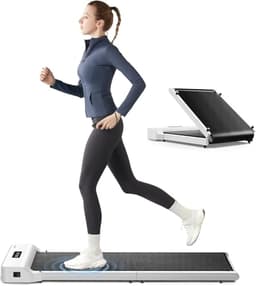
WalkingPad Z1
Smallest storage footprint
The only pad here that folds in half AND stays under 5.5 inches folded, which is the combination a small apartment actually needs.
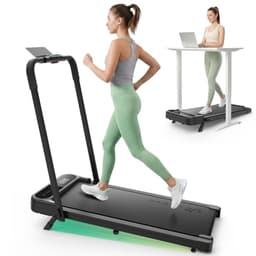
UREVO Strol 2E
Lightest with a handle
The lightest machine here that still has a safety handle, and the only one that goes fast enough to jog on.
Price as of October 21, 2026. #ad How we’re funded
And if what drew you to a rower was the seated, no-footfall part rather than the rowing, the honest third answer is neither machine on this page. The Stamina InMotion E1000 is the seated under-desk machine whose maker publishes the most about it — assembled dimensions, a 24 lb product weight and a 250 lb maximum user weight, all from Stamina rather than a retailer. The seated machines, ranked on desk clearance.
So which one
Buy the walking pad if the machine has to disappear between uses, if the exercise needs to happen during work rather than instead of it, or if 36 square feet of clear floor is not something your home has spare. Check your storage gap against 5.4 in before you order.
Buy the rower ifyou will genuinely schedule sessions, if there is a corner that can hold a nine-foot frame or a 4 ft 4 in folded one, or if the person below you is the binding constraint and you want a machine where nothing lands. Do not buy one expecting it to fold away like a pad does — in this category folding means standing up.
Buy a seated under-desk machine if you want the no-impact part of rowing and the at-your-desk part of a pad, and you accept that it is the least exercise of the three.
We have used none of these machines. Every figure above was read from the sources below on the dates shown, and the two rowers are quoted as published examples of their category rather than as recommendations.
Questions people actually ask
Walking pad or rowing machine for a small apartment?
The walking pad, on published floor area, and it is not close. Concept2 publishes an operational footprint of 9 ft by 4 ft for the RowErg once you include clearance to use it - 36 square feet. The WalkingPad Z1's published open dimensions work out to about 8.6 square feet, and it folds to roughly 4.9 square feet at 5.4 inches tall, which slides under a bed. A rower that folds still ends up as a 52.4 inch tall object standing in the room, on Sunny's own published folded dimensions.
Is rowing better exercise than walking on a walking pad?
They are different rather than ranked, and the useful difference is not intensity - it is whether the exercise has to be a session. Rowing is a seated, two-handed, full-body movement: you cannot type, take a call or read a document while you do it, so it competes with your working day for time. A walking pad runs under a desk while you work, which is why its minutes accumulate without being scheduled. If you will genuinely schedule the sessions, a rower asks far more of you per minute. If you will not, a pad delivers minutes a rower never gets.
Can you use a rowing machine while working at a desk?
No. Both hands are on the handle and your torso travels back and forth through the stroke, so there is no keyboard position and no screen distance that survives it. This is the one comparison on this site where the two machines are not substitutes at all: one is an exercise appointment, the other is a way of not sitting still. If no-impact exercise at a desk is what you want, that is a seated under-desk machine rather than a rower.
Which is quieter for an apartment, a rower or a walking pad?
The rower, structurally, for the same reason a seated bike is: there is no footfall, so no impact energy goes into the floor on every step - and impact transmission is what the apartment below actually hears. That is a statement about mechanism, not a measurement. Neither the Concept2 spec page nor Sunny's product page publishes a decibel figure, and only two of the eight walking pads we track publish one either. A rower's seat and chain or flywheel do make airborne noise, and nobody in either category will tell you how much.
How much does a rowing machine weigh compared with a walking pad?
They are closer than the size difference suggests. Concept2 publishes 57 lb for the RowErg with standard legs; Sunny publishes 60.9 lb for the SF-RW5515. The eight walking pads we track run from 40 lb to 69.5 lb. The difference is not mass, it is shape: a folded pad is a flat slab you slide somewhere, and a rower is a nine-foot frame that either separates into two pieces or stands up against a wall.
Do rowing machines publish better specifications than walking pads?
On body fit, yes, and the gap is striking. Concept2 publishes a seat height, a 54 inch monorail length and a note that an inseam of 38 inches or more may need an extra-long monorail; Sunny publishes a slide rail length and an inseam figure. Not one of the eight walking pads we track publishes a minimum or maximum user height, a stride range or any other figure about the body that will use it. On capacity it goes the other way round in magnitude - the RowErg's 500 lb as tested is well above the 220 to 300 lb published across our pads.
Is a folding rowing machine a good compromise?
It solves the floor and not the room. Sunny's published folded dimensions for the SF-RW5515 are 43.3 by 18.9 by 52.4 inches - it gives back the length and becomes a 4 ft 4 in tall object leaning in the corner. That is the same finding as our upright bike comparison: in this category folding means standing up, not going away. A walking pad folding to 5.4 inches is the only version of folding that ends with the machine out of sight.
Read next
- Walking pad vs stationary bike — the same folding-means-standing-up finding, measured on an upright bike.
- Walking pad vs treadmill — the comparison most people mean when they say they want a running machine.
- Small-space cardio equipment, ranked in square feet — every category we track, ranked on floor in use and floor when stored.
- How much space does a walking pad need? — the clearance figure no pad maker publishes, built from the deck up.
- Quietest under-desk cardio — the seated machines, for when the floor below is the binding constraint.
- Best portable walking pads for travel — what portable means once you measure it - and what an airline makes of it.
Sources
- Concept2 - RowErg product specifications, read 2026-10-20: 96 x 24 in overall, 8 ft x 2 ft operational footprint and 9 ft x 4 ft with clearance for use, 25 x 33 x 54 in stored with standard legs, 57 lb machine weight, 500 lb maximum user weight as tested by Concept2 and 300 lb under EN 20957-7, 14 in seat height, 54 in monorail, and a stated note that an inseam of 38 in or more may require an extra-long monorail
- Sunny Health & Fitness - SF-RW5515 magnetic rowing machine product page, read 2026-10-20: 81.8 x 18.9 x 23.6 in assembled, 43.3 x 18.9 x 52.4 in folded, 60.9 lb product weight, 250 lb maximum user weight, 8 magnetic resistance levels, 53.4 in slide rail, slide rail inseam published as 48.4 in in the specifications and 46.5 in in the FAQ on the same page, 3 year structural frame and 180 days other parts and components
- WalkingPad Z1 - walkingpad.com product spec table: published dimensions, folded size, unit weight, capacity and top speed (read 2026-07-24)
- UREVO Strol 2E - urevo.com product spec table: published dimensions, folded size, unit weight, capacity and top speed (read 2026-07-24)
- Stamina InMotion E1000 - staminaproducts.com product page: published dimensions, folded size, unit weight, capacity and top speed (read 2026-08-11)