WalkingPad P1 review
The widest walking surface you can get in a pad that still folds in half — and the clearest example on this site of what belt width costs you in every other column.
By Stephen V. · Last updated
The P1 gives you a 47 x 16.5 in beltin a machine that still folds to 32.5 inches — the widest walking surface in a fold-in-half pad. It costs 11 lb of carry weight and 22 lb of rated capacity against the Z1. If you type while you walk, that is a good trade. If you carry it upstairs, it is not.
How this page is funded: the buy links here are Amazon affiliate links, and we earn a commission if you buy through one — at no extra cost to you. It does not change what we rank first, because the commission rate is the same across every machine on this page. Full disclosure.
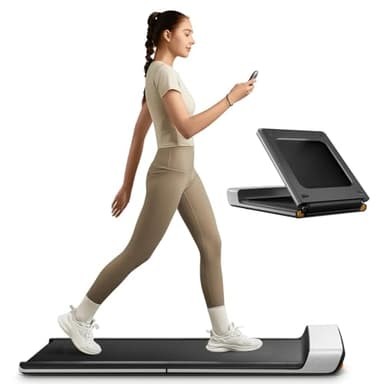
WalkingPad P1
A 16.5 inch belt on a pad that still folds to 32.5 inches — the wider walking surface is the reason to pick it over the Z1.
Best for: Wider belt in a folding pad
The full published specification
Every figure below was read from walkingpad.com product spec table on 2026-07-24. Rows marked “not published” were checked and no figure exists.
| Footprint in use | 56.5" L x 21.5" W x 5" Hmanufacturer spec |
|---|---|
| Folded | 32.5" L x 21.5" W x 5" Hmanufacturer spec |
| Walking belt | 47" L x 16.5" Wmanufacturer spec |
| Unit weight | 62 lbmanufacturer spec |
| Max user weight | 220 lbmanufacturer spec |
| Top speed | 3.75 mphmanufacturer spec |
| Incline | Not publishednot published |
| Published noise | Not publishednot published |
All figures read from walkingpad.com product spec table on 2026-07-24. Where it says “not published”, we checked and no figure exists — we did not estimate one.
What those numbers mean in a small room
The P1’s entire argument is 0.8 inches, and whether that sounds trivial depends on how you intend to use the machine. A 16.5 inch belt against the Z1 and C2’s 15.7 is a small absolute difference and a meaningful practical one, because the situation it protects you from is specific: you are looking at a screen, your attention is on a sentence, and your feet drift.
Belt lengthis effectively identical across the KingSmith range — 47.6 inches on the Z1, 47.2 on the C2, 47 on the P1 and A1 Pro. That 0.6 inch spread is inside the noise. So within this brand, width is the only walking-surface variable that actually moves, and the P1 is at the top of it.
The second specification worth pulling out is the one nobody markets: the P1 starts at 0.3 mph. That is the slowest start of any machine on this site, and at a desk it is genuinely useful. Most pads bottom out around 0.6 to 1 mph, which is already a walk. A machine that will crawl gives you a setting for detailed work — slow enough that your hands stay steady, moving enough that you are not standing still.
Now the bill. At 62 lb the P1 is 11 lb heavier than the Z1 for a fold that is 0.7 inches longer, and it carries 22 lb less. That combination is the opposite of what you would want, and it is worth being blunt: on every specification except belt width and starting speed, the Z1 is the better machine. The P1 is a choice, not an upgrade.
One thing the folding does work in your favor. The P1 folds to the same 5 inches it stands at, because it folds flat rather than stacking one half of the deck onto the other. The Z1 goes from 4.1 inches in use to 5.4 folded. So the P1 is the taller machine to stand on and the shorter one to store, which is exactly backwards from how people assume it works — and it means a sofa gap in the 5 to 5.3 inch band takes a folded P1 and rejects a folded Z1.
The 220 lb capacity is the specification we would check first, because it is the joint-lowest on this site and it is easy to skip past. For a heavier walker the A1 Pro at 230 lb, the Z1 at 242 lb or the UREVO Strol 2E at 265 lb are all better answers from the same price neighborhood.
The fit arithmetic
Folded, this is 32.5 x 21.5 x 5 in. Against the storage gaps we check every machine on this site against:
| Storage spot | Typical gap | Result |
|---|---|---|
| Under a sofa | ~6 in | Fits1 in to spare |
| Under a bed | ~9 in | Fits4 in to spare |
| Standing in a closet | ~24 in | Fits2.5 in to spare |
| Behind a door | ~4 in | Does not fit1 in over |
On stride: the 47 inch belt against a typical stride of 28.4 in for a 5 ft 6 in walker and 31 in for someone 6 ft, using the common 0.43-times-height rule of thumb. That leaves roughly 16in of margin for a 6-foot walker — which has to absorb your forward and backward drift as well as the stride itself.
Who it suits
Anyone who walks while typing. This is the machine for it: the widest belt in a folding pad, and the slowest start of anything we track. Both of those specifications exist for exactly the person whose attention is on a screen.
Someone storing it in a shallow gap.A 5 inch folded height beats the Z1’s 5.4 and matches the A1 Pro. If you have measured a sofa or bed-frame clearance in the 5 to 5.4 inch band, the P1 goes in where the Z1 does not.
Anyone who has clipped a belt edge before. If you know you drift, do not buy the narrower machine to save eleven pounds of carry weight you handle twice a year.
Someone who does not need the decibel line. The A1 Pro is mechanically this machine plus a published noise figure and 10 lb of capacity. If neither of those is deciding you, the P1 is the same walking experience.
Who it does not
Anyone near the 220 lb limit. It is the joint-lowest published capacity on this site. The Z1 gives you 22 lb more headroom while weighing 11 lb less, which is a rare case of a specification going the right way in both directions at once.
Anyone in a walk-up. 62 lb with no real handholds is a genuine two-person carry up three flights. The Strol 2E does the job at 47.2 lb and has a handle.
Anyone who needs a published noise figure. KingSmith publishes none for the P1. If a number on paper is what will let you commit, the A1 Pro is the only machine in this range that has one.
Anyone with a very tight standing desk.The 5 inch deck costs you 0.9 inches more of your desk’s travel than the Z1’s 4.1. On a desk that is already marginal, that is the difference.
Anyone who wants incline or running speed. Neither is published for this model and the ceiling is 3.75 mph.
What we did not do
We have not used this unit. We have not walked on it, we do not own one, and nobody sent us one. Everything above is our reading of the specification WalkingPad publishes, plus arithmetic on those numbers.
Which means there are real questions this page cannot answer: how the belt feels, whether the deck flexes under a heavier walker, how the motor sounds in your room, and whether any of it holds up over two years. Those need use. If a review tells you those things without having used the machine, it is telling you something it made up.
Questions people actually ask
What are the WalkingPad P1 dimensions?
56.5 x 21.5 x 5 inches in use and 32.5 x 21.5 x 5 inches folded, per KingSmith's specification page. The folded height matches the in-use height rather than exceeding it, which is unusual in this category — the Z1 goes from 4.1 inches in use to 5.4 folded. So the number to measure your storage gap against is 5 inches either way.
How wide is the WalkingPad P1 belt?
16.5 inches, which is the joint-widest belt we track alongside the A1 Pro. The Z1 and C2 are 15.7 inches, the Sunny TreadPad is 16 inches and the UREVO Strol 2E is 15 inches. Belt width is the specification that decides whether you clip the edge when you glance at a screen rather than at your feet, so on a desk setup it is worth more than the 0.8 inch gap suggests.
How slow does the WalkingPad P1 go?
It starts at 0.3 mph, the slowest starting speed of anything we track, and tops out at 3.75 mph. The slow start is the underrated specification here: at a desk, the useful pace is one that does not interfere with your hands, and a machine that will crawl gives you somewhere to sit that is not 'off'.
What is the WalkingPad P1 weight limit?
220 lb, per KingSmith — the joint-lowest published capacity on this site alongside the C2 and the Lifepro PacerMini. The Z1 carries 242 lb and the A1 Pro 230 lb, both from the same maker. If you are anywhere near 220 lb, that gap is not a preference, it is the decision.
Is the WalkingPad P1 quiet?
KingSmith publishes no decibel figure for the P1. It publishes one for the A1 Pro only — 'under 65 dB' — and nothing for the P1, Z1 or C2. We are not going to estimate one. What we can say is that the P1 and A1 Pro share a belt, a deck, a footprint and a speed range, so if the figure matters to you the A1 Pro is the way to buy it rather than a reason to think this machine is louder.
Read next
- WalkingPad A1 Pro vs P1 — the four specifications that separate two nearly identical machines.
- WalkingPad C2 vs P1 — 1.1 inches of width against 0.8 inches of belt. Which is your constraint?
- WalkingPad Z1 vs P1 — 0.8 inches of belt against 11 lb of carry weight, settled properly.
- Best walking pads for tall walkers — where the P1's belt makes it our top pick over the whole field.
- WalkingPad A1 Pro review — the same machine with a decibel figure and 10 lb more capacity.
- Best walking pads for a standing desk — the deck-height arithmetic, where the P1's 5 inches has to be checked.
- Walking pad dimensions: every model, folded and open — how the P1's numbers sit against everything else we track.