WalkingPad Z1 vs P1
This is the most lopsided comparison on the site, and it still has a right answer for some people. The P1 wins two specifications. Whether they are your two decides it.
By Stephen V. · Last updated
Take the Z1: it is 11 lb lighter, carries 22 lb more, folds 0.7 in shorter and sits 0.9 in lower. Take the P1only if you walk while typing — its belt is 0.8 in wider and it starts at 0.3 mph, the slowest crawl we track. Those are the P1’s two arguments and they are real ones.
How this page is funded: the buy links here are Amazon affiliate links, and we earn a commission if you buy through one — at no extra cost to you. It does not change what we rank first, because the commission rate is the same across every machine on this page. Full disclosure.
The table first
| Model | Folded (L x W x H) | In use (L x W x H) | Belt (L x W) | Unit weight | Max user | Top speed | Published noise |
|---|---|---|---|---|---|---|---|
| WalkingPad Z1 | 31.8" L x 22" W x 5.4" Hmanufacturer spec | 56.1" L x 22" W x 4.1" Hmanufacturer spec | 47.6" L x 15.7" Wmanufacturer spec | 51 lbmanufacturer spec | 242 lbmanufacturer spec | 4 mphmanufacturer spec | Not publishednot published |
| WalkingPad P1 | 32.5" L x 21.5" W x 5" Hmanufacturer spec | 56.5" L x 21.5" W x 5" Hmanufacturer spec | 47" L x 16.5" Wmanufacturer spec | 62 lbmanufacturer spec | 220 lbmanufacturer spec | 3.75 mphmanufacturer spec | Not publishednot published |
WalkingPad Z1
Smallest storage footprint
The only pad here that folds in half AND stays under 5.5 inches folded, which is the combination a small apartment actually needs.
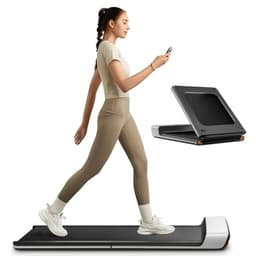
WalkingPad P1
Wider belt in a folding pad
A 16.5 inch belt on a pad that still folds to 32.5 inches — the wider walking surface is the reason to pick it over the Z1.
Where the P1 wins
Two specifications, and both of them are about typing rather than walking. That is the correct frame for this comparison and it is the one nobody uses.
Belt width: 16.5 in vs 15.7 in
0.8 inches. Small in the abstract, specific in practice: the failure mode it protects you from is clipping the edge of the belt while your attention is on a sentence rather than on your feet. Neither machine has a handrail, so there is nothing to catch yourself on. If you have done it before on a narrower deck, you know whether this matters to you; if you have not, it probably does not.
Starting speed: 0.3 mph
This is the specification neither maker markets and the one we think is most undervalued. Most pads bottom out around 0.6 to 1 mph, which is already a walk. A machine that will crawl at 0.3 mph gives you a setting for detailed work — slow enough that your hands stay steady, moving enough that you are not standing still on a stationary belt.
For someone whose plan is “walk during calls, crawl while I write, step off for the fiddly bits”, that bottom end is worth more than the top end. The Z1 does not go below 1 mph.
Where the Z1 wins, which is everywhere else
Unit weight: 51 lb vs 62 lb
Eleven pounds, on machines with no proper handholds, that fold to roughly the same size. This is the difference between a one-person carry up two flights and a job you plan around, and it is felt every time the machine comes out from under the sofa rather than only on moving day.
Capacity: 242 lb vs 220 lb
The lighter machine carries 22 lb more, which is the opposite of the usual relationship and is the single strongest point in the Z1’s favor. The P1’s 220 lb is the joint-lowest figure on this site. If you are within about 20 lb of it, stop reading the rest of this page — the decision is made.
Deck height: 4.1 in vs 5 in
0.9 inches of standing height, which comes straight out of your standing desk’s remaining travel. On a desk that already tops out marginally low for you, that is a real difference rather than a rounding one. The full arithmetic is here.
Folded length: 31.8 in vs 32.5 in
0.7 inches, and honestly it rarely decides anything on its own. Both stand upright in a closet and both go behind most doors. The one place the P1 turns this around: it folds to 5 inches tall against the Z1’s 5.4, so a sofa gap in the 5 to 5.3 inch band takes the P1 and rejects the Z1. Folding a Z1 stacks the deck and makes it taller than it is in use; the P1 folds flat.
Belt length: 47.6 in vs 47 in
0.6 inches in the Z1’s favor, which is inside the range where nobody notices. By total belt area the P1 is ahead, 775.5 square inches to 747.3, because width beats length here.
What neither spec sheet settles
Noise. KingSmith publishes no decibel figure for either machine — it publishes one for the A1 Pro only, and nothing for the Z1, C2 or P1. So on the question that decides most apartment purchases, this comparison has nothing to offer, and anyone giving you a dB comparison between these two is working from something other than the manufacturer’s specification.
Also unsettled: belt feel, deck flex under a heavier walker, motor sound in your particular room, and durability. Those need use, and we have not used either machine. Our method, and what it cannot do.
Choose the P1 if...
- You will be typing while walking, most days. Both its wins serve that.
- You have clipped a belt edge before and remember it.
- Your storage gap measures between 5 and 5.3 inches.
- You want a genuine crawl setting rather than a slow walk.
- The machine will stay in one place and rarely be lifted.
Choose the Z1 if...
- You are anywhere near 220 lb. This is not close.
- You are in a walk-up, or you move often, or the pad lives under a sofa.
- Your standing desk is already marginal for your height.
- You want the shortest folded length available anywhere on this site.
- You have not decided where it will live. The Z1 keeps more options open.
Questions people actually ask
WalkingPad Z1 or P1 — which is better?
On the specification sheet the Z1 wins almost everywhere: 11 lb lighter, 22 lb more capacity, 0.7 inches shorter folded, 0.9 inches lower in use and 0.25 mph faster. The P1's case rests on two figures — a belt 0.8 inches wider, and a starting speed of 0.3 mph, the slowest we track. If you walk while typing, those two are worth more than they look. Otherwise take the Z1.
Which has a wider belt, the Z1 or the P1?
The P1, at 16.5 inches against the Z1's 15.7. That 0.8 inch difference is the P1's main argument, and it matters most when you are reading a screen rather than watching your feet — neither machine has a handrail, so the belt edge is the only thing telling you where you are.
How much heavier is the WalkingPad P1?
62 lb against the Z1's 51 lb, so 11 lb. Both fold to roughly the same size and neither has real handholds, so that difference shows up on stairs, on delivery day, and every time you slide the machine out from under something.
Do the Z1 and P1 have the same speed range?
No, and the difference runs in both directions. The Z1 tops out at 4 mph, the P1 at 3.75 mph. But the P1 starts at 0.3 mph, the slowest starting speed of anything we track, which at a desk is genuinely useful — it gives you a crawl setting that does not interfere with your hands.
What is the difference in weight capacity between the Z1 and P1?
22 lb: 242 lb on the Z1 against 220 lb on the P1. The P1's 220 lb is the joint-lowest published capacity on this site, alongside the WalkingPad C2 and the Lifepro PacerMini. If you are anywhere near it, that gap is not a preference — it is the whole decision.
Read next
- WalkingPad P1 review — what the widest belt in the range actually buys you.
- WalkingPad Z1 vs A1 Pro — the same trade, plus the only published noise figure KingSmith offers.
- Best walking pads for tall walkers — where the P1's belt width makes it our top pick overall.
- Best walking pads for a standing desk — the 0.9 inch deck-height difference, in context.
- Walking pad dimensions: every model, folded and open — the master table both of these figure sets come from.