Cubii JR1 review
The best-known machine in seated cardio, and the one whose published specification most often disqualifies the person reading about it. Check one number first.
By Stephen V. · Last updated
The JR1 is the narrowest seated machine we track (17.56 in) with an elliptical stroke that keeps your knee lower than a pedal circle does, and eight magnetic resistance levels. Then there is the number that decides it: a published 150 lb maximum user weight, the lowest limit on this site by 70 lb. Check that before anything else.
How this page is funded: the buy links here are Amazon affiliate links, and we earn a commission if you buy through one — at no extra cost to you. It does not change what we rank first, because the commission rate is the same across every machine on this page. Full disclosure.
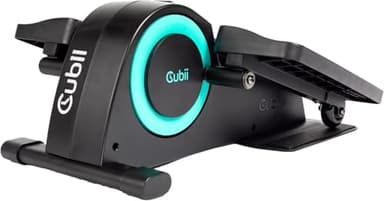
Cubii JR1
An elliptical stroke instead of a circular one, which keeps the knee lower — and it is the only seated machine here that publishes a user weight limit.
Best for: Low-impact seated motion
Price as of September 24, 2026. #ad How we’re funded
The full published specification
Every figure below was read from Amazon retail listing spec table on 2026-07-24. Rows marked “not published” were checked and no figure exists.
| Footprint in use | 23.2" L x 17.56" W x 10" Hretail listing |
|---|---|
| Folded | Not publishednot published |
| Walking belt | Not publishednot published |
| Unit weight | Not publishednot published |
| Max user weight | 150 lbretail listing |
| Top speed | Not publishednot published |
| Incline | Not publishednot published |
| Published noise | Not publishednot published |
| Pedal height | 10 inretail listing |
| Resistance levels | 8retail listing |
All figures read from Amazon retail listing spec table on 2026-07-24. Where it says “not published”, we checked and no figure exists — we did not estimate one.
What those numbers mean in a small room
Start with the limit, because it is the whole review for a lot of people and burying it would be dishonest. The listing publishes a 150 lb maximum user weight. The next lowest figure on this site is 220 lb. The Stamina InMotion E1000, a directly comparable seated elliptical, publishes 250 lb.
To be clear about what we are and are not saying: this is a published figure, in the specification table, not something concealed. But it sits below the median adult weight in the market this machine is sold into, it is not something the product photography or the marketing copy surfaces, and a great many people will buy this machine without ever reading it. We are putting it in the first paragraph for that reason.
If you are comfortably under it, the rest of the specification is genuinely good, and the geometry is the reason.
An under-desk bike is a crank: your foot travels a circle and your knee rises by the full diameter of that circle at the top of every revolution. The JR1 is an elliptical: the same path flattened into an oval, so the same amount of leg movement produces less vertical knee travel. On a desk where clearance is tight, that is the difference between fitting and not, and it is a structural argument rather than a marketing one.
The footprint follows the same logic. At 17.56 inches widethe JR1 is the narrowest seated machine we track — nearly 6.5 inches narrower than the DeskCycle — which under a desk already carrying a tower and a bin is a real advantage. Watch the other axis though: it is 23.2 inches deep, so it reaches further under the desk than the compact photography suggests, and your feet and chair are competing for that same depth.
Eight magnetic resistance levels, 10 inches of height, and no power outlet needed. Nothing here is remarkable on its own; together they make a machine that genuinely does live under a desk permanently, which is the entire product category.
It is worth putting the height in context against the two machines it competes with, because the spread is small and the consequences are not. The Cubii Move publishes 9.5 inches, the JR1 10 inches, and the Stamina InMotion E1000 11.38 inches. Under a desk with a generous open underside, all three fit and the number is irrelevant. Under a desk with a drawer or an apron rail, that 1.88 inch spread is frequently the entire decision — and the JR1 sits in the middle of it, which is the least useful place to be if you have not measured.
The other number to weigh against the height is depth, and it is the one people underestimate. The JR1 reaches 23.2 inches under the desk, against the DeskCycle’s 20 and the Cubii Move’s 21.5. On a shallow desk, or one with a tower or a bin already claiming floor space, the machine that is narrowest side to side is also the one that reaches furthest forward — and your feet and chair are competing for exactly that depth. Measure both axes before you order, not just the one the marketing emphasizes.
The gap we would most like closed, beyond the capacity: Cubii publishes no decibel figure and the listing calls the machine whisper-quiet, which is an adjective standing where a number should be. And no stride length is published, which is the figure that would let you compute knee travel properly instead of using overall height as a proxy for it. The clearance arithmetic is here, with the four measurements to take first.
Who it suits
Anyone under the 150 lb limit with a tight desk. The elliptical path plus a 17.56 inch width is the most desk-friendly combination we track, and that is a genuine engineering answer to a real constraint.
Anyone whose floor situation makes a walking pad impossible. No footfall means nothing transmitted into the ceiling below. In a top-floor-avoiding, thin-floored building that is not a compromise, it is the only workable option.
Anyone with a fixed-height desk. Walking pads need a desk that raises. This does not.
Someone who wants low-impact motion specifically. The flattened stroke is easier on the knee through its range than a pedal circle, which is the reason this design exists.
Who it does not
Anyone at or near 150 lb.This is not a recommendation to buy carefully — it is a recommendation to buy something else. The Stamina InMotion E1000 publishes 250 lb and is the same kind of machine.
Anyone with a shallow desk. 23.2 inches of depth, plus a chair, plus your feet. Measure the depth as carefully as the height.
Anyone who could fit a walking pad. Seated pedaling recruits far less of you than standing and walking. With the floor space, the pad is the better machine and it is not close.
Anyone who needs a published noise figure. There is not one, only an adjective.
Anyone wanting more than eight resistance steps.The YOSUDA under-desk bike publishes 16 — though it publishes no pedal height at all, which is the more consequential omission.
What we did not do
We have not used this unit. We have not walked on it, we do not own one, and nobody sent us one. Everything above is our reading of the specification Cubii publishes, plus arithmetic on those numbers.
Which means there are real questions this page cannot answer: how the belt feels, whether the deck flexes under a heavier walker, how the motor sounds in your room, and whether any of it holds up over two years. Those need use. If a review tells you those things without having used the machine, it is telling you something it made up.
Questions people actually ask
What is the Cubii JR1 weight limit?
150 lb, per the retail listing specification table. That is the lowest published user weight limit of any machine on this site by 70 lb, and it is the single most important thing to check before buying one. It is published rather than hidden, but it is not something the listing photography draws attention to, and it rules the machine out for a large share of the people who would otherwise buy it.
How tall is the Cubii JR1?
10 inches, on a footprint of 23.2 inches deep by 17.56 inches wide. The height puts it in the same desk-clearance class as the DeskCycle; the width is where it separates, at nearly 6.5 inches narrower. The Cubii Move is lower still at 9.5 inches, though nobody publishes a user weight limit for that machine.
Is the Cubii JR1 quiet?
Cubii publishes no decibel figure for it, despite the listing describing it as whisper-quiet. We are not going to convert an adjective into a number. What is categorically true is that a seated machine produces no footfall, so there is no impact energy going into the floor structure at all — which is the transmission path behind almost every complaint about under-desk cardio in an apartment.
Is a Cubii better than an under-desk bike?
For desk clearance, the elliptical geometry is genuinely better. A pedal exerciser moves your foot in a circle, so your knee rises by the full diameter of that circle; the JR1's elliptical path flattens that into an oval, so the same leg movement produces less vertical knee travel. That is a geometric argument rather than a claim about calories, and it is the honest reason to prefer one.
Does the Cubii JR1 need to be plugged in?
No. Resistance is magnetic and set by hand across eight levels, and the display is self-powered. Nothing to plug in means the machine can live anywhere a chair does, which in a small room is part of the point.
Read next
- Cubii Move vs Cubii JR1 — the JR1 wins three specification rows and still is not the pick. Why.
- Cubii JR1 vs Stamina InMotion E1000 — 1.38 inches of height against 100 lb of published capacity.
- DeskCycle vs Cubii JR1 — the two best-known machines in the category, head to head.
- Cubii Move review — half an inch lower, 6.5 lb lighter, and no published capacity at all.
- Stamina InMotion E1000 review — the machine to take if the 150 lb limit rules this one out.
- Best under-desk ellipticals — the three machines we track, and what each maker publishes.
- Will an under-desk machine fit under your desk? — the four measurements, and why height alone is not enough.
- Walking pad vs under-desk elliptical — the honest version of how much exercise sitting down costs you.
- Do walking pads have a weight limit? — every published capacity on this site, this 150 lb figure included.
- DeskCycle under desk bike review — wider, circular pedal path, and no published limit at all.