Niceday mini stair stepper review
About 1.3 square feet of floor, no motor, no outlet and nothing to store. The smallest thing on this site you can genuinely raise a heart rate on.
By Stephen V. · Last updated
16 x 12 x 14 in— roughly a seventh of the floor a walking pad needs — with a published 300 lb capacity and a stated 1.5 mm steel frame. That is more real information than anything else in this category publishes. The gaps: no product weight, no resistance count, no decibel figure, and nothing to hold on to.
How this page is funded: the buy links here are Amazon affiliate links, and we earn a commission if you buy through one — at no extra cost to you. It does not change what we rank first, because the commission rate is the same across every machine on this page. Full disclosure.
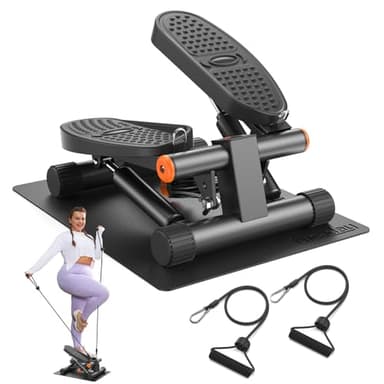
Niceday Mini Stair Stepper
A 16 x 12 inch footprint and a published 300 lb capacity — the most machine per square foot of anything on this site, and the smallest thing here you can genuinely raise your heart rate on.
Best for: Smallest footprint of anything here
The full published specification
Every figure below was read from nicedaysteppers.com product page on 2026-08-12. Rows marked “not published” were checked and no figure exists.
| Footprint in use | 16" L x 12" W x 14" Hmanufacturer spec |
|---|---|
| Folded | Not publishednot published |
| Unit weight | Not publishednot published |
| Max user weight | 300 lbmanufacturer spec |
| Resistance levels | Not publishednot published |
| Material | 1.5 mm steel framemanufacturer spec |
| Published noise | Not publishednot published |
All figures read from nicedaysteppers.com product page on 2026-08-12. Where it says “not published”, we checked and no figure exists — we did not estimate one.
What those numbers mean in a small room
This machine makes a specific trade and the specification sheet describes it clearly, which is more than most of this category manages. Here is what the numbers actually buy.
1.3 square feet, in context
16 x 12 inches is smaller than a dining chair’s footprint. The walking pads on this site occupy between roughly 7 and 10 square feet in use — the WalkingPad Z1 is 56.1 x 22 inches, the Sunny TreadPad is 58.2 x 24.9 — so this is somewhere around a seventh of that.
The consequence people underrate: a machine this small does not need to be put away. Every walking pad recommendation on this site eventually comes down to where the thing lives the other twenty-three hours, because a pad that has to be dragged out is a pad that stops being used. A stepper sits in the corner it lives in, permanently, and the friction between deciding to use it and using it is about two seconds. For comparison, here is what storing a walking pad actually involves.
300 lb, and a construction figure to back it
A 300 lb capacity on a machine this small is a strong claim, and Niceday does something unusual: it publishes a frame thickness, 1.5 mm steel. That does not prove the capacity, but it is a checkable engineering statement rather than a marketing number, and almost nobody at this price offers one.
For context on the rest of the site: 300 lb matches the highest published walking pad capacity we track (the DeerRun, which publishes nothing else at all) and sits above the Stamina SpaceMate’s 250 lb. The Xiser publishes 400 lb and publishes no dimensions to go with it.
The three missing figures
Product weight. The one we most want and the one that is not there. It tells you both how easily the machine moves between rooms and, more usefully, how much mass is resisting you when you push down on a pedal on a hard floor.
Resistance levels. The stride knob is described, the settings are not counted. If you want a machine where the adjustment range is a published number, the Xiser states three.
A decibel figure.“Quiet” and “silent” appear on the product page; a number does not. We treat that the same way we treat every unquantified noise claim on this site — as marketing. Why noise claims in this whole category are worth so little.
And the thing no spec sheet says
Stepping is one fixed motion in a short vertical range, repeated. There is no distance covered and no change of gait. People who get on with steppers use them in short blocks — a phone call, a kettle, a gap between meetings — rather than for an hour. If your plan is to move continuously through a working day, that plan needs a walking pad, and no stepper will substitute for it.
Who it suits
Anyone whose room genuinely has no space for a pad. This is the honest use case. 1.3 square feet fits where nothing else on this site fits, and a machine you own beats a machine you have no room for.
Someone who wants zero setup friction. No assembly, no outlet, no unfolding, nothing to put away. That is the biggest predictor of whether home cardio is still in use six months later.
Someone near the top of typical capacity ranges. 300 lb with a published frame thickness is the strongest capacity claim in this category short of the Xiser, at a small fraction of the price.
Someone who works in short blocks. If you are up and down from a desk all day anyway, a machine that is always ready suits that rhythm better than one that has to be deployed.
Who it does not
Anyone who would want something to hold. There is no handrail. If balance is any kind of question, the Stamina SpaceMate has handlebars, and a seated machine removes the question entirely.
Anyone who wants to move for an hour while working. That is a walking pad job. The two machines, compared directly.
Anyone in a flat above a light sleeper. No motor does not mean no impact. Your weight is landing on a rigid frame on a floor, and that is exactly the energy that travels downwards.
Anyone who wants to know what it weighs before buying. Niceday does not say, and on a hard floor that figure matters.
What we did not do
We have not used this unit. We have not walked on it, we do not own one, and nobody sent us one. Everything above is our reading of the specification Niceday publishes, plus arithmetic on those numbers.
Which means there are real questions this page cannot answer: how the belt feels, whether the deck flexes under a heavier walker, how the motor sounds in your room, and whether any of it holds up over two years. Those need use. If a review tells you those things without having used the machine, it is telling you something it made up.
Questions people actually ask
How much space does the Niceday mini stepper take up?
16 x 12 inches on the floor and 14 inches tall, per Niceday's own product page — about 1.3 square feet. For comparison, the walking pads we track occupy roughly 7 to 10 square feet in use. That ratio is the entire reason this category exists: it is the machine you buy when there is no floor left for anything else.
What is the weight limit on the Niceday stepper?
300 lb, published by Niceday. That matches the highest published capacity of any walking pad on this site and is well above the 250 lb Stamina SpaceMate. Niceday also publishes a 1.5 mm steel frame thickness, which is unusual at this price and makes the capacity claim more credible than a bare number would be.
How much does the Niceday mini stepper weigh?
Not published. Niceday's product page gives dimensions, capacity and construction and does not state the machine's own weight, which is a real gap for two reasons: it tells you how easily the thing moves between rooms, and it tells you how well it stays put when you are pushing down on it. It is the main figure missing from an otherwise well-documented page.
Is the Niceday stepper quiet?
No decibel figure is published — the page uses the words 'quiet' and 'silent', which are adjectives rather than measurements, and we are not going to convert one into the other. What is structurally true is that a hydraulic stepper has no motor, so there is no continuous mechanical noise. What it does have is your body weight landing on a frame repeatedly, and that is impact energy into the floor, which is what a downstairs neighbor actually hears.
Can you put a mini stepper under a desk?
No. A stepper is a standing machine — you are on top of it at full height, moving up and down — so it does not go under anything. If you want to move while seated at a desk, you want an under-desk bike or an under-desk elliptical, which are different machines that happen to solve the same floor-space problem.
How many resistance levels does the Niceday stepper have?
No count is published. Niceday describes a stride adjustment knob at the bottom of the machine and hydraulic cylinders, and does not say how many settings the adjustment has. The Xiser publishes three; nobody else in this category we checked publishes a number either.
Read next
- Niceday mini stepper vs Stamina SpaceMate — 1.3 square feet and nothing to hold, against handlebars that fold away.
- Best mini steppers for small spaces — where this ranks, and what the other two publish.
- Walking pad vs mini stepper — 8.5 square feet against 1.3, and what the smaller machine cannot do.
- Xiser Commercial Mini Stairmaster review — 400 lb capacity, and no dimensions at all, at many times the price.
- Best walking pads for small spaces — if you have more floor than you think, this is the better category.
- Best walking pad mats — the rubber pads are the cheapest thing to put under a stepper.