Walking pad vs mini stepper
These get shopped as the big version and the small version of the same idea. They are not. One of them you can work on and the other you cannot, and that is the decision.
By Stephen V. · Last updated
If you want to move while you work, it is a walking pad and a stepper is not a cheaper alternative — you cannot type on one. If you want some effort in a room with no floor left, a stepper takes about 1.3 sq ft against the pad’s 8.6, costs a fraction, and never needs putting away.
How this page is funded: the buy links here are Amazon affiliate links, and we earn a commission if you buy through one — at no extra cost to you. It does not change what we rank first, because the commission rate is the same across every machine on this page. Full disclosure.
The table first
| Model | In use (L x W x H) | Folded (L x W x H) | Unit weight | Max user | Published noise |
|---|---|---|---|---|---|
| WalkingPad Z1 | 56.1" L x 22" W x 4.1" Hmanufacturer spec | 31.8" L x 22" W x 5.4" Hmanufacturer spec | 51 lbmanufacturer spec | 242 lbmanufacturer spec | Not publishednot published |
| Niceday Mini Stair Stepper | 16" L x 12" W x 14" Hmanufacturer spec | Not publishednot published | Not publishednot published | 300 lbmanufacturer spec | Not publishednot published |
WalkingPad Z1
Smallest storage footprint
The only pad here that folds in half AND stays under 5.5 inches folded, which is the combination a small apartment actually needs.
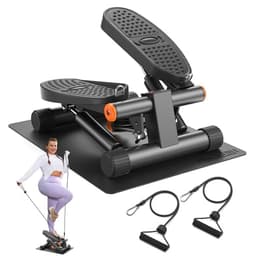
Niceday Mini Stair Stepper
Smallest footprint of anything here
A 16 x 12 inch footprint and a published 300 lb capacity — the most machine per square foot of anything on this site, and the smallest thing here you can genuinely raise your heart rate on.
The difference that actually decides it
A walking pad moves the ground backwards underneath you while your body stays at a fixed height. A stepper moves your body up and down while the ground stays put. That sounds like a distinction without a difference and it is the entire comparison.
Because your head and hands stay at a constant height on a walking pad, a keyboard stays usable and a screen stays readable. That is why desk walking is a thing people do for hours. On a stepper your whole body rises and falls several inches every step — your hands move, your eyeline moves, and typing is not practical. You can hold a phone call. You cannot work.
So the question is not “which is better exercise”. It is whether the machine has to coexist with your working day or replace part of it. If it has to coexist, only one of these two does that.
Where the stepper genuinely wins
Floor space: about 1.3 sq ft against 8.6
The Niceday publishes 16 x 12 inches. The WalkingPad Z1 publishes 56.1 x 22 inches. That is roughly a seven-to-one ratio, and it is a bigger gap than anything else on this site.
The second-order effect matters more than the first. A walking pad has to go somewhere when you are done, and whether it has a home is the strongest predictor of whether it is still in use in six months. A stepper has no such problem: it stays where it is, permanently, because 1.3 square feet in a corner is not in anybody’s way.
Friction to start
No unfolding, no plugging in, no waiting for a belt to reach speed, no remote to find. Step on. For a machine used in five-minute blocks through a day, that is worth more than any specification.
Price, and what it implies
A stepper has no motor, no belt, no deck and no real electronics. The live prices above reflect that, and it means a stepper is a low-stakes way to find out whether you will use home cardio at all before spending properly.
Nothing to maintain
A walking pad deck needs lubricating and its belt needs its tension checking. That is a real if short list. A hydraulic stepper has cylinders and a frame, and no consumables.
Where the walking pad wins, and by how much
Duration, which is the whole game
This is the one that matters and it is not close. People walk on pads for one to three hours across a working day. Almost nobody steps for more than about fifteen minutes at a stretch, because it is one fixed motion in a short range with nothing to look at and no distance covered.
Total movement is duration times intensity, and a stepper’s advantage on intensity does not survive an order-of-magnitude disadvantage on duration. The arithmetic on what desk walking actually adds.
Variety of movement
Walking varies naturally — pace changes, stride changes, you shift weight without thinking. A stepper repeats one path. That is more interesting than it sounds for joints doing the same thing several thousand times.
Balance and something to hold
Neither machine here has a handrail, which makes them equal on this page and not equal in general. Of the two categories, only steppers offer a machine with handlebars at a sensible size — the Stamina SpaceMate — and only walking pads offer one with a safety handle, the UREVO Strol 2E. If holding something matters, it changes which model rather than which category.
It can be put away
Counterintuitively, a folding walking pad has a storage option a stepper does not. The Z1 folds to 31.8 x 22 x 5.4 inches and goes under a sofa or into a cupboard. A stepper is out, always. In a studio where the living room is also the bedroom, that is worth thinking about.
What neither spec sheet settles
Noise, in both cases. KingSmith publishes no decibel figure for the Z1 and Niceday publishes none for its stepper. On mechanism: a stepper has no motor, so your room is quieter; but a stepper drops your body weight onto a rigid frame repeatedly, which is impact energy straight into the floor structure. If the person you are worried about is downstairs rather than beside you, do not assume the motorless machine is the considerate one. The full argument about which noise travels where.
Also unsettled: how each feels, whether the stepper’s hydraulics stay smooth over a year, and whether the pad’s belt holds up. We have used neither machine. Our method, and what it cannot do.
Choose the mini stepper if...
- There is genuinely no floor for a pad, in use or in storage.
- You want short bursts through the day rather than a long session.
- You are testing whether you will use home cardio at all.
- You want zero setup, zero maintenance and no outlet.
- Your budget rules a walking pad out entirely.
Choose the walking pad if...
- You want to move while working. Only the pad does this.
- You are trying to replace sitting rather than add a workout.
- You have measured a storage gap it will fit into.
- You want an hour or two of movement, not ten minutes.
- You want to walk rather than to exercise.
Questions people actually ask
Is a mini stepper as good as a walking pad?
For raising a heart rate in ten minutes, a stepper is arguably harder work. For accumulating an hour or two of movement across a working day, it is not close — a walking pad wins outright, because almost nobody steps for an hour and plenty of people walk for one while working. The two machines answer different questions: 'how do I get some effort into a day' and 'how do I stop sitting for eight hours'.
How much floor space does each one need?
The WalkingPad Z1 is 56.1 x 22 inches in use, which is about 8.6 square feet, and it needs somewhere to go afterwards. The Niceday mini stepper is 16 x 12 inches, about 1.3 square feet, and it does not need to go anywhere because it never gets in the way. That ratio — roughly seven to one — is the whole reason to consider a stepper.
Can you work at a desk on a mini stepper?
Not really, and this is the most common misunderstanding. A stepper moves you vertically by several inches with every step, so your hands move with you and your eyeline moves with you. Typing on it is not practical. A walking pad moves you horizontally under a fixed body height, which is exactly why desk work is possible on one. If working while moving is the goal, the stepper is not a cheaper version of the pad — it is a different product.
Which is quieter for an apartment?
Neither maker publishes a figure, so this is mechanism rather than measurement. A stepper has no motor, so there is no continuous mechanical noise in the room. But a stepper puts your full weight onto a rigid frame repeatedly, and that impact energy goes into the floor structure — which is exactly what a downstairs neighbor hears. A walking pad has motor noise you hear and footfall they hear. Our honest read is that a stepper is quieter in your room and not clearly quieter through the floor.
Which is better for weight loss?
Whichever one you actually use, and that is not a dodge — it is the only defensible answer. Both burn energy; neither burns a dramatic amount per hour. The variable that dominates is total time on the machine over months, and that is decided by friction: how easy it is to start, whether it is in the way, whether you can do it while doing something else. A walking pad wins on the third of those and a stepper wins on the first two.
Is a mini stepper cheaper than a walking pad?
Substantially, and it is the second real argument for one after floor space. The live prices in the buttons on this page come from Amazon and carry the date they were read — check them rather than any number a page like this could hard-code. What is structurally true is that a stepper has no motor, no belt, no deck and no electronics beyond a small display, and the price reflects that.
Read next
- Are mini steppers worth it? — the stepper half of this comparison, taken on its own terms.
- Best mini steppers for small spaces — three machines, and the one that publishes almost nothing.
- Best walking pads for small spaces — if the pad might fit after all, start here.
- Walking pad vs under-desk bike — the seated version of the same trade-off.
- Under-desk elliptical vs mini stepper — if no pad will fit: the seated machine you can work on, against the stepper you cannot.
- Are walking pads worth it? — scoped to someone without a spare room — including when the answer is no.
- Niceday mini stair stepper review — the full spec sheet for the stepper on this page.