Walking pad maintenance: what actually needs doing
It is a shorter list than you would expect, and one item on it does most of the work. Here is the honest version, including where our knowledge stops.
By Stephen V. · Last updated

Three things: keep the deck lubricated with 100% silicone so the belt is not dragging, keep the belt tension correct so it is neither slipping nor overtightened, and keep dust out from under the deck where the motor lives. Intervals come from your manual, not from this page.
What this page is, and what it is not
We have not owned or serviced any of the machines on this site. There is no workshop here, no long-term test unit and no teardown. What follows is the general maintenance model for a rear-roller treadmill deck — the mechanism every walking pad we track uses — plus a clear statement of where a general rule stops and your manual takes over.
That distinction matters more here than on most of our pages, because maintenance intervals are genuinely machine-specific. The manufacturer specification pages we compiled this site from publish dimensions, capacities and speeds; they are not service documentation. The manual in your box is, and where it disagrees with anything below, it wins.
1. Deck lubrication, which is most of the job
A treadmill belt slides over a rigid deck. Between them there is a low-friction layer, and on almost every domestic machine that layer is silicone oil. As it thins, friction rises — and rising friction is the single mechanism behind most of the symptoms people report.
A dry deck makes the motor work harder for the same speed, which shows up as a machine that feels sluggish under load or hesitates as your foot lands. That last symptom is easy to mistake for a loose belt, and people frequently respond by tightening it — which increases friction further and makes the real problem worse. The diagnosis between the two is here.
What to use
100% silicone oil, sold specifically for treadmills. Not a general-purpose penetrating spray, not a petroleum product, not a household oil. The wrong chemistry can attack the belt backing and the deck surface, and it attracts dust rather than repelling it. If your manual names a specific product, use that one.
How, in outline
- Unplug the machine.
- Lift one edge of the belt at the middle of the deck. If the underside feels dry to the touch rather than slick, it wants oil.
- Apply sparingly along the deck under the belt, both sides, following your manual’s quantity. Sparingly is the operative word.
- Run the belt empty at the lowest speed for a minute or two to spread it.
- Wipe any excess from the top surface before you walk on it.
Over-lubricating is a genuine fault, not just waste. Excess silicone migrates to the top of the belt and makes the walking surface slippery, which on a machine with no handrail — which is every pad on this site except the UREVO Strol 2E — is a real safety issue rather than an annoyance.
How often
Your manual. Where it gives no figure, the common practice for a treadmill in light domestic use is to check every few months and apply when the belt underside feels dry rather than on a fixed calendar. A machine doing an hour a day at a desk is a very different duty cycle from one doing twenty minutes a week, and a single interval cannot describe both.
If you need the oil
This page already told you what to use: 100% silicone, sold for treadmills, applied sparingly. This is a listing that matches that description. Your manual still outranks it on quantity and interval.
How this page is funded: the buy links here are Amazon affiliate links, and we earn a commission if you buy through one — at no extra cost to you. It does not change what we rank first, because the commission rate is the same across every machine on this page. Full disclosure.
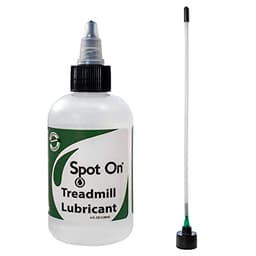
Spot On — Premium Treadmill Belt Lubricant, 100% pure silicone
The one consumable a walking pad actually has. A dry deck raises friction, and rising friction is the mechanism behind most of the symptoms people report — a sluggish belt, a hesitation as the foot lands, a motor working harder for the same speed. The listing states 100% pure silicone and ships with a long application tube, which is what gets oil under the belt without lifting the machine.
The catch: Your manual is the authority on quantity and interval, not this page and not the bottle. Over-lubricating is a genuine fault: excess silicone migrates to the top of the belt and makes a machine with no handrail slippery underfoot. If your manual names a specific product, buy that one instead.
Amazon retail listing, read 2026-08-17. We have not used this item; it is here because a page on this site already told you to do the job it does.
$9.95 · View on AmazonPrice as of September 25, 2026. #ad How we’re funded
2. Belt tension, checked rather than adjusted
Tension is not a routine task. It is a thing you check occasionally and adjust only when a symptom tells you to, and the most common maintenance mistake in this category is adjusting it because it feels like maintenance.
The workshop check most commonly cited: you should be able to lift the belt roughly two to three inches off the deck at the middle of one side. Much more than that and it will slip under load; much less and you are loading rollers, bearings and motor for nothing.
Two moments genuinely worth a check. After the machine has been moved or carried— a light frame lifted by its ends flexes, and a new floor changes the geometry. And in the first few weeks of a new machine, because a new belt beds in and stretches slightly. Beyond that, leave it alone until something changes.
The full procedure, including the difference between a tension adjustment and a tracking adjustment, is in the belt problems guide. They use the same two bolts in opposite ways, which is exactly why it is worth reading before you start turning things.
3. Dust, hair and what is under the deck
The decks on these machines sit a few inches off the floor with the motor and controller in the space underneath. That space collects exactly what the floor collects: dust, hair, carpet fiber, and in a small apartment quite a lot of it, because the machine is by definition in a room people live in.
Two consequences follow. Dust in a motor enclosure is an insulating blanket, so the motor runs warmer than it was designed to. And fiber that works its way between belt and deck adds abrasion at exactly the interface the silicone exists to keep smooth.
Neither needs anything elaborate:
- Vacuum under and around the deck when you vacuum the room. With the machine unplugged. That is the entire task.
- Wipe the top surface of the belt occasionally. A damp cloth, dried afterwards. Sweat and shoe grit are abrasive.
- Do not open the motor housing. That is service work, and on most machines it voids the warranty.
This is also the second reason a rigid board under a carpeted setup is worth having: it keeps the machine out of the pile that is producing the fiber in the first place, and restores the air gap the enclosure was designed around. The carpet reasoning in full.
What you do not need to do
Worth listing, because the category attracts advice borrowed from full-size gym treadmills that does not apply.
- No annual service. These are sealed consumer machines with no user-serviceable drivetrain.
- No scheduled belt replacement. Belts are replaced when they are worn, and on a walking pad at desk speeds that is a long way out.
- No motor brush inspection. Not a user task on machines of this class.
- No calibration. Speed and distance readouts are not user-calibrated on these units. If the numbers look wrong, they are simply the numbers this machine reports.
- No incline maintenance on most of them. Only two machines on this site have an incline mechanism at all, and one of those changes grade by swapping feet by hand.
Storage, folding and the one thing to avoid
Most pads on this site are designed to be folded and stored between sessions, which is the whole point of the category. Three notes on doing that without shortening the machine’s life.
Let it cool first. Folding a machine straight after an hour of use traps warm air in an enclosure that has just been working. A few minutes costs nothing.
Store it dry, and not against an outside wall in an unheated space. Condensation on electronics is the failure mode that has nothing to do with the belt.
Do not store it standing on its end unless the maker says you can.Some pads are designed for upright storage and some are not, and the difference is about where the machine’s weight bears when it is on end. That is a manual question, and it is worth answering before you plan a closet around it — our storage fit page runs the folded dimensions against real gaps, but the orientation is the maker’s call.
And the honest limit of this page: we cannot tell you how long any of these machines lasts. No maker on this site publishes an expected service life, we have not owned one long enough to know, and a number invented for the sake of completeness would be worth less than this paragraph.
Questions people actually ask
Do walking pads need lubricating?
Most rear-roller treadmill decks do, with 100% silicone oil applied between the belt and the deck, and walking pads use the same mechanism. The interval depends on hours of use and is specified by your machine's manual, not by a general rule — some makers state a schedule, others state 'as needed'. What is consistent across the category is the substance: 100% silicone, applied sparingly, and never a general-purpose spray lubricant or a petroleum product.
How often should you lubricate a walking pad?
Follow your manual, because it is written about your machine and this page is not. Where a manual gives no figure, the common practice for a treadmill in light domestic use is a check every few months and application when the underside of the belt feels dry to the touch rather than on a fixed calendar. Over-lubricating is a real fault in its own right — excess silicone works its way to the top surface and makes the belt slippery underfoot.
What maintenance does a walking pad actually need?
Three things, in order of how much they matter: keeping the deck lubricated so the belt is not dragging, keeping belt tension correct so it is neither slipping nor overtightened, and keeping dust and hair out from under the deck where the motor housing sits. Everything else is cleaning. There is no filter to change, no belt to replace on a schedule and no annual service.
Can you use WD-40 on a treadmill belt?
No. General-purpose penetrating sprays and petroleum-based products are the wrong chemistry for a treadmill deck: they can attack the belt backing and the deck surface, and they attract dust rather than repelling it. The product every treadmill maker specifies is 100% silicone oil, and it is inexpensive. If your manual names a specific product, use that one.
How long do walking pads last?
We have no honest answer to that. We have not owned these machines for long enough to know, no maker publishes an expected service life, and any number we gave you would be invented. What we can say is which variables affect it — hours of use, deck friction, belt tension and how much dust reaches the motor — and that three of those four are things you control with the maintenance on this page.
Read next
- How long do walking pads last? — the warranty terms, since nobody publishes a service life.
- Walking pad making a clicking or grinding noise — most of these noises are the maintenance on this page, overdue.
- Walking pad belt slipping or off-center — the two adjustments this page tells you to leave alone until they are needed.
- Can you use a walking pad on carpet? — why a board underneath is a maintenance decision as well as a stability one.
- How to use a walking pad at a desk — pace, shoes and setup — the habits that reduce wear at the source.
- Will it fit? Folded sizes vs real apartment storage — folded dimensions against real gaps, before you plan the storage.
- How we rank these — why this page tells you to read your manual instead of trusting us.
Sources
- WalkingPad Z1 — walkingpad.com product spec table (checked for published maintenance guidance, 2026-07-24)
- WalkingPad C2 — walkingpad.com product spec table (checked for published maintenance guidance, 2026-07-24)
- WalkingPad P1 — walkingpad.com product spec table (checked for published maintenance guidance, 2026-07-24)
- WalkingPad A1 Pro — walkingpad.com product spec table (checked for published maintenance guidance, 2026-07-24)
- UREVO Strol 2E — urevo.com product spec table (checked for published maintenance guidance, 2026-07-24)
- Lifepro PacerMini — Rehabmart retail listing spec table (checked for published maintenance guidance, 2026-07-24)
- Sunny Health & Fitness TreadPad Sleek Stride (SF-T722069) — sunnyhealthfitness.com product spec table (checked for published maintenance guidance, 2026-07-24)
- DeerRun Under-Desk Walking Pad — Amazon retail listing (checked for published maintenance guidance, 2026-07-24)