How long do walking pads last?
The number you want does not exist. Nobody in this category publishes a service life, an hours rating or a duty cycle - so here is the number they do publish, and what it is worth.
By Stephen V. · Last updated

No maker here publishes a service life, so any “three to five years” you read is a guess. The published commitment is the warranty: KingSmith one year with a paid extension across the WalkingPad range, UREVO one year plus 180 days. Read those before the marketing.
The specification that does not exist
Search this question and you will be told three to five years, or seven, or ten with care. None of those numbers has a source. We went looking for one on the manufacturers’ own pages on 2026-08-18 and found no maker on this site publishing any of the following:
- An expected service life, in years or in hours.
- A duty cycle or maximum continuous running time — we checked the WalkingPad Z1 and the UREVO Strol 2E specifically, and neither states one.
- A belt replacement interval, or a belt part number.
- A motor rating in hours, or a bearing life.
That is a real finding rather than a gap in our research, and it is the same pattern this category shows on noise: an adjective where a number should be. What each brand will and will not put in writing.
Every warranty term we could find
The warranty is the one durability statement a manufacturer makes that carries a legal consequence, which makes it the most useful proxy available. Here is what the pages say, read on 2026-08-18:
- KingSmith / WalkingPad Z1, C2, P1 and A1 Pro — “1-year warranty with optional extension available”, stated identically across all four product pages.
- UREVO Strol 2E— “1 Year + 180 Days Extended Warranty”. The longest bundled term we found in this category.
- Lifepro PacerMini— no warranty length stated on the retail listing our specifications for that machine come from.
- Sunny TreadPad Sleek Stride and DeerRun— no warranty term found on the pages we read.
Two things follow. First, twelve months is the norm here, which is shorter than many buyers assume for a motorized machine at these prices. Second, the machines that publish least about their construction are also the ones that publish nothing about backing it — which is consistent, if not reassuring.
Practical consequence: register the machine and keep proof of purchase on the day it arrives. On a twelve-month term, the paperwork you cannot find in month eleven is the whole warranty.
What you can fix, and what you cannot
A useful way to think about lifespan in this category is to sort the parts into two piles.
Things you can put right yourself.Belt tension, belt tracking and lubrication. Slipping is a tension problem, drifting is a tracking problem, and they are adjusted by the same two bolts in opposite directions — the makers document this and supply the tool. The order to do it in, and what routine maintenance actually involves.
Things that are a support conversation.The motor, the controller board, the display and the wireless receiver. No maker on this site publishes a parts catalog or a repair guide for any of them, and the error codes KingSmith does publish end with “contact support” for exactly this reason. Which codes mean which, and where the list stops.
That split is the honest answer to “can you repair a walking pad”. You maintain the mechanical half; the electronic half you either have under warranty or you do not.
The folding joint, and being honest about inference
A folding pad has something a rigid treadmill does not: a hinge that the structure and the drive wiring both have to cross, and that gets flexed every time the machine is put away.
We are flagging that as inference, not data. No maker publishes a fold-cycle rating — not KingSmith, whose entire range folds, and not UREVO. Nobody states how many folds the machine is designed for, and we have not tested one to find out. What we can say is that a joint carrying wiring is a wear point by construction, and that this is one more reason a machine you fold twice a day is being asked to do something a machine you leave out is not.
If that trade bothers you, it is an argument for a pad you can leave in place rather than one you fold constantly — which in a small apartment is usually not an option, and is precisely the compromise this category exists to make. Where each folded machine actually goes.
What plausibly extends it
With no published service life to optimize, the sensible position is to do what the makers ask and not much more:
- Lubricate the deck when the manual says to. This is the one routine every maker in this category asks for, and a dry deck makes the motor work harder against friction.
- Keep the belt correctly tensioned and tracking straight. A belt running off-center wears against the frame rather than the deck.
- Keep grit off it. Shoes carry it in and it ends up between belt and deck. This is the specific argument for a mat under the machine and for not walking on it in outdoor shoes.
- Turn it off when you step away. No maker publishes a continuous-use rating, so leaving it running empty for hours is unbounded rather than approved. What the absence of a duty cycle means.
- Give it its own outlet. Motors draw a surge at startup, and a shared circuit is the most common cause of a machine that cuts out. When stopping is electrical rather than mechanical.
The one thing every maker asks you to have
Deck lubrication is the only maintenance task every manufacturer in this category documents, and the bottle costs less than a takeaway. We have not used this item; check your own manual for the silicone type and interval it specifies before applying anything.
How this page is funded: the buy links here are Amazon affiliate links, and we earn a commission if you buy through one — at no extra cost to you. It does not change what we rank first, because the commission rate is the same across every machine on this page. Full disclosure.
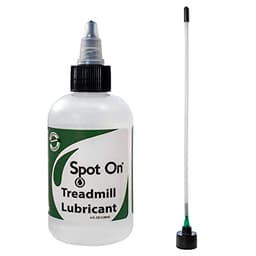
Spot On — Premium Treadmill Belt Lubricant, 100% pure silicone
The one consumable a walking pad actually has. A dry deck raises friction, and rising friction is the mechanism behind most of the symptoms people report — a sluggish belt, a hesitation as the foot lands, a motor working harder for the same speed. The listing states 100% pure silicone and ships with a long application tube, which is what gets oil under the belt without lifting the machine.
The catch: Your manual is the authority on quantity and interval, not this page and not the bottle. Over-lubricating is a genuine fault: excess silicone migrates to the top of the belt and makes a machine with no handrail slippery underfoot. If your manual names a specific product, buy that one instead.
Amazon retail listing, read 2026-08-17. We have not used this item; it is here because a page on this site already told you to do the job it does.
$9.95 · View on AmazonPrice as of October 2, 2026. #ad How we’re funded
What we have not done
We have not run any machine to failure. We have not owned these pads for three years and we are not going to imply otherwise, which is why this page contains no expected-lifespan number.
Every warranty term above is quoted from the page it was read from, with the date. Where a maker publishes nothing, this page says so rather than filling the gap with a category average. Our full method.
Questions people actually ask
How long do walking pads last?
No maker on this site publishes a service life, an expected hours figure or a duty cycle, so anyone quoting you 'three to five years' is repeating a guess. What is published is the warranty, and that is the only commitment you can hold a manufacturer to: KingSmith publishes one year with a paid extension available across the WalkingPad range, and UREVO publishes one year plus a stated 180-day extension for the Strol 2E.
What is the warranty on a WalkingPad?
Reading KingSmith's own product pages on 2026-08-18, the Z1, C2, P1 and A1 Pro all state '1-year warranty with optional extension available'. That is consistent across the range and it is a shorter term than many buyers expect from a motorized machine at these prices. Registering the machine and keeping proof of purchase matters more than usual when the window is twelve months.
What fails first on a walking pad?
We have not run a fleet of these to failure, so we will not rank failure modes as if we had data. What we can say from the published documentation is which parts are user-serviceable and which are not: belt tension and belt tracking are adjustable with the tools in the box, lubrication is a routine you are expected to perform, and everything electronic is a warranty conversation rather than a repair. Where a machine folds, the fold is a joint the drive wiring has to cross, which a rigid treadmill does not have.
Can you repair a walking pad?
Partly. Belt slipping and belt drift are adjustments rather than repairs, and every maker documents the bolts involved. Lubrication is routine maintenance. Beyond that, the motor, the controller board and the display are not user-serviceable on any machine we track, and no maker on this site publishes a spare-parts catalog for them. That is the practical argument for buying from a brand with a support channel and for registering the warranty on day one.
Does maintenance actually extend the life of a walking pad?
The makers clearly think so, because lubrication and belt tension are the two things their documentation tells you to do. What no maker publishes is a figure for how much life it adds — no hours, no cycles, no service interval expressed in miles. So the honest position is that maintenance is what the manufacturer asks of you, it costs very little, and nobody has quantified the payoff.
Is a longer warranty worth paying for?
It depends on what the extension actually covers, which is the thing to read before buying it. KingSmith offers a paid extension across its range and UREVO bundles 180 extra days. Neither converts a one-year part into a five-year one — an extension buys you a longer window in which a failure is somebody else's problem, and in a category where nothing is user-serviceable beyond the belt, that window has real value.
Read next
- Walking pad maintenance: what actually needs doing — lubrication, tension and the dust under the deck.
- Walking pad belt slipping or off-center — the two adjustments that account for most complaints.
- Walking pad error codes explained — the published code list, and what each one points at.
- Walking pad brands, ranked by what they publish — warranty terms are one of the columns brands are judged on.
- How much does a walking pad cost? — what the price actually buys, which is mostly the spec sheet.
Sources
- WalkingPad Z1 — '1-year warranty with optional extension available'; no duty cycle published (read 2026-08-18)
- WalkingPad C2 — warranty term (read 2026-08-18)
- WalkingPad P1 — warranty term (read 2026-08-18)
- WalkingPad A1 Pro — warranty term (read 2026-08-18)
- UREVO Strol 2E — '1 Year + 180 Days Extended Warranty'; no duty cycle published (read 2026-08-18)
- KingSmith / WalkingPad FAQ — support and error-code guidance (read 2026-08-18)