Is a second-hand walking pad worth it?
Sometimes - and the thing you are really buying at a discount is a machine with no warranty path, which the makers' own documents make clearer than any review could.
By Stephen V. · Last updated

Only at a discount big enough to cover replacing it. KingSmith states that its one-year limited warranty applies to products purchased directly from WalkingPad.com, and that terms “may vary by purchase region and sales channel”. UREVO’s extension policy names the channels that qualify and requires registration. A private seller is not any of those channels, so a used pad is an uncoveredpad — and no maker publishes a service life you could price the wear against either.
What the makers' own text says, and why channel is the word that matters
Most advice about buying used equipment is about condition. In this category the bigger variable is paperwork, and unusually for this market there is something concrete to read.
KingSmith’s FAQ states that its one-year limited warranty applies to products purchased directly from WalkingPad.com, and separately that “warranty periods, coverage, and exclusions may vary by purchase region and sales channel”. That is the single most consequential sentence in the category and the maker states it openly rather than hiding it. UREVO goes the other way and is equally specific: its extension policy names the eligible channels — its official website, Amazon.com, Walmart.com, eBay.com and other authorised retailers — and grants an extra 180 days for registering the machine in the app. The full published claim paths, brand by brand.
Now read both of those from the position of somebody buying from a stranger. You did not purchase from WalkingPad.com. You are not an authorised retailer. You did not register the machine, and the extension window began for somebody else. We have not found a single maker in this category that publishes a transfer policy in either direction, so there is nothing to appeal to — and the honest way to plan around an unwritten policy is to assume it does not exist.
There is a quieter version of the same problem in the returns documents: the published return policies require a receipt or proof of purchase, which is not a thing a private seller hands over. The published return windows, and what each one asks for.
Nobody publishes a service life, so nobody can price the wear
The second-hand market for most machinery works because there is a shared sense of what used up means — miles on a car, hours on a mower. This category has no equivalent, and not for lack of looking: no maker we track publishes a service life, an hours rating or a lifetime duty figure for any pad. Every warranty term we could find, and what each one implies.
So when a seller tells you a machine has had light use, there is no published scale to put that on. The nearest thing to an operating limit anybody states is KingSmith’s FAQ guidance of roughly an hour at a time followed by about half an hour off — which is a thermal instruction rather than a lifespan. The published continuous-use limit, quoted in full. A machine used for eight hours a day in a home office has done something very different from one used for twenty minutes a day, and nothing on the unit records which.
The same gap applies to the one genuine consumable. A deck needs lubricating, every maker specifies the same substance, and KingSmith publishes an interval — but there is no way to tell from the outside whether any of that was ever done. What the makers specify, and the products they name as unsuitable. A dry deck is the most common hidden condition on a used belt machine, and it is also the cheapest to fix if you catch it.
Five things to check in ten minutes
Every item here is tied to something a maker actually publishes, so you are checking against a document rather than against a feeling.
1. Run it slowly and watch the belt. Drifting to one side is a tracking problem; a brief stutter as your foot lands is a tension problem. Both are adjusted with the same two rear roller bolts, in opposite ways, and both are treated as user adjustments rather than faults. Tension first, tracking second, and why the order matters.
2. Ask when the deck was last lubricated. A dry deck makes the belt drag, which reads as slipping and gets worse if you tighten the belt in response. If the answer is never, treat that as a known cost rather than a dealbreaker.
3. Ask for the Allen key. It ships in the box and it is the only tool for the two adjustments above. A missing one is a small cost and a useful signal about how the machine was kept.
4. Look at the display and look up any code. KingSmith publishes its own error-code list, and some codes are more serious than others — four of them we could not find any published meaning for at all. The published code list, quoted, with the blanks left blank.
5. Confirm the remote is there. No pad we track publishes a safety key, and on several of these machines the remote is the primary control rather than a convenience. What you can and cannot do without it.
One thing you cannot check and should ask about anyway: whether the model publishes a specification sheet at all. Two of the eight pads we track publish no dimensions, which means a used unit of that model cannot be verified against anything — you are taking a stranger’s word about a machine the manufacturer never described.
| Model | In use (L x W x H) | Folded (L x W x H) | Unit weight | Max user | Top speed |
|---|---|---|---|---|---|
| WalkingPad Z1 | 56.1" L x 22" W x 4.1" Hmanufacturer spec | 31.8" L x 22" W x 5.4" Hmanufacturer spec | 51 lbmanufacturer spec | 242 lbmanufacturer spec | 4 mphmanufacturer spec |
| WalkingPad C2 | 56.9" L x 20.4" W x 4.9" Hmanufacturer spec | 32.5" L x 20.4" W x 5.4" Hmanufacturer spec | 55 lbmanufacturer spec | 220 lbmanufacturer spec | 4 mphmanufacturer spec |
| WalkingPad P1 | 56.5" L x 21.5" W x 5" Hmanufacturer spec | 32.5" L x 21.5" W x 5" Hmanufacturer spec | 62 lbmanufacturer spec | 220 lbmanufacturer spec | 3.75 mphmanufacturer spec |
| WalkingPad A1 Pro | 56.5" L x 21.5" W x 5" Hmanufacturer spec | 32.5" L x 21.5" W x 5" Hmanufacturer spec | 63 lbmanufacturer spec | 230 lbmanufacturer spec | 3.75 mphmanufacturer spec |
| UREVO Strol 2E | 48" L x 22.6" W x 38.9" Hmanufacturer spec | 51.2" L x 22.6" W x 4.6" Hmanufacturer spec | 47.2 lbmanufacturer spec | 265 lbmanufacturer spec | 6.2 mphmanufacturer spec |
| Lifepro PacerMini | 32.7" L x 25" W x 7" Hretail listing | Not publishednot published | 40 lbretail listing | 220 lbretail listing | 3 mphretail listing |
| Sunny Health & Fitness TreadPad Sleek Stride (SF-T722069) | 58.2" L x 24.9" W x 5.9" Hmanufacturer spec | Not publishednot published | 69.5 lbmanufacturer spec | 265 lbmanufacturer spec | 3.7 mphmanufacturer spec |
| DeerRun Under-Desk Walking Pad | Not publishednot published | Not publishednot published | Not publishednot published | 300 lbretail listing | 3.8 mphretail listing |
How to price it honestly
We have no used-market data for this category and we are not going to invent a percentage. What we can give you is the subtraction, in the order the losses actually occur.
Start at the new price of the same model. Take off the whole warranty, not a fraction of it, because the published text ties coverage to a channel you are not buying through. Take off the consumable condition you cannot verify — deck lubrication, and whatever the belt has already done. Take off the return path, since the published policies ask for proof of purchase. Then compare what is left against the cheapest new pad that still publishes a full specification sheet, not against the model you are looking at.
That last comparison is the one that decides it, and in this category it is tighter than most people assume, because the entry price of a documented new machine is low. The budget ranking, with live prices. If a used machine is not clearly cheaper than that, the discount is not paying you for anything.
Three new pads worth comparing a used price against
The clearest warranty path: the UREVO Strol 2E. For the buyer who was considering used and has decided coverage is the point. UREVO is the one brand here whose published extension policy names retail channels as eligiblerather than restricting coverage to its own site, and it grants an extra 180 days for registering the machine — so buying new from an authorised retailer gives you the longest documented path in the category. It is also the only pad we track whose maker publishes a handle, the lightest full-size pad here at 47.2 lb, and publishes 265 lb of capacity and 6.2 mph. Costs: its 40.2 in belt is the shortest full-size surface here, it folds to 51.2 in because the handle lies back over the deck, and UREVO publishes no deck-to-floor height.
The most completely documented: the WalkingPad Z1. For the buyer who wants every figure published so a machine can be checked against it — now or when they come to resell it. KingSmith publishes open size, folded size, belt size, unit weight, capacity and speed: 56.1 x 22 x 4.1 in open, folded in half to 31.8 x 22 x 5.4 inwhich is the shortest fold on this site, a 47.6 x 15.7 in belt, 51 lb and 242 lb. The costs are the narrow belt and the brand’s own channel caveat, which cuts against a direct-only warranty reading.
The closest new price to a used one: the Lifepro PacerMini. For the buyer whose used shortlist exists because of budget rather than preference. It is the smallest pad on this site by floor area and the lightest at 40 lb, its listing states a less-than-60 dB figure which is the strongest noise claim in the category, and it publishes a 220 lb capacity and incline. Read the belt first: at 27.6 init is twenty inches shorter than the Z1’s, Lifepro publishes no folded dimensions, and its figures come from a retail listing rather than a manufacturer spec page.
How this page is funded: the buy links here are Amazon affiliate links, and we earn a commission if you buy through one — at no extra cost to you. It does not change what we rank first, because the commission rate is the same across every machine on this page. Full disclosure.
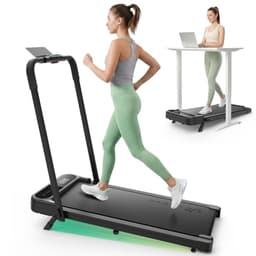
UREVO Strol 2E
Lightest with a handle
The lightest machine here that still has a safety handle, and the only one that goes fast enough to jog on.
Price as of October 22, 2026. #ad How we’re funded
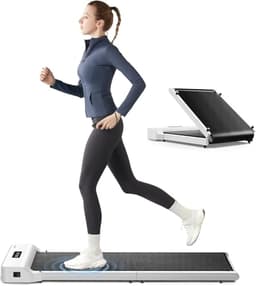
WalkingPad Z1
Smallest storage footprint
The only pad here that folds in half AND stays under 5.5 inches folded, which is the combination a small apartment actually needs.
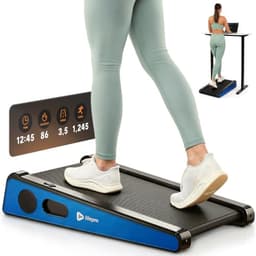
Lifepro PacerMini
Incline in the smallest deck
A 27.6 inch belt is short enough to be a real constraint, but it is the only pad here that publishes both an incline figure and a decibel figure.
What we have not done
We have not bought, inspected or resold a used walking pad, and we have no used-market pricing data — which is why this page contains no suggested discount, no depreciation curve and no valuation. We have not contacted any maker to ask whether a warranty transfers; everything above about coverage is quoted from published policy text, and where a policy is silent we have said that it is silent rather than inferring an answer. Every machine figure is the maker’s own or its retailer’s, read on the date given. The full method.
Questions people actually ask
Is it worth buying a second-hand walking pad?
It can be, and you should price in one specific loss rather than a vague risk: the warranty almost certainly does not travel with the machine. KingSmith's own FAQ states that its one-year limited warranty applies to products purchased directly from WalkingPad.com, and that warranty periods, coverage and exclusions may vary by purchase region and sales channel. UREVO's extension policy lists the channels that qualify - its official website, Amazon.com, Walmart.com, eBay.com and other authorised retailers - and requires app registration. A private seller is not any of those. So a used pad is, for practical purposes, an uncovered pad.
Do walking pad warranties transfer to a second owner?
We have not found a single maker in this category that publishes a transfer policy either way, which is itself the answer you should plan around. What is published points the other direction: coverage tied to a named sales channel, extension schemes tied to registration by the purchaser, and return policies that require a receipt or proof of purchase. None of those is a document a private seller can hand you. Treat an unwritten transfer as a no rather than as an open question.
How long does a walking pad last?
No maker we track publishes a service life, an hours rating or a duty-cycle lifetime, so there is no figure from which to price wear - which is the second reason used pricing in this category is guesswork. What is published is warranty length, which is a statement about the maker's confidence rather than about the machine: KingSmith one year with a paid extension available, UREVO one year plus 180 days for registering in the app. The one operating limit anybody states is KingSmith's FAQ guidance of about an hour at a time, then roughly half an hour off.
What should I check on a used walking pad before buying?
Five things, all checkable in ten minutes and all tied to something a maker actually publishes. Run it at low speed and watch the belt for drift and for a stutter under your foot - those are tracking and tension, and both are user adjustments made with the rear roller bolts. Ask whether the deck has ever been lubricated, because a dry deck makes the belt drag and reads as slipping. Ask for the Allen key, which ships in the box and is the only tool for those adjustments. Check the display for any error code and look it up before you pay. And confirm the remote is present, because no pad we track publishes a safety key.
What is a second-hand walking pad actually worth?
We will not put a figure on it, because we have no used-market data and inventing a percentage would be fabrication. What we can say is how to frame it. Price the machine as new price, minus the full warranty value, minus the consumable condition you cannot verify, and compare the result against the cheapest new pad with a published specification sheet. In this category that gap is often smaller than people expect, which is the whole argument of this page.
Is a used walking pad better than a cheap new one with no published specs?
That is the real comparison and it is closer than it looks, because both options cost you information. A used machine from a documented brand at least has a published specification sheet you can check it against - dimensions, belt size, capacity, speed - even if it has no warranty. A new machine from a brand that publishes nothing has a warranty you can claim on and no figures to check it against before it arrives. We would take the documentation, but it is a genuine trade rather than an obvious call.
Where does a second-hand pad make clear sense?
Three cases. When it is nearly new from a seller with the original receipt from an authorised retailer, which is the one scenario where coverage may still mean something. When the model is one that publishes a full specification sheet, so you can verify what you are looking at. And when the price difference against a new machine is large enough to cover a replacement rather than a repair - because on a sealed, uncovered machine, replacement is the realistic remedy.
Read next
- Walking pad warranties, brand by brand — the sales-channel sentence that decides whose warranty you actually have.
- How long does a walking pad last? — every published warranty term, and the service life nobody states.
- Repair or replace a walking pad? — the decision on a machine you already own, with the same documents.
- Walking pad belt slipping or drifting — the two user adjustments to test before you hand over money.
- Best budget walking pads — the new price a used machine has to beat, with live prices.
- Moving a walking pad — unit weights and folded sizes - useful whether you are buying or selling one.
Sources
- KingSmith / WalkingPad - brand FAQ: the one-year limited warranty stated as applying to products purchased directly from WalkingPad.com; 'warranty periods, coverage, and exclusions may vary by purchase region and sales channel'; the published error-code list; and the continuous-use guidance of about one hour at a time with roughly half an hour off (read 2026-10-11)
- UREVO Strol 2E - urevo.com product spec table: published dimensions, belt size, unit weight, capacity and speed, used here as the figures a second-hand unit can be checked against (read 2026-07-24)
- WalkingPad Z1 - walkingpad.com product spec table: published dimensions, belt size, unit weight, capacity and speed, used here as the figures a second-hand unit can be checked against (read 2026-07-24)
- Lifepro PacerMini - Rehabmart retail listing spec table: published dimensions, belt size, unit weight, capacity and speed, used here as the figures a second-hand unit can be checked against (read 2026-07-24)