Walking pad lubricant: which oil, how much, how often
There are published numbers for all three of those, and they are not on any product page. KingSmith states them in a support article, and the quantity is smaller than almost anybody uses.
By Stephen V. · Last updated

100% silicone oil made for treadmill decks— not a spray, not WD-40, not cooking oil. One to two drops on the deck under the belt, roughly every three monthsat two to three sessions a week, or as often as monthly on heavy daily use. All three figures are KingSmith’s own, published in its support article rather than on any spec sheet.
How this page is funded: the buy links here are Amazon affiliate links, and we earn a commission if you buy through one — at no extra cost to you. It does not change what we rank first, because the commission rate is the same across every machine on this page. Full disclosure.
The deck is the only consumable a pad has
A walking pad has no filter to change, no belt replacement schedule, no annual service and no part that wears to a published limit. What it has is a rubber belt sliding over a rigid board, and a thin film of silicone oil between them doing the only job that genuinely needs topping up.
KingSmith describes the mechanism plainly in its own words: every time you walk, the belt slides over the deck, and without lubrication that contact creates heat and friction which can cause the belt to drag or slip and may damage the deck or motor over time. Friction, it says, makes the machine noisier, puts stress on the motor, accelerates wear and can shorten the machine’s lifespan.
That one sentence links four complaints people treat as separate faults. A pad that has got louder, a pad that feels like it hesitates as your foot lands, a pad that runs warmer than it used to, and a pad whose belt seems to be slipping are frequently the same problem at different stages. KingSmith’s FAQ makes the noise half of that explicit — it lists maintenance condition alongside model, speed, user weight and flooring as a factor in how loud a machine is.
Which is why this is worth a page of its own rather than a bullet. It is a five-minute job, done three or four times a year, that sits upstream of most of the troubleshooting on this site. Why a machine that has become warm is usually reporting friction.
The interval, quoted - and the test that beats it
No walking pad product page we have read publishes a lubrication schedule. KingSmith’s support article does, and this is the whole of it, read on October 6, 2026:
“Frequency depends on how often the treadmill is used, but lubrication is generally recommended every few months. Under normal use (two to three times per week), applying lubricant about once every three months is typically sufficient, while heavy daily use may require lubrication as often as once a month.”
So the honest range is monthly to quarterly, set by how much you actually use the machine rather than by the calendar. For the reader this site is written for — someone walking at a desk through a working day, five days a week — that is the heavy-daily-use end of the range, not the light end. A desk pad doing an hour a day is a different duty cycle from a machine somebody steps on twice a week.
But the same article gives a better test than any interval, and if you remember one thing from this page it should be this one:
“A simple way to check whether lubrication is needed is to unplug the machine, lift the belt, and feel the deck—if it feels dry or rough, it’s time to apply lubricant; if it still feels slightly slick, lubrication can be postponed.”
That takes thirty seconds and it measures the actual variable instead of estimating it. A schedule is a proxy for how dry the deck is; your finger is not a proxy.
One more thing from the same article, worth knowing before you order anything: most treadmills come with lubricant, and many include guidance on whether lubrication is needed before first use. Check the box before you buy a bottle. And where your manual gives a figure, it outranks everything above — it was written about your machine and this page was not.
Which oil, and the three products to never use
The chemistry requirement is narrow and the reason is specific. From the same article: treadmills require non-petroleum lubricants because petroleum distillates can damage the belt and motor, and silicone oil designed specifically for treadmills is what is recommended to lubricate without harming the running surface or the deck.
Now the paragraph that actually answers the thing people are searching for. KingSmith names the substitutes, and it names three:
“Certain household oils, such as WD-40, vegetable oil, or general-purpose silicone sprays, are not suitable for treadmills. These products often contain petroleum distillates that can degrade the belt, attract dust, and negatively affect performance over time.”
Three things worth drawing out of that, because each one is a mistake we see people talk themselves into:
WD-40 is not a lubricant for this job.It is widely treated as a universal answer and it is the first thing named as unsuitable. The failure mode is not that it does nothing — it is that it degrades the belt and attracts dust, which makes the friction problem worse on a longer timescale than you will connect to the can.
Vegetable oil is worse than nothing. It is the cheap improvisation that sounds harmless because it is food. It attracts dust, and it has nowhere to go but into a sealed housing a few inches tall.
“Silicone” on a can is not the same product. This is the trap that catches careful people. A general-purpose silicone spray is explicitly on the unsuitable list alongside the other two, because a spray is a carrier plus propellant plus silicone rather than the oil a deck is specified for. The thing you want says treadmill on it and pours.
What this page will not tell you is a viscosity, a grade or a brand your maker endorses, because no maker on this site publishes one. The specification you get is “100% silicone, sold for treadmills”, and that is as precise as the published record goes.
One to two drops, and why more is a fault
This is the figure that surprises people most, and it is published: KingSmith says to apply one to two drops of silicone oil to the deck under the belt, and to avoid over-lubricating because excess oil may leak and potentially damage internal components or your flooring.
Its own FAQ is asked directly whether over-lubricating is acceptable and answers no: excess lubrication leads to buildup, leakage, or reduced traction on the belt, and using more than the recommended amount can hurt performance rather than improve it.
Reduced traction is the part worth sitting with, because of what these machines do not have. Seven of the eight pads we track have no handrail of any kind — nothing to grab if your foot slides. Excess silicone migrating to the top surface of a belt is not an untidy result on a machine with nothing to hold; it is the one outcome of this job that can actually hurt you.
So the instinct to be generous because the bottle is cheap is exactly backwards here. Two drops, spread by running the machine, then wipe what comes out at the edges. Getting on and off a deck with nothing to hold.
The procedure, in the maker's own order
KingSmith’s published sequence, in its order rather than ours. We have not performed this on any machine on this site — we do not own them — so this is a summary of what the maker wrote, and your manual wins where the two differ.
- Unplug it. Turn the machine off and unplug it before any maintenance task. The article states this first and repeats it in its own FAQ.
- Gather a silicone treadmill lubricant, a clean lint-free cloth and the manual. The cloth is not optional, for the reason in the next step.
- Clean the belt and deck first.Wipe dust, dirt and old lubricant off the deck and the underside of the belt. The article is explicit that new lubricant needs a clean surface to adhere to, and that skipping this compromises the result — so oiling over grit is not a shortcut, it is a different and worse job.
- Get under the belt without loosening it. On a folding pad, raise the running surface halfway to expose the underside. On a non-folding one, gently lift the edge of the belt just enough to apply oil underneath. KingSmith lists do not loosen the belt to lubricate as a mistake to avoid, because it disrupts tension and can cause misalignment.
- Apply one to two drops. Onto the deck, under the belt.
- Check the belt is centered. An off-center belt causes uneven wear and makes the machine feel unstable. Run at a low speed and make small, gradual adjustments until it tracks straight.
- Run it slowly for a few minutes.This is what actually spreads the oil across the deck and belt — two drops is enough precisely because the machine distributes them. Watch that the belt moves smoothly without jerking or slipping.
- Wipe off what escaped, then test. Clear any excess that has seeped out at the edges, then walk on it at a low speed listening for unusual noises and feeling for slippage.
Step six is the one most guides omit and the one most likely to cost you something. Lubrication and belt tracking are the same job on a machine this small, which is why we would read the tracking page before you start rather than after. Belt slipping and off-center tracking, with the adjustment order.
What lubrication does not fix
Worth stating, because a dry deck gets blamed for things it is not doing and oil gets applied to problems it cannot touch.
A noise that survives the oil.KingSmith’s own FAQ addresses this: if noise continues after lubrication, the likely causes are uneven application, a misaligned belt, or worn components. Its main FAQ page goes further on specific noises — a slam suggests a floor problem and a mat, while a sharp metal whistle from the motor brush or an abnormal drum sound is a contact-support case rather than a maintenance one. Which noise means what.
A machine that stops on its own.If it cuts out after a long session, that may be the published behavior rather than a fault — KingSmith states a one-hour limit for a walking machine with a half-hour cool-down, and says the automatic stop is by design. The published duty cycle.
An error code. Those have their own published list and their own published reset interval, and none of them is answered by oil. E01 to E11, explained.
Dust and hair under the deck. A separate job, and the maintenance article is specific about where it comes from: tiny pieces of rubber off your shoes plus airborne dust and hair, which can get caught under the belt or reach the motor. It recommends wiping the belt and frame weekly and vacuuming around the machine. That is cleaning, not lubrication, and doing the second without the first is the mistake in step three above.
What to buy
One item, and the specification you are shopping for is short: 100% silicone, sold for treadmill decks, with a tube long enough to reach under the belt without lifting the machine. That last detail matters more than it sounds on a pad with a hinged deck.
The one consumable
The single item this page tells you to own. It is here because the maintenance guide on this site already told you to use 100% silicone sold for treadmills, and KingSmith's support article now gives the interval and the quantity to go with it.
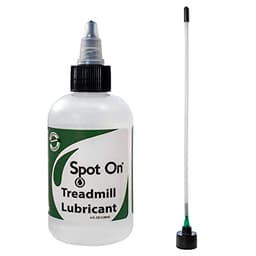
Spot On — Premium Treadmill Belt Lubricant, 100% pure silicone
The one consumable a walking pad actually has. A dry deck raises friction, and rising friction is the mechanism behind most of the symptoms people report — a sluggish belt, a hesitation as the foot lands, a motor working harder for the same speed. The listing states 100% pure silicone and ships with a long application tube, which is what gets oil under the belt without lifting the machine.
The catch: Your manual is the authority on quantity and interval, not this page and not the bottle. Over-lubricating is a genuine fault: excess silicone migrates to the top of the belt and makes a machine with no handrail slippery underfoot. If your manual names a specific product, buy that one instead.
Amazon retail listing, read 2026-08-17. We have not used this item; it is here because a page on this site already told you to do the job it does.
$9.95 · View on AmazonPrice as of October 6, 2026. #ad How we’re funded
What we have not done
We have not lubricated any machine on this site. There is no workshop here, we do not own these pads, and nothing above is a repair instruction. Every figure on this page — the three-month interval, the monthly heavy-use case, the one-to-two drops, the unsuitable-product list, the dry-deck test and the step order — is quoted or closely summarized from the KingSmith support article named at the bottom, with the date we read it. The one claim that is ours rather than theirs is the reduced-traction consequence applied to a machine with no handrail, and that follows from a published spec: seven of the eight pads we track publish no handrail. The full method.
Questions people actually ask
What lubricant do you use on a walking pad?
100% silicone oil sold specifically for treadmill decks. KingSmith's own support article states that treadmills require non-petroleum lubricants because petroleum distillates can damage the belt and motor, and that silicone oil designed for treadmills is the recommended product. If your manual names a specific lubricant, buy that one instead - it was written about your machine.
How often should you lubricate a walking pad?
KingSmith publishes a schedule, which is more than its product pages do: under normal use of two to three times per week, about once every three months is typically sufficient, while heavy daily use may require it as often as once a month. The better test than any calendar is the one in the same article - unplug the machine, lift the belt and feel the deck. Dry or rough means now; still slightly slick means it can wait.
How much lubricant does a walking pad need?
KingSmith's published figure is one to two drops of silicone oil on the deck under the belt. That is far less than most people apply. Over-lubricating is a real fault rather than harmless generosity: the same article warns that excess oil can leak and reach internal components or your flooring, and that too much causes buildup, leakage and reduced traction on the belt.
Can you use WD-40 on a walking pad?
No. KingSmith names WD-40, vegetable oil and general-purpose silicone sprays together as unsuitable for treadmills, because they often contain petroleum distillates that degrade the belt, attract dust and hurt performance over time. The fact that a can says silicone on it does not make it treadmill deck lubricant - a spray is a different product from the oil these decks are specified for.
What happens if you never lubricate a walking pad?
Friction between the belt and deck rises, and that single mechanism is behind most of the symptoms people report. KingSmith states that the friction makes the machine noisier, puts stress on the motor, accelerates wear and can shorten the machine's lifespan. Its FAQ also lists maintenance condition alongside model, speed, user weight and flooring as a factor in how loud a machine is - so a pad that has got louder may be describing a dry deck rather than a fault.
Should you unplug a walking pad before lubricating it?
Yes, and KingSmith says so twice in the same article: powering off and unplugging should be the first step for any maintenance task, because it removes the risk of accidental movement or an electrical problem while your hands are under the belt. These machines have no handrail and, on most models, no control other than a small wireless remote, so the outlet is the real off switch.
Do you need to loosen the belt to lubricate it?
No - and KingSmith lists this as a mistake to avoid rather than a technique. Loosening the belt to get underneath it disrupts the tension and can cause misalignment, which turns a five-minute job into a tracking problem. On a folding pad you raise the deck halfway to expose the underside; on a non-folding one you lift the edge of the belt just enough to apply the oil.
Read next
- Walking pad maintenance: what actually needs doing — the whole short list, of which this page is the one item with a published schedule.
- Walking pad overheating or getting hot — the symptom a dry deck produces first, and the published one-hour limit.
- Walking pad belt slipping or off-center — step six of the procedure above, done properly.
- Walking pad making a clicking or grinding noise — which noises the oil fixes and which ones are a support call.
- How long do walking pads last? — the warranty terms, since nobody publishes a service life.
- Walking pad not working: repair, warranty or replace? — what happens when maintenance is no longer the answer.
- Walking pad error codes explained — the published list, none of which is solved with silicone.
- Quietest walking pads — why maintenance condition belongs in the same sentence as the decibel figure.
- How to use a walking pad without falling — why reduced belt traction is the one outcome of this job that can hurt you.
- How we rank these — why this page quotes a support article instead of summarizing from memory.
Sources
- KingSmith / WalkingPad — “How to Lubricate a Treadmill”: the three-month interval at two to three sessions a week and monthly for heavy daily use, the unplug-and-feel-the-deck test, the non-petroleum requirement, WD-40 / vegetable oil / general-purpose silicone sprays named as unsuitable, the one-to-two-drop quantity, the step order, and the do-not-loosen-the-belt warning (read 2026-10-06)
- KingSmith / WalkingPad — treadmill maintenance article: weekly wipe-down of belt and frame, vacuuming around the machine, and rubber from shoes plus airborne dust and hair as the sources that reach the belt and motor (read 2026-10-06)
- KingSmith / WalkingPad — brand FAQ: maintenance condition listed alongside model, speed, user weight and flooring as a factor in noise level; the noise-by-type triage (floor slam, motor brush whistle, drum sound); and the one-hour continuous-use limit with a half-hour cool-down (read 2026-10-06)
- Spot On Premium Treadmill Belt Lubricant — Amazon retail listing, 100% pure silicone with a long application tube (read 2026-08-17)