Walking pad overheating or getting hot
There is a published number for this, and it is not on any product page. KingSmith states it on its FAQ, and almost nobody writing about walking pads has quoted it.
By Stephen V. · Last updated

KingSmith publishes the limit on its own FAQ: do not run a walking machine for more than one hour at a time (two hours for a running machine), then switch it off and let it cool for about half an hour. It also states that stopping automatically after long use is by design, not a malfunction. If yours runs hot inside that hour, the usual cause is belt-to-deck friction, not the room.
The published limit, quoted
Two other pages on this site record, correctly, that no maker in this category publishes a duty cycle on its product specification pages. We checked the WalkingPad Z1 and UREVO Strol 2E pages for exactly that and found nothing. That is still true.
What we had not checked until now was the brand FAQ. KingSmith’s own FAQ page, read on October 5, 2026, says this:
“The technician suggests that do not use it for more than 1 hour (for walking machine)/2 hours each time (for running machine). The machine will stop automatically after a long time of use. This is helpful in extending the lifetime of the machine, not a malfunction problem. […] Just switch the machine off, let it cool down for half an hour, then switch it on again and keep using.”
That is the whole answer to “how long can I run this”, from the maker of the most widely sold walking pads on the market, and it is considerably shorter than the way these machines are marketed implies. One hour, then thirty minutes off.
Note the distinction it draws, because it is the useful part: a walking machine gets one hour and a running machinegets two. KingSmith’s own FAQ separates its ranges along the same line, pointing under-desk buyers at the walking-only models and anyone who wants to run at a different series entirely. Every pad we track is in the first group.
We are quoting rather than paraphrasing because the sentence is awkwardly translated and we would rather you read what was actually written than our tidier version of it.
Stopping on its own is not a fault
This is the sentence that will save some readers a support ticket. A walking pad that cuts out after a long session has, in KingSmith’s own words, done something “helpful in extending the lifetime of the machine, not a malfunction problem”.
The prescribed response is not a reset sequence or a factory restore. It is: switch it off, leave it half an hour, switch it on, carry on. The half-hour is the specification — not thirty seconds, and not until the housing feels cool to the back of your hand.
There is a related published interval worth knowing alongside it. For any error code beginning with E, KingSmith’s guidance is to power the machine off for about ten minutes before restarting it. Two different waits for two different situations, both from the same maker, and both longer than people instinctively give them. The published error code list, and what each one means.
The case where it is notbenign is a machine that stops at the same point every time — as you step on, as you pass a particular speed, after the same two minutes. That pattern points at load or power rather than heat. Telling a load fault from a power fault from a circuit fault.
Why friction is the usual cause, not ambient heat
People search this query in summer and assume the room is the problem. It usually is not. The dominant variable on a machine that has started running warmer than it used to is friction between the belt and the deck.
A treadmill belt slides over a rigid board, and between them there is a low-friction layer which on almost every domestic machine is silicone oil. As that layer thins, friction rises; as friction rises, the motor draws more current to hold the same belt speed, and current in a small motor in a sealed low housing becomes heat with nowhere to go.
The reason this matters more than the ambient temperature is that it is cumulative and it is yours to fix. A machine that ran cool for six months and now runs warm has not moved to a hotter climate. Deck lubrication: the substance, the method and why intervals come from your manual.
Two other load factors push the same way, and both are published figures you can check. The first is your weight against the machine’s rated capacity — the pads we track publish limits from 220 to 300 lb, and working near the top of a rating is more load for the motor to hold. The second is speed: every pad here publishes a top speed, and a sustained session near it is a different thermal problem from a slow desk walk.
Carpet, airflow and the low housing
“Walking pad overheating on carpet” is a live search in its own right, so it deserves a straight answer including the part we cannot source.
What no maker publishes: a statement about carpet and ventilation, a minimum clearance under the housing, or an operating temperature range. We looked. None of the eight pads we track publishes any of the three.
What is structurally true: these machines are extremely low. The pads we track publish in-use heights from about four to six inches, and the motor housing is inside that. Carpet pile closes whatever gap exists beneath it, and a deep pile also presses against the moving belt edges, which adds drag the motor has to overcome. Both effects push in the same direction as the friction problem above.
What follows practically: if the machine lives on carpet, a firm flat base underneath addresses the clearance and the drag together, and it is also the thing that keeps the deck from flexing. That is a stability and wear argument first and a thermal one second, and we would rather frame it that way than claim a cooling benefit nobody has measured. Walking pads on carpet, in full and the mats that actually fit a walking pad.
What to check, in order
- How long was it running? If the answer is more than an hour, you have found it. Apply the published limit: one hour on, half an hour off.
- When did you last lubricate the deck? If the answer is never, that is the most likely cause of a machine that has become hot rather than always been warm. Follow your manual, not a general rule.
- What is it standing on? Carpet, a rug with a deep pile, or a surface that lets the deck flex. A firm flat base is the fix.
- Is it near a radiator, a heating vent or in direct sun? Ambient heat is rarely the whole cause but it stacks with everything above.
- Were you walking or jogging? Sustained use near a published top speed is a different load from desk pace, and only one pad we track publishes a speed above 4 mph.
- Is there dust packed under the deck? Hair and dust accumulate around the housing where the air moves. Unplug it first.
If all six are clear and it still runs hot, the question has stopped being a usage question and become a warranty question. Which is the maker’s to answer, not ours.
The only maker that publishes any of this
Here is the part worth carrying into a purchase decision. Of the eight pads on this site, one brand publishes a continuous-use limit, a cool-down interval and an error-code procedure anywhere on its website, and it is KingSmith. UREVO, Sunny, Lifepro and DeerRun publish none of the three that we could find.
That is not a performance ranking and we are not presenting it as one. It is a documentation ranking, which is the axis this whole site is built on: if the machine ever does run hot, one of these makers has already told you what it means and what to do, and the others have not.
The three KingSmith pads we track are below. The A1 Pro leads because it is also the only KingSmith model that publishes a decibel figure, which makes it the best-documented machine in the range on the two things an apartment owner worries about.
How this page is funded: the buy links here are Amazon affiliate links, and we earn a commission if you buy through one — at no extra cost to you. It does not change what we rank first, because the commission rate is the same across every machine on this page. Full disclosure.
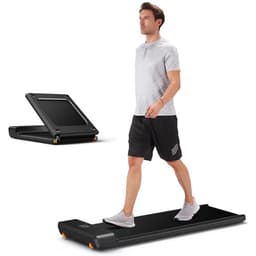
WalkingPad A1 Pro
A published noise figure
One of only two pads on this site whose maker publishes a decibel figure at all, and the only KingSmith model that does.
Price as of October 4, 2026. #ad How we’re funded
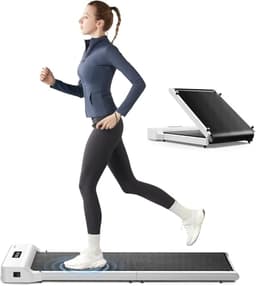
WalkingPad Z1
Smallest storage footprint
The only pad here that folds in half AND stays under 5.5 inches folded, which is the combination a small apartment actually needs.
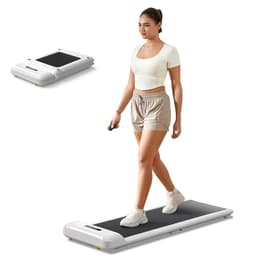
WalkingPad C2
Narrowest closet fit
The narrowest pad we list at 20.4 inches wide, which is the one that fits a genuinely tight closet — you pay for it in belt width.
Price as of October 4, 2026. #ad How we’re funded
None of which means a KingSmith pad runs cooler. We have not measured any machine on this site and we are not going to imply we have. Every brand here, ranked by what it publishes.
When it is a real fault
Four signals that take this out of the realm of normal operation:
- A burning or hot-electrical smell. Stop, unplug, contact the maker. This is not a troubleshooting situation.
- It trips the breaker. That is a circuit problem or a fault drawing far more current than it should, and it is not heat. What a 15 amp circuit actually allows.
- It cuts out within minutes, repeatedly, from cold. A thermal cut-out protects against sustained load; one that triggers from cold is reporting something else.
- A motor-protection or overcurrent error code. Those exist precisely to tell you the load is wrong, and KingSmith publishes the list.
We have not serviced any of these machines, there is no workshop here, and nothing above is a repair instruction. Where this page and your manual disagree, your manual wins — it was written about your machine and this was not.
Questions people actually ask
Why does my walking pad get hot?
A walking pad is a motor in a sealed housing a few inches tall, driving a belt that slides over a rigid deck. Almost all the heat comes from two places: the motor working against belt-to-deck friction, and the motor itself under sustained load. Friction rises as the deck's silicone layer thins, so a machine that has started running warm is usually telling you about lubrication rather than about the weather.
How long can you run a walking pad continuously?
KingSmith publishes a figure on its own FAQ and it is shorter than most owners assume: do not use it for more than one hour at a time for a walking machine, or two hours for a running machine, then switch it off and let it cool for about half an hour. That is the only continuous-use guidance we have found from any maker in this category, and no maker publishes it on a product specification page.
My walking pad stopped on its own. Is it broken?
Probably not. KingSmith states plainly that the machine will stop automatically after a long period of use, that this extends the life of the machine, and that it is not a malfunction - the instruction is to switch it off, let it cool for half an hour, and carry on. If it stops under load, at a particular speed, or takes the circuit with it, that is a different problem.
Will a walking pad overheat on carpet?
No maker publishes a statement about carpet and ventilation, so we will not pretend there is a sourced answer. What is true structurally is that the motor housing on these machines sits very low - several of the pads we track are under five inches tall in use - so carpet pile closes the gap beneath it, and a deep pile also drags on the belt edges and raises the load on the motor. A firm flat base under the machine addresses both, which is the main reason to use a mat on carpet.
What should I do if my walking pad smells hot or smells of burning?
Stop using it, unplug it, and contact the maker. A hot electrical or burning smell is in a different category from a warm housing, and nothing on this page is a reason to keep running it. We are not going to publish a troubleshooting procedure for a suspected electrical fault on a 110 V motor, because the correct answer is the manufacturer and not an article.
Does overheating shorten a walking pad's life?
Nobody publishes a service life for any machine in this category, so we cannot quantify it. What KingSmith does say is the reverse of the question: it describes the automatic stop and the half-hour cool-down as helpful in extending the lifetime of the machine. Treating the cool-down as a rule rather than an inconvenience is the one maintenance habit a maker has actually asked for in print.
Read next
- Walking pad keeps stopping or tripping the breaker — the three different faults that get described in the same four words.
- Walking pad maintenance: what actually needs doing — deck lubrication, which is the cause behind most machines that run warm.
- How long should you walk on a walking pad? — the health guidance, now with the maker's one-hour machine limit beside it.
- Walking pad error codes explained — the published code list and the ten-minute reset interval.
- How long do walking pads last? — why the warranty is the only commitment any maker here will put in writing.
- Can you use a walking pad on carpet? — the clearance and drag problem, with the stability consequences.
- Walking pad mat slipping or sliding — the other half of getting the base right under a machine that runs warm.
- Best mats for a walking pad — the firm flat base this page recommends, sized against real pads.
- What a walking pad costs to run — the motor and circuit figures behind the thermal argument here.
- Walking pad brands, ranked by what they publish — why one maker answering this question at all is worth noting.
- How we rank these — why this page quotes a translated FAQ instead of paraphrasing it.
Sources
- KingSmith / WalkingPad — brand FAQ: one-hour continuous use for a walking machine, two hours for a running machine, automatic stop by design, half-hour cool-down; plus the product-series split between walking and running models (read 2026-10-05)
- WalkingPad A1 Pro — walkingpad.com product spec table, checked for a published duty cycle, operating temperature range and minimum clearance; none published (read 2026-07-24)
- WalkingPad Z1 — walkingpad.com product spec table, checked for a published duty cycle, operating temperature range and minimum clearance; none published (read 2026-07-24)
- WalkingPad C2 — walkingpad.com product spec table, checked for a published duty cycle, operating temperature range and minimum clearance; none published (read 2026-07-24)
- UREVO Strol 2E — product spec table, checked for a published duty cycle; none published (read 2026-08-18)