Walking pad mat slipping? Why it slides and what stops it
Every step puts a small horizontal force into whatever is under you. On a sealed floor with a thin mat, there is almost nothing resisting it - and a week later the machine is two feet from where it started.
By Stephen V. · Last updated
First work out what actually moved: the mat on the floor, the machine on the mat, or the belt under your foot. If it is the mat, the levers are mass, material and geometry— and of the four mats we track, not one publishes a material and not one publishes a weight.
How this page is funded: the buy links here are Amazon affiliate links, and we earn a commission if you buy through one — at no extra cost to you. It does not change what we rank first, because the commission rate is the same across every machine on this page. Full disclosure.
Which of the three things is moving
“My walking pad slips” describes three separate problems with three different fixes. Spend thirty seconds identifying yours before changing anything.
The mat is sliding on the floor. Over days or weeks the whole assembly walks across the room, usually in the direction you push off. Mat and machine stay in the same relationship to each other.
The machine is sliding on the mat. The mat stays put and the pad creeps toward one edge of it. That points at the surface of the mat rather than the underside.
The belt is slipping under your foot. Nothing has moved across the room. The belt hesitates or lurches when you push off, particularly at low speed, which is a tension problem adjusted at the rear roller bolts. Tension against tracking, and the order to adjust them — and please do not tighten a belt to fix a mat.
Why a mat creeps in the first place
Walking is not a vertical activity. Every step puts a small backward force into the deck as you push off, and the deck passes it into whatever is underneath. On a sealed hardwood, laminate or tile floor there is very little friction available to absorb it, so each step moves the assembly a fraction of a millimeter — and a fraction of a millimeter a thousand times a day is how a machine ends up somewhere else by Friday.
Three things resist that force, and they are the three levers you have:
- Mass. A heavier mat, or a heavier machine, needs more force to move. Published unit weights for the pads we track run 40 to 69.5 lb, which is a genuine spread — the lightest machines creep most readily.
- Material. Rubber grips a hard floor better than smooth vinyl or a thin PVC sheet. This is the specification you would shop on if it were published.
- Geometry. A mat that cannot go anywhere — because a wall, a sofa foot or a heavy bookcase is in the way — does not need friction at all. This is free and it is the fix most people overlook.
What the mats actually publish
Here is the frustrating part, and it is consistent with everything else in this category: the figure that decides this is mostly missing.
- Material: none of the four mats we track publishes it. One did until September 2026 — SuperMats stated “heavy duty vinyl” for the 13GS on its own size table — and that listing is no longer available to buy, which leaves the column empty.
- Mat weight: none of the four publishes a weight. That is the single best predictor of whether a mat stays put, and it does not exist on any listing we read.
- Thickness: all four publish one, from 0.16 in to 0.5 in. Thickness is about impact and floor protection rather than grip, though it tends to travel with mass.
| Model | Mat size (L x W) | Thickness | Material | Unit weight |
|---|---|---|---|---|
| Stepwaver Walking Pad Treadmill Mat | 55.2" x 23.6"retail listing | 0.16 inretail listing | Not publishednot published | Not publishednot published |
| Fitvids High Density Equipment Mat (30 x 60) | 60" x 30"retail listing | 0.25 inretail listing | Not publishednot published | Not publishednot published |
| Marcy Fitness Equipment Mat (Mat-366) | 78" x 36"retail listing | 0.25 inretail listing | Not publishednot published | Not publishednot published |
| BESTXD Rubber Treadmill Mat Pads (4-pack) | 3.94" x 3.94"retail listing | 0.5 inretail listing | Not publishednot published | Not publishednot published |
So the honest shopping advice is narrow, and it got narrower when the one mat that named its material went out of stock: prefer more thickness where the price is close, prefer a mat you can trap against something immovable, and expect to solve the rest with placement rather than with a purchase. All four mats ranked on what they do publish.
The fixes, cheapest first
1. Put it somewhere it cannot go. Set the back edge of the mat against a wall, a skirting board or the foot of a heavy sofa, with the direction of travel into the obstruction. This costs nothing, works immediately, and solves most cases outright.
2. Slow down. Push-off force rises with pace. If the creep only appears when you walk faster, that is the mechanism telling you what it is — and slowing down also does more for the flat below than anything you can buy. Finding the pace you can actually work at.
3. Add mass or grip under it. A larger or thicker mat is the purchase-shaped version of the fix. Two of the mats we track are the sensible candidates: a full 30 x 60 in mat for a machine that lives in one place, or thick rubber pads placed under the feet where the load is concentrated.
4. Check the floor is level. Older apartment floors rarely are, and a machine on a slope is being helped downhill by gravity every step. If the creep has a consistent direction and the room has a slope, they are usually the same direction.
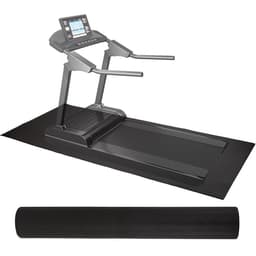
Fitvids High Density Equipment Mat (30 x 60)
Standing margin behind the belt
A 30 x 60 in mat at a stated quarter inch thick — the size that covers a full-size pad and still leaves you somewhere to step off, with both numbers in the listing title and nothing else published at all.
Price as of October 2, 2026. #ad How we’re funded
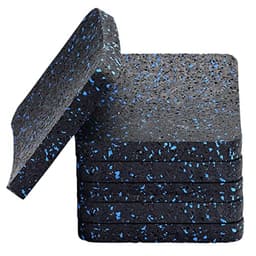
BESTXD Rubber Treadmill Mat Pads (4-pack)
Thickest rubber, least floor covered
Not a mat at all — four 3.94 in rubber pucks that go under the feet. Half an inch thick, which is twice any full mat here, and it costs a fraction of one.
Price as of October 2, 2026. #ad How we’re funded
We have not used either of these. The Fitvids mat is the largest one on this site that still fits a small room, at 30 x 60 in and a published 0.25 in, and it is the option for a machine that lives in one place; the BESTXD pads publish the thickest rubber at 0.5 in and cover the least floor, which suits a machine you move often rather than one that lives out. Neither maker publishes a material or a mat weight.
What not to do
Do not put furniture sliders under a machine you want to stay put. Felt sliders exist to reduce friction so a folded pad can be pushed across a floor, which is genuinely useful on moving day and exactly backwards here. Where sliders do belong.
Do not tighten the belt. If the machine is moving across the room, belt tension is not involved, and an over-tight belt loads the rollers and the motor continuously — which is one of the conditions that trips a protective cut-out. When a machine stops under load.
Do not fix anything to the floor. Adhesive mat tape, carpet tack strip and anything else that bonds to the surface is the one category of fix a renter cannot undo. Nothing on this site touches the property. Setting one up without touching anything.
What we have not done
We have not measured friction, tested a mat or run a machine on one. The material and thickness figures above are published specifications with their sources dated below, the empty weight column is a record of what nobody publishes, and the mechanism described is ordinary physics rather than a test result. Our full method.
Questions people actually ask
Why does my walking pad mat keep sliding?
Two surfaces with very little friction between them and a horizontal force applied every time you push off. On a sealed hardwood, tile or laminate floor a thin mat has almost nothing to grip, and each step drives it a fraction of an inch. The fix is mass, material or geometry — a heavier mat, a grippier one, or a mat trapped against something that cannot move.
Is it the mat sliding or the belt slipping?
Check what moved. If the whole assembly has migrated across the room over a week, that is the mat sliding on the floor, or the machine sliding on the mat. If the belt hesitates or lurches under your foot while the machine stays put, that is belt tension and it is adjusted with the bolts at the rear roller — a completely different fix. Confusing the two leads people to over-tighten a belt that was never the problem.
What material stops a mat from sliding?
Rubber, generally, because it has a higher coefficient of friction against a hard floor than smooth vinyl or a thin PVC sheet. The trouble is that the makers in this category do not publish the material at all: as of September 2026 not one of the four mats we track states what it is made of. So this is a case where you are shopping on a specification that does not exist.
Does a thicker mat slide less?
Not directly — thickness is about impact and floor protection rather than grip. What thickness correlates with in practice is mass, and a heavier mat takes more force to move. Published thicknesses across the mats we track run from 0.16 in to 0.5 in, but not one of the four publishes its weight, which is the figure that would actually predict this.
Can I use furniture sliders to stop a walking pad moving?
No — sliders do the opposite by design. Felt sliders exist to let a heavy folded machine glide across a floor when you are moving it, which is genuinely useful on moving day and is exactly wrong underneath a machine you want to stay put. If your pad already creeps, take anything low-friction out from under it.
Will a mat stop my walking pad from moving on carpet?
Carpet is usually the opposite problem: grip is rarely the issue, stability and heat are. A pad on deep pile can rock as the surface compresses unevenly under load, which is why a rigid board rather than a soft mat is the usual recommendation there. If your machine moves on carpet, look at leveling and at what is under it rather than at friction.
Read next
- Best walking pad mats — four mats, three published thicknesses and one stated material.
- Walking pad belt slipping or off-center — the other kind of slipping, and the bolts that fix it.
- Can you use a walking pad on carpet? — where stability, not grip, is the problem.
- Setting one up without drilling anything — why nothing here bonds to the floor.
- Are walking pads loud? — what a mat does and does not do about the flat below.
Sources
- Stepwaver Walking Pad Treadmill Mat — Amazon retail listing (read 2026-08-12)
- Fitvids High Density Equipment Mat (30 x 60) — Amazon retail listing (read 2026-09-11)
- Marcy Fitness Equipment Mat (Mat-366) — Amazon retail listing (read 2026-08-12)
- BESTXD Rubber Treadmill Mat Pads (4-pack) — Amazon retail listing (read 2026-08-12)