Are mini steppers worth it?
It is the smallest and cheapest cardio machine on this site and the one that asks the most of you. Both halves of that sentence decide the answer, and most pages only tell you the first.
By Stephen V. · Last updated
Yes, for one buyer: steady on your feet, almost no floor space, wants real effort in short blocks, and will actually stop working to use it. About 1.3 sq ft, no outlet, and all 3 of the 3 we track publish a maximum user weight — which the seated machines almost never do. No, if you wanted to move while you work: you cannot work on one.
Three questions that decide it
This page is not a ranking — we have one of those — and it is not the calorie arithmetic either, which has its own page. It is the prior question: should you buy one at all. Three answers settle it, and none of them is about the machine’s build quality.
- Is floor space your binding constraint? If yes, the stepper has an argument nothing else on this site can match.
- Do you want to move while you work, or instead of working? A stepper only does the second. This is the question most buyers get wrong.
- Is your balance a live question? If it is, the answer is no, and we would rather say that on the page where you are deciding than after you have bought one.
What you get for the floor space
This is the strongest argument for a stepper and it is worth stating with the actual numbers rather than as “compact”.
Niceday publishes 16 x 12 x 14 inches for its mini stair stepper. That is about 1.3 square feetof floor — roughly a quarter of what a walking pad occupies in use, and less than half of what a seated pedal exerciser takes. It is the smallest machine on this site by a wide margin, and it is the smallest thing here you can genuinely raise your heart rate on.
It also needs no outlet. All three steppers we track are hydraulic, which means no motor, no plug, no cable across a floor and nothing to trip a breaker — a real advantage in a room with one socket already taken. Which machines here run on nothing at all.
And two of the three need no assembly: they arrive ready to stand on. The exception is the Stamina SpaceMate, which needs assembling and is also the only one of the three that folds afterwards — to a published 9.5 inches, which slides under a bed frame the way a walking pad does.
The one thing this category does better
Here is something genuinely to the stepper’s credit that almost no review mentions, and we only noticed it by comparing the two categories side by side.
All 3 steppers we track publish a maximum user weight. Niceday states 300 lb, Stamina states 250 lb for the SpaceMate, and Xiser states 400 lb — the highest published figure of any machine on this entire site, alongside an aircraft-grade cast aluminum alloy frame that makes it credible on a machine that small.
Now the comparison. Of the six seated under-desk machines we track, exactly onepublishes a maximum user weight on its maker’s own site. Three of the six publish nothing at all, and Cubii publishes no limit for any model in its range.
The mechanical logic is straightforward — a stepper takes your entire body weight through two cylinders, so a maker has to have a figure in mind — but the consequence for a buyer is the thing worth carrying away: in this one respect, the cheapest and smallest category on the site is the best documented. The full split, bike by bike and stepper by stepper.
What you cannot do on it
Now the cost, and the first item is the one that decides most purchases in this category.
You cannot work on it.You are standing, and every step raises and lowers your whole body — which means your hands and your eyeline go up and down too. You can take a phone call on a stepper. You cannot type, read a spreadsheet or do anything that needs your eyes to stay still. If you came to this category from a walking pad or a desk bike search, this is the difference that matters most, because it moves the machine out of your working hours and into a slot you have to find.
It is not walking. Stepping is a fixed, repetitive motion through a short range, with no forward travel and nothing resembling a stride. We compared it with a pad directly and the conclusion was that the cheaper machine is not the smaller compromise — it is a different activity at a smaller price.
Two of the three have nothing to hold.Only the SpaceMate publishes handlebars. On the Niceday and the Xiser, balance is part of the activity rather than incidental to it — Xiser’s own page presents that as a benefit, and it is also a requirement. What is available on this site if you need something to hold.
Two of the three publish no unit weight. Niceday publishes none and Xiser publishes none, which means we cannot tell you what either is to carry or how well it will stay put. The Xiser publishes no dimensions at all, on the most expensive machine on this site.
The effort claim, and why nobody can size it
The argument for a stepper is effort per minute, and it is a sound argument right up to the point where anyone tries to put a number on it.
What is true:you stand on it, so each step lifts your own body mass against gravity. That is more work per repetition than any seated machine at any resistance setting, because a seated machine lifts nothing — your weight is on the chair. This follows from the mechanics rather than from a claim, which is why we are willing to state it.
What is not available: how much. Work is mass times the height it is lifted, and not one of the three stepper makers we track publishes a step height. Without that figure the work per step cannot be computed even in principle, never mind converted into a calorie figure. None of these machines has a console that knows your weight either, and one of them has no console at all.
So treat any specific number you are shown for a stepper as decoration. We took that arithmetic as far as it honestly goes and then stopped, which is further than the listings do and less far than you would like.
The three buyers it is wrong for
We would rather lose the sale than have you buy the wrong machine, so here are the three cases where the answer to the title is no.
1. Anyone whose balance is a live question. A stepper is used standing, on two pedals that move independently of each other, and two of the three we track have no handrail. That asks more of your balance than a walking pad does, not less. This is why none appears on our ranking for older buyers and why the pad ranking for the same buyer routes toward seated machines instead. If a fall is in your history, this is not the machine and no price makes it one.
2. Anyone who wanted to move while working.If the plan was “exercise during my seated day”, a stepper cannot deliver it at any price, because you cannot do desk work while stepping. That plan needs a seated machine or a walking pad, and the seated machines start much cheaper than most people expect.
3. Anyone buying on a resistance number.One of the three publishes a resistance count and none publishes a force. If the listing in front of you is leading with levels, it is leading with the figure that means least in this category — and on a stepper your own body weight is the main load anyway, which the level count has nothing to do with.
What to look for
If you are in the buyer this machine suits, four checks, in order of how much they decide.
1. A published maximum user weight. On a machine taking all of you through two cylinders, this is the figure most closely tied to how it was engineered. Good news: the whole category publishes it.
2. Whether there is anything to hold. Stated in the specification, not inferred from a photograph. One of three.
3. Whether it folds, and whether dimensions exist at all. A stepper that does not fold lives in the corner of a room permanently, which for a lot of small-apartment buyers undoes the floor-space argument that brought them here. And a maker who publishes no dimensions is asking you to buy a fit on faith.
4. A stated frame material. Unusually, this category gives you one: Niceday publishes a 1.5 mm steel frame and Xiser an aircraft-grade cast aluminum alloy. On a machine with a high capacity figure and a small footprint, the frame statement is what makes the capacity figure credible.
The three we track
The one to start with: the Niceday Mini Stair Stepper. The smallest footprint of anything on this site at a published 16 x 12 x 14 in, a 300 lb capacity, a stated 1.5 mm steel frame, hydraulic cylinders with no motor or outlet, and nothing to assemble. Against it: no handrail, no published unit weight, and no resistance count.
If you want handlebars, or somewhere to put it:the Stamina SpaceMate. The only stepper here with full-height handlebars and the only one that folds — to a published 38.5 x 16.25 x 9.5 in. Stamina publishes assembled size, folded size, unit weight and a 250 lb capacity together, which almost nobody in this category does. Against it: 54.5 in tall in use so it stands in the room, 45 lb which is heavier than several full walking pads, assembly required, and Stamina’s own spec tab prints two contradictory assembled sizes which we flag rather than choose between.
The highest capacity, and the emptiest spec sheet: the Xiser Commercial Mini Stairmaster. A 400 lb user capacity and an aircraft-grade cast aluminum alloy frame, three published cylinder settings, ready to use with no assembly and no power. It is also the most expensive machine on this entire site and publishes no dimensions, no folded size and no unit weight on its own page, which at that price is the finding rather than a footnote.
How this page is funded: the buy links here are Amazon affiliate links, and we earn a commission if you buy through one — at no extra cost to you. It does not change what we rank first, because the commission rate is the same across every machine on this page. Full disclosure.
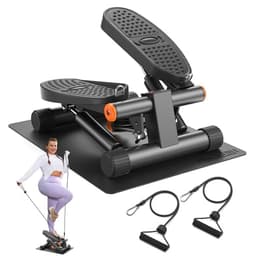
Niceday Mini Stair Stepper
Smallest footprint of anything here
A 16 x 12 inch footprint and a published 300 lb capacity — the most machine per square foot of anything on this site, and the smallest thing here you can genuinely raise your heart rate on.
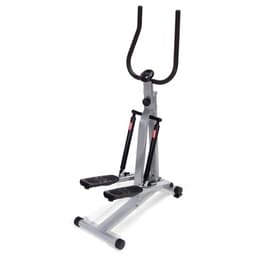
Stamina SpaceMate Folding Stepper
Handlebars, and it folds away
The only stepper here with handlebars and the only one that folds — 9.5 inches tall folded, which is the whole argument for buying a stepper you cannot leave out.
Price as of September 24, 2026. #ad How we’re funded
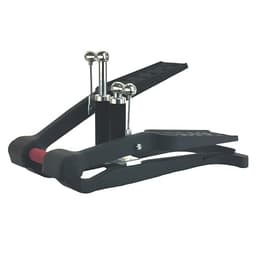
Xiser Commercial Mini Stairmaster
The highest published capacity here
The most expensive machine on this entire site and the one that publishes the least about itself — a 400 lb capacity, an aluminum frame, three resistance settings and no dimensions at all.
Price as of September 24, 2026. #ad How we’re funded
| Model | In use (L x W x H) | Folded (L x W x H) | Unit weight | Max user | Resistance levels | Material |
|---|---|---|---|---|---|---|
| Niceday Mini Stair Stepper | 16" L x 12" W x 14" Hmanufacturer spec | Not publishednot published | Not publishednot published | 300 lbmanufacturer spec | Not publishednot published | 1.5 mm steel framemanufacturer spec |
| Stamina SpaceMate Folding Stepper | 30.25" L x 16.25" W x 54.5" Hmanufacturer spec | 38.5" L x 16.25" W x 9.5" Hmanufacturer spec | 45 lbmanufacturer spec | 250 lbmanufacturer spec | Not publishednot published | Heavy duty steel framemanufacturer spec |
| Xiser Commercial Mini Stairmaster | Not publishednot published | Not publishednot published | Not publishednot published | 400 lbmanufacturer spec | 3manufacturer spec | Aircraft grade cast aluminum alloymanufacturer spec |
The prediction nobody makes
One last thing, and it is the part we would want told to us.
Of all the machines on this site, a stepper is the one most likely to go unused — and the reason has nothing to do with how it is built. A walking pad and a seated pedaler both attach to something you already do: you were going to sit at that desk anyway, and the machine runs underneath it. A stepper requires a new decision every time. Stop what you are doing, stand on it, step for ten minutes, get off.
Habits that need a fresh decision fail far more often than habits that hitch onto an existing one. That is not a criticism of steppers; it is the single most useful thing to know before buying one, and it means the question to ask yourself is not whether the machine is good. It is whether you are the sort of person who will stop working to use it.
If the honest answer is no, spend the money on the seated machine and get the hours instead of the intensity. If the honest answer is yes, this is the best value on the site: it is the cheapest route to real effort, in the least floor space, with the best-documented capacity figures in the whole category.
Skip this one
Any stepper sold on a level count, and any that publishes no size
Skip anything leading with a resistance level count. No stepper maker we track publishes a force, so a level count is the number of positions on a knob between two unstated endpoints. On a stepper your own body weight is the main load in any case, so a listing that leads with levels is leading with the figure that tells you least about the machine.
And be careful with any stepper that publishes no dimensions. We track one, and it is on this page because its capacity figure and frame statement are genuinely notable — but a category whose entire argument is floor space, sold without a footprint, is asking you to buy the one thing you came for on faith. If you are ordering to fit a specific corner, buy from a maker that states a size.
What we have not done
We have not stepped on any of these machines.No test lab, no owned units. Every figure above is read from each maker’s own page with the date we read it, and the floor-area arithmetic is computed from those published dimensions rather than typed in. Our full method.
We have not quantified how much harder stepping is than pedaling. No maker publishes a step height, so the comparison can be described and not measured. Where this page says a stepper is more work per minute, that is mechanics — your mass is being lifted — not a figure.
This is general information about published specifications. It is not medical advice, and a stepper asks something of your balance: if that is a live question for you, it belongs with a clinician rather than with us.
Questions people actually ask
Are mini steppers worth it?
For one buyer, clearly yes: someone steady on their feet, with almost no floor space, who wants real effort in short blocks and will actually stop what they are doing to use it. It is the smallest cardio machine on this site at about 1.3 square feet, it needs no outlet, and every stepper we track publishes a maximum user weight - which the seated machines almost never do. For everyone else it is usually the wrong purchase, and the most common reason is not the machine. It is that a stepper requires you to set aside time, and a machine that requires a new decision gets used less than one that attaches to a habit you already have.
Are mini stair steppers effective?
Per minute, they are the hardest work of anything in the under-desk category, and that follows from mechanics rather than from a measurement: you stand on it, so every step lifts your own body mass against gravity. A seated pedal exerciser lifts none of it because the chair carries you. What nobody can tell you is how effective, because no stepper maker we track publishes a step height - and without knowing how far your mass travels per step, the work per step cannot be computed even in principle.
What does a mini stepper actually do?
It moves your hips, knees and ankles through a short vertical range against a pair of hydraulic cylinders, while your body weight goes up and down with each step. There is no motor, no outlet and no forward travel - you are going up and down on the spot, and the machine goes exactly as fast as you push it. Two of the three we track have nothing to hold, so balance is part of the activity rather than incidental to it.
Is a mini stepper better than a walking pad?
They are not competing for the same slot. A walking pad runs under a desk for hours while you work; a stepper needs your full attention for ten minutes. If you have the floor space and want the hours, the pad is the better buy and it is not close on total movement. If you have neither the space nor the budget for a pad, a stepper is a real machine rather than a consolation - it just occupies a different part of your day.
Can you use a mini stepper at a desk?
No, and not because it is slightly too tall. You stand on it, so your whole body - and therefore your hands and your eyeline - rises and falls with every step. You can take a phone call on a stepper. You cannot do detailed work on one. None of the three stepper makers we track describes seated use for its stepper, and the Stamina SpaceMate is 54.5 inches tall in use because it has handlebars. If moving while you work is the goal, the machine built for it is a seated pedal exerciser or an under-desk elliptical.
Are mini steppers safe for seniors?
Not as a default, and that is why none appears on our ranking for older buyers. A stepper is used standing, on two pedals that move independently of each other, and only one of the three we track publishes handlebars to hold. That combination asks more of your balance than a walking pad does, not less. If you are steady on your feet and want the higher effort, our stepper ranking covers them properly. If balance is any part of the question, a seated machine removes it rather than mitigating it. This is general information about published specifications, not medical advice.
Do mini steppers have weight limits?
All three we track publish one, which makes this category unusually good on the figure that matters most: Niceday 300 lb, Stamina 250 lb for the SpaceMate, and Xiser 400 lb - the highest published figure of any machine on this site. That is a genuine advantage over the seated machines, where exactly one of six makers publishes a limit at all. It makes mechanical sense: a stepper carries your entire body weight through two cylinders, so the maker has to have a number in mind.
How much resistance do mini steppers have?
Published by one of the three, as a count. Xiser states three cylinder resistance settings set by a knob, which at least exists. Niceday describes a stride knob without quantifying it, and Stamina describes the SpaceMate's resistance as adjustable with no level count at all. None of the three states a force. On a stepper this matters less than on a seated machine, because your body weight is the main load rather than the cylinder setting - but it still means you cannot compare two steppers on how hard they are.
Read next
- Best mini steppers for small spaces — the ranking, if this page has answered yes and you now need which one.
- Mini stepper calories, and the number nobody publishes — how far the effort arithmetic gets without a published step height.
- Under-desk bike vs mini stepper — hours against intensity, and the total split on published user weight limits.
- Walking pad vs mini stepper — 8.5 square feet against 1.3, and why the cheaper machine is not the smaller compromise.
- Are walking pads worth it? — the same question asked of the machine most people compare a stepper against.
- Is there a walking pad that needs no electricity? — why the steppers are the answer to a question the pads cannot answer.
- Small-space cardio equipment, ranked by floor space — every category on this site measured in square feet, in use and stored.