How to use a mini stepper
One maker in this category publishes an actual routine, and it recommends four minutes. The same maker publishes what its resistance settings are for, and the mapping is backwards from what everyone assumes.
By Stephen V. · Last updated
Start shorter than you think. The only published protocol in this category is Xiser’s: four minutes a day, three times a week, building to four minutes five times a week. Keep the whole foot on the pedal, stand tall, and use the full pedal travel. And on a hydraulic stepper, high resistance is the slow-pace setting— not the hard one.
What the machine actually does
A mini stepper is two pedals on a frame with a hydraulic cylinder beneath them. There is no motor, no flywheel and no outlet. When you step down, your body weight compresses a cylinder; the cylinder’s resistance to being compressed is the entire workout.
All three machines we track publish the mechanism, which is more than the seated category manages. Niceday and Stamina both publish hydraulic cylinders. Xiser publishes more detail than either: a patented system in which a silicone-based fluid travels from one cylinder to the other as you step, which it contrasts with cheaper steppers where the oil is compressed and the feel is “spongy”.
The consequence that matters for how you use it: because the resistance comes from fluid moving through a restriction, it is rate-dependent. The cylinder pushes back harder the faster you try to compress it. That single fact explains the resistance section below and most of what feels strange about a stepper in the first week.
It also explains why your whole body weight is the load. There is no saddle and no chair; you are standing on the machine. That is the difference between this category and the seated one, and it is why all three steppers here publish a maximum user weight while four of the six seated machines publish none. Every published limit in both categories.
The four-minute protocol, quoted
Nobody in this category publishes a training plan except Xiser, and what Xiser publishes is short enough that most people will assume it is a typo. From its own product page, read on October 5, 2026:
“We recommend that you start with the simple Xiser stepping routine which is 4 minutes per day, three times a week. Then you can progress to the Core 4 Training which will require an investment of time of 4 minutes per day 5 times a week – total of 20 minutes per week.”
Four minutes. Three times a week. Progressing, eventually, to twenty minutes a week in total.
Two things to take from that. First, it is an intensity statement disguised as a duration: that machine is sold for interval work, and four minutes is a credible interval session rather than a token one. Second, it sets a sane expectation for a beginner on any stepper. If a maker whose entire marketing rests on results recommends four minutes, then an hour on day one is not ambition, it is a sore week.
The honest caveat: this is one maker’s protocol for one machine, aimed at high-intensity use, and it is a marketing page rather than a clinical guideline. We are not converting it into a general prescription or into a calorie figure. For how much movement public health guidance actually asks for in a week, we use the US National Library of Medicine rather than any manufacturer. What the guidance says, and what counts toward it.
Resistance runs backwards
This is the single most useful thing on this page, and almost nothing written about mini steppers mentions it. Xiser publishes what each of its three knob settings is for:
“High resistance which would be best for a walking pace, Medium Resistance which you would use for moderate aerobic stepping and low resistance which is for use when doing HIIT training.”
Read that twice. High resistance is the setting for a slow pace. Low resistance is the setting for the hardest session. That is the opposite of how resistance works on a magnetic bike, where you turn it up to make a given cadence harder.
It makes sense once you have the mechanism from the section above. A hydraulic cylinder resists the rateof compression. Turn the restriction up and the pedal simply will not travel quickly, so your cadence falls — the setting governs speed more than effort. Turn it down and the pedals move freely, which is what you need to step fast enough for intervals.
The practical instruction: if the machine feels sluggish and your heart rate is not moving, you are probably on too much resistance rather than too little. Try less, not more.
Two limits on this advice, stated rather than buried. It is published for the Xiser specifically. Stamina describes the SpaceMate’s cylinders as adjustable without publishing a level count or a mapping, and Niceday publishes neither a count nor a mapping for its knob — so on those two machines the principle should hold mechanically, but nobody has confirmed it in print. Every published resistance figure in this category.
Form, and the part nobody publishes
No maker on this site publishes a form guide, a step height or a stride length, so what follows is mechanical reasoning rather than a sourced instruction, and we are labeling it that way.
Whole foot on the pedal. The pedals are short and the temptation is to work off the ball of the foot, which turns a leg movement into a calf movement and loads the ankle.
Stand tall. Leaning forward over your knees shifts the load and is also the position from which you are most likely to step off the side.
Use the whole travel. Short bouncy steps at the top of the range are the default when the resistance is too high, and they are also where the movement stops being worth doing. Let the pedal come up fully.
Both pedals or one at a time.Stamina publishes “independent stepping action” for the SpaceMate, which means the two pedals are not linked and each one returns on its own. That is a feel difference worth knowing about before you assume a machine is faulty.
The figure you cannot check.Not one of these three makers publishes a step height. Xiser describes its step height as “biomechanically correct” and states the machine is longer than other mini steppers — and then publishes no dimensions whatsoever, so there is no number behind either claim. For a shorter or taller user that is the specification you would most want, and it does not exist anywhere in the category.
Balance: two of these have nothing to hold
A walking pad keeps both your feet moving along a fixed surface. A stepper raises and lowers you, which is a balance task as well as a cardio one, and the published specifications are blunt about who has help with it.
The Stamina SpaceMate is the only one of the three with handlebars — full height, foam covered, and Stamina also publishes skid-resistant rubber floor protectors on the base. Neither the Niceday nor the Xiser has a handrail at all, and in the Xiser’s case that is at the highest price of any machine on this site.
If balance is a live question, that is a purchase decision rather than a technique one, and no amount of careful stepping substitutes for something to hold. Standing near a wall or a doorframe is the obvious improvisation, and we mention it as an improvisation rather than a recommendation: a wall you can touch is not a handrail and nobody has rated it.
We do not make medical or fall-risk assessments anywhere on this site. If that is the question you are actually asking, it belongs to someone who can see you.
Where the force goes, if you have neighbors
Worth a paragraph because this site is written for apartments, and it is the thing stepper buyers discover last.
A stepper is the quietest machine in the category by airborne noise — there is no motor, so there is nothing to hum. It is also the one that puts the most force into your floor, because your full body weight is raised and lowered through a small frame onto a small contact area, every step, for the whole session.
Which means a stepper can be the quietest machine in your room and the worst choice in your building at the same time. Not one of the nine machines on this site publishes a decibel figure, so this is a mechanical statement rather than a measurement — but it is the mechanism, and a mat does far less about it than people hope, because the force is continuous rather than an impact to absorb. What each machine puts into the floor, worked through.
The three machines, and what each publishes
If you have read this far and concluded the category suits you, here is the whole field — there are only three machines in it on this site. Ranked here on how much each maker tells you about using it, which is the subject of this page rather than a general ranking.
| Model | In use (L x W x H) | Folded (L x W x H) | Unit weight | Max user | Resistance levels | Material |
|---|---|---|---|---|---|---|
| Niceday Mini Stair Stepper | 16" L x 12" W x 14" Hmanufacturer spec | Not publishednot published | Not publishednot published | 300 lbmanufacturer spec | Not publishednot published | 1.5 mm steel framemanufacturer spec |
| Stamina SpaceMate Folding Stepper | 30.25" L x 16.25" W x 54.5" Hmanufacturer spec | 38.5" L x 16.25" W x 9.5" Hmanufacturer spec | 45 lbmanufacturer spec | 250 lbmanufacturer spec | Not publishednot published | Heavy duty steel framemanufacturer spec |
| Xiser Commercial Mini Stairmaster | Not publishednot published | Not publishednot published | Not publishednot published | 400 lbmanufacturer spec | 3manufacturer spec | Aircraft grade cast aluminum alloymanufacturer spec |
How this page is funded: the buy links here are Amazon affiliate links, and we earn a commission if you buy through one — at no extra cost to you. It does not change what we rank first, because the commission rate is the same across every machine on this page. Full disclosure.
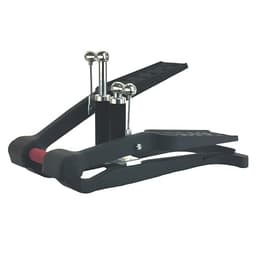
Xiser Commercial Mini Stairmaster
The highest published capacity here
The most expensive machine on this entire site and the one that publishes the least about itself — a 400 lb capacity, an aluminum frame, three resistance settings and no dimensions at all.
Price as of October 4, 2026. #ad How we’re funded
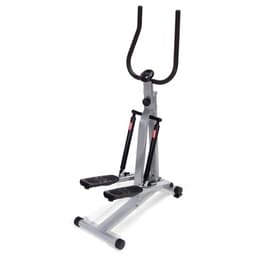
Stamina SpaceMate Folding Stepper
Handlebars, and it folds away
The only stepper here with handlebars and the only one that folds — 9.5 inches tall folded, which is the whole argument for buying a stepper you cannot leave out.
Price as of October 4, 2026. #ad How we’re funded
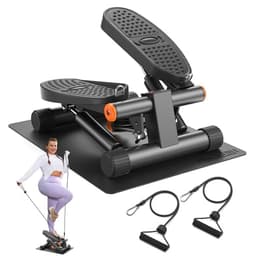
Niceday Mini Stair Stepper
Smallest footprint of anything here
A 16 x 12 inch footprint and a published 300 lb capacity — the most machine per square foot of anything on this site, and the smallest thing here you can genuinely raise your heart rate on.
Xiser Commercial Mini Stairmaster— the only machine here with a published routine and a published resistance mapping, three knob settings, a 400 lb capacity and an aircraft-grade cast aluminum alloy frame with no welded joints. It is also the most expensive machine on this site and publishes no dimensions, no folded size and no unit weight, so you cannot check whether it fits the space you have.
Stamina SpaceMate Folding Stepper— the one to pick if you want something to hold. Foam-covered full-height handlebars, hydraulic cylinders, an electronic monitor that shows steps per minute, a 250 lb published capacity, and it folds to 9.5 inches thick. Two caveats: it stands 54.5 inches tall in use, so it is not a small object, and at 45 lb it is heavier than several full walking pads here.
Niceday Mini Stair Stepper— the smallest cardio machine on this site at roughly 1.3 square feet, with a 300 lb published capacity and a 1.5 mm steel frame. No handrail, no published unit weight and no resistance level count, so the setting advice above has to be applied by feel.
The same three ranked on footprint instead — which is the ranking that matters if the room is the constraint.
What goes wrong in month two
Three failure modes, in the order we would expect them, and none of them is the machine breaking.
It was too hard, so it stopped being used. This is the big one and it is why the four-minute protocol above matters more than any technique note. A stepper is the hardest machine on this site per minute, because it lifts all of you. A plan you can do on a bad Tuesday beats one you abandon in week three.
It is in the wrong place. A stepper has to be stood on in open floor with clear height above you, which is a different requirement from a machine that slides under a desk. Two of the three here do not fold, so wherever you put it is where it lives.
It walks across the floor. Hydraulic steppers are light and the side-to-side load is real. Stamina publishes rubber floor protectors; the other two publish no unit weight at all, so there is no number to tell you how firmly they plant. A textured surface helps; a slick floor does not.
We have not used any of these machines and there is no test lab here. Everything on this page is either quoted from a maker with the date we read it, or clearly flagged as mechanical reasoning. The full method.
Questions people actually ask
How long should you use a mini stepper?
The only maker on this site that publishes a protocol is Xiser, and it recommends starting at four minutes a day, three times a week, then progressing to four minutes a day five times a week - twenty minutes a week in total. That is far shorter than people expect, and it is a deliberate consequence of how hard the machine is: a stepper lifts your entire body weight on every step.
How does a mini stepper work?
Two pedals sit on a frame with a hydraulic cylinder under each one, or a linked pair. Your body weight compresses a cylinder as you step down, and the cylinder's resistance to being compressed is what makes the movement work rather than simply dropping. Xiser publishes that its patented system moves a silicone-based fluid between the two cylinders as you step, and both Stamina and Niceday publish hydraulic cylinders as their mechanism. None of the three has a motor and none needs an outlet.
Which resistance setting should I use on a mini stepper?
On the one machine here that publishes guidance, the answer is the opposite of the intuitive one. Xiser states that high resistance is best for a walking pace, medium for moderate aerobic stepping, and low resistance for interval training. Resistance on a hydraulic stepper limits how fast the cylinder can compress, so turning it up slows you down rather than making it harder - which is why a hard, fast session wants the low setting.
What is the correct form on a mini stepper?
No maker on this site publishes a form guide, so we are giving you the mechanics rather than a sourced instruction. Keep your whole foot on the pedal rather than the ball of the foot, stand tall instead of leaning forward over your knees, and let the pedal travel its full range instead of bouncing at the top. Two of the three steppers here have nothing to hold, so if balance is a question for you, that is a buying decision rather than a technique one.
Can you use a mini stepper at a desk while working?
No, and this is the most common disappointment in the category. You are standing on it, your body weight is rising and falling, and your hands are free only in the sense that they are not holding anything useful. The machines that work while you type are the seated pedal exercisers and under-desk ellipticals, which are a different product entirely.
How do you use a mini stepper to lose weight or for glutes?
We will not publish a program for either, because no maker here publishes an output figure that would let us quantify one and we are not a training site. What we can tell you is what the machines publish about resistance, and that the stepping motion is a fixed vertical path in a small range - which is a real limitation that no amount of routine design removes. We have separate pages on what the calorie displays can and cannot know and on which muscles the motion actually uses.
Read next
- Are mini steppers worth it? — the honest case for and against the category, before the technique matters.
- Best mini steppers for small spaces — the same three machines ranked on published footprint.
- Mini stepper calories, and the number nobody publishes — why we will not convert the four-minute routine into a calorie figure.
- What muscles does an under-desk machine work? — the honest answer to the 'for glutes' version of this query.
- How to use an under-desk bike or pedal exerciser — the seated equivalent of this page, where the chair is the problem.
- Under-desk machines with adjustable resistance — why a level count is a granularity claim and not a magnitude.
- Quietest under-desk cardio machines — why the quietest machine in your room can be the worst in your building.
- Under-desk elliptical vs mini stepper — seated against standing, if this page has made you reconsider.
- Pedal exerciser vs walking: is pedaling as good? — where a stepper sits between the two, mechanically.
- Under-desk cardio weight limits — why every stepper publishes one and most seated machines do not.
Sources
- Xiser — product page: published four-minute stepping routine, the three-setting resistance mapping (high for walking pace, low for interval work), the silicone-fluid hydraulic system and the 400 lb capacity (read 2026-10-05)
- Stamina SpaceMate Folding Stepper — product page: hydraulic cylinders, independent stepping action, foam-covered handlebars, skid-resistant rubber floor protectors and the steps-per-minute monitor (read 2026-10-05)
- Niceday Mini Stair Stepper — nicedaysteppers.com product page, checked for a published step height and stride length; neither published (read 2026-08-12)
- Stamina SpaceMate Folding Stepper — staminaproducts.com specification tab, checked for a published step height and stride length; neither published (read 2026-08-12)
- Xiser Commercial Mini Stairmaster — myxiser.com product page, checked for a published step height and stride length; neither published (read 2026-08-12)
- MedlinePlus, US National Library of Medicine — weekly physical activity guidance for adults (read 2026-09-17)