Are under-desk ellipticals worth it?
Yes, if the thing it is replacing is sitting still. The harder problem is not whether the machine works - it is that the best-known brand in the category will barely tell you what it is.
By Stephen V. · Last updated

Worth it if the alternative is sitting still; not worth it as a substitute for exercise.That is the same conclusion we reach for the desk bike and the stepper, and the published record supports no stronger claim. The thing that should actually worry a buyer is different and specific: the best-known maker in this category publishes no dimensions, no user weight limit, no stride length and no warranty term for any model — and answers “No” to the full-body question for the model we track.
The case for: it attaches to a habit you already have
Every piece of home cardio equipment fails in the same way. It is not that the machine is bad — it is that using it requires a new decision every day, and the decision eventually stops being made. That is the prediction we published about the mini stepper and we stand by it: a stepper asks for a fresh decision every time, which is why it is the machine here most likely to go unused.
A seated elliptical is the one category on this site that does not ask for that decision. It sits in the footwell of a desk you are already at for six or eight hours. You do not change clothes, you do not go anywhere, and you do not interrupt the work. The thing it replaces is not a gym session — it is the hours your legs spend completely still. On those terms it is genuinely good value, and that is the honest case for it.
Two practical points reinforce it. None of these machines needs an outlet, because none has a motor — not one of the nine seated and standing machines here is powered, which removes the cable, the running cost and the place where a pad fails. And a seated machine makes no footfall at all, which is the one impact-related statement in this whole market that is structural rather than claimed. Why that matters, and the motion-path ranking.
The case against, in three specific buyers
1. The buyer who wants to lose weight. We publish no calorie figure for any machine on this site, and here the reason is harder than caution. A walking pad publishes a speed, so its work rate is at least bounded. A seated machine publishes a resistance level count with nothing anchoring it — Cubii 6, 8 and 12, YOSUDA 16, Stamina “adjustable tension”, Sunny nothing — so level 6 on one machine could be harder than level 16 on another and the arithmetic cannot be started. The full version of that argument.
2. The buyer who wants their step count to move. It will not, and the vendors say why. Apple states that its Activity app relies on arm motion and an accelerometer and tells users to let the watch arm swing naturally; Fitbit states that moving your body while keeping your arms still changes the count. Seated pedaling is the extreme arms-still case. What each vendor actually says, quoted.
3. The buyer who wants an upper-body workout. Cubii answers this one itself, and the answer is no. Its own model comparison carries a Full-Body Workout row which, re-read on 2026-10-17, reads Yes for the Cubii Total Body and No for both the Go and the Move. We track the Move. The one machine here whose listing does claim arm use.
The real problem is not the machine, it is the paperwork
Most “is it worth it” pages argue about effectiveness. The more useful argument in this category is about evidence, because the category leader publishes less about its products than any brand on this site.
We re-read Cubii’s own model comparison on 2026-10-17. It publishes a price, a resistance level count (12, 8 and 6), a display type, a portability note and a product weight for each of its three current models. It also prints a Dimensions row with no values in it for all three. There is no maximum user weight for any model, no stride length, and no warranty term. And the model most buyers have heard of, the JR1, is not listed at all — while it is still on sale at retail carrying a 150 lb limit Cubii has never published for anything.
Take those absences one at a time and each is survivable. Together they mean a buyer cannot check whether the machine fits under their desk, cannot check whether it is rated for their body weight, cannot check how far their knee will travel, and has nothing in writing about what happens if it breaks. That is a lot of not-knowing on a mechanical product with a moving linkage.
The contrast inside the same category is the useful part. Stamina publishes assembled dimensions, a 24 lb product weight and a 250 lb maximum user weight together on its own page, says the pedals reverse, says the frame is rated for standing as well as seated use, and states 1 year frame and 90 days parts. One company in this category behaves like a manufacturer of machines and the other behaves like a manufacturer of an app. That, far more than any effectiveness claim, is what decides whether buying one is worth it.
What to look for if you decide to buy one
A published height, and your own tape measure first. This is the only specification that can make a machine unusable rather than disappointing. Your desk height is fixed; every inch of machine raises your knee inside a gap that did not change. The published spread is 9.5 in to 11.38 in, and three of the six seated machines we track publish no height at all. The four measurements to take, in order.
A maximum user weight from the manufacturer. One of six publishes one. If you need a stated rating, that single fact narrows the category to one machine.
A resistance magnitude, not a level count. A count tells you how finely the range is divided; it says nothing about where the range ends. Exactly one machine here states the end: 8 settings up to 39 lb. Ranked on magnitude first.
A warranty term with the word parts in it. Two of the three machines below have one. The third does not, and it is the cheapest.
The three we would buy, and who each is for
If you want the machine documented: the Stamina InMotion E1000. For the buyer who will not spend money on a machine whose maker will not state what it is. The only elliptical here where dimensions, unit weight and a 250 lb capacity all come from the manufacturer, with reversible pedals, a frame rated for standing as well as seated use and a stated warranty. The cost is the one figure that can disqualify it: at 11.38 in it is the tallest of the three, so a low desk apron is a real risk, and Stamina publishes no resistance level count and no stride length.
If your desk gap is tight: the Cubii Move. For the buyer whose clearance decides everything and who accepts a retailer’s figures. At a published 9.5 in it is the lowest seated machine we have found a height for, and at 17.5 lb the lightest machine of any kind here, with six magnetic levels and nothing to assemble or store. Everything in the section above applies: Cubii states no capacity, no stride length, no warranty and leaves its own dimensions row empty.
If you want to know how hard it gets: the DeskCycle. For the buyer who intends to actually use the resistance rather than just the motion. The only machine in this category that publishes a magnitude — 8 magnetic settings to 39 lb— plus a steel frame, adjustable pedal straps and a 1 year warranty, all re-read on 2026-10-17. It is a pedal circle rather than an elliptical linkage, so the knee is lifted by the full crank diameter at the top of every turn, VIVO publishes no crank diameter, and at 24 in wide it wants the most footwell width here.
How this page is funded: the buy links here are Amazon affiliate links, and we earn a commission if you buy through one — at no extra cost to you. It does not change what we rank first, because the commission rate is the same across every machine on this page. Full disclosure.
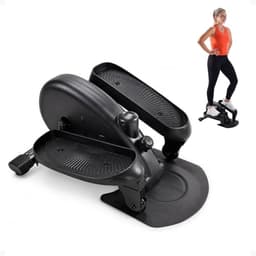
Stamina InMotion E1000
The most complete published spec
The only seated machine here whose maker publishes dimensions, unit weight and a user weight limit together — and the tallest of the three, at 11.38 inches.
Price as of October 21, 2026. #ad How we’re funded
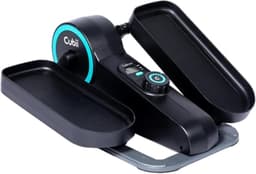
Cubii Move
Lowest published height
The lowest seated machine we have found a published height for, at 9.5 inches — which is the whole argument when your desk apron is the constraint.
Price as of October 21, 2026. #ad How we’re funded
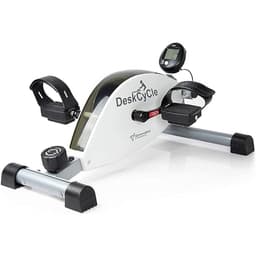
DeskCycle Under Desk Bike Pedal Exerciser
Fitting under a low desk
A 10 inch pedal height is the whole product — it is the seated machine most likely to actually clear a standard 27 inch desk.
Price as of October 21, 2026. #ad How we’re funded
| Model | In use (L x W x H) | Unit weight | Max user | Resistance levels |
|---|---|---|---|---|
| DeskCycle Under Desk Bike Pedal Exerciser | 20" L x 24" W x 10" Hmanufacturer spec | Not publishednot published | Not publishednot published | 8manufacturer spec |
| Cubii JR1 | 23.2" L x 17.56" W x 10" Hretail listing | Not publishednot published | 150 lbretail listing | 8retail listing |
| YOSUDA Under Desk Bike | Not publishednot published | Not publishednot published | Not publishednot published | 16retail listing |
| Sunny Health & Fitness Under Desk Smart Mini Pedal Exerciser (SF-B023005) | Not publishednot published | Not publishednot published | Not publishednot published | Not publishednot published |
| Stamina InMotion E1000 | 24.5" L x 17" W x 11.38" Hmanufacturer spec | 24 lbmanufacturer spec | 250 lbmanufacturer spec | Not publishednot published |
| Cubii Move | 21.5" L x 19.5" W x 9.5" Hretail listing | 17.5 lbretail listing | Not publishednot published | 6retail listing |
What we have not done
We have not used any of these machines, measured any stroke, or tested any claim about effectiveness. There is no EMG study of any machine here, no force data, and no published stride length to derive range of motion from. Nothing on this page is medical or fitness advice; the public-health guidance we lean on elsewhere is about activities, not products. Every figure and every quoted phrase was read from the page named in the sources on the date given. The full method.
Questions people actually ask
Are under-desk ellipticals worth it?
Worth it for one buyer and not for another, and the line between them is sharp. If you sit for six or eight hours and the realistic alternative is sitting still, a seated elliptical replaces some of that stillness with movement you will actually do, because it attaches to a habit you already have. If you are buying it to lose weight, to get your steps up, or as a substitute for exercise you are not otherwise doing, the published record does not support it - and three different pages on this site reach that same conclusion from three different directions.
Do under-desk ellipticals actually work?
The mechanism works - pedals, a linkage and a magnetic brake, no motor and no outlet needed. The question is what you expect it to work AT. It moves the hip, knee and ankle through a repeated low range while you are seated, and nothing else: no arms, no weight-bearing, no forward travel. Cubii is explicit about the arms part. Its own model comparison carries a Full-Body Workout row that reads No for both the Cubii Go and the Cubii Move, re-read on October 17, 2026.
Will an under-desk elliptical help me lose weight?
We do not publish a calorie figure for any machine on this site and this one is no exception, because the arithmetic cannot be started. A walking pad at least publishes a speed, which bounds the work rate. A seated machine publishes an unanchored resistance level count - Cubii 6, 8 and 12, YOSUDA 16, Stamina adjustable tension, Sunny nothing at all - so level 6 on one machine could be harder than level 16 on another and nobody can say. Two of the three inputs you would need, your body mass and the force at the pedal, are absent on almost every machine here.
Does an under-desk elliptical count as steps?
Almost nothing, and it is not a fault in the machine. Apple states that the Activity app relies on arm motion and an accelerometer, and tells users to allow the arm with the watch to swing naturally; Fitbit states that moving your body while keeping your arms still changes the count. Seated pedaling is the extreme arms-still case. If a readout is what keeps you using the thing, you need a workout mode or a chest strap rather than a wrist count.
Is a Cubii worth the money?
The mechanism is the same class as everything else here. What you should weigh is what Cubii will tell you about it. Re-read on October 17, 2026, its own model comparison publishes a price, a resistance level count, a display type, a portability note and a product weight - and a Dimensions row with no values in it for any of the three models, no maximum user weight for any model, no stride length and no warranty term. It also no longer lists the JR1 at all, while that model is still on sale at retail with a 150 lb limit Cubii has never published.
Which under-desk elliptical should I buy if I decide it is worth it?
The Stamina InMotion E1000, unless your desk gap is tight. Stamina publishes assembled dimensions, a 24 lb product weight and a 250 lb maximum user weight together on its own page, states that the pedals reverse, states that the frame is rated for standing as well as seated use, and states a warranty of 1 year on the frame and 90 days on parts. No other elliptical here puts that much in writing. If your clearance is tight, the Cubii Move's 9.5 inch published height is 1.88 inches lower and that will matter more than any of it.
What is the honest case against buying one?
Three cases, and we would rather state them than bury them. One: if the machine will live out of sight behind a chair, it will not be used, because the whole value of this category is that it attaches to time you were already spending seated. Two: if what you actually want is to move more during the day, standing up and walking for five minutes an hour costs nothing and is better documented than any machine on this page. Three: if you need a stated weight rating, most of this category will not give you one.
Read next
- Under-desk bike benefits, honestly — the same question for the pedal machine: it replaces stillness, not exercise.
- Is a mini stepper worth it? — the stepper sibling, and the three buyers it is wrong for.
- Are walking pads worth it? — the belt version, where the machine has a speed and the arithmetic can at least start.
- Best under-desk ellipticals — the ranking itself, built on published desk clearance.
- Does an under-desk elliptical count as steps? — Apple's and Fitbit's own wording on why a wrist count sees almost nothing.
- Under-desk cardio vs just walking — the free alternative, measured against the machine.
Sources
- Cubii - model comparison page, re-read 2026-10-17: three models (Total Body, Go, Move) with prices, resistance level counts 12 / 8 / 6, display types, portability notes and product weights; a Full-Body Workout row reading Yes / No / No; a Dimensions row printed with no values; no maximum user weight, no stride length and no warranty term for any model; the JR1 is not listed
- Stamina - InMotion E1000 product page: 24.5 x 17 x 11.38 in, 24 lb, 250 lb maximum user weight, reversible pedals, rated for standing as well as seated use, 1 year frame and 90 days parts warranty (read 2026-08-11, re-checked 2026-10-17)
- VIVO (DeskCycle) - product page, re-read 2026-10-17: 20 x 24 x 10 in, 8 magnetic settings to 39 lb, steel frame, adjustable pedal straps, 1 year warranty; no product weight and no maximum user weight published
- Rehabmart - Cubii Move retail listing spec table: 21.5 x 19.5 x 9.5 in, 17.5 lb, 6 magnetic resistance levels; no maximum user weight (read 2026-08-11)