Is there a walking pad that does not need electricity?
The short answer is no, and it is worth understanding why before you keep searching. The longer answer is that the constraint behind the question usually has a better solution than the product you asked for.
By Stephen V. · Last updated
No. All 8walking pads we track are a motor, a belt and a mains plug — the motor is what lets the deck be four inches tall, so removing it removes the product. But three machines on this site need no outlet at all: two hydraulic steppers and one magnetic-resistance pedal exerciser, and the pedal exerciser goes under a desk.
Why no walking pad works without a plug
A walking pad is a treadmill with the frame taken off. What is left is a belt, two rollers, a control board and a motor, in a deck four to five inches tall. The motor is not a feature bolted onto that format — it is the reason the format can exist. It is what moves the belt, and moving the belt is the entire mechanism.
A belt that moves without a motor has to be driven by your own feet pushing against something that resists: a flywheel, or a friction brake. That is a manual treadmill, and it is a genuinely different machine. The flywheel needs a frame to be mounted in, the frame needs uprights, the uprights come with handrails, and the deck is usually curved so gravity helps. The result is taller, much heavier, and it does not fold flat and slide under a sofa.
So “non-electric walking pad’ is not a product that exists and is hard to find. It is two requirements that pull against each other: no motor and four inches tall and foldable. Every machine in this category resolves that conflict the same way, and none of them resolves it in favor of the plug.
Do walking pads have motors? All of them
Every one of the 8 pads we track is motorized, and this is one of the few things the whole category agrees on. What it does not agree on is how to describe the motor, and that inconsistency is worth seeing because it tells you how much weight to put on the figure.
Across the brands we track, motor ratings are published as horsepower, as peak horsepower, and in at least one case as watts — sometimes several of those within a single brand’s own range, with figures that do not reconcile. We set out exactly which brand publishes what, and the motor row is the clearest example of a specification published as marketing rather than as measurement.
The practical point: at walking speed, motor rating is close to irrelevant. A pad at 1 to 2 mph under one person is asking very little of any motor in this category. What the number does tell you is that there is a motor, and therefore a plug.
If the reason is the electricity bill
A good share of people searching for a non-electric machine are not short of outlets — they are worried about what the thing costs to run. That is a reasonable worry and it has a checkable answer, which we worked out on its own page rather than repeating here.
The short version: the highest wattage published by any maker on this site is the WalkingPad P1’s 746 W, and that functions as a ceiling rather than a running draw, because desk-pace walking asks far less of a motor than its maximum rating. Run that against a published national average electricity price and the number that comes out is small. What a walking pad actually costs to run has the full arithmetic and its source.
If your reason is the outlet itself — one socket in the room and a lamp already in it, or a desk in the middle of a floor with no skirting nearby — then the rest of this page is for you. And if the pad is going ahead anyway, the cable across the step-off zone is a problem with a cheap fix that does not touch the property.
What to look for in a no-outlet machine
Before any specific machine, this is the checklist. “No plug” is easy to claim and only two of these four points are usually stated in writing.
1. A named mechanism, not an adjective. You want the maker to say hydraulic cylinders or magnetic resistance, because both of those are self-evidently unpowered. “Manual” on its own is not the same claim — it is often used for a motorized machine whose incline you set by hand.
2. A published maximum user weight. This matters more on an unpowered machine than on a powered one, and the reason is mechanical: with no motor, everything that happens goes through the frame and the cylinders, loaded by your body weight. A maker who will not state a limit on a machine like that is declining to state the figure most closely tied to how it was engineered.
3. Whether it can be used at a desk. This is where most of the no-outlet options fall down for the person who came here from a walking-pad search. A stepper is used standing, so your hands and eyeline rise and fall with every step and you cannot work on it. Only the seated machines coexist with a keyboard.
4. Whether the display needs power even when the machine does not. Almost nobody publishes this, and we give it its own section below because it is the one place a “no power” machine can quietly still need a trip to the shop.
The three machines that run on nothing
Against that checklist, three machines on this site stand out. Two are standing hydraulic steppers and one is a seated magnetic pedal exerciser — and the pedal exerciser is the only one of the three you can use at a desk, which for most people arriving from a walking-pad search is the deciding fact.
Smallest, with a published limit:the Niceday Mini Stair Stepper. Hydraulic cylinders, no motor and no outlet, a published 16 x 12 x 14 in footprint — about 1.3 square feet, roughly a quarter of what a pad needs in use — and a 300 lb capacity, which is a real answer to point 2 above. Niceday also publishes a 1.5 mm steel frame, which is more construction detail than most of this category gives.
The only one that goes under a desk: the DeskCycle. Magnetic resistance, a steel frame, no assembly and no power outlet, stated plainly by the maker. Its 10 in overall height is the whole product — it is what lets the machine live under a desk you already own — and it publishes eight settings up to 39 lb of resistance, which is the only statement in either category of how hard the hardest setting actually is.
The highest published capacity: the Xiser Commercial Mini Stairmaster. Three cylinder resistance settings set by a knob, an aircraft-grade cast aluminum alloy frame, ready to use with no assembly and no power, and a 400 lb user capacity— the highest figure of any machine on this site. It is also the most expensive machine here and publishes no dimensions and no unit weight at all, which we would rather say next to the recommendation than three paragraphs after it.
How this page is funded: the buy links here are Amazon affiliate links, and we earn a commission if you buy through one — at no extra cost to you. It does not change what we rank first, because the commission rate is the same across every machine on this page. Full disclosure.
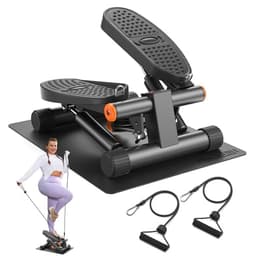
Niceday Mini Stair Stepper
Smallest footprint of anything here
A 16 x 12 inch footprint and a published 300 lb capacity — the most machine per square foot of anything on this site, and the smallest thing here you can genuinely raise your heart rate on.
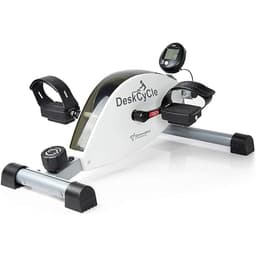
DeskCycle Under Desk Bike Pedal Exerciser
Fitting under a low desk
A 10 inch pedal height is the whole product — it is the seated machine most likely to actually clear a standard 27 inch desk.
Price as of September 24, 2026. #ad How we’re funded
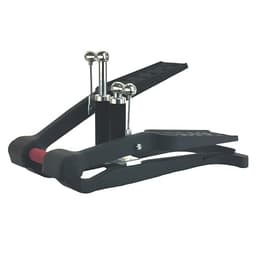
Xiser Commercial Mini Stairmaster
The highest published capacity here
The most expensive machine on this entire site and the one that publishes the least about itself — a 400 lb capacity, an aluminum frame, three resistance settings and no dimensions at all.
Price as of September 24, 2026. #ad How we’re funded
| Model | In use (L x W x H) | Unit weight | Max user | Resistance levels | Material |
|---|---|---|---|---|---|
| Niceday Mini Stair Stepper | 16" L x 12" W x 14" Hmanufacturer spec | Not publishednot published | 300 lbmanufacturer spec | Not publishednot published | 1.5 mm steel framemanufacturer spec |
| DeskCycle Under Desk Bike Pedal Exerciser | 20" L x 24" W x 10" Hmanufacturer spec | Not publishednot published | Not publishednot published | 8manufacturer spec | Not publishednot published |
| Xiser Commercial Mini Stairmaster | Not publishednot published | Not publishednot published | 400 lbmanufacturer spec | 3manufacturer spec | Aircraft grade cast aluminum alloymanufacturer spec |
What no motor costs you
Losing the plug is not free, and the price is paid in three places. We would rather set them out than let the no-outlet advantage carry the whole decision.
You supply the pace, and you will stop. A motorized belt keeps moving whether or not you were concentrating, which is why people log hours on a pad while working. An unpowered machine goes exactly as fast as you push it, and it stops the moment your attention does. In practice that turns hours into minutes, and minutes are worth a lot less across a week.
There is no speed to set. On a pad, speed is the one control that matters and we have a whole page on choosing it. On a stepper there is nothing equivalent: resistance changes how hard each step is, not how many you take, and cadence is entirely on you.
It is not walking. A stepper is a fixed, repetitive motion through a small range. A seated pedaler moves your legs and carries none of your body weight, because the chair does. Pad against stepper and pad against pedal exerciser both take that trade seriously, in both directions.
The gap none of them publishes
Here is the one place a “needs no power” machine can still need power, and we could not find a single maker on this page who addresses it.
Several unpowered machines have a small monitor that shows time, revolutions or steps, and an inferred calorie figure. The mechanism needs nothing. The monitorhas to be run off something. Cubii’s own model comparison, read on 2026-09-17, lists a “Basic LCD Monitor” for the Move and a “Backlit LCD Monitor” for the two models above it, and states nothing anywhere about how any of them is powered or what replacing that power source involves. Niceday, Stamina and Xiser publish nothing on the subject either.
Two things follow. If the display matters to you, treat it as an unknown rather than as included — and if it does go dark, remember that the numbers on it were inferred in the first place. Where a stepper’s calorie number actually comes from is worth reading before you weight that feature heavily. None of these machines knows what you weigh.
What we did not do
We have not used any of these machines, and we have not measured the electricity draw of any walking pad. There is no test lab here. The wattage on this page is a manufacturer’s own published figure and the rest is read from each maker’s specification with the date we read it. Our full method.
We have not ranked manual treadmills, because we do not carry one and would not be able to source a comparison honestly. If the machine does not have to fold and hide, a manual treadmill is a legitimate answer to the no-outlet problem — it is just not one this site is equipped to rank.
Questions people actually ask
Is there a non-electric walking pad?
Not among the eight walking pads we track, and we have not found one worth ranking. Every pad on this site is a motor driving a belt from a mains outlet - that is what the product is. A belt that moves without a motor would have to be driven by your own feet against a flywheel or a friction brake, which is a manual treadmill: a much larger, much heavier machine with a curved deck and a frame, and not something that folds flat and slides under a sofa. If your constraint is the outlet rather than the walking, the machines further down this page solve it.
Do all walking pads have motors?
Every one of the eight we track does. There is no version of a walking pad in this category that runs on your own effort, because the whole format depends on the motor: it is what lets the deck be four to five inches tall and hold nothing but a belt, a roller and a control board. Take the motor out and you need a flywheel and a frame to mount it in, and at that point you no longer have a walking pad.
How much electricity does a walking pad actually use?
Less than most people expect, and only one maker on this site publishes a figure you can work from. The WalkingPad P1's published 746 W is the highest number in the category and functions as an upper bound rather than a running draw - desk-pace walking asks far less of a motor than its maximum rating. We ran the arithmetic against a published national average electricity price on our running-cost page. If the reason you want a non-electric machine is the bill, read that first: the answer is usually that the bill is not the problem.
Which under-desk machines need no outlet at all?
The hydraulic steppers and the magnetic-resistance seated machines. All three mini steppers we track - Niceday, Stamina SpaceMate and Xiser - work on hydraulic cylinders with no motor and nothing to plug in. The DeskCycle is a steel frame with eight magnetic settings and states plainly that it needs no power outlet, and the Cubii Move ships assembled and needs none either. Every one of those runs on you, which is also the honest limitation: you supply the pace.
Do the displays on these machines need a battery?
Probably, and that is as far as we can honestly go, because not one maker on this page publishes it. Several of these machines have a small monitor showing time, revolutions and an inferred calorie figure - Cubii's own comparison page, read on September 17, 2026, lists a 'Basic LCD Monitor' for the Move and a 'Backlit LCD Monitor' for the two models above it - and none of them states how that display is powered or what replacing its power source involves. For a mechanical product you might own for years, that is a real gap. We name it rather than fill it in.
Is a manual treadmill a better answer than a walking pad?
For a small apartment, usually not, and that is why we do not carry one. A manual treadmill needs a frame to mount the flywheel and the handrails, which makes it taller, heavier and far harder to put away than anything on this site. Our whole ranking exists for a reader whose binding constraint is where the machine lives when it is not in use, and a manual treadmill fails that test before the no-outlet advantage gets a chance to matter. If you have the room and want one, that is a reasonable purchase - just not one we can rank from published specs the way we rank these.
Can I run a walking pad off a battery or a power station?
We are not going to tell you yes or no, because the number that would settle it does not exist for seven of the eight pads we track. Sizing a battery requires the machine's actual running draw at the speed you walk, and only one maker publishes any wattage at all. Running a motor off an undersized supply is also the sort of thing that voids a warranty quietly. If there is no outlet where the machine has to go, the honest answer on this page is to buy a machine that does not need one.
Read next
- What does a walking pad cost to run? — the arithmetic on the one published wattage in the category, if the bill is the real reason.
- Best mini steppers for small spaces — the hydraulic machines ranked properly, on floor space and what each maker publishes.
- Best under-desk bikes and pedal exercisers — the seated no-outlet option, ranked on published pedal height.
- Under-desk bike vs mini stepper — the head-to-head between the two unpowered categories on this page.
- Are mini steppers worth it? — whether the smallest machine here is one you will still be using in March.
- Setting a walking pad up without drilling — if the pad is going ahead, the cable across the step-off zone has a cheap fix.
- Walking pad brands, ranked by what they publish — including the motor row, which is the least consistent specification in the category.
Sources
- Niceday Mini Stair Stepper — nicedaysteppers.com product page (read 2026-08-12)
- DeskCycle Under Desk Bike Pedal Exerciser — VIVO (DeskCycle) product spec table (read 2026-07-24)
- Xiser Commercial Mini Stairmaster — myxiser.com product page (read 2026-08-12)
- WalkingPad P1 — the 746 W figure, the highest published wattage of any pad we track and the ceiling used in our running-cost arithmetic (read 2026-09-17)
- Cubii model comparison — 'Basic LCD Monitor' for the Move and 'Backlit LCD Monitor' for the Go and Total Body, with no power or battery specification stated for any model (read 2026-09-17)