Walking pad vs stair climber
One of these machines publishes how much floor it needs to be used safely. It is not the walking pad - and the figure is 39 square feet before you count the ceiling.
By Stephen V. · Last updated
On published figures this is not close on space and not close on intensity, in opposite directions. The StairMaster StepMill 3 manual states a workout area of 67 x 84 in — 39.1 sq ft — a required 19 in clear area on every side, a height of 73 in and a unit weight of 223 lb. A WalkingPad Z1 needs about 8.6 sq ft in use and folds to roughly 4.9 sq ft at 5.4 in tall. So: climber if you have a room for it and want an appointment with intensity, pad if the machine has to vanish and the minutes have to come out of a working day.
How this page is funded: the buy links here are Amazon affiliate links, and we earn a commission if you buy through one — at no extra cost to you. It does not change what we rank first, because the commission rate is the same across every machine on this page. Full disclosure.
First, which machine do you actually mean?
“Stair climber” and “stair stepper” are used for two machines that share a principle and nothing else, and the comparison you want depends entirely on which one is in your head.
- The revolving staircase. A stepmill: real steps that come up out of the machine and go back into it. The StairMaster StepMill 3 is the archetype, and its own manual gives 46 x 29 x 73 in and 223 lb. This is the machine this page compares against.
- The pedals on cylinders. A mini stepper: two hydraulic cylinders, a frame, usually under 30 lb, which is the machine this site actually tracks and ranks. The walking pad against a mini stepper is its own comparison, and if the thing you are picturing is small and cheap, that is the page you want rather than this one.
The home market sits between them and makes the confusion worse. Sunny Health & Fitness publishes 21.9 x 18.5 x 49.8 in and 25.4 lb for the SF-S020027— a stepper with a handlebar and a hydraulic resistance system, warranted for 1 year structural frame, 180 days other parts and components. At 2.8sq ft of floor that is a small machine wearing a big machine’s name, and on published figures it belongs with the mini steppers rather than with the stepmill.
We do not track stair climbers or stepmills, so neither outside machine on this page is ranked, recommended or linked. They are quoted from their makers’ own documents as examples of what that category publishes — the same rule this site uses for rowing machines and full-size ellipticals.
The space figures, and the one nobody else publishes
This is where the comparison is decided for the buyer this site is written for, and it is decided by a document rather than by an opinion. The StairMaster StepMill 3owner’s manual does something no walking pad maker we track has ever done: it publishes how much room the machine needs.
- Workout area: 67 in wide x 84 in long — 39.1 sq ft, stated in the specification table alongside the overall dimensions.
- “Keep at least 19inches (50cm) clear area around the machine” — a safety instruction, given as the recommended distance for access and for emergency dismounts.
- Bystanders at least 3 ft (1 m) away — also an instruction, not a suggestion, and a figure that has no equivalent anywhere in the walking pad category.
Set that against the pad. The machine’s own in-use footprint is 9.3 sq ft and its usable space is 39.1 sq ft; a WalkingPad Z1 computes to 8.6 sq ft in use from its published 56.1 x 22 in and about 4.9 sq ft folded. The climber asks for roughly 4.5 times the floor the pad uses while walking, and the pad gives almost all of it back afterwards.
Then there is the dimension this site rarely has to think about, because every machine on it is ankle-high. A 73 in machine that you then stand on top of is a ceiling problem before it is a floor problem, and the published height is the machine at rest rather than the top of your head on the top step. Our space-requirements guide runs the pad arithmetic in full; the stepmill does not fit the kind of room it is written for.
One honest point in the climber’s favor on space: its 9.3 sq ft of floor is permanently committed, but it is vertical rather than long. A 29 in wide machine against a wall intrudes less into a room than a 56.1 in belt lying across the middle of it. If what you lack is length rather than volume, that is a real difference and the pad does not automatically win it.
Machine weight and user weight
Two numbers, pulling in opposite directions. The machine weight is not close: the SM3 manual gives a unit weight of 223 lb and a shipping package weight of 298 lb, against 69.5 lb for the heaviest pad we track, the Sunny Health & Fitness TreadPad Sleek Stride (SF-T722069). That is 3.2 times the weight, it arrives on a pallet rather than in a box, and it does not go up a flight of stairs with a friend. What a renter actually has to carry is a page that exists because 50 to 70 lb is already awkward.
The user weight goes the other way than people expect. The SM3 manual states a maximum user weight of 275 lbs (125 kg), repeats it as a safety instruction — “do not use if you are over this weight” — and prints it on the machine’s warning label. Sunny publishes 250 lb for the SF-S020027.
1 of the walking pads we track publish a higher maximum user weight than the SM3 does — DeerRun Under-Desk Walking Pad — which is worth knowing before you assume a 223 lb commercial machine is automatically the higher-rated one. How much to trust any of these capacity figures is its own question, and the answer varies by how much else the maker is willing to publish.
The SM3 manual also publishes two things this site almost never gets from a walking pad maker: a rated input of 12VDC 6A, and compliance with named safety standards — EN957-1, EN957-8 and EN60335-1. Model number 140001. Whatever else is true of the comparison, the commercial category documents itself far better than the one we cover.
What the climber wins, stated plainly
It would be easy for a site about walking pads to pretend this is a one-sided comparison. It is not, and the climber’s wins are worth stating without hedging.
Intensity, and the ceiling on it. The SM3 console displays a step rate in floors per minute and an intensity level on a scale of 1 to 20, and the work is your own body weight lifted repeatedly. A walking pad has no equivalent ceiling: five of the eight pads we track publish no incline at all, and the top speeds run from 3 to 6.2 mph with most of the range under 4. What little incline this category publishes is the whole reason people start looking at other machines.
Progression you do not have to invent. Twenty levels against a flat belt is a genuinely different training proposition, and it is the honest answer to the reader who has gotten comfortable at 2.5 mph and wants the next thing. The walking pad answers that question with speed, duration or carried load, and carried load lands on the one figure every pad maker publishes. What a routine can actually ask of a walking pad works through all three levers against the published figures, and the honest answer is that the category sells duration rather than intensity.
A documented machine. The clearance figure, the workout area, the named safety standards and the warning-label maximum are all things we had to go looking for in the walking pad category and mostly did not find.
Appointment minutes against during-work minutes
Strip out the dimensions and the real difference is when the exercise happens. A stepmill is an appointment: you change, you go to the machine, you work hard, you stop, you shower. A walking pad is a background process that runs underneath something you were going to do anyway — a call, an email backlog, an afternoon of reading.
That is not a claim about which produces more of anything, and we are not going to publish calorie arithmetic to pretend it is. The public guidance is written in minutes rather than machines: MedlinePlus, from the US National Library of Medicine, states that adults should get at least 150 to 300 minutes a week of moderate-intensity aerobic activity. The useful question is which machine you will actually accumulate those minutes on, and that is a question about your week.
The pad’s own limit on accumulated minutes is worth knowing before you assume it is unlimited: exactly one maker in this category publishes a continuous-use figure, and it is one hour at a time. What all-day use actually means against that one published duty cycle. Seven of the eight pads publish nothing at all.
If the appointment model is what suits you and the floor is the problem, the machine on this site that comes closest to the climber’s bargain is a mini stepper — a small appointment machine rather than a background one. The mini steppers we track, ranked, including the Xiser Commercial Mini Stairmaster, which publishes the highest user weight on this site at 400 lb and almost nothing else.
If the pad is the answer
Two machines, for the two reasons someone leaves this comparison choosing a belt. Neither is a stair climber substitute and we are not going to present them as one.
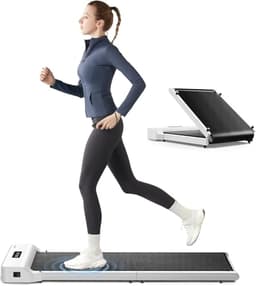
WalkingPad Z1
Smallest storage footprint
The only pad here that folds in half AND stays under 5.5 inches folded, which is the combination a small apartment actually needs.
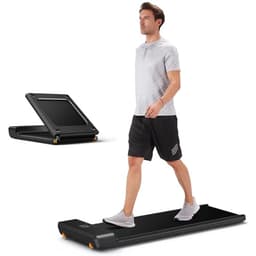
WalkingPad A1 Pro
A published noise figure
One of only two pads on this site whose maker publishes a decibel figure at all, and the only KingSmith model that does.
Price as of November 12, 2026. #ad How we’re funded
The WalkingPad Z1 is the answer to the space half of this comparison, which is the half most people arrive with: 8.6 sq ft in use against 39.1, and then 31.8 x 22 x 5.4 in folded. The costs are the ones on every KingSmith pad: a 15.7 in belt is narrow, there is no handrail, and KingSmith publishes no decibel figure for it. The full read on that machine.
The WalkingPad A1 Pro is there for the reader who wanted the climber because they wanted to work harder: it has the joint-widest belt on the site at 16.5 in, a 230lb rating, and it is the only model in its brand with a published noise figure (“Under 65 dB”). It is also the heaviest KingSmith pad at 63 lb and it publishes no incline, which is exactly the limit the stair climber does not have. The full read on that one.
Every pad we track, on the figures this comparison needs
| Model | In use (L x W x H) | Folded (L x W x H) | Max user | Incline | Unit weight |
|---|---|---|---|---|---|
| WalkingPad Z1 | 56.1" L x 22" W x 4.1" Hmanufacturer spec | 31.8" L x 22" W x 5.4" Hmanufacturer spec | 242 lbmanufacturer spec | Not publishednot published | 51 lbmanufacturer spec |
| WalkingPad C2 | 56.9" L x 20.4" W x 4.9" Hmanufacturer spec | 32.5" L x 20.4" W x 5.4" Hmanufacturer spec | 220 lbmanufacturer spec | Not publishednot published | 55 lbmanufacturer spec |
| WalkingPad P1 | 56.5" L x 21.5" W x 5" Hmanufacturer spec | 32.5" L x 21.5" W x 5" Hmanufacturer spec | 220 lbmanufacturer spec | Not publishednot published | 62 lbmanufacturer spec |
| WalkingPad A1 Pro | 56.5" L x 21.5" W x 5" Hmanufacturer spec | 32.5" L x 21.5" W x 5" Hmanufacturer spec | 230 lbmanufacturer spec | Not publishednot published | 63 lbmanufacturer spec |
| UREVO Strol 2E | 48" L x 22.6" W x 38.9" Hmanufacturer spec | 51.2" L x 22.6" W x 4.6" Hmanufacturer spec | 265 lbmanufacturer spec | Not publishednot published | 47.2 lbmanufacturer spec |
| Lifepro PacerMini | 32.7" L x 25" W x 7" Hretail listing | Not publishednot published | 220 lbretail listing | Two fixed settings, 5 and 7 degreesretail listing | 40 lbretail listing |
| Sunny Health & Fitness TreadPad Sleek Stride (SF-T722069) | 58.2" L x 24.9" W x 5.9" Hmanufacturer spec | Not publishednot published | 265 lbmanufacturer spec | Six auto levels, 1.67 to 3.81 degreesmanufacturer spec | 69.5 lbmanufacturer spec |
| DeerRun Under-Desk Walking Pad | Not publishednot published | Not publishednot published | 300 lbretail listing | 6 percent, manualretail listing | Not publishednot published |
What this page does not do
We do not track stair climbers or stepmills.The two outside machines above are quoted from their own makers’ published documents, read on 2026-11-03, as examples of what that category publishes. Neither is ranked, neither is recommended and neither is linked for sale anywhere on this site. We have not stood on either one.
There is no calorie arithmetic here and no claim that one machine burns more than the other. There is no step-rate conversion either: the SM3 console displays floors per minute, we found no manufacturer figure for the step-per-minute range that we would quote, and a marketplace listing is not a source for a number that specific.
And three figures that would improve this comparison do not exist on the walking pad side at all: no pad maker we track publishes a required clearance, a cushioning or deflection figure, or a continuous duty cycle for seven of the eight machines. Our full method, including what we refuse to estimate.
Questions people actually ask
Walking pad or stair climber - which is better?
They answer different questions and the honest split is about when you exercise rather than how hard. A stair climber is an appointment: you go to it, you work, you stop. A walking pad is a background process that runs underneath a working day. The published figures make the trade concrete - the StairMaster SM3's own manual states a 67 x 84 in workout area, which is 39.1 sq ft, against about 8.6 sq ft for a WalkingPad Z1 in use, and the pad then folds to roughly 4.9 sq ft. If you have a spare room and want intensity, the climber wins on its own terms. If the machine has to disappear, there is no contest.
Is a stair climber the same as a mini stepper?
No, and the search term covers both, which is why people end up comparing the wrong things. A mini stepper is a pair of pedals on hydraulic cylinders, usually under 30 lb, which is the machine this site actually tracks. A stair climber or stepmill is a revolving staircase - the StairMaster SM3 is 73 in tall and its manual gives a unit weight of 223 lb. They share a name and almost nothing else. If the machine you are picturing is the small one, our walking pad against mini stepper comparison is the page you want.
How much space does a stair climber need?
This is the one question where the stair climber category is more honest than the walking pad category, and it is worth knowing. The StairMaster SM3 manual publishes an overall size of 46 x 29 x 73 in, a workout area of 67 x 84 in, and a safety instruction to "keep at least 19 inches (50cm) clear area around the machine", plus a stated bystander distance of at least 3 ft. Not one walking pad maker we track publishes a clearance figure of any kind. The pad needs less room; the climber is the only one of the two that tells you how much.
Can you put a stair climber in an apartment?
We are not going to tell you it is impossible, but the published figures are not encouraging and the ceiling is the part people forget. A 73 in machine that you then stand on top of needs considerably more than 73 in of ceiling, and the SM3's unit weight of 223 lb is 3.2 times the heaviest walking pad we track. A home stair stepper is a different proposition - Sunny publishes 21.9 x 18.5 x 49.8 in and 25.4 lb for the SF-S020027 - but that machine is much closer to the mini steppers we already cover than to a gym stepmill.
Is a stair climber or walking pad better for weight loss?
We do not publish calorie arithmetic on this site and we are not going to start for this comparison, because every figure that would make the sum work - your weight, your pace, your efficiency - is yours rather than the machine's, and no maker in either category publishes a model we would quote. The public guidance is written in minutes rather than in machines: MedlinePlus, from the US National Library of Medicine, says adults should get at least 150 to 300 minutes a week of moderate-intensity aerobic activity. The relevant question is which machine you will actually accumulate minutes on, and that is a scheduling question rather than a specification.
Is a stair climber harder on your knees than a walking pad?
That is a question for someone who can look at you, not for a spec table, and we are not clinicians. What we can state is mechanism and published fact. Climbing is a loaded flexion-and-extension cycle driven by your own body weight; walking on a flat belt is not. Neither category helps you judge it, either: no walking pad maker we track publishes a cushioning or deck-deflection figure, and the StairMaster manual publishes step dimensions and a maximum user weight rather than anything about impact. If your knees are the deciding factor, our ranking of the seated and standing machines for a knee-sensitive buyer is the better starting point.
What is the weight limit on a stair climber?
The StairMaster SM3 manual states a maximum user weight of 275 lbs (125 kg) and repeats it as a safety instruction - "do not use if you are over this weight" - and it is printed on the machine's own warning label. Sunny publishes 250 lb for the SF-S020027. Worth noting for the comparison: 1 of the walking pads we track publish a higher figure than the SM3 does, so a 223 lb commercial machine is not automatically the higher-rated choice.
Does a stair climber fold up?
The gym machine does not, in any sense - the SM3's own specification is a single set of overall dimensions with no folded figure, because a revolving staircase has nothing to fold. Home stair steppers vary and Sunny's page for the SF-S020027 does not state whether it folds at all, which we are recording rather than guessing about. Every walking pad we track either folds or is short enough not to need to, which is the entire reason this category exists.
Read next
- Walking pad vs mini stepper — the small stepper, which is the machine most people mean and the one we actually track.
- Walking pad vs elliptical — the other full-size machine quoted from its maker's figures rather than ranked.
- Walking pad vs rowing machine — same rule, same framing: a category that publishes body-fit figures ours does not.
- Best mini steppers for under a desk — if the appointment model suits you but 39 square feet does not.
- Best cardio equipment for a small apartment — every category we cover, ranked in square feet in use and in storage.
- Best walking pads for video calls and meetings — the during-work half of this comparison, ranked for a microphone two feet away.
Sources
- StairMaster StepMill 3 owner's manual (Core Health & Fitness), Product Specifications page, read 2026-11-03: model SM3, 46 x 29 x 73 in, unit weight 223 lbs (101 kg), shipping package weight 298 lbs, workout area 67 in W x 84 in L, max user weight 275 lbs (125 kg), 19 in (50 cm) clear area required around the machine, bystanders at least 3 ft (1 m) away, rated input 12VDC 6A, model no. 140001, safety standards EN957-1 / EN957-8 / EN60335-1
- Sunny Health & Fitness SF-S020027 stair stepper product page, read 2026-11-03: 21.9 x 18.5 x 49.8 in, 25.4 lb product weight, 250 lb max user weight, hydraulic resistance with no published level count, 1 year structural frame and 180 days other parts, no noise figure and no folded dimensions published
- MedlinePlus (US National Library of Medicine) - How much exercise do I need: at least 150 to 300 minutes a week of moderate-intensity aerobic physical activity for adults
- WalkingPad Z1 - walkingpad.com product spec table: published in-use and folded dimensions, maximum user weight, incline and unit weight (read 2026-07-24)
- WalkingPad C2 - walkingpad.com product spec table: published in-use and folded dimensions, maximum user weight, incline and unit weight (read 2026-07-24)
- WalkingPad P1 - walkingpad.com product spec table: published in-use and folded dimensions, maximum user weight, incline and unit weight (read 2026-07-24)
- WalkingPad A1 Pro - walkingpad.com product spec table: published in-use and folded dimensions, maximum user weight, incline and unit weight (read 2026-07-24)
- UREVO Strol 2E - urevo.com product spec table: published in-use and folded dimensions, maximum user weight, incline and unit weight (read 2026-07-24)
- Lifepro PacerMini - Rehabmart retail listing spec table: published in-use and folded dimensions, maximum user weight, incline and unit weight (read 2026-07-24)
- Sunny Health & Fitness TreadPad Sleek Stride (SF-T722069) - sunnyhealthfitness.com product spec table: published in-use and folded dimensions, maximum user weight, incline and unit weight (read 2026-07-24)
- DeerRun Under-Desk Walking Pad - Amazon retail listing: published in-use and folded dimensions, maximum user weight, incline and unit weight (read 2026-07-24)