Walking pad and weighted vest: what the capacity figure allows
A vest is the cheapest way to make a flat belt harder, and it is also the fastest way to spend a number the maker wrote. Here is the arithmetic, run against every published capacity on this site.
By Stephen V. · Last updated

Treat the vest as part of your weight, because no maker on this site says whether it is. Published capacities here run 220 lb to 300 lb. Against the CDC’s published mean body weight for US men, 199 lb, the 3 pads rated at 220 lb leave 21 lb— which a single vest can consume. The pad we would pick for this is the UREVO Strol 2E, at 265 lb and the only machine here with a handrail.
How this page is funded: the buy links here are Amazon affiliate links, and we earn a commission if you buy through one — at no extra cost to you. It does not change what we rank first, because the commission rate is the same across every machine on this page. Full disclosure.
Why people reach for a vest at all
Because this category will not sell them an incline. Of the eight walking pads we track, 5 publish no incline figure of any kind, and of the three that do, one sets the angle with feet you swap by hand and one publishes it in percent while the other publishes degrees. The full state of incline in this category is thinner than any listing implies.
So the reader who bought a flat pad, got comfortable at 2.5 mph and wants the next thing has three real options: walk faster, walk longer, or carry something. Speed is capped low here — published top speeds run from 3 to 6.2 mph and most of the range sits under 4 — and longer runs into the one duty cycle anybody publishes. A vest is the remaining lever, which is exactly why the search exists.
This page is not here to talk you out of it. It is here because the lever pulls on a number nobody checks first, and because this site already holds every published capacity figure in the category in one place.
The question no maker answers
Every pad in our registry is rated with a maximum user weight. Not one of the spec pages we read states whether that figure is the weight of your body or the weight of your body plus whatever is on it.
That silence is the whole problem, and it is not a small one. A rated maximum is the point at which the maker stops standing behind the machine — which is a ceiling rather than a recommended operating point — and a 20 lb vest is a 20 lb change to the only input that ceiling is written against. There are two readings available:
- The permissive reading: the rating describes the person, so a 190 lb walker in a 30 lb vest is still a 190 lb user. Nothing published supports this. It is just the reading that lets you buy the vest.
- The conservative reading:the belt, the deck and the motor are carrying a total, and a total is what the rating has to be about. Also nothing published supports it — but it is the reading that fails safe, and it is the one we use for every figure on this page.
If you are anywhere near the limit, the figure to ask the maker for in writing is whether the rating is static or dynamic. In our reading of this category nobody publishes that either, which tells you something about how much of this is specified at all.
Your headroom, pad by pad
To make this concrete without inventing a reader, we use two published figures. The CDC’s National Center for Health Statistics publishes a mean body weight of 199 lb for US men aged 20 and over and 171.8 lb for women, from its August 2021 to August 2023 survey data. Those are population averages and they are almost certainly not you — the point of the table is the method, so substitute your own number and redo the subtraction.
| Pad | Published max user | Headroom at 199 lbCDC mean, US men 20+ | Headroom at 171.8 lbCDC mean, US women 20+ |
|---|---|---|---|
| DeerRun Under-Desk Walking Pad | 300 lbretail listing | 101 lb | 128.2 lb |
| UREVO Strol 2E | 265 lb | 66 lb | 93.2 lb |
| Sunny Health & Fitness TreadPad Sleek Stride (SF-T722069) | 265 lb | 66 lb | 93.2 lb |
| WalkingPad Z1 | 242 lb | 43 lb | 70.2 lb |
| WalkingPad A1 Pro | 230 lb | 31 lb | 58.2 lb |
| WalkingPad C2 | 220 lb | 21 lb | 48.2 lb |
| WalkingPad P1 | 220 lb | 21 lb | 48.2 lb |
| Lifepro PacerMini | 220 lbretail listing | 21 lb | 48.2 lb |
The shape of that table is the finding. 3 of the eight pads we track are rated at 220 lb — the WalkingPad C2, WalkingPad P1, Lifepro PacerMini — which leaves the average American man 21 lb for everything he puts on before stepping onto the belt. That is one vest, and the sum is finished.
The average American woman has 48.2lb on the same machine, which is a genuinely different purchase from the same spec sheet — and one of the clearer illustrations of why a single capacity number is a poor summary of whether a pad suits you. Our ranking of these capacities on their own terms takes the same figures and asks a different question: which of them to trust.
One documented exception worth knowing before you shop around the problem: KingSmith sells the A1 Pro in a 300 lb capacity variantalongside the standard 230 lb version. It is the only route to more rated headroom inside a brand we track, and it is a different product rather than a setting — check which one a listing is actually selling you. What else separates that model from the rest of the range.
How fast the load uses it up
The other way to read the same registry is to fix the walker and move the load. Using the CDC mean for US men, 199 lb, here is how many of the 8 rated pads keep that walker inside the number on the spec sheet as the load goes up.
| Added load | Pads still inside their ratingwalker at 199 lb, of 8 rated | Pads still inside their ratingwalker at 171.8 lb, of 8 rated |
|---|---|---|
| +10 lb | 8 of 8 | 8 of 8 |
| +20 lb | 8 of 8 | 8 of 8 |
| +30 lb | 5 of 8 | 8 of 8 |
| +40 lb | 4 of 8 | 8 of 8 |
Two things fall out of that. The first is how early the category starts shedding machines for the heavier of the two reference walkers: at +20 lb he is already outside 0 of the 8 rated pads, while at the same load the lighter reference walker is still inside 8.
The second is that this is a buying decision rather than a usage decision. If you already own a 220 lb pad, no amount of reading changes the rating. The useful version of this page is the one you read before you buy the machine: if load is part of your plan, buy the capacity first and the vest second.
The figure that is not about weight
There is a second published fact that bears on this and nobody mentions it, because it is not a weight at all.
Exactly one of the eight pads we track has a handrail: the UREVO Strol 2E. The other seven are a flat deck with nothing above it. Added load changes where your mass sits and how quickly you can correct a misstep, and on seven of these eight machines there is nothing to reach for when you do. The full account of handles in this category is a short one, which is the point.
The deck is the other half of it. Belt lengths here run from 27.6 in to 47.6 in, and the shortest of those is already shorter than a six-foot walker’s stride before anything is added. The stride arithmetic, run against real walker heights. A vest does not change your stride, but it does change what a drift to the back of a short deck costs you.
And one practical note that is not in any spec table: a vest is worn at a desk, if you are doing this while you work. The desk-height arithmetic for a walking pad is already tight, and loading your shoulders while typing at a standing height you chose for unloaded walking is a change to your working position, not just to your workout.
What load does to a motor, honestly
We have not run a loaded pad to failure, we are not going to describe a failure we have not seen, and we are not going to estimate a figure no maker publishes. What we can give you is the mechanism and the one published number that touches it.
The mechanism: more weight on the belt is more work for the motor and more heat in it, over the same minutes.
The number: KingSmith’s own brand FAQ states a limit of one hour at a time for a walking machine, followed by about half an hour off, and says the automatic stop after long use is by design rather than a fault. It is the only continuous-use figure published by any maker on this site, and the pads built for the longest total day are ranked against it.
Put those together and the conclusion is conservative rather than alarming: on seven of the eight pads here there is no stated duty cycle to plan around at all, so adding load to those machines means adding work to a motor with no published limit. Shorter blocks are the cheap insurance, and what the makers do say about heat is worth reading before you load the belt rather than after.
Warranty is the other half of that thought. The published warranty terms in this category are short, and a claim on a machine used over its rating is a conversation we would rather you did not have to have.
The pads with room to do this
If load is part of the plan, two machines stand out on published figures and they stand out for different reasons. Neither is a recommendation to add any particular amount of weight — it is a ranking of how much rated headroom you are buying.
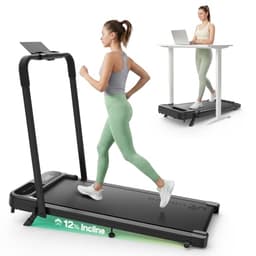
UREVO Strol 2E
265 lb published capacity
The lightest machine here that still has a safety handle, and the only one that goes fast enough to jog on.
Price as of November 12, 2026. #ad How we’re funded
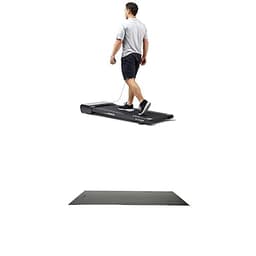
Sunny Health & Fitness TreadPad Sleek Stride (SF-T722069)
265 lb published capacity
The only pad here with a motorized incline you can change while walking, and the only maker that publishes the deck-to-floor height you actually need for desk clearance math.
Price as of November 12, 2026. #ad How we’re funded
The UREVO Strol 2E is our pick for this specific use, and the capacity is only half the reason. It publishes 265 lb, joint-highest among the pads that publish dimensions at all, and it is the one machine here with something to hold. The costs are real: a 40.2 in belt is over seven inches shorter than the KingSmith decks, and folded it is 51.2 in long because the handle folds along the deck rather than off it. The full read on that machine.
The Sunny Health & Fitness TreadPad Sleek Stride (SF-T722069) matches it at 265 lb and answers the question a different way: it is the only pad here with a motorized incline you can change while walking, which is load you do not have to carry. It is also the heaviest machine on this site at 69.5 lb, it is 58.2 in long in use, and Sunny publishes no folded dimensions for it at all. The full read on that one.
If storage is still the binding constraint, the WalkingPad Z1 sits in the middle of this question: 242 lb of rated capacity, which is 43 lb of headroom at the CDC mean for men, and the smallest folded package on the site. It has no handrail.
Every pad we track, on the figures this question needs
| Model | Max user | Belt (L x W) | Top speed | Incline | Unit weight |
|---|---|---|---|---|---|
| DeerRun Under-Desk Walking Pad | 300 lbretail listing | Not publishednot published | 3.8 mphretail listing | 6 percent, manualretail listing | Not publishednot published |
| UREVO Strol 2E | 265 lbmanufacturer spec | 40.2" L x 15" Wmanufacturer spec | 6.2 mphmanufacturer spec | Not publishednot published | 47.2 lbmanufacturer spec |
| Sunny Health & Fitness TreadPad Sleek Stride (SF-T722069) | 265 lbmanufacturer spec | 45.7" L x 16" Wmanufacturer spec | 3.7 mphmanufacturer spec | Six auto levels, 1.67 to 3.81 degreesmanufacturer spec | 69.5 lbmanufacturer spec |
| WalkingPad Z1 | 242 lbmanufacturer spec | 47.6" L x 15.7" Wmanufacturer spec | 4 mphmanufacturer spec | Not publishednot published | 51 lbmanufacturer spec |
| WalkingPad A1 Pro | 230 lbmanufacturer spec | 47" L x 16.5" Wmanufacturer spec | 3.75 mphmanufacturer spec | Not publishednot published | 63 lbmanufacturer spec |
| WalkingPad C2 | 220 lbmanufacturer spec | 47.2" L x 15.7" Wmanufacturer spec | 4 mphmanufacturer spec | Not publishednot published | 55 lbmanufacturer spec |
| WalkingPad P1 | 220 lbmanufacturer spec | 47" L x 16.5" Wmanufacturer spec | 3.75 mphmanufacturer spec | Not publishednot published | 62 lbmanufacturer spec |
| Lifepro PacerMini | 220 lbretail listing | 27.6" L x 15.7" Wretail listing | 3 mphretail listing | Two fixed settings, 5 and 7 degreesretail listing | 40 lbretail listing |
What we are not telling you
We do not track weighted vests. No vest is named, ranked or linked anywhere on this page, and that is deliberate rather than an oversight: we have not read a spec sheet for one, so we have nothing to rank and nothing honest to say about fit, strap placement or how a given vest distributes its load. Every load figure above is a variable you supply, not a product we are implying.
We are also not telling you what a vest does for you. There is no calorie arithmetic on this page, no claim about muscle, bone or heart rate, and no conversion from pounds carried to a result — we do not trust the console numbers these machines already print, which makes inventing a better one on top of them indefensible. The public guidance we would point at is written in minutes of moderate-intensity activity rather than in loads.
And three figures that would make this page much better simply do not exist in this category. No maker publishes whether its maximum user weight is static or dynamic; no maker publishes a deck deflection or belt-tension figure that would let anybody model added load; and seven of the eight publish no continuous-use limit to measure extra work against. Our full method, including what we refuse to estimate.
Everything above was read from the sources below on 2026-10-27 or on the dates shown against each machine. We have not walked on any of these pads, loaded or otherwise.
Questions people actually ask
Can you wear a weighted vest on a walking pad?
Mechanically there is nothing stopping you, and the figure that decides whether you should is the pad's published maximum user weight. Across the eight pads we track those run from 220 lb to 300 lb. The catch is that not one maker states whether that rating is your body weight or your body weight plus whatever you are carrying, so the only safe reading is the conservative one: everything on the belt counts. Add your body weight and the vest together, and check the total against the number on the spec sheet before you buy either.
Does a weighted vest count toward the walking pad weight limit?
No maker we track answers that question, which is itself the answer you have to plan around. A maximum user weight is the point at which the manufacturer stops standing behind the machine, and a rating written as a user weight is not obviously a rating for a loaded user. We would treat the vest as part of the load every time. If you are close to the limit, the figure to ask the maker for in writing is whether the rating is a static or a dynamic one - and in our reading of this category, nobody publishes that either.
How much headroom does a walking pad actually have?
Less than most people assume once a real body weight goes into the sum. The CDC's National Center for Health Statistics publishes a mean body weight of 199 lb for US men aged 20 and over and 171.8 lb for women, from its August 2021 to August 2023 survey data. Measured against the lowest published capacity on this site, 220 lb, that is 21 lb of headroom for the average man and 48.2 lb for the average woman. Those are population averages rather than you - put your own weight into the table on this page instead.
Which walking pad has the most room for a weighted vest?
On published capacity, two of the pads we track publish 265 lb - the UREVO Strol 2E and the Sunny TreadPad Sleek Stride - and the DeerRun listing states 300 lb. We rank the UREVO first for this specific use for a reason that is not about the number: it is the only pad on this site with a handrail, and added load is exactly the situation where having something to hold matters. The DeerRun's 300 lb is the highest figure on the site and comes from a listing that publishes no dimensions, no deck size and no unit weight at all, so we are not going to put it first.
Will a weighted vest damage the walking pad motor?
We have not run a loaded pad to failure and we are not going to describe a failure we have not seen. What we can say is the mechanism and the one published figure that bears on it: more load on the belt is more work for the motor, and the only maker in this category that publishes a continuous-use limit is KingSmith, at one hour at a time followed by about half an hour off. Seven of the eight pads we track publish no duty cycle whatsoever, which is a reason to be more conservative with added load on those machines rather than less.
Is a weighted vest better than incline on a walking pad?
For most buyers here it is not a choice, which is why the question comes up at all: 5 of the eight pads we track publish no incline of any kind. If your pad is one of them, a vest is the only way to add load to a flat belt. If you are still choosing, the honest comparison is that incline is a figure the machine publishes and a vest is a figure you supply - and that one of the two eats into a rating the maker wrote and the other does not.
Does walking with a weighted vest burn more calories?
We are not going to put a number on that, and we would be suspicious of anyone who does on a page selling you something. The public guidance is written in minutes rather than in loads: MedlinePlus, from the US National Library of Medicine, says adults should get at least 150 to 300 minutes a week of moderate-intensity aerobic activity. No maker on this site publishes a calorie model, our own calorie-accuracy guide explains why the console figures should not be trusted either, and we found no published figure from any source we would quote that converts added load into a result.
Is it safe to walk with a weighted vest?
That is a medical question and we are not clinicians, so the answer is not ours to give. The two things we can tell you are specific and published: added load counts against a rating the maker set, and only one of the eight pads we track - the UREVO Strol 2E - has anything to hold on to. The other seven have no handrail, which means a loaded walker who misjudges a step has nothing to grab. If you have any reason to ask whether this is safe for you, ask someone who can look at you rather than a spec table.
Read next
- Best walking pads for heavier walkers — the same published capacities, ranked on whether the number can be trusted.
- Walking pad weight limits explained — what a rated maximum actually is, and why it is a ceiling rather than a target.
- Best walking pads with incline — the load you do not have to carry, and how little of it this category publishes.
- Walking pads with a handle or handrail — the one machine here with something to hold, which matters more under load.
- Best walking pads for all-day use — the one-hour duty cycle, which is the only published limit on how long the motor works.
- Walking pad vs vibration plate — the other way people try to make a small machine do more.
Sources
- CDC / National Center for Health Statistics - FastStats, Body Measurements, read 2026-10-27: mean body weight 199.0 lb for US men aged 20 and over and 171.8 lb for women, from Anthropometric Reference Data for Children and Adults: United States, August 2021-August 2023, tables 4, 8 and 12
- MedlinePlus (US National Library of Medicine) - How much exercise do I need: at least 150 to 300 minutes a week of moderate-intensity aerobic physical activity for adults, written in minutes rather than in load
- DeerRun Under-Desk Walking Pad - Amazon retail listing: published maximum user weight, deck size, top speed, incline and unit weight (read 2026-07-24)
- UREVO Strol 2E - urevo.com product spec table: published maximum user weight, deck size, top speed, incline and unit weight (read 2026-07-24)
- Sunny Health & Fitness TreadPad Sleek Stride (SF-T722069) - sunnyhealthfitness.com product spec table: published maximum user weight, deck size, top speed, incline and unit weight (read 2026-07-24)
- WalkingPad Z1 - walkingpad.com product spec table: published maximum user weight, deck size, top speed, incline and unit weight (read 2026-07-24)
- WalkingPad A1 Pro - walkingpad.com product spec table: published maximum user weight, deck size, top speed, incline and unit weight (read 2026-07-24)
- WalkingPad C2 - walkingpad.com product spec table: published maximum user weight, deck size, top speed, incline and unit weight (read 2026-07-24)
- WalkingPad P1 - walkingpad.com product spec table: published maximum user weight, deck size, top speed, incline and unit weight (read 2026-07-24)
- Lifepro PacerMini - Rehabmart retail listing spec table: published maximum user weight, deck size, top speed, incline and unit weight (read 2026-07-24)