Walking pad vs vibration plate
These two look like rivals because they are the same size and they live in the same corner of the same small room. They are not rivals. One is measured in hours a day and the other, by its own maker, in ten minutes.
By Stephen V. · Last updated
Buy the walking padif you want movement to accumulate while you work. Sunny’s own specifications for its Fitboard platform say “do not use the vibration platform for more than 10 minutes at a time”, and the only continuous-use limit published anywhere in the walking pad category is KingSmith’s one hour. The plate does win one thing outright, and it is worth knowing: at a published 2.4 sq ft the Sunny platform takes less floor than a WalkingPad Z1 does folded.
How this page is funded: the buy links here are Amazon affiliate links, and we earn a commission if you buy through one — at no extra cost to you. It does not change what we rank first, because the commission rate is the same across every machine on this page. Full disclosure.
What we track, and what we do not
Pad & Pace tracks walking pads and under-desk machines. We do not track vibration plates, we have not stood on one, and we are not going to publish a plate ranking dressed up as research.
What we can do honestly is take two real machines from opposite ends of the vibration category, read what their makers publish, and set those figures beside the pads we do track. Both pages below were read on 2026-10-27.
- Sunny Health & Fitness Fitboard 2D (SF-VP822056), the budget end — and the same maker as one of the walking pads in our registry, which is useful here, because it means one company’s own documents sit on both sides of this comparison. Its specifications publish 22.8 L x 15.1 W x 5.4 H in, a 20 lb product weight, a 265 lb maximum user weight, 99 speed levels, 2D oscillation, a frequency range of 6.38 to 12.92 Hz (383 to 775 vibrations per minute), an amplitude of 15.8 mm plus or minus 10 percent, 5 built-in programs and 1 manual mode, resistance bands and an infrared remote— and the instruction this whole page turns on: “do not use the vibration platform for more than 10 minutes at a time”. Motor power is not published, and the warranty is listed as Manufacturer Warranty with no stated duration.
- Power Plate MOVE, the reference end. Its page publishes 30 W x 24 D x 9 H in, an 85 lb machine weight, a frequency range of 30 to 40 Hz across six settings - 30 Hz, 35 Hz and 40 Hz, each Low or High, amplitude published only as Low or High, and a warranty of 3 years hardware, 1 year electronics, 1 year labor. There is no maximum user weight in the specification table; the page's description says it is sturdy enough to support a full 300 lb, and the power requirement is not published.
If you want a vibration plate recommendation, this is not the site for it. If you are trying to work out which of these two belongs in a room you also have to live in, keep reading — because the honest answer is not the one the two listings imply.
The sentence that decides it
Almost every comparison on this site is settled by a dimension. This one is settled by a sentence, and the sentence is the maker’s own.
In the Fitboard’s published specifications, Sunny writes: “do not use the vibration platform for more than 10 minutes at a time”. That is not a marketing line and it is not a reviewer’s opinion. It is the company that built the machine stating the length of a session.
Now the other side. The only maker in the walking pad category that publishes a continuous-use limit at all is KingSmith, whose brand FAQ states 60 minutes at a time followed by roughly half an hour off, and says the automatic stop after long use is by design rather than a fault. We built a whole ranking on that figure, because it is the only one that exists — seven of the eight pads we track publish no duty cycle whatsoever.
So the two published session figures in front of a buyer are 10 minutes and 60 minutes, a factor of six, and they are not describing the same kind of object. A pad’s hour is a thermal limit on a motor driving a belt; the plate’s ten minutes is guidance about standing on a vibrating platform. For the buyer the consequence is identical, and it is the whole decision: a plate is an appointment and a pad is a background process.
That matters more here than it would on a general fitness site, because the reason most people on this site want a machine at all is that they sit for eight hours. The minutes-per-week arithmetic behind that only works if the minutes happen without being scheduled. Ten minutes a day that you have to schedule is a different product from forty minutes an hour that you barely notice.
One fair caveat, because this is the strongest claim on the page: ten minutes is what one maker publishes for onemodel. Power Plate publishes no session length on the page we read, which is not permission — it is a second maker declining to answer the question the first one answered. If you buy a plate, the session length is a figure to ask for before you pay, not after.
The floor each one needs, as published
This is the section where the plate wins, clearly, and we are not going to bury it. If the binding constraint in your home is floor area, a vibration plate is the smaller machine by a wide margin.
The Sunny Fitboard’s published 22.8 by 15.1 in platform is 2.4 sq ftof floor. The WalkingPad Z1’s published open dimensions work out to 8.6 sq ft in use and about 4.9 sq ft folded. Read that again: the plate in use is smaller than the pad folded, by about 2.5 sq ft. And at 5.4 in tall it will go under a sofa or a bed about as readily as a folded pad will.
The Power Plate MOVE is a different proposition: 30 W x 24 D x 9 H in is 5 sq ft, still well under the pad in use, but it is 9 in tall and nothing about it folds. It is a permanent object on your floor in the way a pad specifically is not, which is the same finding as our comparison against an upright exercise bike — in most categories, small does not mean storable.
One number a pad needs that neither plate does, put on the other side of the ledger to be fair: a pad needs clearance to step off the back of it, and no pad maker publishes that figure either. Our space-requirements guide builds it from the deck up. A plate needs its own footprint plus your arm span, which is also unpublished. Neither category will tell you how much room you actually need; one of them at least folds to nothing when the answer is wrong.
The category that contains both extremes
The most useful thing we found about vibration plates is that “vibration plate” does not describe a size of object.
The Sunny Fitboard is 20 lb, which is half the weight of the lightest walking pad we track — 40 lb — and under a third of what the heaviest one weighs. That is genuinely a one-hand carry, genuinely a thing you slide behind a door.
The Power Plate MOVE is 85 lb. That is 15.5 lb heavier than the Sunny Health & Fitness TreadPad Sleek Stride (SF-T722069) at 69.5 lb, which is the heaviest machine of any kind on this site, and unlike that machine it does not fold at all. Our portability ranking exists because 29.5 lb of spread inside the walking pad category is already enough to decide a purchase. The vibration category spans 65 lb between two machines sold under the same two words.
So if a plate is on your list because it sounded like the small option, check the weight line before anything else. The vibration category spans the entire weight range of this comparison on its own: lighter than any walking pad at one end, heavier than all of them at the other.
Two machines, two scales that will not compare
Readers of this site will recognize the next finding, because it is the documentation problem we keep running into in the walking pad category — and the vibration category has it worse.
Sunny publishes a frequency range of 6.38 to 12.92 Hz. Power Plate publishes 30 to 40 Hz. Those ranges do not overlap, and the gap between them is 17.08 Hz. The fastest setting on one machine is less than half the slowest setting on the other. Both are sold as whole-body vibration platforms, to the same buyer, in the same search results.
Amplitude is worse. Sunny publishes 15.8 mm plus or minus 10 percent— a figure with a stated tolerance on it, which is more rigor than any walking pad maker applies to any number on this site. Power Plate publishes amplitude as published only as Low or High. One is a measurement; the other is an adjective.
And the two invert on the figure a walking pad buyer is trained to look for. Sunny publishes a 265 lb maximum user weightin its specifications — the same figure the UREVO Strol 2E and Sunny’s own TreadPad publish. Power Plate’s specification table has no maximum user weight at all; the 300 lb number on that page lives in the description, as a sentence about sturdiness rather than a rated limit. Why the difference between those two things matters.
The honest conclusion is not that one plate is better specified than the other. It is that in this category the published numbers are not yet comparable between brands, so a plate bought on its Hz figure is bought on a number that means something different one listing over. Walking pads have a version of this problem — one brand publishes four different motor ratings across one range — and at least there the dimensions are in inches on both sides.
What the floor below you gets
Most people reading this site rent, and the person downstairs is usually the real constraint. Neither vibration plate publishes a decibel figure, and only two of the eight walking pads we track do — so this section is mechanism, with no measurement from us or from anybody else.
A walking pad puts footfall into the floor: discrete impacts, one per step, which is why a dense mat under the deck is the standard fix and why our noise guide is mostly about transmission rather than loudness.
A vibration plate’s purpose is to put vibration into whatever it is standing on, continuously. On the Sunny’s own published figures that is 383 to 775cycles a minute, at a 15.8 mm amplitude, into a platform resting on your floor. We have not measured what reaches the apartment below and we are not going to guess at it. We will say that of these two machines, the one whose operating principle is transmitting vibration into a shared structure is not obviously the safer choice in a building with neighbors — and that the published 10-minute session is at least a short exposure for them as well as for you.
If the floor below is the binding constraint and you want something with no footfall at all, the answer is neither machine on this page. The seated under-desk machines, ranked on what their makers will publish about noise.
The pads in this comparison, on published figures
| Model | In use (L x W x H) | Folded (L x W x H) | Belt (L x W) | Unit weight | Max user | Published noise |
|---|---|---|---|---|---|---|
| WalkingPad Z1 | 56.1" L x 22" W x 4.1" Hmanufacturer spec | 31.8" L x 22" W x 5.4" Hmanufacturer spec | 47.6" L x 15.7" Wmanufacturer spec | 51 lbmanufacturer spec | 242 lbmanufacturer spec | Not publishednot published |
| WalkingPad A1 Pro | 56.5" L x 21.5" W x 5" Hmanufacturer spec | 32.5" L x 21.5" W x 5" Hmanufacturer spec | 47" L x 16.5" Wmanufacturer spec | 63 lbmanufacturer spec | 230 lbmanufacturer spec | Under 65 dBmanufacturer spec |
The plate figures are deliberately not in that table. A vibration plate has no belt, no folded state and no speed in mph, and forcing one through a walking pad spec set would print four rows of “Not published” for figures that do not exist rather than figures a maker declined to publish — which would corrupt the one signal this site’s whole spec layer exists to carry.
If the pad is the answer
Two pads cover almost everyone who arrives at this page. The WalkingPad Z1is the storage answer — it is the pad that gets closest to the plate’s one real advantage, folding to 5.4 in and about 4.9 sq ft. The WalkingPad A1 Pro is the shared-room answer, because it is the only machine in its brand with a published noise figure to compare at all.
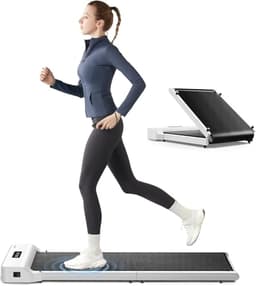
WalkingPad Z1
Smallest storage footprint
The only pad here that folds in half AND stays under 5.5 inches folded, which is the combination a small apartment actually needs.
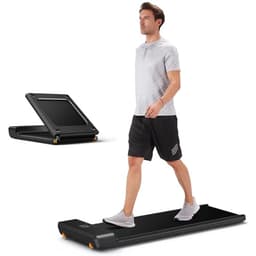
WalkingPad A1 Pro
A published noise figure
One of only two pads on this site whose maker publishes a decibel figure at all, and the only KingSmith model that does.
Price as of November 12, 2026. #ad How we’re funded
And if what drew you to a plate was standing still rather than the vibration — no stepping, no impact, no coordination while you work — the honest third answer is neither machine on this page. The Cubii Move is the lowest seated machine we have found a published height for, at 9.5 in, and at 17.5 lb it is the lightest machine of any kind on this site — lighter than the Sunny plate. The seated machines, ranked on desk clearance.
So which one
Buy the walking pad if the point is to move more during a sitting day rather than to add a session to it, if you want steps and distance you can count, or if you need the machine to be doing something while you are doing something else. Check your storage gap against the folded height before you order.
Buy the vibration plate iffloor area is the absolute binding constraint — 2.4 sq ft at 5.4in tall is genuinely less than a folded pad — and if a short, deliberate daily session is a thing you will actually do. Buy it understanding that the maker’s own instruction caps that session at 10 minutes, and that it is not a cardio machine pretending to be small; it is a different machine entirely.
Buy a seated under-desk machine if what you wanted was the no-footfall part of a plate and the at-your-desk part of a pad, and you accept that it asks the least of you of the three.
Do not buy a plate expecting it to replace walking, and do not buy a pad expecting it to be as invisible as a plate once stored. Those are the two mistakes this comparison exists to prevent.
We have used none of these machines. Every figure above was read from the sources below on the dates shown, and the two vibration plates are quoted as published examples of their category rather than as recommendations. Our full method, including what we refuse to estimate.
Questions people actually ask
Walking pad or vibration plate for a small apartment?
On floor area the plate wins and it is not close: the Sunny Fitboard's published 22.8 by 15.1 inch platform is about 2.4 square feet, which is less floor than a folded WalkingPad Z1 occupies. On what you can do with it, the pad wins by the same margin. Sunny's own specifications tell you not to use the platform for more than 10 minutes at a time, and the only continuous-use figure published for a walking pad is KingSmith's one hour. A machine you may stand on for 10 minutes is not a substitute for a machine that runs under your desk through a working day.
Can a vibration plate replace walking?
Nothing we read from either maker claims that, and we are not going to claim it for them. MedlinePlus, from the US National Library of Medicine, writes the public guidance in minutes of moderate-intensity aerobic activity - at least 150 to 300 a week - and brisk walking is its stock example. A vibration plate is sold as a toning, balance and recovery device, it produces no steps and no distance, and the one maker here that states a session length states 10 minutes. Whether vibration training delivers anything comparable is a clinical question and we are not clinicians.
Can you use a vibration plate at a standing desk while you work?
Not through a working day, on the makers' own numbers. The Sunny platform's stated 10-minute session cap settles it before ergonomics do, and both machines would also change your working height - 5.4 inches for the Sunny, 9 inches for the Power Plate MOVE, which is 2 inches more than the tallest walking pad deck we track. The reason a pad earns its place at a desk is that its minutes accumulate while you do something else. A plate asks for the opposite: a short, deliberate session where standing on it is the activity.
Is a vibration plate quieter than a walking pad in an apartment?
Neither plate maker publishes a decibel figure, so nobody can answer that with a number - and the mechanism cuts against the plate in the one place a renter cares about. What the floor below hears from a pad is footfall: impact energy delivered a step at a time. A vibration plate's entire operating principle is delivering vibration into whatever it stands on, continuously, at a published 383 to 775 cycles a minute on the Sunny. That is a statement about how each machine works rather than a measurement, and we have measured neither.
How much does a vibration plate weigh compared with a walking pad?
It depends entirely which plate, which is the useful finding. The Sunny Fitboard is 20 lb, lighter than every walking pad we track and half the weight of the lightest. The Power Plate MOVE is 85 lb, which is 15.5 lb heavier than the heaviest machine of any kind on this site, and it does not fold. The vibration category spans the whole weight range of this comparison on its own - lighter than any walking pad at one end, heavier than all of them at the other - so the word compact in a plate listing tells you nothing about which machine you are looking at.
What frequency should a vibration plate be?
We cannot tell you, and the reason is worth seeing. The two machines we read publish frequency ranges that do not overlap at all: Sunny states 6.38 to 12.92 Hz, Power Plate states 30 to 40 Hz. The top of one is more than 17 Hz below the bottom of the other, and both are sold as whole-body vibration platforms. Sunny publishes an amplitude in millimeters, 15.8 mm plus or minus 10 percent; Power Plate publishes amplitude as the words Low or High. When two machines in one category describe themselves on scales that cannot be compared, a decision made on the number alone is not really a decision.
Is there a walking pad and vibration plate in one?
Combination units are advertised and we do not track any of them, so we are not going to tell you which to buy. What we would check first is the pair of figures this page is built on: the session limit and the continuous-use limit. A machine that is both things has to honor both constraints, and if a maker publishes a 10-minute vibration limit and a 1-hour belt limit on the same chassis, you own one machine with two different timers. Ask for both numbers in writing before buying, because neither is usually in the listing.
Which one is better for bad knees?
That is a medical question and we are not qualified to answer it. What we can say structurally: on a walking pad every step lands, on a vibration plate you stand still, and on a seated under-desk machine your feet never leave the pedals at all. Those are three different mechanisms and none of them is a measured difference in joint load - no pad maker on this site publishes a deck deflection figure, and neither plate maker publishes what the platform transmits into a standing body. If your knees are the reason you are reading this, the question belongs with a clinician who can look at them.
Read next
- Walking pad vs rowing machine — the same appointment-against-background-process argument, measured on floor area.
- Best walking pads for all-day use — the one-hour duty cycle this page's central comparison rests on.
- Best walking pads for small spaces — every folded dimension against every realistic storage gap.
- Walking pad and weighted vest — the other way people try to make a small machine do more, and what the capacity figure allows.
- Walking pad vs elliptical — the other machine that looks like a pad rival and turns out to be a different purchase.
- Quietest under-desk cardio — for when what the floor below hears is the whole decision.
Sources
- Sunny Health & Fitness - Fitboard 2D Vibration Platform with Resistance Band (SF-VP822056) product specifications, read 2026-10-27: 22.8L x 15.1W x 5.4H in, 20 lb product weight, 265 lb max user weight, 99 adjustable speed levels, 6.38-12.92 Hz, 383-775 vibrations per minute, 15.8 mm +/- 10% amplitude, 5 built-in programs plus a manual mode, resistance bands and infrared remote included, motor power not published, warranty listed with no stated duration, and the instruction "do not use the vibration platform for more than 10 minutes at a time"
- Power Plate - MOVE product page, read 2026-10-27: 30 x 24 x 9 in, 85 lb, 30-40 Hz across six settings (30, 35 and 40 Hz each Low or High), amplitude published only as Low or High, 3 year hardware / 1 year electronics / 1 year labor warranty, no maximum user weight in the specification table (the description states it is sturdy enough to support a full 300 lb), power requirement not published
- MedlinePlus (US National Library of Medicine) - How much exercise do I need: at least 150 to 300 minutes a week of moderate-intensity aerobic physical activity for adults, written in minutes of activity rather than in sessions on a machine
- WalkingPad Z1 - walkingpad.com product spec table: published dimensions, folded size, unit weight, capacity, top speed and noise figure (read 2026-07-24)
- WalkingPad A1 Pro - walkingpad.com product spec table: published dimensions, folded size, unit weight, capacity, top speed and noise figure (read 2026-07-24)
- Cubii Move - Rehabmart retail listing spec table: published dimensions, folded size, unit weight, capacity, top speed and noise figure (read 2026-08-11)