Walking pad workout plan: what your machine can actually run
Nearly every routine written for these machines assumes an incline, a wide speed band and unlimited runtime. Most walking pads have none of the three, so here is the plan the specifications leave you.
By Stephen V. · Last updated
Plan in minutes, because minutes are the only variable every pad here gives you. 5 of the eight pads we track publish no incline at all, 5 of 8top out under 4 mph — too narrow a band to interval in — and exactly one maker publishes a continuous-use limit, at 60 minutes on, 30 off. MedlinePlus puts the target at 150 to 300 minutes a week of moderate-intensity activity, which is 5 half-hour blocks at the low end. Everything else on this page is about which machine widens which lever.
How this page is funded: the buy links here are Amazon affiliate links, and we earn a commission if you buy through one — at no extra cost to you. It does not change what we rank first, because the commission rate is the same across every machine on this page. Full disclosure.
Why most walking pad plans do not fit the machines
Search for a walking pad routine and you will find plans written in the vocabulary of a gym treadmill: warm up at 3 mph, climb to a 6 percent grade, push to 4.5 for ninety seconds, recover at 3. Reasonable instructions, and on most of the machines in this category you cannot follow a single line of them.
That is not a criticism of the plans or of the pads. It is a mismatch, and it is the reason this page exists on an equipment site rather than a fitness one. A walking pad is a treadmill with things removed — the category is defined by the subtraction — and the things removed are exactly the three a structured routine needs: the grade, the top of the speed range, and the motor headroom for an hour of hard work.
So this page runs the other way round. Start from what your machine publishes, work out which levers it actually gives you, and build the week from those. The answer for most readers will be shorter and more frequent than the plan they were looking for, and it will be a plan they can actually execute on the machine they own.
Your machine's published envelope
Three published figures define what a routine can ask for, and across the eight pads we track they look like this.
- Incline. 5 of the eight publish none. The 3 that do publish it in three different ways, and only one of them changes while you walk.
- Top speed. 3 to 6.2 mph across the category, with 5 machines under 4 mph. The UREVO Strol 2E is the single outlier and it has the shortest full-size belt.
- Continuous runtime.One maker publishes a figure. KingSmith’s FAQ gives 60 minutes at a time for a walking machine, then about 30 minutes off. The other seven machines publish nothing.
Read that list as a sentence rather than a table and it says something specific: this category sells duration. It does not sell intensity, it does not sell progression, and in most cases it does not sell a documented limit on how long you can go. The plan has to be built from the thing it does sell.
The one lever every pad gives you
The only published health guidance we will quote on this page is written in minutes, which is convenient, because minutes are the one currency every machine here accepts. MedlinePlus, from the US National Library of Medicine, states that adults should get at least 150 to 300 minutes a week of moderate-intensity aerobic physical activity.
That turns a vague plan into arithmetic you can do against your own calendar. Here is the same weekly target expressed as sessions, for the session lengths people actually manage at a desk.
| Session length | Sessions a week for 150 min | Sessions a week for 300 min | Inside the one published duty cycle? |
|---|---|---|---|
| 15 minutes | 10 | 20 | Yes |
| 20 minutes | 8 | 15 | Yes |
| 30 minutes | 5 | 10 | Yes |
| 45 minutes | 4 | 7 | Yes |
| 60 minutes | 3 | 5 | Yes |
The useful thing about that table is what it does to the shape of a plan. Nothing in the published guidance requires a long session, and the only machine limit anybody publishes is per-session rather than per-week — so frequent short blocks are both the easier plan and the one that stays inside the one documented constraint. Three twenty-minute blocks in a working day is a different ask from an hour you have to find.
The practical version, for the reader who wants a shape rather than a principle: attach the blocks to things already in your day instead of to a time. One block on the calls you do not have to present in, one while you read, one after lunch. If that sounds unambitious, it is worth saying plainly that our duration guide reaches the same place from the other direction, and that the routine people abandon is almost always the one that needed its own slot.
Intervals: what the speed band allows
Interval work is the first thing people want to add, and it is the lever this category restricts hardest. An interval needs two paces far enough apart to feel different, and on most of these machines the distance between them is a rounding error.
Published top speeds across the eight pads run 3 mph on the Lifepro PacerMini to 6.2 mph on the UREVO Strol 2E, and 5 of 8sit under 4 mph. If your ceiling is 3.7 and your comfortable desk pace is 2.5, your entire hard-effort range is 1.2 mph wide — and the top of it is a pace you cannot type at anyway.
Two further constraints that belong in a plan rather than in a spec sheet. The first is the control: most of these machines are driven from a small remote in fixed increments, which is not a responsive tool for a ninety-second effort. The second is the deck, and it is the one that actually sets the limit — stride lengthens as pace rises and the belts here are short, so the fast half of an interval is also the half where you have the least room for error.
What does work, and what we would actually plan: vary duration rather than pace. A twenty-minute block and a forty-minute block are a genuinely different ask on the same machine at the same speed, and nothing in the specification stops you.
Incline, and the five machines without it
Incline is the lever most published routines lean on hardest and the one this category supplies least. 5 of the eight pads we track publish no incline figure of any kind: WalkingPad Z1, WalkingPad C2, WalkingPad P1, WalkingPad A1 Pro, UREVO Strol 2E.
The 3 that do publish something do not publish it the same way, which makes them hard to compare even with each other: one gives a range in degrees, one gives two fixed settings in degrees, and one gives a single figure in percent. The Sunny Health & Fitness TreadPad Sleek Stride (SF-T722069) publishes “Six auto levels, 1.67 to 3.81 degrees” — and it is the only machine here whose angle changes while you are walking on it. The full state of incline in this category is thinner than any listing implies, and the most-searched incline protocol asks for a grade no machine here reaches.
If your pad is one of the flat five, your remaining levers are speed, duration and carried load — and carried load has its own page here, because it lands on the one figure every pad maker publishes. What the capacity figure allows once you add weight is the arithmetic to do before you buy a vest, not after: no maker states whether its maximum user weight includes what you are carrying.
The published limit on a long session
If your plan involves long blocks, there is one published figure you should know and seven silences you should plan around.
KingSmith states on its own brand FAQ that you should not use a walking machine for more than 60 minutes at a time, then switch it off and let it cool for about 30 minutes. It also states that the machine stopping itself after a long run is by design rather than a fault. That is the only continuous-use guidance we have found from any maker in this category, and it does not appear on a single product specification page.
The other seven machines publish nothing, which is not permission. Why friction rather than ambient heat is the usual cause is the page that works through what actually gets hot, and the all-day ranking takes the same published limit and asks which machines are built to live near it. For a plan, the practical consequence is the one the minutes table already pointed at: two forty-minute blocks are safer than one eighty-minute block on every machine here, and on a KingSmith the longer block is outside the maker’s own instruction.
One maintenance note that belongs in a plan rather than in a troubleshooting page, because it is the thing a routine changes: more hours on the belt is more hours of friction, and deck lubrication is the one job in this category that actually matters. Which oil, how much and how often, from the maker’s own documentation.
The pads that widen a lever
If you have not bought yet and a structured routine is the point, two machines widen a lever the rest of the category leaves closed. This is a ranking of published capability, not a claim about results.
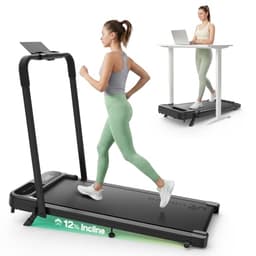
UREVO Strol 2E
Lightest with a handle
The lightest machine here that still has a safety handle, and the only one that goes fast enough to jog on.
Price as of November 12, 2026. #ad How we’re funded
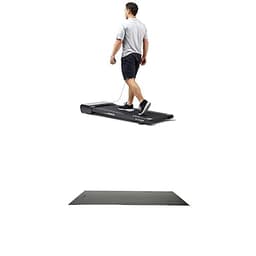
Sunny Health & Fitness TreadPad Sleek Stride (SF-T722069)
Motorized incline
The only pad here with a motorized incline you can change while walking, and the only maker that publishes the deck-to-floor height you actually need for desk clearance math.
Price as of November 12, 2026. #ad How we’re funded
The UREVO Strol 2E widens the speed lever and it is the only machine here that does: 6.2 mph against a category that mostly stops under 4, which is the difference between a plan with one pace and a plan with two. It is also the one pad with a handrail, which matters more at the top of a speed range than at the bottom. The costs are real: the 40.2 in belt is the shortest of the full-size decks, which is the wrong direction for fast walking, and UREVO publishes no incline and no decibel figure. The full read on that machine.
The Sunny Health & Fitness TreadPad Sleek Stride (SF-T722069) widens the incline lever, and it is the only pad we track whose grade changes under you rather than between sessions: Six auto levels, 1.67 to 3.81 degrees. For a routine that is the difference between progression and a fixed setting. The costs are the heaviest on this site — 69.5 lb, the heaviest machine we track, no published folded dimensions at all, and a 3.7 mph ceiling that puts it in the narrow-band group on speed. The full read on that one.
If neither lever is what you need and the plan is simply more minutes, more often, the machine that supports that best is the one that is easiest to deploy and put away — which on this site is the WalkingPad Z1, at 31.8 in long and 5.4 in high folded. A plan executed on a machine you actually unfold beats a plan on a better machine in a closet.
Every pad we track, on the figures a plan needs
| Model | Top speed | Incline | Belt (L x W) | Max user | Unit weight |
|---|---|---|---|---|---|
| UREVO Strol 2E | 6.2 mphmanufacturer spec | Not publishednot published | 40.2" L x 15" Wmanufacturer spec | 265 lbmanufacturer spec | 47.2 lbmanufacturer spec |
| WalkingPad Z1 | 4 mphmanufacturer spec | Not publishednot published | 47.6" L x 15.7" Wmanufacturer spec | 242 lbmanufacturer spec | 51 lbmanufacturer spec |
| WalkingPad C2 | 4 mphmanufacturer spec | Not publishednot published | 47.2" L x 15.7" Wmanufacturer spec | 220 lbmanufacturer spec | 55 lbmanufacturer spec |
| DeerRun Under-Desk Walking Pad | 3.8 mphretail listing | 6 percent, manualretail listing | Not publishednot published | 300 lbretail listing | Not publishednot published |
| WalkingPad P1 | 3.75 mphmanufacturer spec | Not publishednot published | 47" L x 16.5" Wmanufacturer spec | 220 lbmanufacturer spec | 62 lbmanufacturer spec |
| WalkingPad A1 Pro | 3.75 mphmanufacturer spec | Not publishednot published | 47" L x 16.5" Wmanufacturer spec | 230 lbmanufacturer spec | 63 lbmanufacturer spec |
| Sunny Health & Fitness TreadPad Sleek Stride (SF-T722069) | 3.7 mphmanufacturer spec | Six auto levels, 1.67 to 3.81 degreesmanufacturer spec | 45.7" L x 16" Wmanufacturer spec | 265 lbmanufacturer spec | 69.5 lbmanufacturer spec |
| Lifepro PacerMini | 3 mphretail listing | Two fixed settings, 5 and 7 degreesretail listing | 27.6" L x 15.7" Wretail listing | 220 lbretail listing | 40 lbretail listing |
What this page refuses to tell you
There is no calorie figure on this page, no heart-rate zone, no fat burn claim and no before-and-after arithmetic. Those are the numbers this query is usually answered with, and we cannot source a single one of them: every input belongs to you rather than to the machine, and we do not trust the console figures these pads already print, which makes building a plan on top of them indefensible.
We also have not run any of these routines, because we have not walked on any of these machines. Everything above is published maker data, read on the dates in the sources below or in the registry, plus arithmetic computed from it at build time and one piece of public health guidance quoted as written.
And three figures that would make a real training plan possible do not exist in this category: no maker publishes a minimum speed increment, a motor duty cycle for seven of eight machines, or any grade figure at all for five of eight. Our full method, including what we refuse to estimate. If you want a plan built around your body rather than around your machine, that is a conversation with someone qualified to have it, and this page is not a substitute for one.
Sources read on 2026-11-03 or on the dates shown against each machine.
Questions people actually ask
What is a good walking pad workout plan for beginners?
The version the specifications support is boring and it works on every machine here: short, frequent, slow, and attached to something you were already doing. MedlinePlus, from the US National Library of Medicine, says adults should get at least 150 to 300 minutes a week of moderate-intensity aerobic activity - that is the target, and it is written in minutes rather than in protocols. At 20 minutes a session that is 8 sessions a week to reach the bottom of the range. Build the habit at the slowest speed the machine will hold before you touch anything else, because the thing that ends most plans is the machine ending up folded under the bed.
Can you do interval training on a walking pad?
Less than the internet implies, and the reason is published. Interval work needs a speed band to move within, and across the pads we track the top speeds run from 3 to 6.2 mph with 5 of the 8 sitting under 4 mph. On a machine whose ceiling is 3.7 mph, the gap between your easy pace and your hard pace is a fraction of a mile per hour - which is a change in effort you will struggle to feel, let alone train with. The one genuine exception is the UREVO Strol 2E at 6.2 mph, and even there the belt is the shortest of the full-size decks. There is also a practical limit nobody mentions: most of these machines change speed from a remote in 0.5 mph steps, which is not a responsive interval tool.
How long should a walking pad session be?
There are two answers and only one of them is about you. The one about the machine is published by exactly one maker: KingSmith's FAQ states that you should not run a walking machine for more than 60 minutes at a time, then switch it off and let it cool for about 30 minutes. Seven of the eight pads we track publish no continuous-use figure at all, which is a reason to be more conservative on those rather than less. The one about you is the weekly total rather than the session - see our full guide to how long to walk, which works through both.
Can you lose weight with a walking pad routine?
We do not publish weight-loss arithmetic on this site and we are not going to build a plan around a number we cannot source. Every input that would make the sum work - your weight, your pace, your efficiency, what you eat - is yours rather than the machine's, and the console figures these pads print are not a reliable starting point either. What this page can do is tell you what the machine will allow you to accumulate, which is the part of the question that is actually about the equipment.
What is a good walking pad schedule for a work day?
Attach the walking to meetings and reading rather than to a slot in your calendar, because a plan that competes with work loses to work. The arithmetic that matters is the weekly one: 150 minutes split across five working days is 30 minutes a day, which is one long call or two short reading blocks. If your machine is a KingSmith, the published 60-minute continuous limit also makes two shorter blocks the better shape than one long one.
Should I add incline or weight to make a walking pad harder?
For most buyers here it is not a choice, which is why the question comes up: 5 of the eight pads we track publish no incline figure of any kind, and of the 3 that do, one sets the angle with feet you change by hand. If your pad is one of the flat ones, your available levers are speed, duration and carried load. Carried load has its own page here because it lands on the one figure every pad maker publishes - the maximum user weight - and no maker states whether that rating includes what you are carrying.
How many steps should I aim for on a walking pad?
Steps are a proxy for minutes and the machines are better at one than the other, so we would plan in minutes and let the step count report itself. The reason is mechanical: a pad measures belt speed and elapsed time, and everything else on the display - steps, distance, calories - is inferred from those two. Our steps guide works through the arithmetic that converts a speed and a duration into a distance, and where the inference starts.
Is it bad to use a walking pad every day?
Nothing published by any maker we track says so, and the only limit anybody publishes is per-session rather than per-week: KingSmith's 60 minutes on, 30 minutes off. On the human side, the public guidance is a weekly minutes target rather than a rest-day prescription, so daily short sessions are a perfectly ordinary way to reach it. If you are asking because something hurts, that is a question for someone who can look at you rather than for a spec sheet.
Read next
- How long should you walk on a walking pad? — the duration question answered as a single session rather than as a week.
- Can you do 12-3-30 on a walking pad? — the most-searched protocol, measured against the grades these machines publish.
- What speed should you set a walking pad to? — every published speed range, and why the bottom of it matters more than the top.
- Best walking pads for all-day use — the same one-hour duty cycle, used to rank machines rather than sessions.
- Walking pad and weighted vest: what the capacity figure allows — the lever you reach for when the machine publishes no incline.
- Best walking pads for video calls and meetings — where most of these minutes actually come from in a working day.
Sources
- MedlinePlus (US National Library of Medicine) - How much exercise do I need: at least 150 to 300 minutes a week of moderate-intensity aerobic physical activity for adults, stated in minutes rather than in protocols
- KingSmith / WalkingPad brand FAQ: do not use a walking machine for more than one hour at a time, then switch off and cool for about half an hour; automatic stop after long use is by design rather than a malfunction. The only continuous-use figure published by any maker in this category
- UREVO Strol 2E - urevo.com product spec table: published top speed, incline, belt size, maximum user weight and unit weight (read 2026-07-24)
- WalkingPad Z1 - walkingpad.com product spec table: published top speed, incline, belt size, maximum user weight and unit weight (read 2026-07-24)
- WalkingPad C2 - walkingpad.com product spec table: published top speed, incline, belt size, maximum user weight and unit weight (read 2026-07-24)
- DeerRun Under-Desk Walking Pad - Amazon retail listing: published top speed, incline, belt size, maximum user weight and unit weight (read 2026-07-24)
- WalkingPad P1 - walkingpad.com product spec table: published top speed, incline, belt size, maximum user weight and unit weight (read 2026-07-24)
- WalkingPad A1 Pro - walkingpad.com product spec table: published top speed, incline, belt size, maximum user weight and unit weight (read 2026-07-24)
- Sunny Health & Fitness TreadPad Sleek Stride (SF-T722069) - sunnyhealthfitness.com product spec table: published top speed, incline, belt size, maximum user weight and unit weight (read 2026-07-24)
- Lifepro PacerMini - Rehabmart retail listing spec table: published top speed, incline, belt size, maximum user weight and unit weight (read 2026-07-24)