Can you run on a walking pad?
The specification answers this before your fitness does. Seven of the eight machines we track stop at a brisk walk, and the eighth has the shortest full-size belt.
By Stephen V. · Last updated
On almost all of them, no. Seven of the eight pads here top out between 3 and 4 mph — a brisk walk. The exception is the UREVO Strol 2E at 6.2 mph, which is jog-capable on a 40.2 in belt. No pad here has a handrail, and none publishes a safety key.
How this page is funded: the buy links here are Amazon affiliate links, and we earn a commission if you buy through one — at no extra cost to you. It does not change what we rank first, because the commission rate is the same across every machine on this page. Full disclosure.
Start with the published top speed
Most people transition from a fast walk into a jog somewhere around 4.5 to 5.5 mph. Where exactly depends on your leg length and your gait, and it is worth knowing your own number, because it settles this question against the spec sheet in about ten seconds.
Published top speeds across the eight walking pads we track: two stop at 4 mph, two at 3.75, one at 3.8, one at 3.7 and one at 3.0. Every one of those is below the pace at which most people start running. The single exception is the UREVO Strol 2E at 6.2 mph.
That is not a coincidence or a cost-saving. The category is defined by removing the parts of a treadmill that make running possible — the handrail, the console mast and the long deck — which is exactly what lets these machines fold to five inches and live under a bed. What a walking pad actually is, defined by its numbers.
Deck length is the real constraint
Suppose you buy the machine that does 6.2 mph. The next question is whether there is deck under you when you land, and this is where the arithmetic gets uncomfortable.
Walking stride length is commonly given as roughly 0.41 to 0.45 times your height. For someone 5 ft 10 in (70 in) that is about 30.1 in per stride at a walkingpace. Running stride is substantially longer, and it lengthens further as pace rises — we are deliberately not giving you a running multiplier, because it varies with gait and speed and any single number we published would be invented.
What we can do is give you the decks. Belt lengths across this site run from 27.6 in (Lifepro PacerMini) to 47.6 in (WalkingPad Z1). The machine that reaches 6.2 mph has a 40.2 in belt — over seven inches shorter than the longest deck here.
So the fastest pad on the site is also one of the shortest, which is the opposite of what running needs. And the deck has to absorb more than your stride: it also has to absorb the forward and backward drift of not concentrating on your feet. Deck length against real stride, run for every model.
What a walking pad removed, and why it matters at pace
Three things a treadmill has that the machines on this site do not, all of which are load-bearing at running speed:
A handrail. Of the eight pads we track, exactly one publishes a safety handle. On the rest there is nothing to catch. At 1.5 mph a stumble means a step off the back; at 6 mph it means being carried off it.
A safety key. The clip-and-lanyard cut-out is standard on treadmills and we found no published safety key on any walking pad spec table we read. That is a real difference in what happens after you lose your footing, and it is also why the child-safety advice for treadmills does not map cleanly onto these machines. What the absence of a safety key changes in a house with children.
A deck you can see the end of. On a treadmill the console mast is a visual reference for where you are. On a low flat pad, with your eyes on a screen, there is nothing marking the front edge. That is manageable at walking pace and it is the specific thing that goes wrong at jogging pace. The two failure modes, and the habits that prevent them.
Every published speed and belt on this site
| Model | Top speed | Belt (L x W) | In use (L x W x H) | Max user |
|---|---|---|---|---|
| WalkingPad Z1 | 4 mphmanufacturer spec | 47.6" L x 15.7" Wmanufacturer spec | 56.1" L x 22" W x 4.1" Hmanufacturer spec | 242 lbmanufacturer spec |
| WalkingPad C2 | 4 mphmanufacturer spec | 47.2" L x 15.7" Wmanufacturer spec | 56.9" L x 20.4" W x 4.9" Hmanufacturer spec | 220 lbmanufacturer spec |
| WalkingPad P1 | 3.75 mphmanufacturer spec | 47" L x 16.5" Wmanufacturer spec | 56.5" L x 21.5" W x 5" Hmanufacturer spec | 220 lbmanufacturer spec |
| WalkingPad A1 Pro | 3.75 mphmanufacturer spec | 47" L x 16.5" Wmanufacturer spec | 56.5" L x 21.5" W x 5" Hmanufacturer spec | 230 lbmanufacturer spec |
| UREVO Strol 2E | 6.2 mphmanufacturer spec | 40.2" L x 15" Wmanufacturer spec | 48" L x 22.6" W x 38.9" Hmanufacturer spec | 265 lbmanufacturer spec |
| Lifepro PacerMini | 3 mphretail listing | 27.6" L x 15.7" Wretail listing | 32.7" L x 25" W x 7" Hretail listing | 220 lbretail listing |
| Sunny Health & Fitness TreadPad Sleek Stride (SF-T722069) | 3.7 mphmanufacturer spec | 45.7" L x 16" Wmanufacturer spec | 58.2" L x 24.9" W x 5.9" Hmanufacturer spec | 265 lbmanufacturer spec |
| DeerRun Under-Desk Walking Pad | 3.8 mphretail listing | Not publishednot published | Not publishednot published | 300 lbretail listing |
The one machine that can
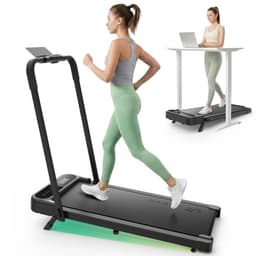
The UREVO Strol 2E publishes 0.6 to 6.2 mph, a safety handle, a 265 lb capacity and a 47.2 lb unit weight — the lightest pad we track. It is a genuinely capable machine and it is the only one here we would describe as jog-capable at all.
The honest framing is that it is a walking pad that can also jog rather than a running machine that also walks. The 40.2 in belt is the constraint, and it does not change with the speed setting. If you are over about six foot, or you know your stride is long, run the deck arithmetic before you assume the 6.2 figure is usable for you.
UREVO Strol 2E
Lightest with a handle
The lightest machine here that still has a safety handle, and the only one that goes fast enough to jog on.
WalkingPad Z1
Smallest storage footprint
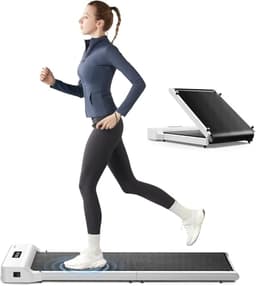
The only pad here that folds in half AND stays under 5.5 inches folded, which is the combination a small apartment actually needs.
The Z1 is there as the contrast: 4 mph, a 47.6 in belt — the longest on this site — and the shortest folded length. It is the better walking machine of the two and it will never jog. The two of them compared in full.
What to buy if running is the point
A folding treadmill built for running, and we do not cover those on this site. Not because they are bad — because they do not solve the problem this site is about. A running treadmill has the deck and the handrail, and in exchange it stays where you put it: it does not fold to five inches and it does not go under a bed.
If you are choosing between the two categories, the question to answer first is whether the machine has to disappear. If it does, you are buying a walking pad and running is not on the table. Walking pad against treadmill, on footprint, deck and speed.
And if what you actually want is more effort rather than more speed, incline is the lever that works at a desk, because your hands cap your pace long before your legs do. Incline against flat, with the desk-height cost.
What we have not done
We have not run on any of these machines. Everything above comes from published speed ranges and deck dimensions, read from the sources below on the dates shown, plus stride arithmetic whose inputs are stated so you can redo it.
We have deliberately not published a running-stride multiplier, a maximum safe user height for jogging, or a claim about whether a pad motor survives being run above its published range. Those would all be numbers we do not have. Our full method.
Questions people actually ask
Can you run on a walking pad?
On almost all of them, no — seven of the eight pads we track top out between 3 and 4 mph, which is a brisk walk rather than a jog. One machine on this site, the UREVO Strol 2E, publishes 6.2 mph, which is a genuine running speed for many people. Even there we would call it jog-capable rather than a running treadmill: its belt is 40.2 inches, the shortest of the full-size pads, and stride lengthens as pace rises.
What speed do you need to run on a treadmill?
It depends on your legs rather than a fixed threshold, but most people transition from a fast walk to a jog somewhere between 4.5 and 5.5 mph. That matters here because it sits above the top speed of every walking pad on this site except one — so for most of this category the question is settled by the specification before you consider anything else.
Is it safe to run on a machine with no handrail?
It is riskier than the same speed on a treadmill, and the reason is structural rather than a matter of skill. A treadmill gives you a handrail to catch and, usually, a safety key that cuts power if you leave the deck. Walking pads have neither: nothing to grab, and on every machine we track, no published safety key. The failure mode is that a misstep at jogging pace has no recovery available. Only one pad we track publishes a safety handle at all.
How long does a treadmill belt need to be for running?
Longer than any walking pad on this site provides. Our decks run from 27.6 to 47.6 inches; full treadmills built for running typically publish substantially longer belts, because running stride is much longer than walking stride and it grows with pace. We are not going to give you a magic number, because stride depends on your height and gait — but if you are already near the ends of the deck while walking, jogging will put you past them.
Will running damage a walking pad?
We have not tested it, so we will not claim a failure mode. What is published and relevant: these are compact motors with published capacities that assume walking loads, and impact force on the deck at a jog is considerably higher than at a walk. Where a maker publishes a top speed below jogging pace, running is outside its stated operating range, and that is the only claim we can support from the documentation.
What should I buy if I want to run at home in a small space?
Honestly, not a walking pad. The category exists because it removed the handrail, the console mast and the long deck — that is what makes it fold and store. If running is the point, a folding treadmill built for it is the right machine, and it will not disappear under a bed. If you want one machine that walks at a desk and jogs occasionally, the UREVO Strol 2E is the only one on this site with the published speed to do both.
Read next
- UREVO Strol 2E review — the only machine here that reaches running speed, in full.
- What speed should you set a walking pad to? — why the bottom of the range matters more than the top.
- How to use a walking pad without falling — no handrail, a short deck, and the habits that prevent both failure modes.
- Best walking pads for tall walkers — the deck-length arithmetic, model by model.
- Walking pad vs treadmill — what the category gave up to fold, stated plainly.
Sources
- WalkingPad Z1 — walkingpad.com product spec table (read 2026-07-24)
- WalkingPad C2 — walkingpad.com product spec table (read 2026-07-24)
- WalkingPad P1 — walkingpad.com product spec table (read 2026-07-24)
- WalkingPad A1 Pro — walkingpad.com product spec table (read 2026-07-24)
- UREVO Strol 2E — urevo.com product spec table (read 2026-07-24)
- Lifepro PacerMini — Rehabmart retail listing spec table (read 2026-07-24)
- Sunny Health & Fitness TreadPad Sleek Stride (SF-T722069) — sunnyhealthfitness.com product spec table (read 2026-07-24)
- DeerRun Under-Desk Walking Pad — Amazon retail listing (read 2026-07-24)