Walking pad incline vs flat
Incline is the one way to make a desk walk harder without walking faster. It is also the feature most likely to put the deck above what your desk can give back.
By Stephen V. · Last updated
Get incline if you want more effort at the same pace — at a desk your hands cap your speed, so incline is the only lever left. Skip it if your desk clearance is tight: Sunny publishes 4.1 in flat and 5.7 in inclined, and that 1.6 in comes straight out of your desk’s travel.
How this page is funded: the buy links here are Amazon affiliate links, and we earn a commission if you buy through one — at no extra cost to you. It does not change what we rank first, because the commission rate is the same across every machine on this page. Full disclosure.
The real case for incline at a desk
On a normal treadmill, incline is one of two ways to make a session harder. On a walking pad at a desk it is the only one, and that is a much stronger argument than the marketing usually makes.
The reason is that your speed is capped by your hands rather than your legs. Typing accuracy degrades with pace long before walking gets difficult, so most people settle somewhere near the bottom of the dial for keyboard work and never touch the top of the machine’s range. Why the useful range sits at the bottom.
Incline changes the effort without changing the pace. You walk at the same speed, your keyboard accuracy is unaffected, and the work goes up. For anyone whose reason for buying is “I sit too much and I want this to count for something”, that is the feature that does the most.
What we will not do is quantify it. Pages that tell you incline burns a specific percentage more are producing a number from a model of a body they have never met. What these machines can and cannot know about your burn.
What incline costs you in deck height
This is the trade nobody puts on the box, and there is exactly one maker on this site who gives you the numbers to see it.
Sunny publishes deck-to-floor height for the TreadPad Sleek Stride in both positions: 4.1 inches flat and 5.7 inches at maximum incline. Raising the incline raises you by 1.6 inches, and that 1.6 inches is subtracted from what your standing desk has left at the top of its travel.
Run it: a desk topping out at 48 inches leaves you 43.9 inches of working height with the deck flat, and 42.3 inches at full incline. If your elbows want 43, the machine works flat and does not work inclined — the same machine, same desk, one setting apart.
The Lifepro PacerMini illustrates the other version of this cost. It sits 7 inches off the floor before you do anything, the highest deck on this site, and its incline positions raise it further from there. The full desk-clearance arithmetic for every model we track.
Degrees, percent, and why the numbers do not compare
Three machines on this site publish an incline figure and they use two different units, which makes the specification unreadable unless you convert.
- Sunny TreadPad: six levels, 1.67 to 3.81 degrees. As a grade, 3.81 degrees is about 6.7 percent.
- Lifepro PacerMini: two fixed positions, 5 and 7 degrees. As a grade, roughly 8.7 and 12.3 percent.
- DeerRun: 6 percent, manual. As an angle, about 3.4 degrees.
Read that list twice. The PacerMini’s “5 degrees” is a steeper slope than the DeerRun’s “6 percent”, even though 6 is the bigger number. Percent is rise over run; degrees is the angle; the conversion is the tangent, and no listing in this category does it for you.
Our conversions above are ours, computed from the published figures, and you can check them with any calculator that does tangents. The published figures themselves are in the table below with their sources.
The three inclined pads against a flat one
| Model | In use (L x W x H) | Belt (L x W) | Incline | Unit weight | Max user | Published noise |
|---|---|---|---|---|---|---|
| Sunny Health & Fitness TreadPad Sleek Stride (SF-T722069) | 58.2" L x 24.9" W x 5.9" Hmanufacturer spec | 45.7" L x 16" Wmanufacturer spec | Six auto levels, 1.67 to 3.81 degreesmanufacturer spec | 69.5 lbmanufacturer spec | 265 lbmanufacturer spec | Not publishednot published |
| Lifepro PacerMini | 32.7" L x 25" W x 7" Hretail listing | 27.6" L x 15.7" Wretail listing | Two fixed settings, 5 and 7 degreesretail listing | 40 lbretail listing | 220 lbretail listing | Less than 60 dBretail listing |
| DeerRun Under-Desk Walking Pad | Not publishednot published | Not publishednot published | 6 percent, manualretail listing | Not publishednot published | 300 lbretail listing | Not publishednot published |
| WalkingPad Z1 | 56.1" L x 22" W x 4.1" Hmanufacturer spec | 47.6" L x 15.7" Wmanufacturer spec | Not publishednot published | 51 lbmanufacturer spec | 242 lbmanufacturer spec | Not publishednot published |
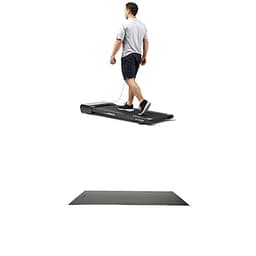
Sunny Health & Fitness TreadPad Sleek Stride (SF-T722069)
Motorized incline
The only pad here with a motorized incline you can change while walking, and the only maker that publishes the deck-to-floor height you actually need for desk clearance math.
Price as of October 2, 2026. #ad How we’re funded
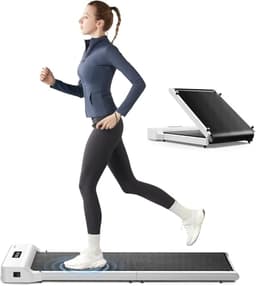
WalkingPad Z1
Smallest storage footprint
The only pad here that folds in half AND stays under 5.5 inches folded, which is the combination a small apartment actually needs.
Auto, fixed and propped: three different products
“Has incline” describes three different experiences here, and the difference decides whether you will ever use it.
Motorized, changed while walking. Only the Sunny does this: six levels from the remote, no stopping. That is the version that gets used, because you can add effort during a call you are only listening to and take it off when you need to type. It is also the heaviest machine on this site at 69.5 lb, and Sunny publishes no folded dimensions for it at all.
Fixed positions, set by hand.The PacerMini’s 5 and 7 degree settings come from swapping the feet under the deck. That is a decision you make once and live with, not a control — and on a 27.6 inch belt, the shortest on this site, an incline steepens a walk that is already short.
A prop under the deck.The DeerRun’s 6 percent is manual in the most literal sense. It is remarkable at the price, and DeerRun publishes no dimensions of any kind — no footprint, no folded height, no belt size — so you cannot check what the inclined deck height does to your desk. Where it still earns its place.
So which one
Go flat if you use a height-adjustable desk near the top of its travel, if you need the machine to fold and disappear, or if you mainly walk during calls rather than to get a workout. The Z1 is the flat pad we point most renters at: 4.1 inches in use, 31.8 inches folded, 51 lb.
Go inclined if the point of the machine is effort rather than step count, and you have measured your desk with 1.6 inches to spare. The Sunny TreadPad is the only one here where incline is something you use rather than something you set up, and it is the only maker publishing the inclined deck height you need to check it. The full incline ranking.
We have walked on none of these machines. The published figures are sourced and dated below; the degree-to-percent conversions and the desk arithmetic are ours, and both are reproducible. How we rank.
Questions people actually ask
Do you need incline on a walking pad?
Only if you want more effort without more pace, which is a genuinely useful thing at a desk — your hands set your speed limit long before your legs do, so incline is the one lever that adds work while you keep typing. If you use the machine mainly for calls and meetings, or if you already walk near the top of your comfortable speed, incline adds cost, weight and deck height for something you will rarely touch.
Does incline raise the deck height?
Yes, and Sunny is the only maker on this site that publishes both numbers: 4.1 inches deck-to-floor flat, and 5.7 inches at maximum incline. That is 1.6 inches taken out of your standing desk's remaining travel at the moment you raise the incline — so a pad that fits your desk flat may not fit it inclined. Nobody else in this category publishes the inclined height at all.
Is 5 degrees the same as 5 percent incline?
No, and the categories mix the two units constantly. Percent is rise over run: a 5 percent grade is a rise of 5 units per 100 traveled, which is about 2.9 degrees. Conversely 5 degrees is roughly an 8.7 percent grade. So the Lifepro PacerMini's '5 and 7 degrees' is a steeper claim than the DeerRun's '6 percent', even though 6 is the larger number. Check the unit before comparing two machines.
What is the difference between auto incline and manual incline?
Auto incline is motorized and changed from the remote while you walk — on this site only the Sunny TreadPad does that, across six levels from 1.67 to 3.81 degrees. Manual incline means stopping, stepping off and physically changing something: the DeerRun uses a prop under the deck for its 6 percent setting, and the Lifepro PacerMini uses swappable feet for its 5 and 7 degree positions. Manual incline is a setup choice, not a control.
Is incline better than speed for burning calories on a walking pad?
At a desk it is the only lever you have, which is the honest version of that question. Typing accuracy falls apart well below the speed at which walking becomes hard work, so you cannot raise effort with pace while you work. Incline raises effort at the same pace. What we will not do is put a calorie number on that difference — the machine does not know your weight, and neither do we.
Which walking pads have incline?
Three of the eight we track. The Sunny TreadPad Sleek Stride has six motorized levels from 1.67 to 3.81 degrees; the Lifepro PacerMini has two fixed positions at 5 and 7 degrees set with swappable feet; the DeerRun publishes a 6 percent manual incline. The four KingSmith pads and the UREVO Strol 2E publish no incline at all.
Read next
- Best walking pads with incline — the three inclined machines ranked, with the desk math for each.
- Best walking pads for a standing desk — why deck height is the pass-or-fail number.
- Sunny TreadPad Sleek Stride review — the only auto incline here, and the only published inclined height.
- What speed should you set a walking pad to? — why your hands cap the pace, which is the case for incline.
- Do walking pads help you lose weight? — the honest arithmetic on effort at a desk.
Sources
- Sunny Health & Fitness TreadPad Sleek Stride (SF-T722069) — sunnyhealthfitness.com product spec table (read 2026-07-24)
- Lifepro PacerMini — Rehabmart retail listing spec table (read 2026-07-24)
- DeerRun Under-Desk Walking Pad — Amazon retail listing (read 2026-07-24)
- WalkingPad Z1 — walkingpad.com product spec table (read 2026-07-24)