Can you add incline to a walking pad?
The suggestion you will find everywhere is to prop the back end on books or blocks. No maker of any machine on this site supports it, and the reasons are worth understanding before you try it anyway.
By Stephen V. · Last updated
No — not in any way a maker supports.Nobody in this category sells an incline riser, publishes instructions for raising one end, or states a tilt the frame will tolerate. “Manual incline” in this category means a mechanism built into the machine, not blocks under it. If incline is the point, three of the eight pads here publish one.
What 'manual incline' actually means
Most of the confusion behind this search comes from one phrase. Listings say “manual incline”, people read it as “you arrange the incline yourself”, and from there propping the machine on something sounds like the intended method. It is not what the term means.
KingSmith defines it on its own FAQ page, read on October 5, 2026:
“Automatic incline uses a motor to adjust the deck through the product controls, while manual incline requires the user to set the deck position manually.”
The deck position.Both kinds of incline move a part of the machine that was designed to move. The difference is whether a motor does it or your hands do. On the pads we track, a manual system means swapping or flipping feet under the deck, or setting a position the frame provides — a designed adjustment with a defined end stop.
Stacking something under a machine that has no such mechanism is a different activity entirely, and no maker has described it, permitted it or rated it.
The same FAQ also settles a related question we get asked. KingSmith names the models in its own range that offer incline — and none of the four KingSmith pads we track is among them. The Z1, C2, P1 and A1 Pro publish nothing in the incline field, and that absence is now confirmed by the maker’s own documentation rather than inferred from a silent spec table.
Three mechanical reasons not to prop it
What follows is reasoning from how these machines are built rather than a published manufacturer warning, and we would rather say so than dress it up. No maker on this site publishes a statement about tilting a pad in either direction.
1. The load moves onto two feet
A pad is designed to rest flat, with its weight distributed across its feet and the deck supported along its length. Raise one end and the machine’s own weight plus yours is carried by the feet still touching the floor, through a frame a few inches deep. Walking adds a repeated vertical load on top of that, thousands of times per session.
2. Several of these pads hinge at mid-span
This is the one most people have not considered. The folding pads we track fold in half, which means the hinge is in the middle of the deck — exactly where a propped machine develops the largest bending moment. The hinge was designed to let the deck fold when nobody is standing on it, not to carry a span load while you walk across it.
3. The belt runs on a flat reference
Belt tracking depends on the two rollers staying parallel and the deck staying flat. The standard fix for a belt that drifts to one side is to confirm the machine is sitting level and to shim the low foot; a deliberately tilted frame is the opposite of that. If your pad already wanders, tilting it is not a neutral change. Belt slipping and off-center tracking.
There is a fourth consideration that is not mechanical. The warranties in this category are short — KingSmith publishes one year across the WalkingPad range and UREVO publishes one year plus a stated 180-day extension for the Strol 2E — and nobody publishes how they would treat a machine that had been run propped on blocks. We cannot predict that conversation for you, which is itself a reason to think about it first.
The desk-clearance problem, which decides it anyway
For most readers the mechanical argument is academic, because the arithmetic rules it out before safety does.
Whatever you put under the machine goes straight onto the deck height, and deck height is the specification already limiting a walking desk setup. You need your elbow height plus the deck, and a standing desk has a published maximum. On this site we have measured that the highest maximum height published by any desk sold for a walking pad is 47 inches, which already fails to reach a walker of about 5 ft 10 in on most pads.
Add two inches of blocks and you have spent clearance you did not have, on a rise of a couple of degrees. That is the trade in one sentence, and it is why incline and standing desks pull against each other even on the machines that have incline built in. Incline against flat, with the clearance arithmetic and the published maximum height of every desk sold for this.
If you walk on the floor in front of a TV rather than at a desk, that constraint disappears — and the mechanical ones in the previous section do not.
Shimming for level is a different job
Worth separating, because the two get conflated and only one of them is sensible.
Shimming to make a machine level is standard practice on any treadmill. Floors are not flat, a pad with one foot slightly off the ground rocks, and rocking shows up as belt drift and as a knock through the floor. Put something thin under the low foot and the machine sits properly. That is restoring the condition the machine was designed for.
Blocking one end to create a slope is removing that condition on purpose. Same materials, opposite intent, and the fact that the first is normal is the reason the second looks reasonable.
If the machine is on carpet, there is a third thing going on that is worth handling first: a soft base lets the deck flex and the feet sink unevenly, which produces several of the symptoms people try to fix by adjusting height. Walking pads on carpet and the mats that give it a firm flat base.
On 'incline attachments'
“Walking pad incline attachment” and “walking pad incline riser” are both real searches, so here is a direct answer about what we can and cannot tell you.
There is no incline riser or incline attachment in our product registry. Every figure on this site is read from a named manufacturer page or retail listing on a recorded date, and we have no product of this kind to read specifications from — no published load rating, no compatible-model list, no tilt angle. So we are not ranking one, and we are not going to describe one we have not sourced.
What we will say is what the shape of an honest version would be: it would state a maximum machine weight, a maximum user weight, the angle it produces, and which models it is rated for. If you find something claiming to do this job, those four figures are the test. A product that raises a 60 lb machine with a person walking on it and publishes none of them has not answered the question.
What to do instead
Three routes, in the order we would actually suggest them.
1. Use speed and time, which you already have.Incline is popular in this category mostly because the machines are slow — most pads here cap at 3.75 to 4 mph. If more effort is the goal, the controls on the machine are the free version of it. Note the real ceiling on a walking desk is not the motor: at a keyboard your hands cap your pace long before your legs do.
2. Buy a pad that publishes an incline figure. Three of the eight we track do. Two of those three publish a steeper figure than you would get from a couple of inches of blocks, with a frame designed to hold that position and a warranty that still applies.
3. Accept that a walking pad is not a hill.The published figures in this category are small — a nudge in effort rather than a gradient. If incline training is genuinely the objective, a treadmill with a handrail and a real incline range is the right machine, and it is not a product we cover. Walking pad against treadmill, on footprint, deck and speed.
The three pads that publish an incline
If route two is yours, here is the whole field. Each figure is printed in the unit its maker published — degrees for two of them, percent for the third — and we deliberately do not convert between them, because a conversion we performed would be our number rather than the maker’s.
| Model | Incline | Belt (L x W) | Unit weight | Max user | Top speed |
|---|---|---|---|---|---|
| Sunny Health & Fitness TreadPad Sleek Stride (SF-T722069) | Six auto levels, 1.67 to 3.81 degreesmanufacturer spec | 45.7" L x 16" Wmanufacturer spec | 69.5 lbmanufacturer spec | 265 lbmanufacturer spec | 3.7 mphmanufacturer spec |
| Lifepro PacerMini | Two fixed settings, 5 and 7 degreesretail listing | 27.6" L x 15.7" Wretail listing | 40 lbretail listing | 220 lbretail listing | 3 mphretail listing |
| DeerRun Under-Desk Walking Pad | 6 percent, manualretail listing | Not publishednot published | Not publishednot published | 300 lbretail listing | 3.8 mphretail listing |
How this page is funded: the buy links here are Amazon affiliate links, and we earn a commission if you buy through one — at no extra cost to you. It does not change what we rank first, because the commission rate is the same across every machine on this page. Full disclosure.
Sunny Health & Fitness TreadPad Sleek Stride (SF-T722069)
Motorized incline
The only pad here with a motorized incline you can change while walking, and the only maker that publishes the deck-to-floor height you actually need for desk clearance math.
Price as of October 4, 2026. #ad How we’re funded
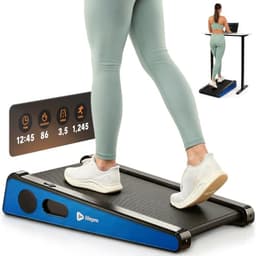
Lifepro PacerMini
Incline in the smallest deck
A 27.6 inch belt is short enough to be a real constraint, but it is the only pad here that publishes both an incline figure and a decibel figure.
Price as of October 4, 2026. #ad How we’re funded
DeerRun Under-Desk Walking Pad
Highest capacity for the money
The cheapest way onto this list with a 300 lb capacity and an incline, and the clearest example of what you give up: no published dimensions at all.
Price as of October 4, 2026. #ad How we’re funded
Sunny TreadPad Sleek Stride— the only pad here with a motorized incline you can change while walking: six automatic levels from 1.67 to 3.81 degrees. It is also the heaviest pad we track at 69.5 lb, which is the cost of the mechanism.
Lifepro PacerMini— the steepest published angle in the category, two fixed settings at 5 and 7 degrees, set by swapping the feet under the deck. It is the lightest pad on this site at 40 lb and one of only two that publish a decibel figure. The 27.6 inch belt is very short and caps who it suits.
DeerRun under-desk pad— 6 percent, manual, alongside a 300 lb capacity, the highest published on this site. The catch is the one this page keeps returning to: DeerRun publishes no dimensions at all, so you cannot do the clearance arithmetic for it.
The full ranking of these three, with the desk arithmetic worked through.
What we have not done
We have not tilted, propped or modified any machine, and we have not tested a riser of any kind. The quoted definition of manual and automatic incline is KingSmith’s, with the date we read it. The incline figures are each maker’s own, in each maker’s own unit. The load-path, hinge and belt-tracking arguments are reasoning from how these machines are built, labeled as reasoning, and your manual outranks all of it. The full method.
Questions people actually ask
Can you add incline to a walking pad?
Not in any way a manufacturer supports. No maker of any pad we track publishes an incline accessory, a riser, or instructions for raising one end, and the two makers who do publish incline deliver it through the machine's own mechanism rather than through anything placed underneath it. If a pad was sold flat, it is a flat machine.
What does 'manual incline' mean on a walking pad?
It means the machine has an incline mechanism that you set by hand before you start, rather than a motor that changes it from a remote while you walk. KingSmith's own FAQ puts it precisely: automatic incline uses a motor to adjust the deck through the product controls, while manual incline requires the user to set the deck position manually. On the pads we track that means swapping or flipping feet under the deck, or setting a prop built into the frame - not stacking anything under the machine.
Can I put blocks or a riser under one end of my walking pad?
We would not, and we are not going to publish instructions for it. Three reasons, all mechanical: it transfers the machine's whole load onto two of its four feet, it raises the deck height which is usually the specification already limiting a desk setup, and on the pads that fold in half the hinge sits at mid-span where propping concentrates load it was not designed to carry. There is also no maker on this site that has told you it is acceptable, and the warranty conversation after a failure is not one we can predict for you.
Is there such a thing as a walking pad incline attachment?
Not in our product registry, and we are not going to rank something we have not sourced. We only publish figures read from a named source, and we have no attachment of this kind to read specifications from. If what you want is incline, the honest route is a pad whose maker publishes an incline specification - there are three on this site.
Which walking pads actually have incline?
Three of the eight we track publish an incline figure: the Sunny Health & Fitness TreadPad Sleek Stride at six automatic levels from 1.67 to 3.81 degrees, the Lifepro PacerMini with two fixed manual settings of 5 and 7 degrees, and the DeerRun under-desk pad at 6 percent, manual. We print each in the unit its maker published, because converting between degrees and percent would make the figure ours rather than theirs.
Do the KingSmith WalkingPad models have incline?
Not the four we track - the Z1, C2, P1 and A1 Pro all publish nothing in the incline field. KingSmith's FAQ names the models in its range that do have incline, and those four are not among them; the FAQ points under-desk buyers at the walking-only models instead. So that is an absence confirmed by the maker rather than a gap in our research.
Is propping it up safe?
A walking pad already removed the handrail that a treadmill uses to make a slope manageable - seven of the eight pads on this site have nothing at all to hold. Tilting the deck moves your weight forward on a deck that is between 27.6 and 47.6 inches long. We are not in a position to assess your setup, and that is exactly why we are not giving you a method.
Read next
- Best walking pads with incline — the three machines that publish a figure, ranked, with the clearance arithmetic.
- Walking pad incline vs flat — the buying fork, and what a raised deck costs a standing-desk setup.
- Walking pad belt slipping or off-center — why levelness is the first thing to check, and shimming done properly.
- Best standing desks for a walking pad — the 47 inch published ceiling that the clearance argument rests on.
- How to use a walking pad without falling — mounting and dismounting, on a deck with nothing to hold.
- Walking pad overheating or getting hot — the other published KingSmith FAQ figure nobody quotes.
- Lifepro PacerMini review — the steepest published angle here, and the 27.6 inch belt that comes with it.
- Lifepro PacerMini vs WalkingPad Z1 — incline and a decibel figure against a longer belt and a shorter fold.
- Best mats for a walking pad — a firm flat base, which is the thing that actually belongs under the machine.
- What speed should you set a walking pad to? — the free alternative to incline, and the real ceiling at a keyboard.
- Walking pad maintenance: what actually needs doing — what a flat, properly supported deck is protecting.
Sources
- KingSmith / WalkingPad — brand FAQ: the definitions of automatic and manual incline, and the list of models in the range that offer either (read 2026-10-05)
- Sunny Health & Fitness TreadPad Sleek Stride (SF-T722069) — sunnyhealthfitness.com product spec table, published incline figure in the maker's own unit (read 2026-07-24)
- Lifepro PacerMini — Rehabmart retail listing spec table, published incline figure in the maker's own unit (read 2026-07-24)
- DeerRun Under-Desk Walking Pad — Amazon retail listing, published incline figure in the maker's own unit (read 2026-07-24)
- WalkingPad Z1 — product spec table, checked for an incline figure and for any statement about tilting or riser use; neither published (read 2026-08-18)
- UREVO Strol 2E — product spec table, checked for an incline figure and for a published warranty term; incline not published, warranty stated as 1 year plus 180 days (read 2026-08-18)